Back to Practice After 30 Years
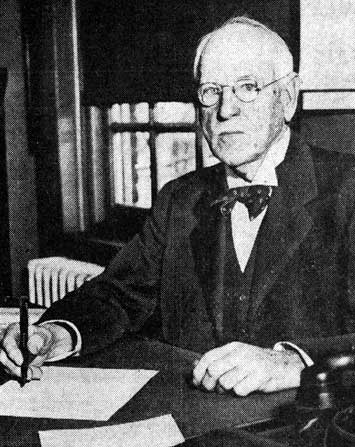
Back to Practice After 30 Years
Lloyd Reveals He Declined Offer From Governor for Another Term
Justice Declares Pace of Court Work Calls for Toil Unsuited to Man of 78
Sails Next Week on Ocean Cruise
Resuming law practice after 30 years on the bench, former Supreme Court Justice Frank T. Lloyd yesterday revealed that Governor Moore offered to reappoint him for another term but he declined.
“The work in the Supreme Court in these days is terrific,” Judge Lloyd said at his desk at the law offices of Starr, Summerill and Lloyd, of which his son, Frank T. Lloyd, Jr., is a partner. Justice Lloyd retired from the bench on Saturday.
“My physical and mental faculties are good, but the endurance of the pace is too much,” the former jurist, who is 78, said with a kindly smile. “You are required to read 2000 law books in a year. You read them in the daytime and lay awake at nights thinking about them.”
“I am leaving on February 11 for an ocean cruise to and from Venezuela. I have made these trips before, but took about 25 briefs with me to write opinions on Court of Errors and Appeals cases. This time I will have no opinions to write, but will enjoy a complete rest, returning on the last day of the month.”
Reminiscing he recalled a number of circumstances, which led him into public life and eventually to the dream of every attorney, the Supreme Court bench.
Native of Delaware
Born at Middletown, Delaware, on October 29, 1859, he was graduated from the Middletown Academy. In 1875 he moved to Camden and became a compositor. While serving his apprenticeship he studied law in the office of Judge James Otterson, of Philadelphia. He was admitted to the bar of Pennsylvania in 1882 and practiced in the Philadelphia courts 15 years.
“Here is where the series of coincidents come in,” Justice Lloyd said. “I was elected to the Assembly from Camden county in 1896, a year before I was admitted to the New Jersey bar.”
“The chairman of the State Examining Board asked why I did not apply for admission to the New Jersey bar. It was only through his persuasion that I was admitted in 1897, and that year I was re-elected to the Assembly.”
“Three years later I became a counselor-at-law. That was in 1900. That year I was named prosecutor of Camden County. One of the requirements to qualify as a prosecutor is that an attorney must be a counselor-at-law.”
“Wilson Jenkins was prosecutor and William Carson his assistant. Then came another series of coincidents. Mr. Jenkins fell dead. Mr. Carson was slated for prosecutor. But before the appointment could be made he was shot and killed by a relative in North Jersey.”
Named as Prosecutor
“I was named prosecutor to succeed Mr. Jenkins at a time when lawlessness was rampant in Camden county. The county had not recovered from the racetrack days. Legislature had passed drastic laws to wipe out the evils of the racetrack days but they had not been effectively enforced as yet. That lot fell to me.”
This conversation led up to the recent criticism of the jurist in enforcing laws against lotteries of churches and lodges.
“I have quite a little feeling about gambling,” Justice Lloyd declared. “I had nothing to do with making the laws restricting gambling and putting an end to racetracks in the state. They were made before I went to the Legislature.”
“As judge I had to recognize them and bring them to the attention of the grand juries from time to time. The rigid enforcement of these laws sometimes was not so easy.”
Views on Gambling
“There is a great difference in gambling. If I had the laws to make, I would not make them so drastic. There is a difference between the games conducted in churches and lodges and those of the commercial and professional gambler. The trouble is the law does not raise the distinction.”
“And perhaps after all if the people would stop to think the development of the gambling spirit can be created among youth, with pinball machines and bingo games in churches and lodges. I hate to see so many thousands of dollars taken out of Camden County by professional gambling syndicates. I am speaking of horse race betting and the numbers racket. The income taxes some of these people pay gives you an idea what honest people are losing by playing either of them.”
“When little children spend their lunch pennies to play the numbers, as they have done in South Camden, then it is alarming. If the people knew how many wives came to me and complained that their husbands were playing all of their wages on the numbers and horse race betting. This habit grows on the player as the dope habit grows on an addict. I think he can never get rid of it.”
Here and there Justice Lloyd mentioned some celebrated cases he participated in as presiding jurist.
Praises Courier-Post
“The Gladys May Parks case was the outstanding trial I ever presided at on the Supreme bench,” he declared. “I mean that also from a psychological standpoint.”
Then he inquired about the health of the Sphinx woman, who was convicted in his court of slaying two children—second cousins. He was informed she is alive and at the State Hospital for Insane.
Then Justice Lloyd commended the Courier-Post Newspapers for their enterprise in reporting the woman’s trial, recalling a camera smuggled into the room and a photograph taken without the use of a flashlight bulb. At the time the photo was taken, Justice Lloyd was asking the woman 13 questions as to why she even wanted the children in her custody.
“We had considerable difficulty to get sugar as the supplies were limited,” he declared. “At one time none of the small dealers had sugar in stock and appealed to the American Stores Company and the Atlantic and Pacific Tea Company to divide their stocks with the small storekeepers, which they did handsomely.”
Speaks of His Career
In summing up his career of distinguished service he said:
“Any mistakes I have made have been of the head and not the heart. No matter whether they agreed with me politically or not the people will have to agree with me on that.”
And in conclusion he said:
“Have said this before and wish to reiterate it. I want to thank the Courier-Post Newspapers for their kindly and courteous treatment. Of course, they have not always agreed with me. I did not expect them to. And I am grateful for the manifestation of confidence on the part of the people.”
During his second term in the Assembly, Justice Lloyd served as chairman of the judiciary committee and sponsored new marriage laws, few of which have since been revised. He was appointed to the Circuit bench in 1906 by former Gov. Edward C. Stokes. He was re-appointed by Gov. George S. Fielder in 1914 and Gov. Edward I. Edwards in 1921. He was named to the Supreme Court in 1924 and re-appointed in 1931.
“If we had had that same enterprise while I was prosecutor I would not have had so much trouble in solving the Charles Woodward murder case,” he said. “Woodward coaxed two boys into robbing their parents’ homes. Then he lured them to the woods and murdered them by giving them pie filled with deadly poison just to get the few trinkets they had stolen from home.”
Refers to Noted Trial
Speaking of his career on the Circuit Court bench Justice Lloyd said one of the outstanding cases tried before him was an alienation suit in which former Gov. George S. Silzer was one of the attorneys.
“A boarder alienated the affections of the wife of his landlord,” he said. “After breaking up the landlord’s home, he deserted the new-found wife and then alienated the affections of her daughter from her husband.”
Speaking of his experiences as food administrator during the war he commended the people on their loyalty to the Government.