39th Street
Thirty-Ninth Street runs south from Jersey Avenue to Camden Avenue in East Camden, crossing Westfield Avenue and High Street. City directory and newspaper records document occupants of the 200, 300 and 400 blocks from 1924 to 1947.

Tag

Thirty-Ninth Street runs south from Jersey Avenue to Camden Avenue in East Camden, crossing Westfield Avenue and High Street. City directory and newspaper records document occupants of the 200, 300 and 400 blocks from 1924 to 1947.

Retired Camden detective Lt. Louis Shaw, 59, dies at his home; his partnership with George Ward broke up robber and narcotic gangs.

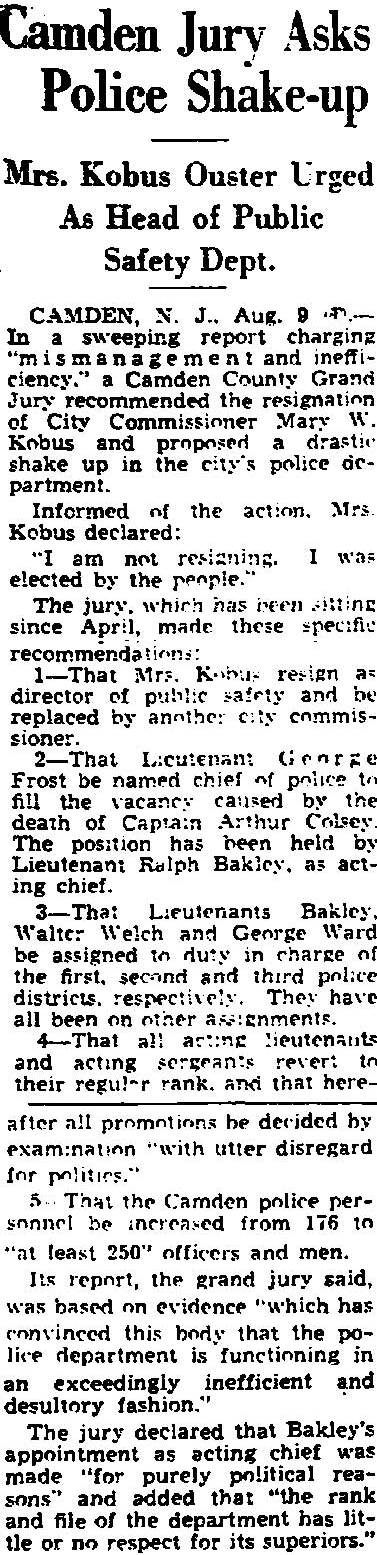
A Camden County Grand Jury recommends that City Commissioner Mary W. Kobus resign as director of public safety and proposes a shake-up of the Camden police department, Trenton Times, August 9, 1940.

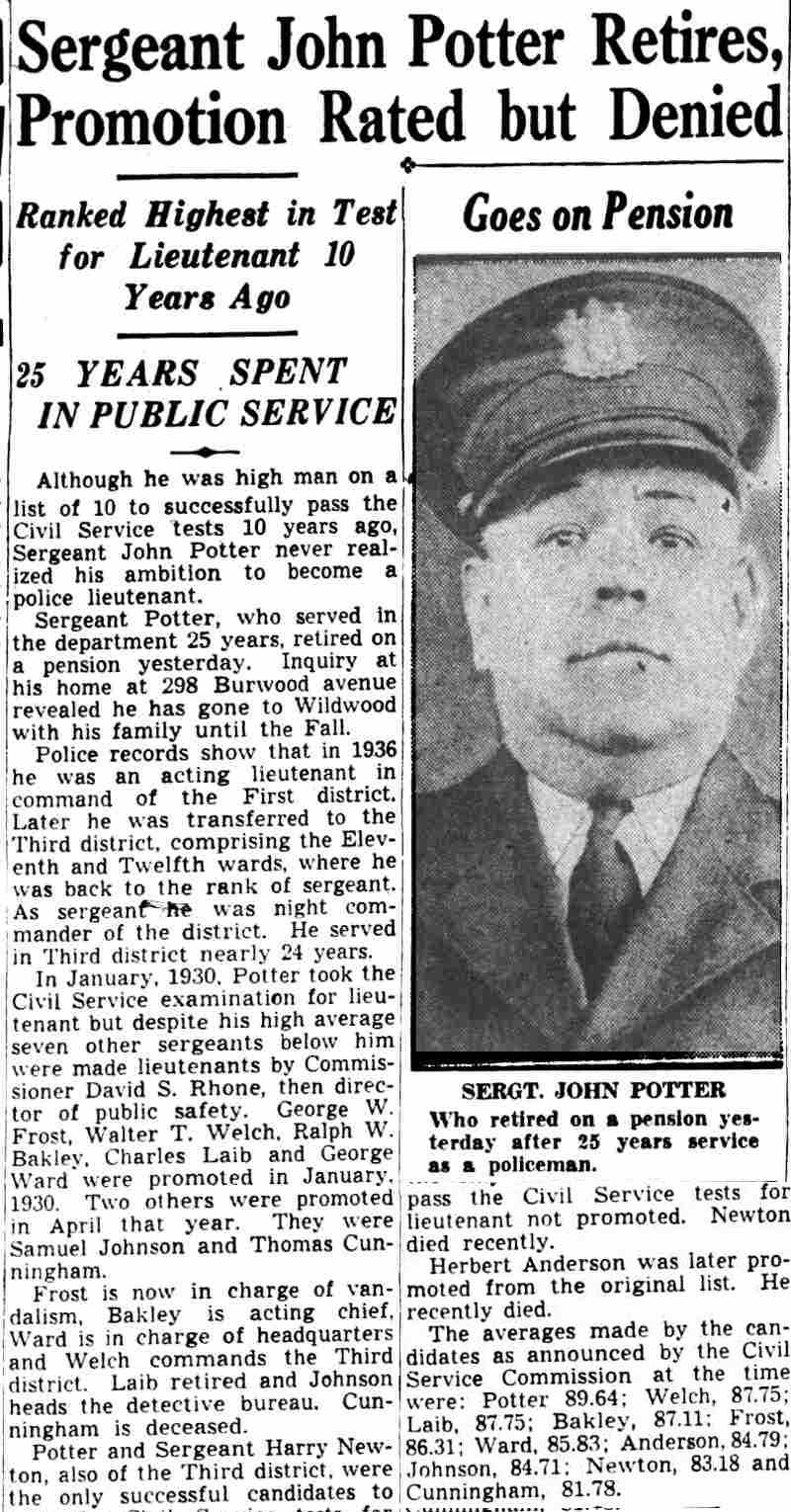
Sergeant John Potter Retires, Promotion Rated but Denied - Camden Post-Telegram, June 1, 1940

Mariano Says He Won't Postpone Any More as Complaint is Thrown Out Police Judge Gene R. Mariano gave notice yesterday that "unless a very good reason is advanced," there will be no more drunken driving cases postponed in Police Court.

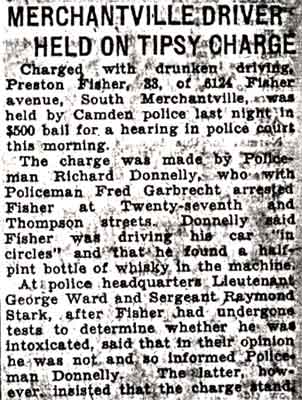
Preston Fisher of South Merchantville was held in $500 bail on a drunken driving charge made by Policeman Richard Donnelly. After Fisher underwent tests, Lieutenant George Ward and Sergeant Raymond Stark said they did not consider him intoxicated; Donnelly insisted the charge stand.

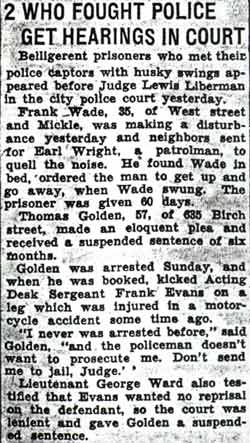
Two prisoners who fought police appeared before Judge Lewis Liberman: Frank Wade, who swung at Patrolman Earl Wright, got 60 days, and Thomas Golden, who kicked Acting Desk Sergeant Frank Evans, received a suspended six-month sentence.

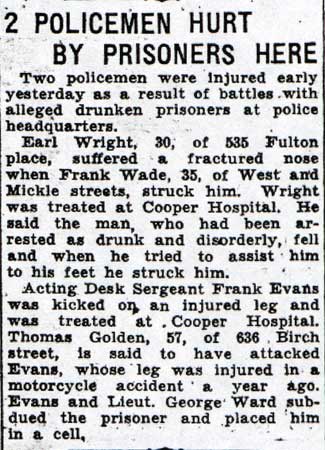
Two Camden policemen were injured in battles with alleged drunken prisoners at police headquarters; Earl Wright suffered a fractured nose.

Temporary changes in the police department to offset the absence of Lieutenant George Frost , head of the First District, who is ill, and Lieutenant George Ward , of headquarters, who is away on police business, were announced yesterday by Chief Arthur Colsey .

By Charles L. Humes In a shakeup of Camden police officials yesterday afternoon Lieutenant Samuel E. Johnson was named acting chief of detectives by Commissioner Mary W. Kobus , director of public safety.

Men Nabbed Here Believed to Be Members of Ring A tie-up between a huge counterfeiting ring and a gambling syndicate backing the "numbers" was believed unearthed by Camden police and Federal authorities following the arrest here yesterday of six colored men on charges of attempting to pass bogus money.

Calls for 100% Efficiency and Promises Square Deal for All in Talk to Commanders; Stresses Fact Colsey is Chief "I want 100% efficient police department and not a political machine.
Three weeks after the slaying of Detective William T. Feitz, Camden police admitted they were "completely in the dark," while Mickey Blair's lawyer Edward V. Martino attacked the department's handling of the case.

Material Witness Will View Suspects Caught by Camden Sleuths BRICKNER QUESTIONED BY COLSEY ON HOLDUP Police Order All Persons Arrested to Face 'Line Up' in Slaying Probe Seven men and women held by Camden as police as material witnesses in the murder of Detective William T. Feitz two weeks ago in an alleged South Camden disorderly house will look over two men arrested in Chester PA after a store holdup here.

Mickey Blair tells the Courier-Post he was in Emma Heisler's house trying to borrow money hours before Detective William T. Feitz was shot, while Mayor Roy R. Stewart announces a probe of policemen's bank accounts.

Feitz Murder, City Grafting to Face Inquiry. Action Follows Parley With Orlando and Mayor on Conditions. More Suspensions of Police Intimated. Mickey Blair Quizzed on Detective's Killing; Stewart Warns, 'Clean Up'.

Chief of Police Arthur Colsey suspended Lieut. Ralph Bakley and 11 other Camden policemen in the investigation of the killing of Detective William T. Feitz, as Supreme Court Justice Frank T. Lloyd entered the inquiry.

Prosecutor Samuel P. Orlando gave credence to reports that Detective William T. Feitz, Jr., was slain by gunmen staging a shake-down rather than a hold-up, and planned to take the case to Justice Frank T. Lloyd.

Detective William T. Feitz, Jr., Camden's first policeman murdered in the line of duty, was to be buried with the honors of a hero, with about 100 policemen and city officials expected to attend; nearly 1500 people had viewed his body the night before.

Prosecutor Samuel P. Orlando began studying all police data on the murder of Detective William T. Feitz, Jr., and planned to go before Supreme Court Justice Frank T. Lloyd about engaging private investigators.

Mayor Roy R. Stewart ordered an investigation into the suicide of Mrs. Emma Heisler, key witness to the murder of Detective William T. Feitz, who leaped from a detective bureau window in city hall.

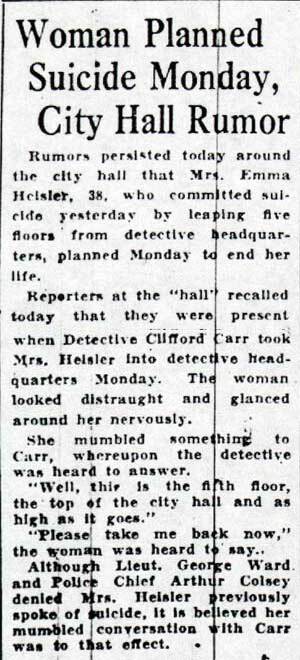
Camden Evening Courier, September 5, 1934: city hall rumors held that Mrs. Emma Heisler, who leapt from detective headquarters, had planned on Monday to end her life.

The name of Mrs. Emma Heisler, who leaped to her death from a city hall window, was pasted into the police docket the day after her death; Lieut. George A. Ward and Lieut. Samuel Johnson could not explain it.

Mayor Roy R. Stewart says a shakeup of the Camden police department is likely after the slaying of District Detective William T. Feitz in a disorderly house at 243 Sycamore Street.

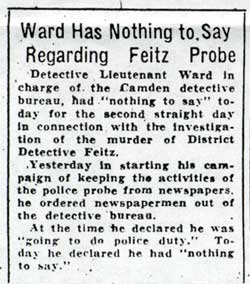
Detective Lieutenant Ward, head of the Camden detective bureau, had "nothing to say" for a second day about the investigation of the murder of District Detective Feitz.

Camden police under Chief Arthur Colsey opened a city-wide hunt for the bandits who shot Detective William T. Feitz four times in the back when he surprised a holdup of 20 persons in a house at 243 Sycamore Street.

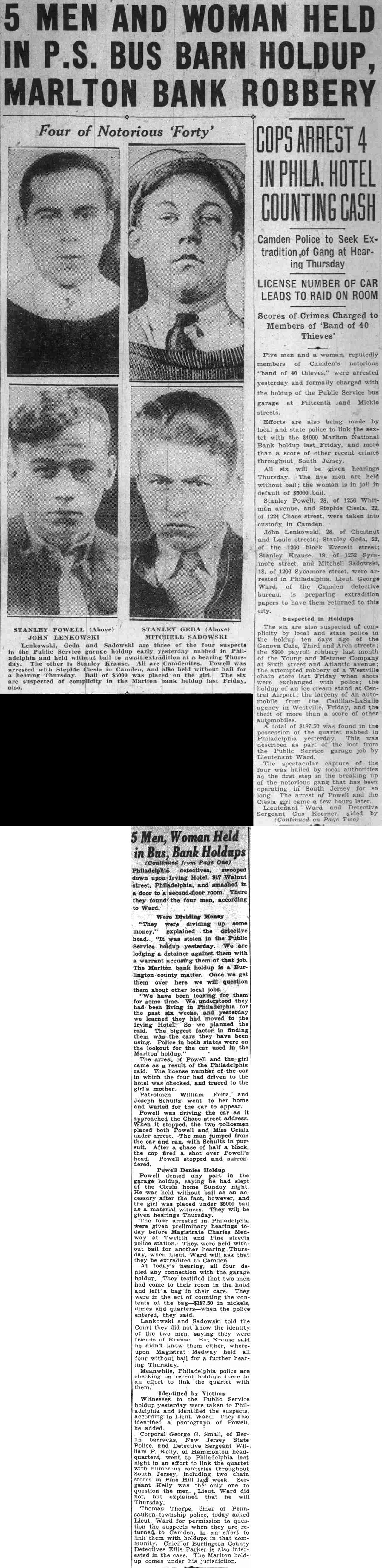
5 Men and Woman Held in P.S. Bus Barn Holdup, Marlton Bank Robbery, Camden Courier-Post, June 19, 1934 Camden Courier-Post, June 19, 1934

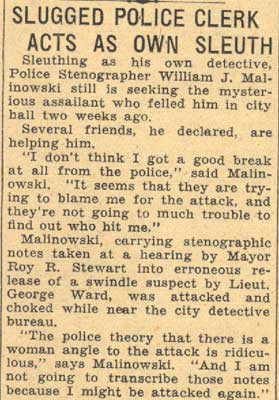
Police Stenographer William J. Malinowski, attacked in city hall while carrying notes of a hearing into Lieut. George Ward's release of a swindle suspect, says he is investigating the assault himself.
Six barefoot children and their parents, two months on the road from California, were fed by firemen at the No. 6 fire house and sheltered overnight at police headquarters, where Lieutenant George Ward collected money for their shoes.
Herbert Bott was re-elected president of the Camden Police and Firemen's Association on February 9, 1933, with William P. Spencer winning a three-cornered fight for vice president.
Notice of the February 9, 1933 election of officers of the Camden Police and Firemen's Association, with Herbert Bott unopposed for president. Russell Anderson was among ten candidates for fireman trustee.

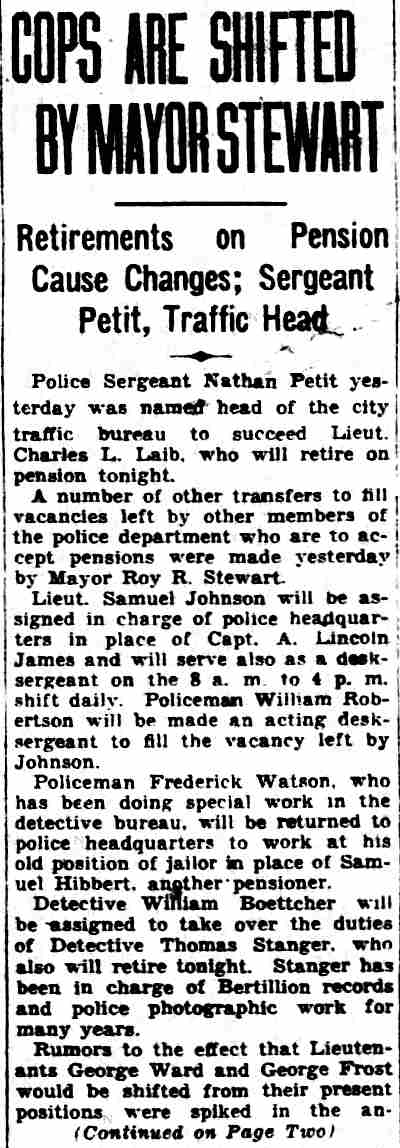
As pension retirements opened vacancies in December 1932, Mayor Roy R. Stewart reassigned Camden police, naming Sergeant Nathan Petit head of the traffic bureau to succeed Lieut. Charles L. Laib.

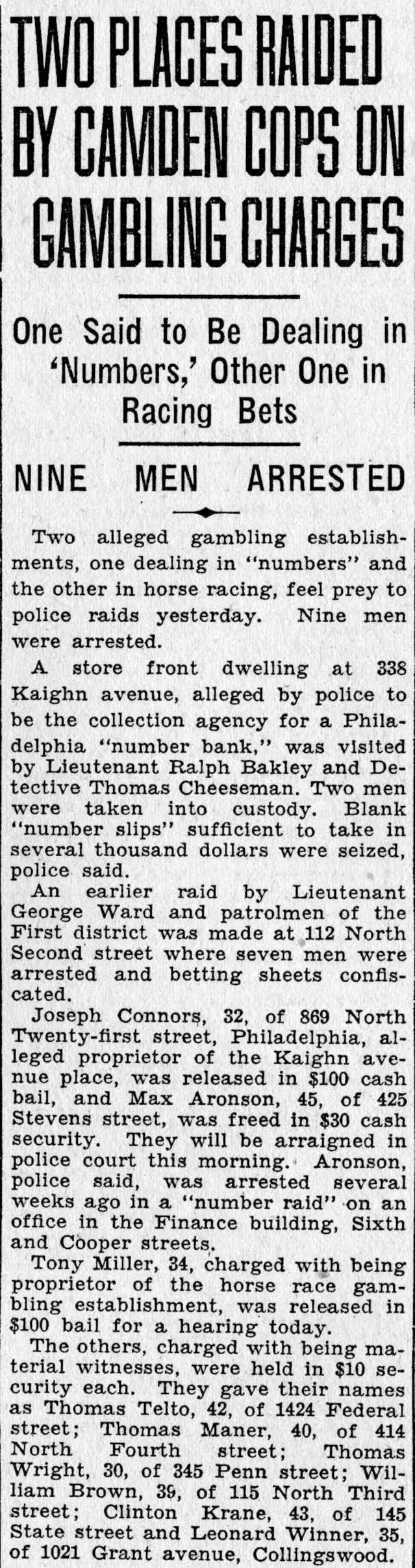
Camden police raided two alleged gambling places, a "numbers" collection agency at 338 Kaighn Avenue and a horse-race betting room at 112 North Second Street, arresting nine men.

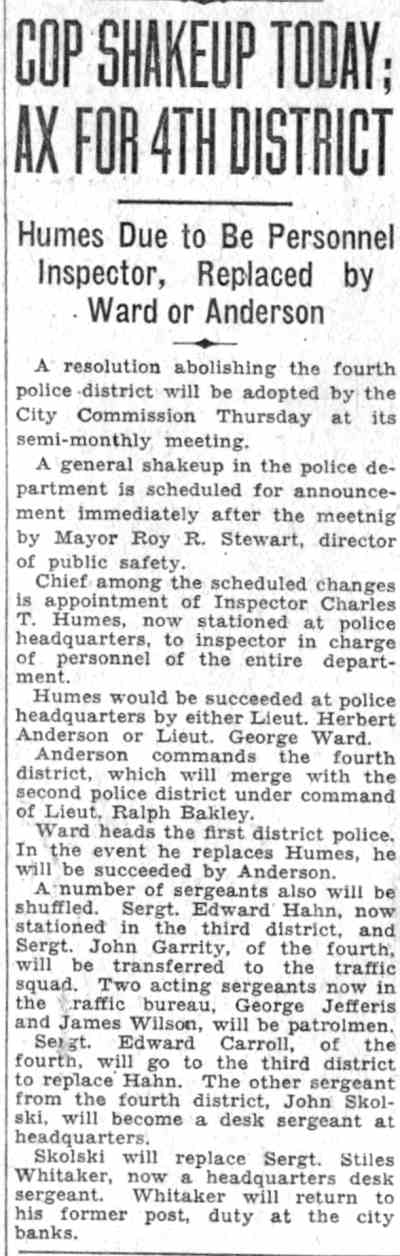
A police department shakeup announced by Mayor Roy R. Stewart abolished Camden's fourth police district; Sergeant Edward Hahn was among the officers transferred to the traffic squad.

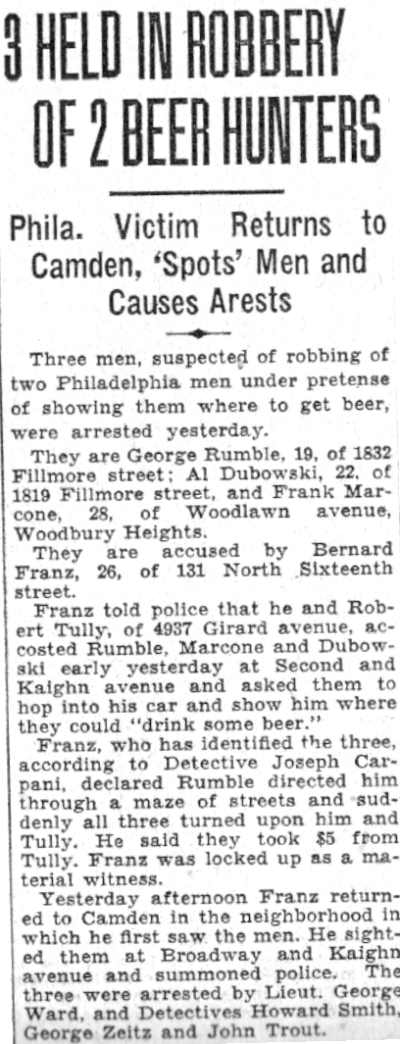
George Rumble, Al Dubowski and Frank Marcone were arrested at Broadway and Kaighn Avenue after Bernard Franz of Philadelphia accused them of robbing him and Robert Tully under pretense of showing them where to get beer.
Thomas Fleeyne of 515 Taylor Avenue was jailed for 50 days in default of a $50 fine after police raided his home; two men were fined as inmates and John Kershaw forfeited bail.
Mrs. Velda Mosely of North Third Street planned a complaint against police after Lieutenant George Ward raided a party at her home and arrested four women and eight men under the disorderly act.

A relative's scream of "They are in there—dead" nearly started a panic among 1,000 persons gathered at the Public Service gas plant at Locust and Cherry Streets after an explosion killed more than a dozen men.

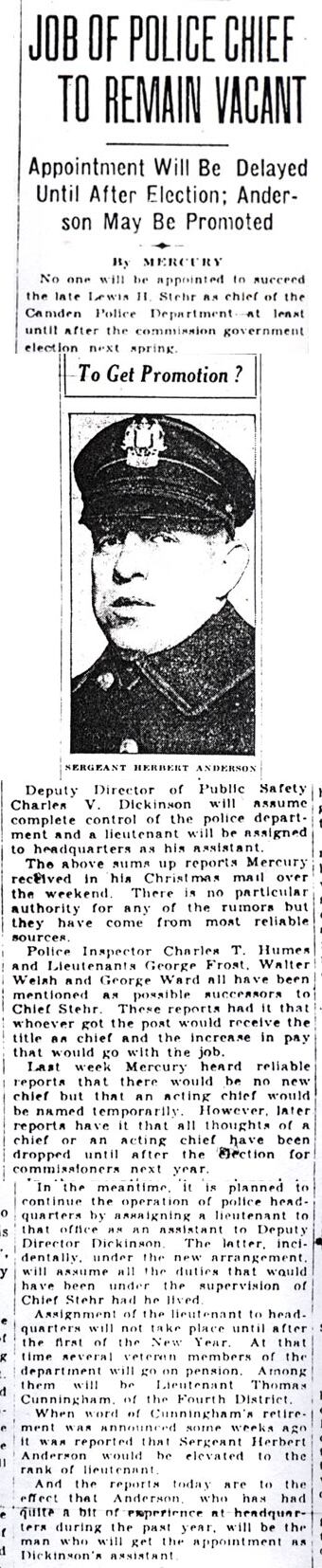
The Camden Evening Courier reports that no successor to the late Chief Lewis H. Stehr will be named until after the spring commission election, and that Sergeant Herbert Anderson may be promoted.

Major Charles V. Dickinson opened an inquiry into how word of a raid on a large North Camden distillery at Ninth and State streets leaked out before police arrived.

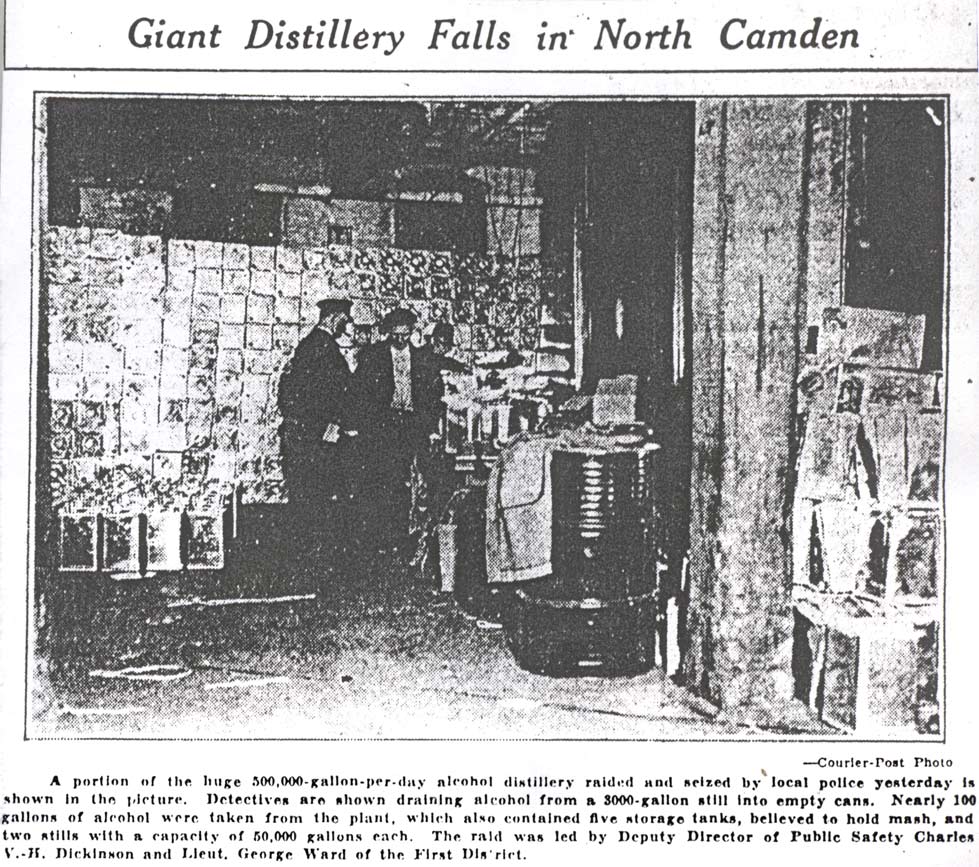
Photo of detectives draining alcohol from a 3000-gallon still at a 500,000-gallon-per-day distillery raided and seized by Camden police, a raid led by Deputy Director of Public Safety Charles V. H. Dickinson and Lieut. George Ward of the First District.

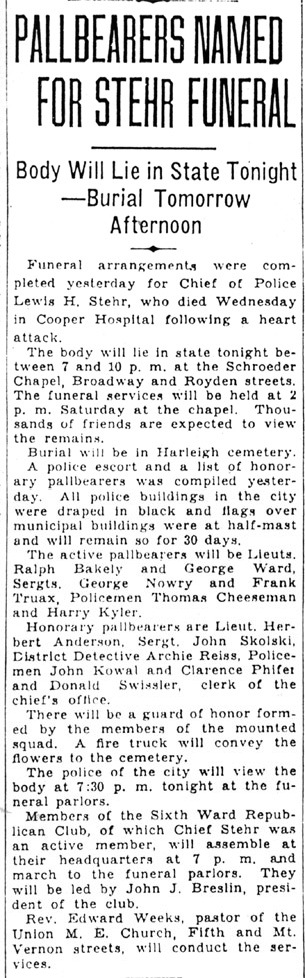
Funeral arrangements for Camden Chief of Police Lewis H. Stehr, who died in Cooper Hospital following a heart attack: his body would lie in state at the Schroeder Chapel, Broadway and Royden streets, with burial in Harleigh cemetery. The article lists the active and honorary pallbearers.

Funeral arrangements for Camden Police Chief Lewis H. Stehr, who died in Cooper Hospital: his body would lie in state at the Schroeder Chapel with burial in Harleigh Cemetery, and the article names the pallbearers and prints tributes from the police union and city officials.

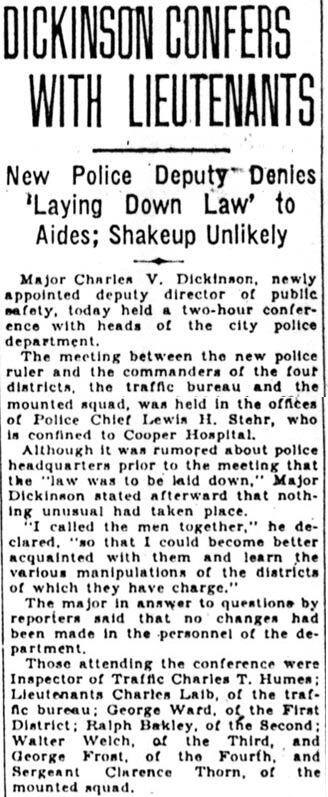
Newly appointed deputy director of public safety Major Charles V. Dickinson held a two-hour conference with Camden police commanders and said no personnel changes had been made.

Sergeants Samuel Johnson and Thomas Cunningham were sworn in as Camden police lieutenants, and reports circulated that five patrolmen — among them Edward Hahn of the third district — would soon be promoted to sergeant.

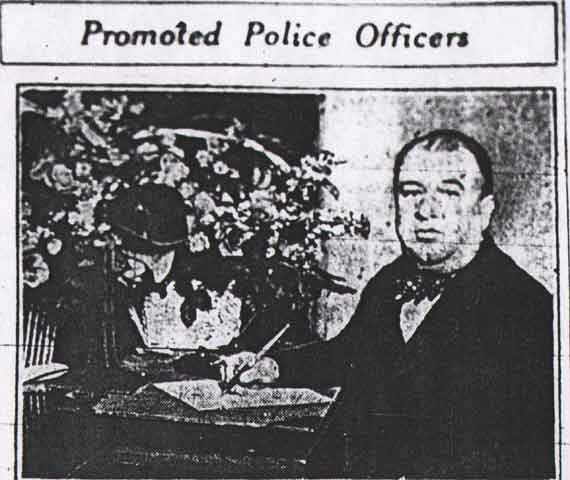
Camden Director of Public Safety David S. Rhone appointed five police lieutenants and one sergeant; the article also lists the civil service exam grades of the ten candidates.

Lieutenant George Ward and ten policemen raid Andrew Kelly's saloon at Second and Federal streets, seizing beer samples and arresting 25 men and 12 women as a county grand jury probes vice, Camden Courier-Post, May 18, 1929.
More than 30 members of the Camden police department were shifted on February 16, 1929, as a fourth police district was created and the rank of district captain was abolished.

Joseph "Mose" Flannery, 26, Eighth ward political worker and slot machine distributor, lay dying in West Jersey Homeopathic Hospital after being shot before dawn outside a saloon at Front street and Kaighn avenue. He refused to name his assailants — "My lips are sealed" — as Camden police and county detectives rounded up eight men and hunted for a motive.

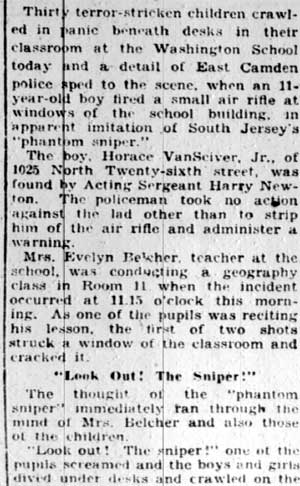
Thirty children dived beneath their desks at the Washington School when an 11-year-old boy fired an air rifle at the classroom windows, while county and city detectives split sharply over whether one "phantom sniper" was behind more than two dozen shootings.