Bertman Criticizes Raid Minus Warrant
View transcription
Inveighs Against Unreasonable Searches in Freeing Couple
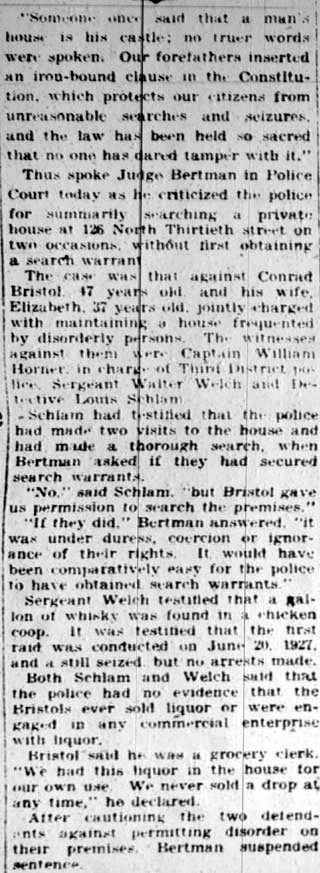
"Someone once said that a man's house is his castle; no truer words were spoken. Our forefathers inserted an iron-bound clause in the Constitution, which protects our citizens from unreasonable searches and seizures, and the law has been held so sacred that no one has dared tamper with it."
Thus spoke Judge Bertman in Police Court today as he criticized the police for summarily searching a private house at 126 North Thirtieth street on two occasions, without first obtaining a search warrant.
The case was that against Conrad Bristol, 47 years old, and his wife, Elizabeth, 37 years old, jointly charged with maintaining a house frequented by disorderly persons. The witnesses against them were Captain William Horner, in charge of Third District police, Sergeant Walter Welch and Detective Louis Schlam.
Schlam had testified that the police had made two visits to the house and had made a thorough search, when Bertman asked if they had secured search warrants. "No," said Schlam, "but Bristol gave us permission to search the premises." "If they did," Bertman answered, "it was under duress, coercion or ignorance of their rights. It would have been comparatively easy for the police to have obtained search warrants."
Sergeant Welch testified that a gallon of whisky was found in a chicken coop. It was testified that the first raid was conducted on June 20, 1927, and a still seized, but no arrests made.
Both Schlam and Welch said that the police had no evidence that the Bristols ever sold liquor or were engaged in any commercial enterprise with liquor.
Bristol said he was a grocery clerk. "We had this liquor in the house for our own use. We never sold a drop at any time," he declared.
After cautioning the two defendants against permitting disorder on their premises, Bertman suspended sentence.