People
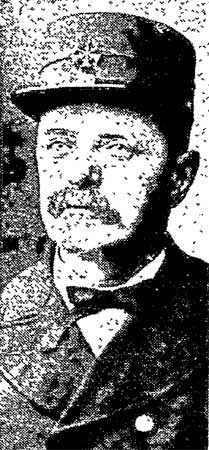
Samuel S. Buzine
Samuel S. Buzine (1844–1917) was a founding member of Camden's first paid fire department in 1869, serving 42 years and rising to Assistant Chief Engineer.
Tag
Samuel S. Buzine (1844–1917) was a founding member of Camden's first paid fire department in 1869, serving 42 years and rising to Assistant Chief Engineer.
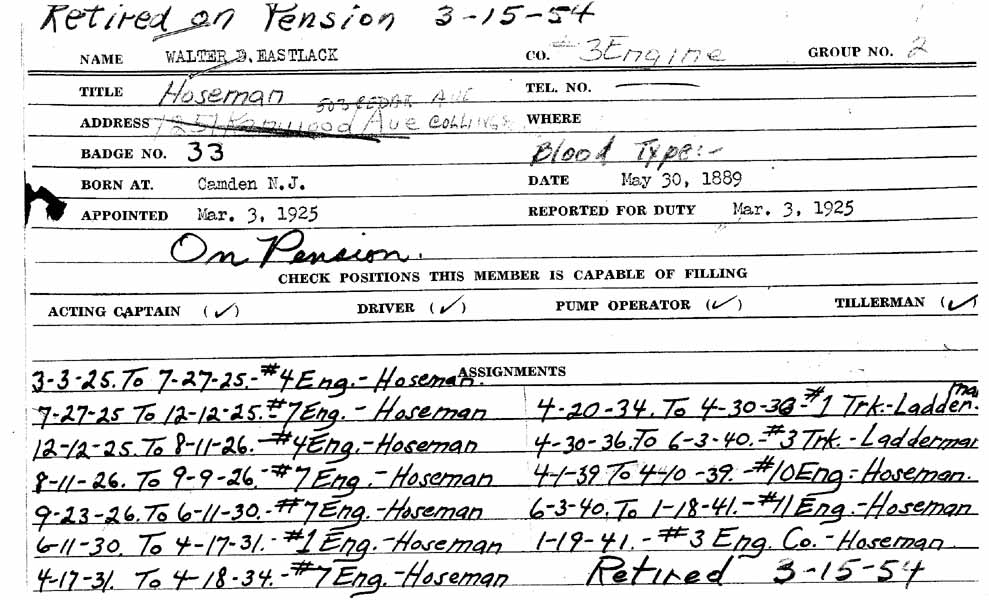
Walter Dayton Eastlack (1889–1964) was a Camden firefighter who served 29 years with the Camden Fire Department, from his appointment on March 3, 1925 to his retirement on March 15, 1954.
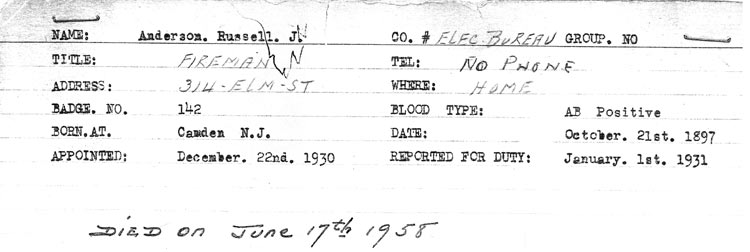
Russell J. Anderson (1897–1958) served with the Camden Fire Department for over 27 years, from December 1930 until his death in June 1958, assigned to Ladder Company 1 and later the Electrical Bureau.
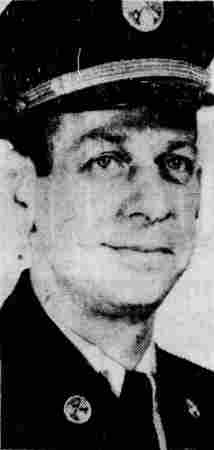
Harold Hadley Pike Jr. (1926–1998) served the Camden Fire Department for over 30 years, rising from ladderman to Fire Marshal and Chief of the Bureau of Fire Prevention.

Alexander Peacock was one of the original members of the Camden Fire Department , joining as an extra man with Engine Company 1 on December 7, 1869. Before joining the fire department, he worked as a carpenter.
Earl A. Smith Sr., born on April 28, 1921, was one of at least nine children born to Catherine and Spencer H. Smith Sr . The elder Smith had a lengthy and distinguished career as a Camden Firefighter, starting in 1914.
John W. Sutton had two distinct stints of service with the Camden Fire Department while concurrently managing and owning bars in Camden for nearly five decades.

Jesthroe Hunt's life story is deeply intertwined with the history of Camden, New Jersey, and serves as a testament to the city's cultural and societal evolution throughout the 20th century.
Joseph A. Ware, born in 1878 to Emma and James Ware Jr., spent most of his life in Camden's historic Eighth Ward. In his early years, the Ware family lived near South 7th Street and Ferry Avenue .
Wilson L. Bromley came into the world in New Jersey, around the year 1853, as the child of Joseph and Ann Eliza Bromley. His father, Joseph Bromley, earned his living as a boilermaker.

William Bogia was born in Delaware, approximately 1846, to parents John F. and Josephine. He was one of at least ten children born into the Bogia family. During the 1850 Census, the Bogias resided in New Castle, Delaware.
Benjamin Cavanaugh was born in Canada in March 1843 to Matthew and Elizabeth Cavanaugh. The family later moved to Pennsylvania before settling in Camden, New Jersey. In the 1850 Census, they were listed as residents of Camden's South Ward.

Leonard Iannelli, born into a family of dedicated firefighters, followed in the footsteps of his father, Frank Iannelli , who had lost his life while battling a fire as a member of Engine Company 9 on April 5, 1942.
SAMUEL SUBERS was appointed to the Camden Fire Department at some point not long after November 12, 1874 as a replacement for Alfred S. Ivins as an extra man with Engine Company 1 .

April 1948- In the company office of Engine Company 1, South 4th & Pine Streets. (Seated) Captain Raymond Amos; (standing) Captain Jesse Jones.

RAYMOND T. AMOS was born in Frankford, Delaware on December 28, 1905 to Albert and Catherine Amos. His father was a minister. The family had moved to Camden by the summer of 1910 and taken up residence at 1004 Central Avenue .

EUGENE F. ALSTON was born October 16, 1919 in Camden to Richard Alston and his wife, the former Dolly Robinson. His father had been born in 1891 in Henderson, North Carolina.

THOMAS R. ALLIBONE was one of the original members of the Camden Fire Department, entering service on September 2, 1869 as an extra man with Engine Company 1 .

CHARLES L." SHAD" ALCOTT was born in New Jersey around 1857. The Census indicates July of 1858. Sorting him out can be confusing as there was a Charles M. Alcott, born February of 1857, who lived in Camden at the same time.
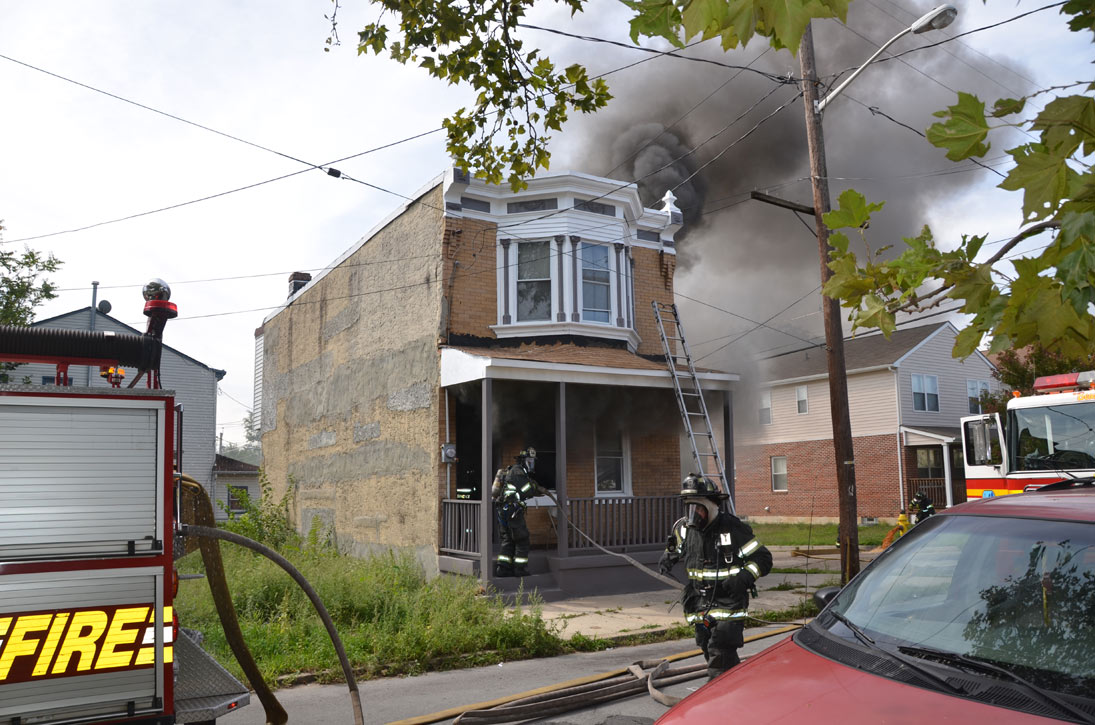
Camden Fire Department response to a fire at 1227 North 28th Street in Cramer Hill on September 19, 2011.
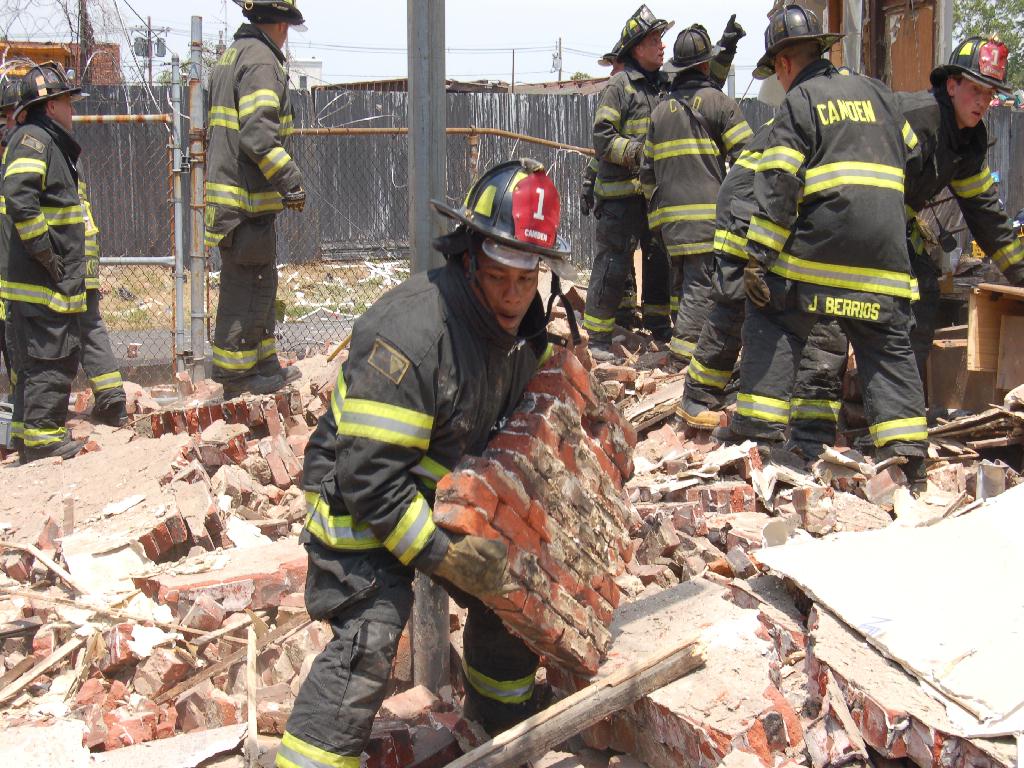
Camden firefighters worked four all-hands fires and two second alarms over a 24-hour tour in June 2006, culminating in an explosion and collapse at 620 Sycamore Street where a badly burned woman was rescued from the second floor.

Story and Photos by Bob Bartosz , Camden NJ Fire Department Photographer On Saturday morning, May 20, 2006 a group of Camden Fire Fighters, Camden County Fire Fighters, retired members of the Fire Force, along with United States Congressman Robert Andrews, Camden City Mayor Gwendolyn A. Faison , Fire Chief Joseph Marini and Msgr.
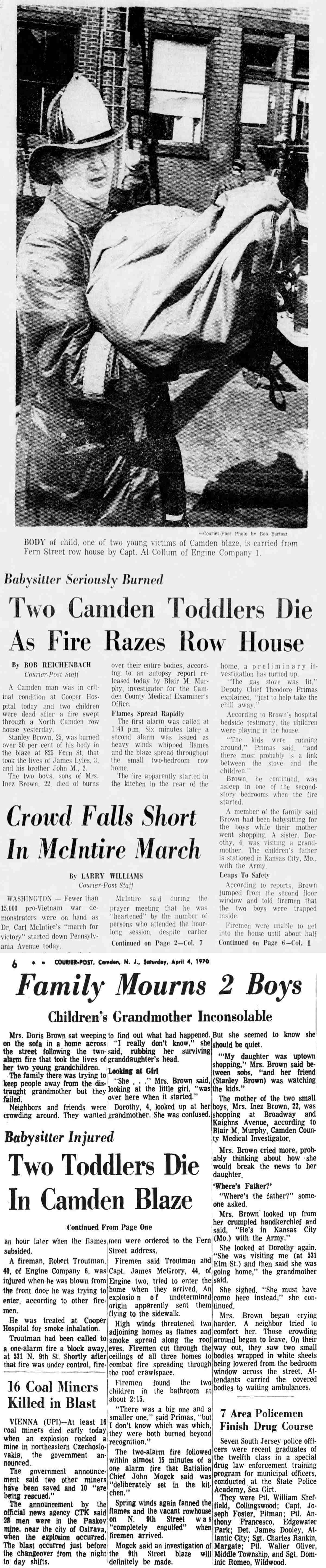
Two young brothers died and a Camden man was critically burned when fire swept a row house at 825 Fern Street in North Camden, April 3, 1970, as firemen also fought a blaze at 531 N. 9th Street.

March 30, 1970 Captain Maycott as last member removed from collapse is carried to waiting ambulance. Units at scene breached walls and performed tunneling and shoring operations to reach trapped members.
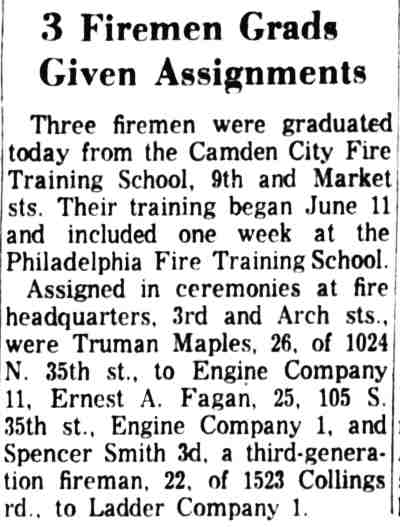
Three graduates of the Camden City Fire Training School received their company assignments in July 1964 — Truman Maples of 1024 North 35th Street, Ernest A. Fagan of 105 South 35th Street, and Spencer Smith 3d of 1523 Collings Road.
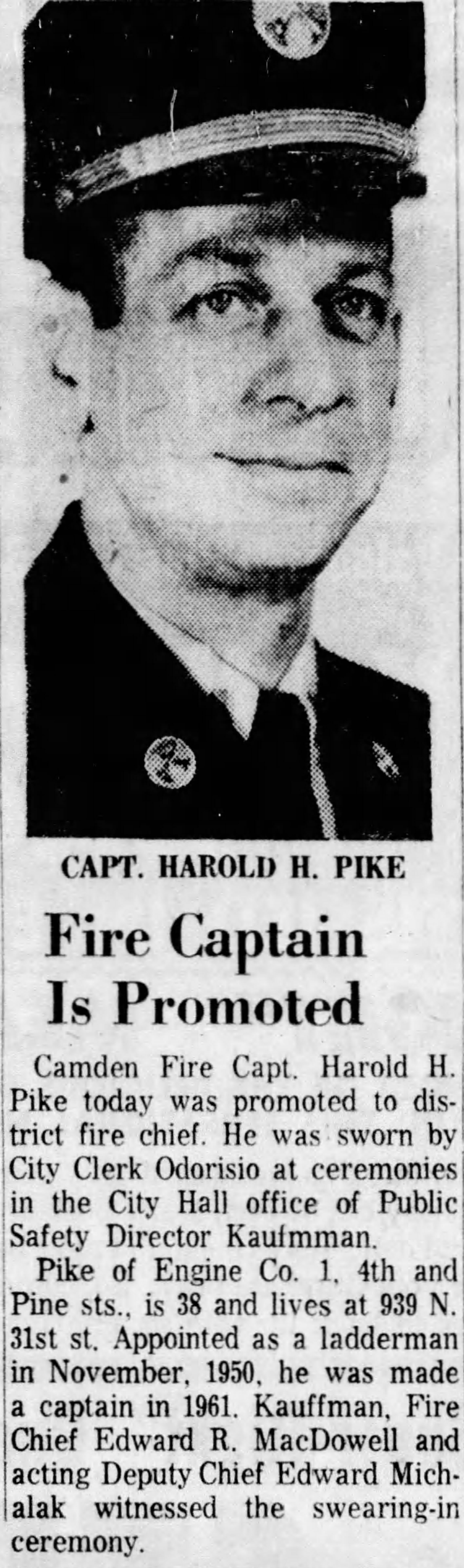
Camden Fire Captain Harold H. Pike was promoted to district fire chief on April 30, 1964, sworn in at City Hall by City Clerk Odorisio before Public Safety Director Kauffman, Fire Chief Edward R. MacDowell, and acting Deputy Chief Edward Michalak.

A Camden fire pumper from Engine 1, answering a mattress fire, collided with an automobile and crashed through the front of an insurance office at Broadway and Pine Streets, injuring firemen, a passerby and the car's occupants and leaving the building condemned.
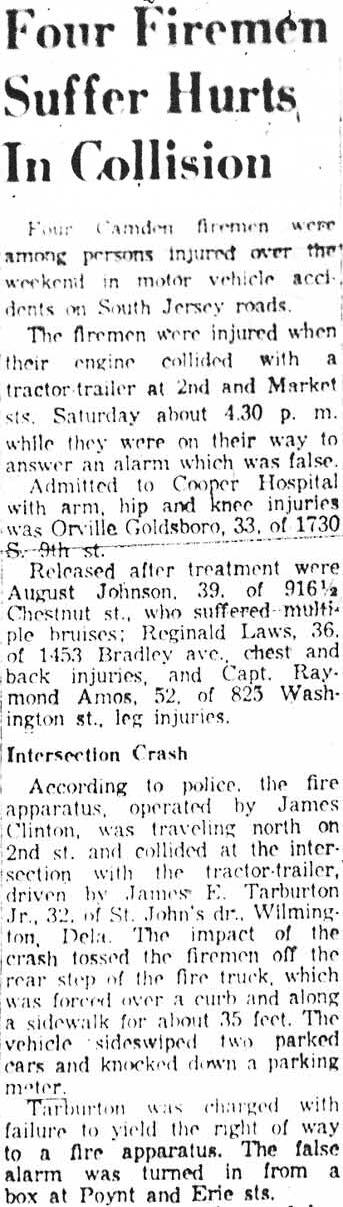
Four Camden firemen were injured when their engine collided with a tractor-trailer at 2nd and Market streets while answering a false alarm; the truck driver was charged with failure to yield to a fire apparatus.

A neighbor who ran several blocks Friday night when she saw smoke and flames brought firemen to rescue Samuel Liberetti, 88, of 606 Avon Street, near West and Beckett Streets. Firemen of Engine Co. 1 wearing oxygen masks found him semi-conscious in the cellar, and he was treated at Cooper Hospital for smoke inhalation.

Veteran Camden fireman William Earl Toy died of injuries suffered when Acting Chief William Van Pfefferle's car, which he was driving to a fire at Berwick and Boyd streets, collided with a Public Service bus at Sixteenth and Federal streets.

The clothing and jewelry store of S. Lester at 713 Broadway was destroyed by a two-alarm fire of undetermined origin following an explosion. Eight companies fought the fire for seven hours, and damage was estimated at $100,000.
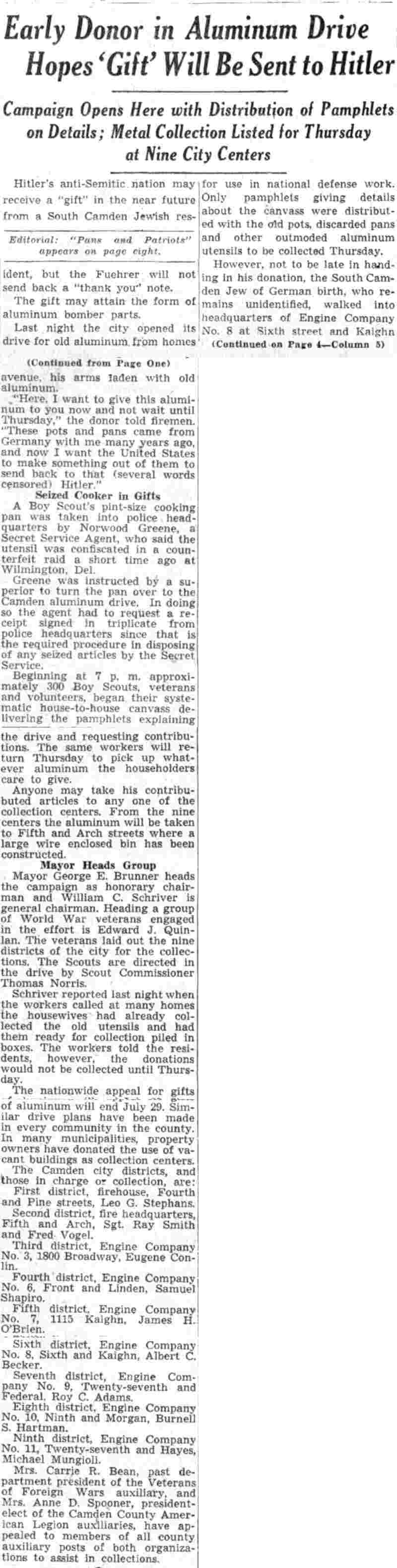
As Camden opened its World War II drive to collect old aluminum for national defense, an unidentified South Camden resident of German birth was among the first donors, carrying his old pots and pans to Engine Company No. 8's firehouse.
Truck Disbanded, Engine Company Created 13 Men Transferred Commissioner Mary W. Kobus yesterday announced a number of changes in the fire department, including the disbanding of Truck Company No. 4 ; creation of a new engine company No. 10 , and the transfer of 18 officers and men, 12 of them captains.

The second installment of Frank Sheridan's 1936 Courier-Post history of fire fighting in Camden traces the Weccacoe Fire Company, whose headquarters moved to the old City Hall lot on Federal Street, and the Mohawk, Independence and Shiffler volunteer companies.

A Camden fire engine bound for the fire training school and a Public Service bus collided on wet pavement at River Road and Federal Street, injuring fireman Harry Hess and four bus passengers.
Camden police officer and firefighter who served six years with the police department and 28 years with Engine Company No. 1 at Fourth and Pine streets, passing away on April 18, 1930.
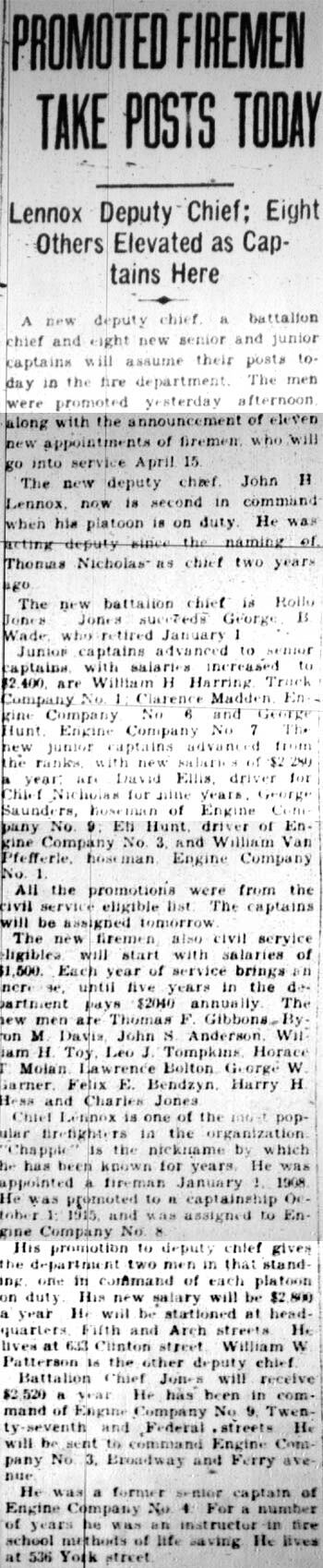
Camden Courier-Post, April 4, 1928. John H. Lennox was promoted to deputy chief and Rollo Jones to battalion chief of the Camden Fire Department, eight men were elevated to senior and junior captain, and eleven new firemen were appointed.
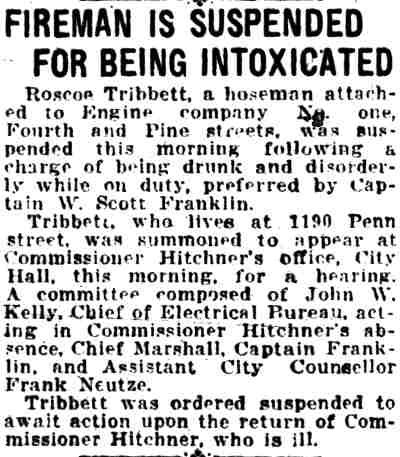
Hoseman Roscoe Tribbett of Engine Company No. 1, Fourth and Pine streets, was suspended on a charge of being drunk and disorderly on duty, preferred by Captain W. Scott Franklin.
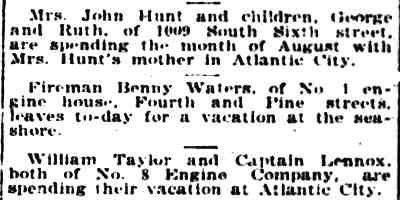
Three August 1921 personal notices from the Camden Post-Telegram: a firefighter's family, Fireman Benny Waters of No. 1 engine house at Fourth and Pine streets, and two No. 8 Engine Company men vacationing.

Camden Post-Telegram - December 30, 1920 Double Shift System Becomes Effective at 8 O'clock on Saturday Morning Saturday morning at 8 o'clock the two-platoon system of the Fire Department becomes effective.
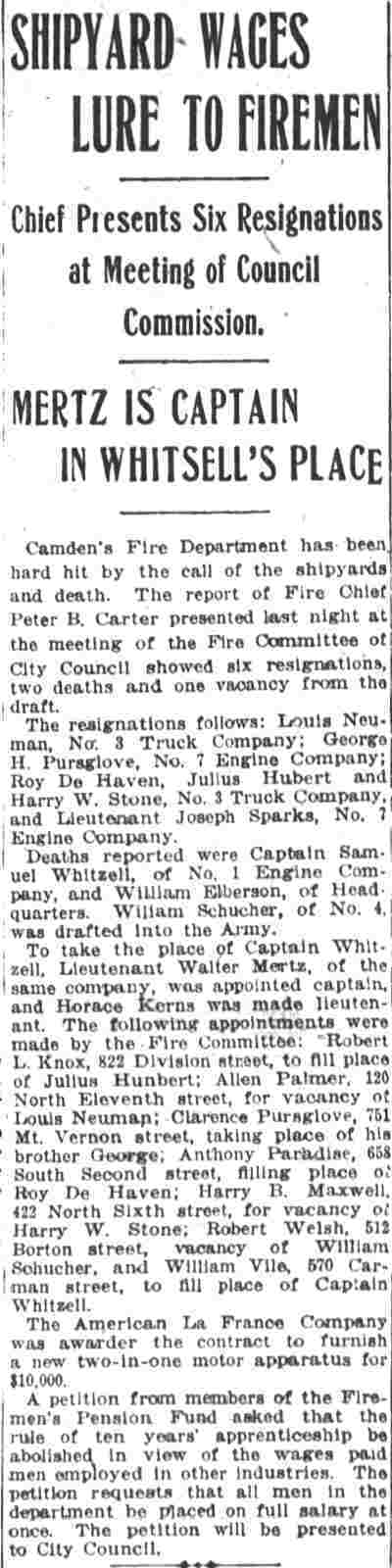
Fire Chief Peter B. Carter reported six resignations, two deaths and one vacancy from the draft as the shipyards drew men from Camden's Fire Department; Lieutenant Walter Mertz was made captain and the Fire Committee appointed seven new firemen.
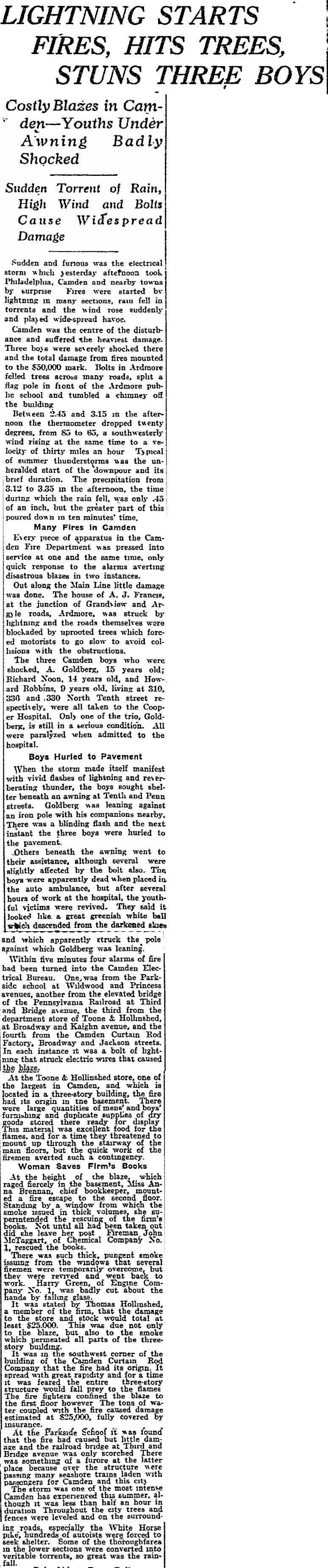
A sudden electrical storm on August 18, 1915 struck Camden hardest: lightning shocked three boys sheltering under an awning at Tenth and Penn streets, and set fires at the Parkside school, a Pennsylvania Railroad bridge, the Toone & Hollinshed department store at Broadway and Kaighn avenue, and the Camden Curtain Rod Factory at Broadway and Jackson streets.
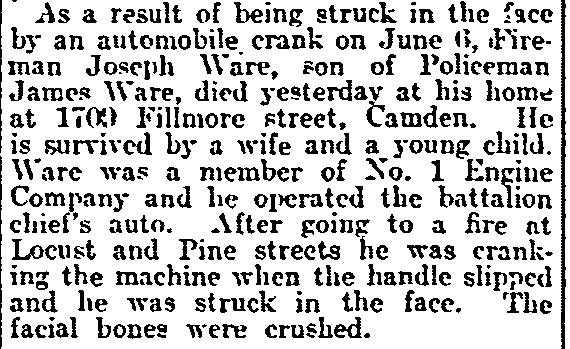
Camden Fireman Joseph Ware, son of Policeman James Ware and a member of No. 1 Engine Company, died at his home on Fillmore Street after an automobile crank slipped and struck him in the face on June 6.
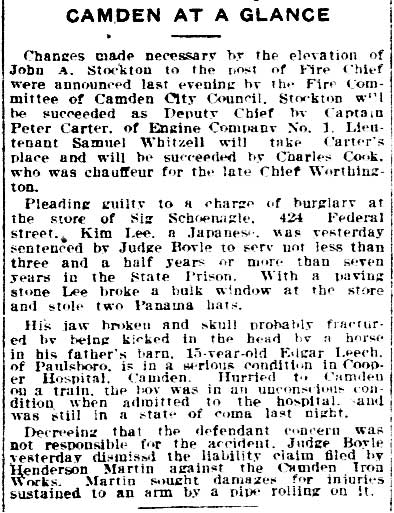
Captain Peter Carter of Engine Company No. 1 was named Deputy Chief after John A. Stockton's elevation to Fire Chief, and Kim Lee was sentenced for the burglary of Sig Schoenagle's store at 424 Federal Street.
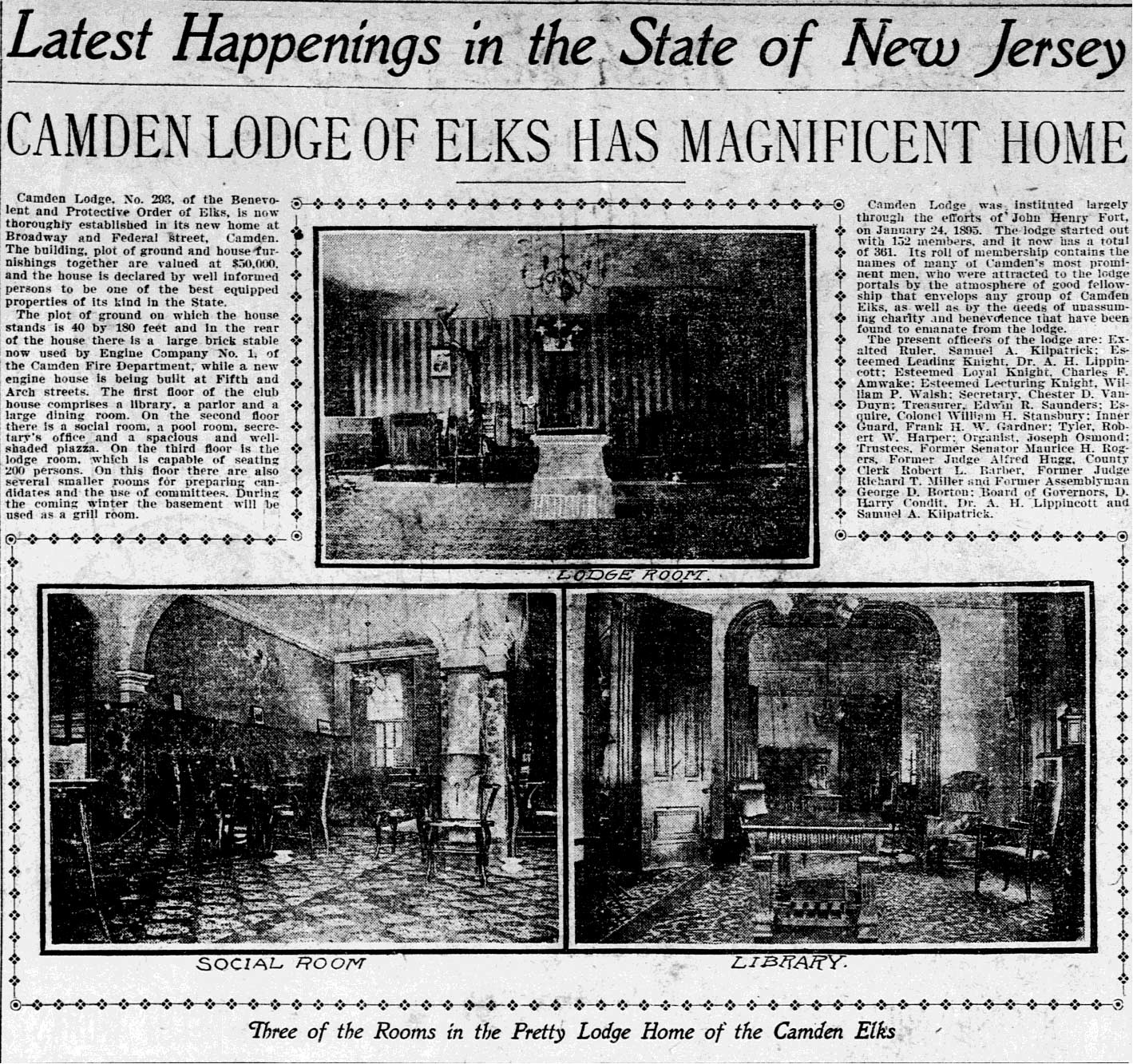
Camden Lodge, No. 293, of the Benevolent and Protective Order of Elks is established in its new home at Broadway and Federal Street, valued with its furnishings at $50,000. The Philadelphia Inquirer describes the club house and lists the lodge's officers.
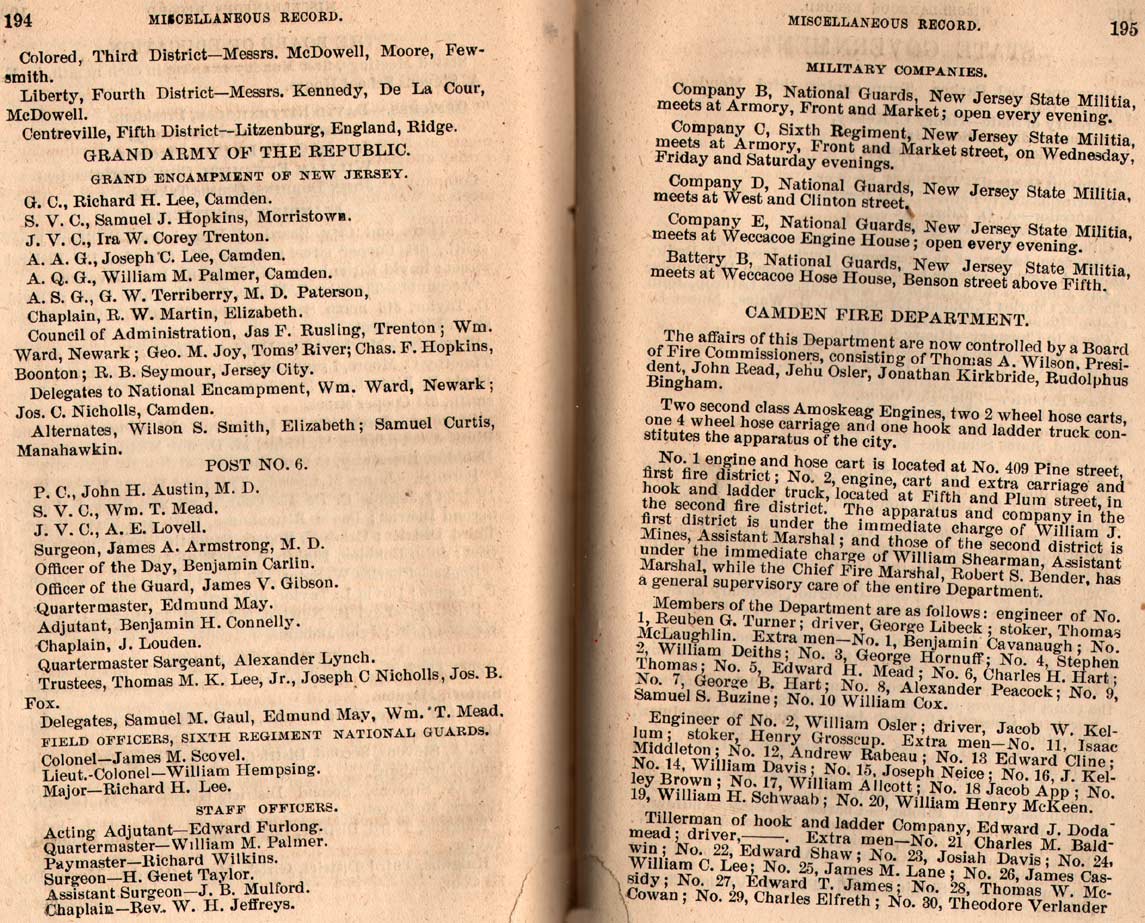
Pages 194 and 195 of the Miscellaneous Record in Chew's Camden City Directory for 1872, listing Grand Army of the Republic officers, military companies and the Camden Fire Department roster, including No. 1 engine at 409 Pine Street.
During the Civil War, Camden purchased its first steam fire apparatus on June 4, 1864 the Independence Fire Company No. 3 purchased an Amoskeag steamer for $3250. This apparatus was a third class, single pump style with serial #92.