Pace of Cleanup Worries Residents
They fear they will lose their homes
By Lawrence Hajna, Courier-Post Staff
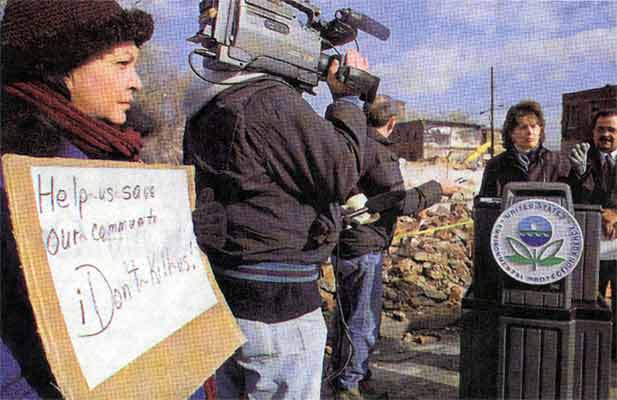
City and federal officials gathered Wednesday to mark a milestone in the cleanup of pollution in the Waterfront South neighborhood—the demolition of century-old rowhomes contaminated with radiation from a neighboring gas-mantle plant.
But, in an ironic twist, residents of the gritty, mostly minority neighborhood also gathered to express their fear that the cleanup marks the beginning of the end for their neighborhood.
They worry a fledgling city plan to redevelop the area as an industrial zone will drive them out of their longtime homes.
“We would like to keep our homes,” said 71-year-old South 4th Street resident Lula Williams. “My home is paid for. I live off of Social Security, a pension. Where am I going? We are senior citizens that have worked hard and paid for our homes and struggled.”
The city is in the early stages of mapping out a plan that could target the Waterfront South area for an industrial zone as part of Camden's overall redevelopment.
Officials on Wednesday did not rule out the possibility that this could involve relocation of some of the neighborhood's 1,700 residents.
Mayor Gwendolyn Faison and Randy Primas, the state-appointed chief operating officer for the city, attempted to ease residents' fears, though.
“You are not going to be forgotten, you will have a say,” Faison said. “But I want you to remember, your health is the most important thing.”
Primas said the state Department of Environmental Protection has launched a comprehensive study of the neighborhood's air, ground and water to determine how great a health risk current and past pollution sources pose.
“My concern has been the quality of the environment and moving people into an environment that may not be healthy,” Primas said.
The residents have long lived with pollution from existing industries as well as the soils contaminated by mills and factories that once flourished along the Delaware River.
Over the past two decades, Camden County officials also built a trash-to-steam incinerator and foul-smelling sewage treatment plant in the neighborhood.
The construction several years ago of St. Lawrence Cement, a plant that grinds slag into a component of cement, put residents over the edge. They sued the state, arguing the neighborhood has been targeted for pollution-generating facilities because it is largely black and Hispanic.
Jane Kenny, the regional director for the Environmental Protection Agency, visited Arlington Street on Wednesday to mark what the agency views as a positive step toward ending the area's environmental problems.
She marked the demolition of 54 homes on Arlington Street contaminated by the neighboring General Gas Mantle plant, which once used radioactive thorium to make gas-lantern mantles.
The $2 million project is part of what is expected to be a $200 million federal cleanup of scores of radiation-tainted properties in South Camden and neighboring Gloucester City.
Although the EPA's Superfund cleanup program is strapped for cash, Kenny said the Arlington Street cleanup was given priority because of the city's eagerness to redevelop the area.
Instead of cheers, Kenny was met by residents carrying signs declaring, “Waterfront South is Our Home.”
Christopher Auth is director of the Heart of Camden, a nonprofit group that has rehabilitated about 120 homes in the neighborhood. Auth said Primas has rejected the idea of giving his group any share of the state's $175 million city aid package.
“Our concern is that the government—the city, the state and the county, put all these toxic facilities in the neighborhood…but now they're saying it's unhealthy,” Auth said.
Calvin Aiken, a 62-year-old retired roofer, has lived on Fillmore Street, a block from Arlington, for 30 years. “They're running us away with nowhere to go,” he said.
Williams, the 4th Street resident, has more questions than answers now. But she said, “If they relocated me, and it was in a nice neighborhood, then I would have to go. What else could I do?”