Pennington Was to be a Tragedienne
Cleveland Plain Dealer, October 5, 1921
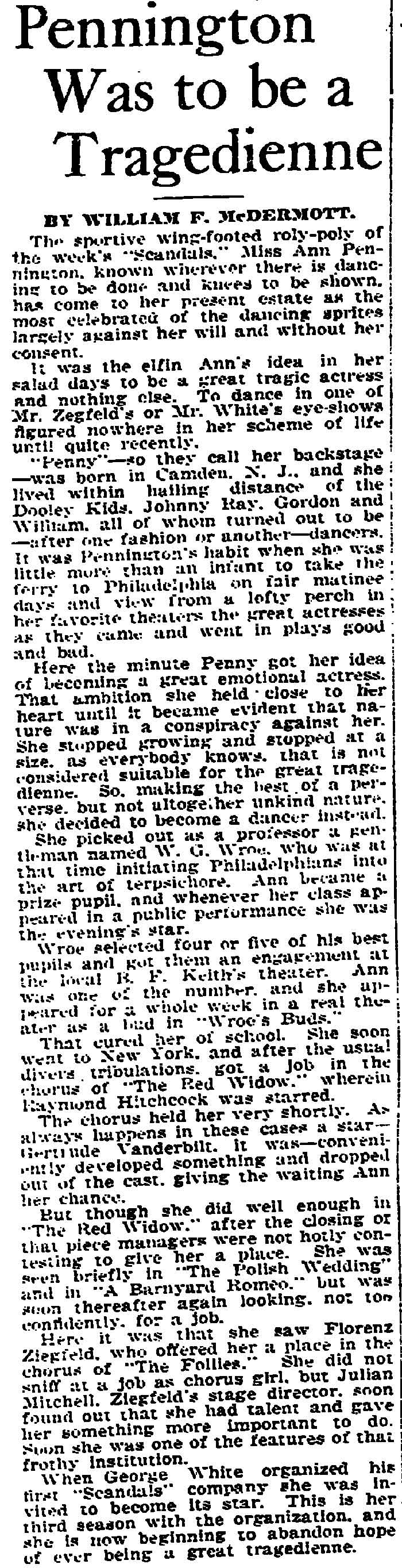
View transcription
Pennington Was to be a Tragedienne
By William F. McDermott.
The sportive wing-footed roly-poly of the week's "Scandals," Miss Ann Pennington, known wherever there is dancing to be done and knees to be shown, has come to her present estate as the most celebrated of the dancing sprites largely against her will and without her consent.
It was the elfin Ann's idea in her salad days to be a great tragic actress and nothing else. To dance in one of Mr. Zegfeld's or Mr. White's eye-shows figured nowhere in her scheme of life until quite recently.
"Penny"—so they call her backstage—was born in Camden, N. J., and she lived within hailing distance of the Dooley Kids, Johnny, Ray, Gordon and William, all of whom turned out to be—after one fashion or another—dancers.
It was Pennington's habit when she was little more than an infant to take the ferry to Philadelphia on fair matinee days and view from a lofty perch in her favorite theaters the great actresses as they came and went in plays good and bad.
Here the minute Penny got her idea of becoming a great emotional actress. That ambition she held close to her heart until it became evident that nature was in a conspiracy against her. She stopped growing and stopped at a size, as everybody knows, that is not considered suitable for the great tragedienne. So, making the best of a perverse, but not altogether unkind nature, she decided to become a dancer instead.
She picked out as a professor a gentleman named W. G. Wroe, who was at that time initiating Philadelphians into the art of terpsichore. Ann became a prize pupil, and whenever her class appeared in a public performance she was the evening's star.
Wroe selected four or five of his best pupils and got them an engagement at the local B. F. Keith's theater. Ann was one of the number, and she appeared for a whole week in a real theater as a bud in "Wroe's Buds."
That cured her of school. She soon went to New York, and after the usual divers tribulations, got a job in the chorus of "The Red Widow," wherein Raymond Hitchcock was starred.
The chorus held her very shortly. As always happens in these cases a star—Gertrude Vanderbilt, it was—conveniently developed something and dropped out of the cast, giving the waiting Ann her chance.
But though she did well enough in "The Red Widow," after the closing of that piece managers were not hotly contesting to give her a place. She was seen briefly in "The Polish Wedding" and in "A Barnyard Romeo," but was soon thereafter again looking, not too confidently, for a job.
Here it was that she saw Florenz Ziegfeld, who offered her a place in the chorus of "The Follies." She did not sniff at a job as chorus girl, but Julian Mitchell, Ziegfeld's stage director, soon found out that she had talent and gave her something more important to do. Soon she was one of the features of that frothy institution.
When George White organized his first "Scandals" company she was invited to become its star. This is her third season with the organization, and she is now beginning to abandon hope of ever being a great tragedienne.
Advertisement