The Effect of the present Monetary Contraction
Camden Weekly Phenix, May 22, 1858
View transcription
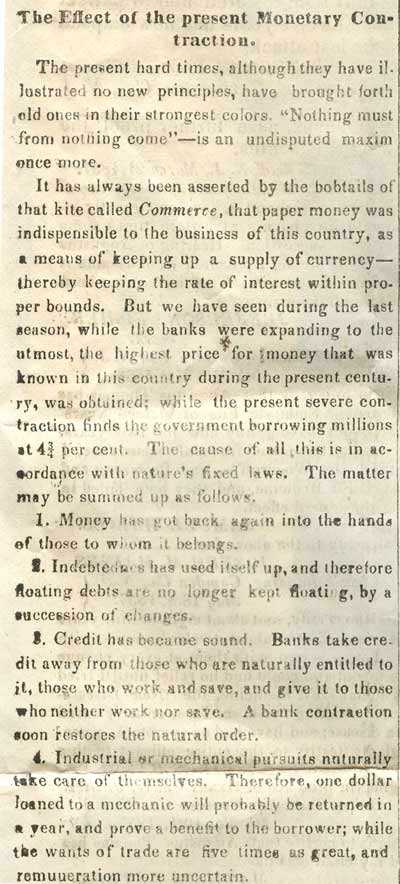
The Effect of the present Monetary Contraction
The present hard times, although they have illustrated no new principles, have brought forth old ones in their strongest colors. "Nothing must from nothing come"—is an undisputed maxim once more.
It has always been asserted by the bobtails of that kite called Commerce, that paper money was indispensible to the business of this country, as a means of keeping up a supply of currency—thereby keeping the rate of interest within proper bounds. But we have seen during the last season, while the banks were expanding to the utmost, the highest price for money that was known in this country during the present century, was obtained; while the present severe contraction finds the government borrowing millions at 4¾ per cent. The cause of all this is in accordance with nature's fixed laws. The matter may be summed up as follows.
1. Money has got back again into the hands of those to whom it belongs.
2. Indebtedness has used itself up, and therefore floating debts are no longer kept floating, by a succession of changes.
3. Credit has became [sic] sound. Banks take credit away from those who are naturally entitled to it, those who work and save, and give it to those who neither work nor save. A bank contraction soon restores the natural order.
4. Industrial or mechanical pursuits naturally take care of themselves. Therefore, one dollar loaned to a mechanic will probably be returned in a year, and prove a benefit to the borrower; while the wants of trade are five times as great, and remuneration more uncertain.
Advertisement