Victim of Huns' Brutality Enlists
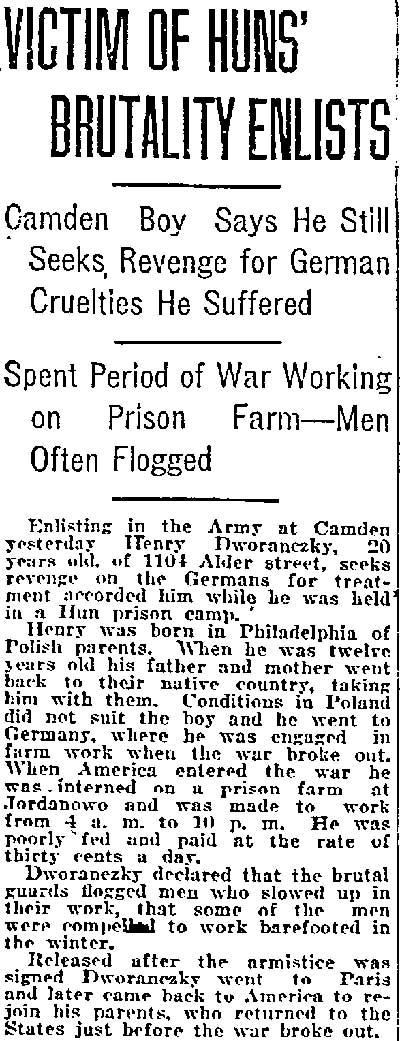
Victim of Huns' Brutality Enlists — Henry Dworanczky, 1104 Alder Street, Philadelphia Inquirer, June 22, 1919
Philadelphia Inquirer, June 22, 1919
View transcription
Victim of Huns' Brutality Enlists Camden Boy Says He Still Seeks Revenge for German Cruelties He Suffered Spent Period of War Working on Prison Farm—Men Often Flogged Enlisting in the Army at Camden yesterday Henry Dworanczky, 20 years old, of 1104 Alder street, seeks revenge on the Germans for treatment accorded him while he was held in a Hun prison camp. Henry was born in Philadelphia of Polish parents. When he was twelve years old his father and mother went back to their native country, taking him with them. Conditions in Poland did not suit the boy and he went to Germany, where he was engaged in farm work when the war broke out. When America entered the war he was interned on a prison farm at Jordanowo and was made to work from 4 a. m. to 10 p. m. He was poorly fed and paid at the rate of thirty cents a day. Dworanczky declared that the brutal guards flogged men who slowed up in their work, that some of the men were compelled to work barefooted in the winter. Released after the armistice was signed Dworanczky went to Paris and later came back to America to rejoin his parents, who returned to the States just before the war broke out.

Camden Boy Says He Still Seeks Revenge for German Cruelties He Suffered

Spent Period of War Working on Prison Farm—Men Often Flogged

Enlisting in the Army at Camden yesterday Henry Dworanczky, 20 years old, of 1104 Alder street, seeks revenge on the Germans for treatment accorded him while he was held in a Hun prison camp.

Henry was born in Philadelphia of Polish parents. When he was twelve years old his father and mother went back to their native country, taking him with them. Conditions in Poland did not suit the boy and he went to Germany, where he was engaged in farm work when the war broke out. When America entered the war he was interned on a prison farm at Jordanowo and was made to work from 4 a. m. to 10 p. m. He was poorly fed and paid at the rate of thirty cents a day.

Dworanczky declared that the brutal guards flogged men who slowed up in their work, that some of the men were compelled to work barefooted in the winter.

Released after the armistice was signed Dworanczky went to Paris and later came back to America to rejoin his parents, who returned to the States just before the war broke out.

Advertisement

Comments