Derived from George Reeser Prowell's History of Camden County NJ Camden County was also strongly represented in the Second New Jersey Brigade of three years' troops, which was composed of the Fifth, Sixth, Seventh and Eighth Regiments.
The 6th New Jersey Infantry Regiment was organized under an act of Congress approved July 22, 1861, and mustered into U.S. service at Camp Olden, Trenton, on August 19, 1861, for a three-year term.
John Atwood Ewing was born on July 7, 1845, in Delaware to parents John and May Ewing. In his early years, he lived in Penns Grove, Salem County, New Jersey.
J. B. VAN SCIVER & CO. This firm occupy a handsome building on the corner of Delaware avenue and Federal street . It is of mammoth proportions and is visible along the whole river front.
By Thomas A. Bergbauer , Retired Courier-Post Editor A few times in the past two months I have received several phone calls from readers asking if a hospital ever existed in North Camden next to the Ben Franklin Bridge and if so, what was its name.
Reprinted from the series of stories of Camden's earlier days, under the title Sixty Years in Camden County - Gosh! by Will Paul, appearing in The Community news, of Merchantville, NJ.
Excerpted from History of Camden County, New Jersey, George Reeser Prowell, 1885 THE WEST JERSEY FERRY , familiarly known as " The Market Street Ferry ," extends from Market Street , Camden, to Market Street, Philadelphia, and is now, and has long been one of the leading lines of· transportation across the Delaware between the two cities.
David Baird Sr. was one of Camden's leading citizens for well over 50 years. Born in Ireland in on April 7th of 1839, he came to America in 1858 after the death of his father, and settled in Camden the following year.
From George Reeser Prowell's History of Camden County, New Jersey , 1886 Newton Friend's Meeting About the year 1800, when the general opening of roads made it no longer important to be on the water, Newton Friends determined to move from their old meeting-house on Newton Creek to a place more central; and in Fourth Month, 1801, Joseph Kaighn gave them the lot of land-at the corner of the Mount Ephraim road and Mount Vernon Street , in the present city of Camden, on which, in the same year, they built the brick meetinghouse that now stands there.
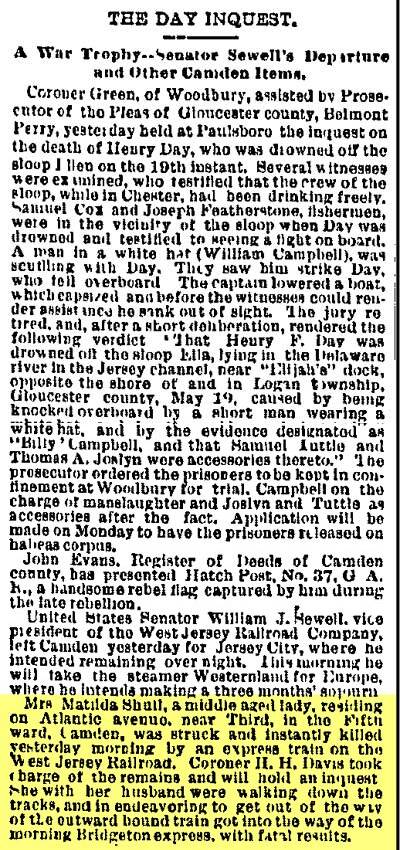
A Philadelphia Inquirer column of Camden items, including the death of Mrs. Matilda Scholl on the West Jersey Railroad, of which Coroner H. H. Davis took charge.
St. Paul's Episcopal Church, Camden, elected Abraham Browning and Marmaduke B. Taylor as wardens and a vestry that included Maurice Browning, William J. Sewell and Jesse W. Starr.