The John R. Evans Company manufactured leather at its factory at 2nd and Erie Streets in North Camden. John R. Evans was a major employer in Camden and one of the largest of several leather factories in the city. Founded in 1858, the business employed up to 700 people before its closing shortly before the December 19, 1971 fire which destroyed the entire five-building complex. The plant had been involved in or threatened by fire several times in its long history.
Four John R. Evans employees — Francis J. Knox, Norbert C. Rowan, Morris Wilson Rickenbach Jr., and Raymond Price — gave their lives for America during World War II.
Another company, located nearby at 72 Erie Street, was also in the leather manufacturing business for many years. Known at different times as McNeely & Company, Allied Kid, and the Julius Brand Leather Company, this factory remained in operation into the early 1970s.
Advertisement
$225,000 Fire Ruins 5 Uptown Plants
Camden Courier-Post — February 22, 1928
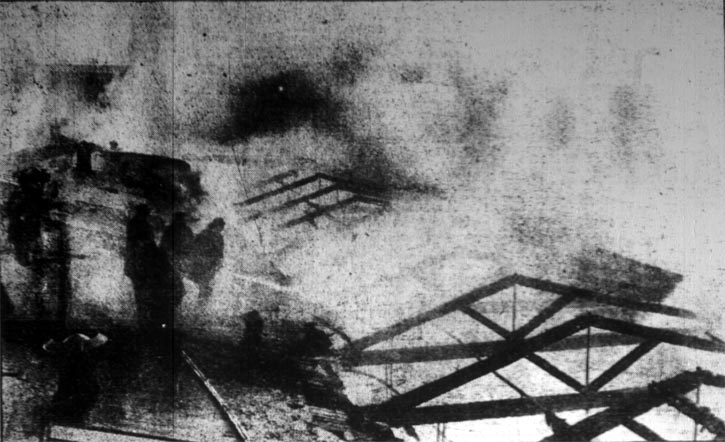
How flames gutted the big industrial building on Erie Street, February 22, 1928View transcription
Residents Flee as Flames Rage in Big Building — Factory of Evans Leather Co. Saved by Valiant Work of Firemen
Sweeping through the Varoma Building on Erie street and driving 80 persons from their homes, a spectacular fire early today wrecked the quarters of five industrial concerns and caused damage estimated at $225,000. Responding to three alarms, every piece of fire apparatus in the city, with the exception of the “cover-up” companies, fought the blaze for hours.
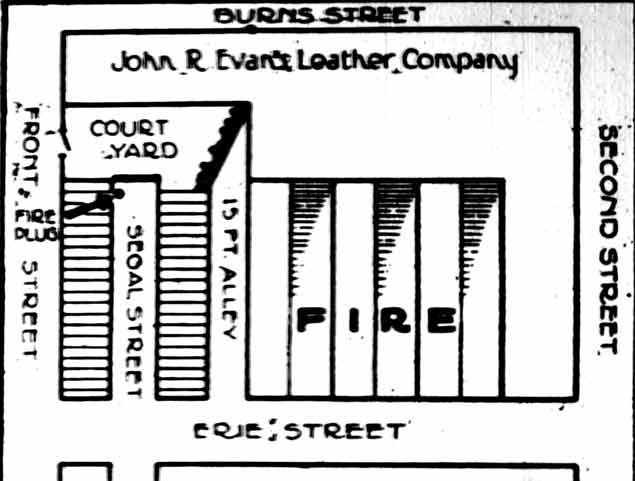
Handicapped by the location of fire-plugs and the breakdown of several pieces of apparatus, the firemen prevented the flames from spreading to the huge building of the Evans Leather Company, which forms an “L” on two sides of the burned structure. Twenty dwellings on the east side of Segal street, separated from the Varoma building only by a narrow alley, were also saved after their occupants had fled to the street.
Fire Chief Thomas Nicholas announced he would begin a rigid investigation into the blocking of Segal street by a high board fence and the piling of refuse around a fireplug at the head of the street. The wrecked building was owned by the Varoma Corporation. The industries in the building included the MacIntosh Printing and Lithographing Company ($10,000), the Blue and Gray Textile Company ($30,000), the Allied Metal Stamping Company ($75,000), James A. MacMillan & Co., manufacturing chemists ($10,000), and the Philadelphia Metal Stamping Company ($50,000).
Hose lines were taken to the flat roof of the Evans Company, high above the burning building, and water poured onto the flames from this altitude. Firemen were handicapped because the Evans Leather Company had blocked off Segal street at the north end with a high board fence, and a fireplug there was blocked by a pile of chemical containers. Chief Nicholas said the leather company had failed to place gates in the Segal street fence as required.
The fire today was the fourth big blaze on the site. The first was in 1867, when a roller mill and nail factory were destroyed. In the second, in 1908, flames destroyed the morocco plant of the R. H. Evans Company. In 1919, with the temperature at zero, firemen were again called out to fight a disastrous blaze in the rebuilt Evans plant.
Headline: Residents flee as flames rage in big buildingView transcription
Residents Flee as Flames Rage in Big Building — Factory of Evans Leather Co. Saved by Valiant Work of Firemen
Sweeping through the Varoma Building on Erie street and driving 80 persons from their homes, a spectacular fire early today wrecked the quarters of five industrial concerns and caused damage estimated at $225,000. Responding to three alarms, every piece of fire apparatus in the city, with the exception of the “cover-up” companies, fought the blaze for hours.
Handicapped by the location of fire-plugs and the breakdown of several pieces of apparatus, the firemen prevented the flames from spreading to the huge building of the Evans Leather Company, which forms an “L” on two sides of the burned structure. Twenty dwellings on the east side of Segal street, separated from the Varoma building only by a narrow alley, were also saved after their occupants had fled to the street.
Fire Chief Thomas Nicholas announced he would begin a rigid investigation into the blocking of Segal street by a high board fence and the piling of refuse around a fireplug at the head of the street. The wrecked building was owned by the Varoma Corporation. The industries in the building included the MacIntosh Printing and Lithographing Company ($10,000), the Blue and Gray Textile Company ($30,000), the Allied Metal Stamping Company ($75,000), James A. MacMillan & Co., manufacturing chemists ($10,000), and the Philadelphia Metal Stamping Company ($50,000).
Hose lines were taken to the flat roof of the Evans Company, high above the burning building, and water poured onto the flames from this altitude. Firemen were handicapped because the Evans Leather Company had blocked off Segal street at the north end with a high board fence, and a fireplug there was blocked by a pile of chemical containers. Chief Nicholas said the leather company had failed to place gates in the Segal street fence as required.
The fire today was the fourth big blaze on the site. The first was in 1867, when a roller mill and nail factory were destroyed. In the second, in 1908, flames destroyed the morocco plant of the R. H. Evans Company. In 1919, with the temperature at zero, firemen were again called out to fight a disastrous blaze in the rebuilt Evans plant.
Residents Flee as Flames Rage in Big Building — Factory of Evans Leather Co. Saved by Valiant Work of Firemen
Sweeping through the Varoma Building on Erie street and driving 80 persons from their homes, a spectacular fire early today wrecked the quarters of five industrial concerns and caused damage estimated at $225,000. Responding to three alarms, every piece of fire apparatus in the city, with the exception of the “cover-up” companies, fought the blaze for hours.
Handicapped by the location of fire-plugs and the breakdown of several pieces of apparatus, the firemen prevented the flames from spreading to the huge building of the Evans Leather Company, which forms an “L” on two sides of the burned structure. Twenty dwellings on the east side of Segal street, separated from the Varoma building only by a narrow alley, were also saved after their occupants had fled to the street.
Fire Chief Thomas Nicholas announced he would begin a rigid investigation into the blocking of Segal street by a high board fence and the piling of refuse around a fireplug at the head of the street. The wrecked building was owned by the Varoma Corporation. The industries in the building included the MacIntosh Printing and Lithographing Company ($10,000), the Blue and Gray Textile Company ($30,000), the Allied Metal Stamping Company ($75,000), James A. MacMillan & Co., manufacturing chemists ($10,000), and the Philadelphia Metal Stamping Company ($50,000).
Hose lines were taken to the flat roof of the Evans Company, high above the burning building, and water poured onto the flames from this altitude. Firemen were handicapped because the Evans Leather Company had blocked off Segal street at the north end with a high board fence, and a fireplug there was blocked by a pile of chemical containers. Chief Nicholas said the leather company had failed to place gates in the Segal street fence as required.
The fire today was the fourth big blaze on the site. The first was in 1867, when a roller mill and nail factory were destroyed. In the second, in 1908, flames destroyed the morocco plant of the R. H. Evans Company. In 1919, with the temperature at zero, firemen were again called out to fight a disastrous blaze in the rebuilt Evans plant.
$225,000 Fire Ruins 5 Uptown Plants — Camden Courier-Post, February 22, 1928 (full clipping)View transcription
$225,000 Fire Ruins 5 Uptown Plants
[See also: 022328-erievaroma-11.jpg through 022328-erievaroma-19.jpg for continuation]
Sweeping through the Varoma Building on Erie street and driving 80 persons from their homes, a spectacular fire early today wrecked the quarters of five industrial concerns and caused damage estimated at $225,000.
Responding to three alarms, every piece of fire apparatus in the city, with the exception of the "cover-up" companies, fought the blaze for hours.
Handicapped by the location of fire-plugs and the breakdown of several pieces of apparatus, the firemen prevented the flames from [continued in 022328-erievaroma-11.jpg]
spreading to the huge building of the Evans Leather Company, which forms an “L” on two sides of the burned structure.
Twenty dwellings on the east side of Segal street, separated from the Varoma building only by a narrow alley, were also saved after their occupants had fled to the street.
Fire Chief Thomas Nicholas announced later today, after the flames had been brought under control, that he would begin a rigid investigation into the blocking of Segal street by a high board fence and the piling of refuse around a fireplug at the head of the street.
The wrecked building is owned by the Varoma Corporation of which Thomas Van Osten, of Palmyra, is president; William MacIntosh, 237 Vine street, vice president; Alfred Van Osten, of Palmyra, secretary, and David B. Robinson, of West Collingswood.
Building Loss $50,000
MacIntosh today estimated the damage to the building alone at $50,000. He is also president of the MacIntosh Printing and Lithographing Company, of which James J. Stinson, of Merchantville is secretary. Damage estimated at $10,000 resulted from the fire in the quarters of that concern.
The other industries, all located in the big brick building, which suffered in the blaze, with official estimate of the damage to each, are as follows:
Blue and Gray Textile Company, of which T. A. Carr, of 302 Porter road, Fairview, is president, $30,000.
Allied Metal Stamping Company, of which Joseph A. Skublicki, of 115 State street, is president, and William Daugherty, vice president, $75,000.
James A. MacMillan & Co., manufacturing chemists, headed by James MacMillan, of 809 North Third street, $10,000.
Philadelphia Metal Stamping Company, of which firm Clement A. and Mrs. Florence Perrin, of Collingswood, and Edwin L. Seabrook, of 566 Benson street, are members, $50,000.
Other Concerns Escape
The fire was discovered at 5.35 o'clock by a watchman who sounded the first alarm. The flames had started, from causes as yet undetermined, in that portion of the building occupied by the Blue & Gray Textile Company. The building, which housed nine separate industries, covered an area 100 by 300 feet. Part of it was one story in height and another part two stories. Four of the industries in the two-story section of the building escaped serious damage. They are Kruse & Slattery, tool-makers; the Camden Hardware Manufacturing Company, the Wolf Company, manufacturers of advertising novelties; the Thomas C. Van Osten pattern-makers, headed by the president of the concern who [continued in 022328-erievaroma-14.jpg]
The structure, at 105-107 Erie street, extends back almost to Segal street and has a frontage covering most of the block on Erie street between Second and Burns streets.
Arriving in response to the watchman's alarm, Chief Nicholas visioned the danger of repetition of the fire nine years ago when buildings at the same location were wiped out by flames. He immediately sounded the second and third alarms, bringing almost every piece of apparatus in the city to the scene.
Carr, president of the textile company, estimated the loss there at $30,000, stating that a large shipment of intricate machinery from Germany had arrived only a few days ago. The concern was anticipating removal, in a short time, to larger quarters at Ninth and State streets, Carr added.
From the two large rooms occupied by the Blue & Gray textile firm, the flames swung over to the quarters of the Allied Metal Stamping Company. Daugherty, the vice-president of this concern, said his company was filling a large order for electric switch-boxes and had been working at capacity for several weeks. Switch-boxes valued at $40,000 were destroyed by the fire, with machinery and other equipment valued by Daugherty at an additional $35,000.
Blasts Add to Perils
Moving northward, the flames next struck the MacMillan plant, where chemicals are manufactured for paints and drug companies. Here the flames reached a number of containers of chemicals and, for a time, the blaze was punctuated by a series of explosions. Here, firemen risked imminent peril to their lives by carrying other containers of chemicals out of reach of the flames.
Still continuing northward, the fire next reached the MacIntosh lithographing plant and spread through the cutting and shipping rooms, causing damage estimated at $10,000 before firemen succeeded in dragging two lines of hose into this section of the building and driving back the flames.
The Philadelphia Metal Supply Company went next as the fire swept eastward. In this plant, metal cornices and valuable hand-made dies were destroyed at a loss estimated by Perrin, a member of the firm, at $50,000. Arriving at the scene, apparatus from Engine Companies No. 1 and No. 7 developed boiler trouble and were unable to work. Firemen were further handicapped by the fact that the Evans Leather Company has blocked off Segal street at the north end by a [continued in 022328-erievaroma-16.jpg]
high board fence. A fireplug at this point was also blocked by a pile of chemical containers, declared to have been placed there by the leather company.
Declaring that he could have attached at least four more hose lines had this plug not been blocked, Chief Nicholas announced that he would conduct an investigation. He said also that the leather company had failed to place gates in the Segal street fence, as city officials required them to do when permission was given for erection of the barrier.
Hose lines were taken to the flat roof of the Evans Company, high above the burning building, and water poured onto the flames from this altitude. Hundreds of persons were attracted to the scene by the spectacular nature of the fire, which was visible from the Camden bridge and for miles around. A police detail and Chief James E. Tatem and Inspector Lewis Etehr kept the crowd in check.
Firemen escaped injury while fighting the flames at their height, but while they were still pouring streams of water onto the ruins shortly before noon today, the first casualty occurred. Emanuel Kane, of 703 North Third street, a fireman attached to Engine Company No. 6, was struck on the head and knocked down by a [continued in 022328-erievaroma-17.jpg]
12-foot length of steel bar, six inches thick, which pinned him under it as he fell. Companions ran to his aid, lifted the bar from him and revived him. Hospital treatment was not necessary.
Eight other firemen narrowly escaped serious injury a few minutes later when a section of the east wall fell. The eight men were standing under the wall when one of them saw it totter. They dashed from the spot just in time to avoid being buried by the falling debris. Three of these firemen were from Engine Company No. 1 at Fifth and Arch streets; three from No. 4, Fourth and Vine streets, and two from No. 2 Company, Front and Hadden streets.
Jack Sperry, an Evening Courier photographer, was walking along the roof of a part of the burned building when he fell through a portion of it which had been burned from beneath. Pinned at his arm-pits, he was dragged out. He got his picture.
While carrying a hose line into the structure, Firemen Harry Lee and David Ellis were knocked down when a coupling blew off the hose but [were] hurt.
threatened by the flames, rushed to the street, many of them clad only in night clothing. Carrying screaming children with them, occupants of the dwellings also dashed out with furniture and personal belongings which they piled in the street. Cellars of the score of houses on Segal street were flooded by water from the firehoses, which was knee-deep amid the ruins.
Families whose homes were menaced and who were driven from the dwellings were those of Paul Warner, 1002 Segal street; Frank Bosco, 1004; Giles Beebe, 1006; Howard Pratt, 1008; Mrs. Mary Sweeten, 1010; Charles Randall, 1012; Harry Burr, 1014; John Sweeten, 1016; Leona Moore, 1018; Dora Annastasio, 1020; John Hamilton, 1024; Abe Granis, 1026; George Stewart, 1028; Arthur Wilkins, 1032; Charles Stutzenburg, 1034; George Wilson, 1036; George Bowers, 1040, and A. W. Dickinson, 1042 Segal street.
The fire today was the fourth big blaze that has occurred on the site. The first was in 1867, when a roller mill and nail factory were destroyed.
In the second, in 1908, flames destroyed the morocco plant of R. H. Evans Company.
In 1919, with the temperature at the zero point, firemen were again called out to fight another disastrous blaze in the Evans plant that had been rebuilt.
Fence That Hampered Firemen
Camden Courier-Post — February 23, 1928
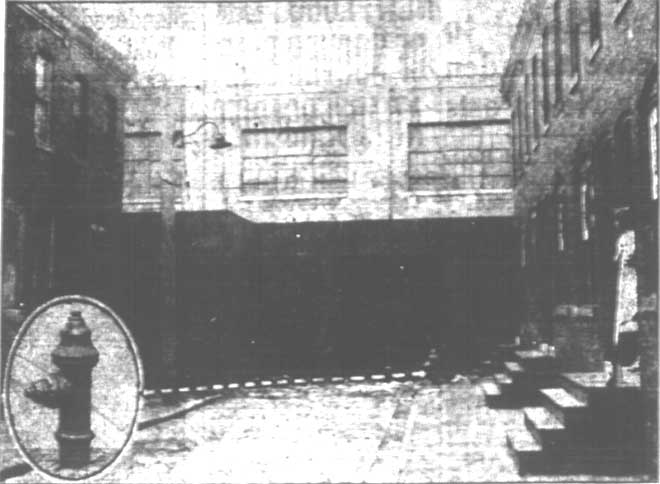
Photograph showing the fence at Segal Street above Erie Street that hampered firemen, with inset showing the blocked fireplugView transcription
The upper view shows the fence at the end of Segal Street, above Erie Street, which firemen say hampered them during the big fire that caused $225,000 damage. The insert shows how a fireplug was blocked. Officials of several plants destroyed by fire said they would demand from city officials an explanation as to why the fence was built.
2 Firms to Demand City Begin Probe of Fence as Aid in Fire — Gates Found Bolted
Officials of two North Camden industrial plants wiped out by fire announced they would demand a thorough investigation as to why a ten-foot fence was allowed to be built across Segal street and a wide alley adjoining their property on Erie street. They claimed that if the fence had not been erected, Camden firemen would have been able to check the blaze. The officials were Vincent P. Dougherty of the Allied Metal Stamping Company and C. E. Perrin of the Philadelphia Metal Stamping Company.
“The fences were constructed of heavy planking by the John R. Evans and Company,” Dougherty said. “Gates were installed in the fence leading into the alley but some time ago the gates were bolted and carboys of acids and other chemicals were placed against the fence.” Charles Jones, chief engineer of the Evans plant, said the company was within its rights, as the fence was built on Evans property bought about nine years earlier. Fire Chief Nichols said that had there been a gate on the two fences, the fire loss would have been greatly cut down.
The upper view shows the fence at the end of Segal Street, above Erie Street, which firemen say hampered them during the big fire that caused $225,000 damage. The insert shows how a fireplug was blocked. Officials of several plants destroyed by fire said they would demand from city officials an explanation as to why the fence was built.
Bird's-eye view map showing the John R. Evans Leather Company, Segal Street, the 15-foot alley, and the fire location at Erie StreetView transcription
The upper view shows the fence at the end of Segal Street, above Erie Street, which firemen say hampered them during the big fire that caused $225,000 damage. The insert shows how a fireplug was blocked. Officials of several plants destroyed by fire said they would demand from city officials an explanation as to why the fence was built.
2 Firms to Demand City Begin Probe of Fence as Aid in Fire — Gates Found Bolted
Officials of two North Camden industrial plants wiped out by fire announced they would demand a thorough investigation as to why a ten-foot fence was allowed to be built across Segal street and a wide alley adjoining their property on Erie street. They claimed that if the fence had not been erected, Camden firemen would have been able to check the blaze. The officials were Vincent P. Dougherty of the Allied Metal Stamping Company and C. E. Perrin of the Philadelphia Metal Stamping Company.
“The fences were constructed of heavy planking by the John R. Evans and Company,” Dougherty said. “Gates were installed in the fence leading into the alley but some time ago the gates were bolted and carboys of acids and other chemicals were placed against the fence.” Charles Jones, chief engineer of the Evans plant, said the company was within its rights, as the fence was built on Evans property bought about nine years earlier. Fire Chief Nichols said that had there been a gate on the two fences, the fire loss would have been greatly cut down.
2 Firms to Demand City Begin Probe of Fence as Aid in Fire — Camden Courier-Post, February 23, 1928 (full clipping)View transcription
2 FIRMS TO DEMAND CITY BEGIN PROBE OF FENCE AS AID IN FIRE
Structure Across Alley Caused Heavier Loss at Factory Blaze, Officials Say — GATES FOUND BOLTED
Officials of two North Camden industrial plants that were wiped out by fire yesterday morning announced today they would demand a thorough investigation by the building inspectors and highway department as to why a ten foot fence was allowed to be built across Segal street and a wide alley adjoining their property on Erie street. They claim that if the fence had not been erected Camden firemen would have been able to check the blaze which caused $225,000 damage.
Officials who will demand an investigation are Vincent P. Dougherty, vice president of the Allied Metal Stamping Company, whose loss was $75,000, and C. E. Perrin, head of the Philadelphia Metal Stamping Company, who suffered a $50,000 loss in the blaze.
"I intended to ask Mayor Price to start a probe that will not end in a whitewash," Dougherty said. "The fences were constructed of heavy planking by the John R. Evans and Company. It is my impression that when the company sought permission to erect these fences they were informed gates must be placed there in case of fire. Gates were installed in the fence leading into the alley but some time ago the gates were bolted and carboys of acids and other chemicals were placed against the fence.
Fence Near Fireplug
"The fence cutting off Segal street is right against a fire plug and this hampered the firemen in their work. If the firemen had been able to use this plug at once the fire loss would not have been so great."
"The erection of these fences was an outrage. I don't know who gave the Evans company permission to build them, but I want to find out why they were allowed to be built," Perrin said.
Firemen said they believed the fence contained a gate, but when they arrived at the blaze they found the gates bolted. Fire Chief Nichols said the fence compelled the firemen to lay 900 feet of hose where if they had been able to get through the fence at once they would have been required to lay only 100 feet to reach the blaze.
Engineer Defends Action
Charles Jones, chief engineer of the Evans plant, said the company was within its rights in constructing the wooden fence as it was built on the Evans property. "We bought property on Segal street about nine years ago. Segal street was never a through street and when we bought the property we tore down the buildings and moved the dead end further south. The city, after we made the purchase, removed water and gas mains and if they left a fire plug up against our fence that is the fault of the city."
Fire Chief Nichols said today had there been a gate on the two fences the fire loss would have been greatly cut down. George W. Johnson, building inspector, said the matter had not been brought to his attention as yet.
2 Firms to Demand City Begin Probe of Fence as Aid in Fire — Gates Found Bolted
Officials of two North Camden industrial plants wiped out by fire announced they would demand a thorough investigation as to why a ten-foot fence was allowed to be built across Segal street and a wide alley adjoining their property on Erie street. They claimed that if the fence had not been erected, Camden firemen would have been able to check the blaze. The officials were Vincent P. Dougherty of the Allied Metal Stamping Company and C. E. Perrin of the Philadelphia Metal Stamping Company.
“The fences were constructed of heavy planking by the John R. Evans and Company,” Dougherty said. “Gates were installed in the fence leading into the alley but some time ago the gates were bolted and carboys of acids and other chemicals were placed against the fence.” Charles Jones, chief engineer of the Evans plant, said the company was within its rights, as the fence was built on Evans property bought about nine years earlier. Fire Chief Nichols said that had there been a gate on the two fences, the fire loss would have been greatly cut down.
Letter to the Editor
Camden Courier-Post — February 22, 1928
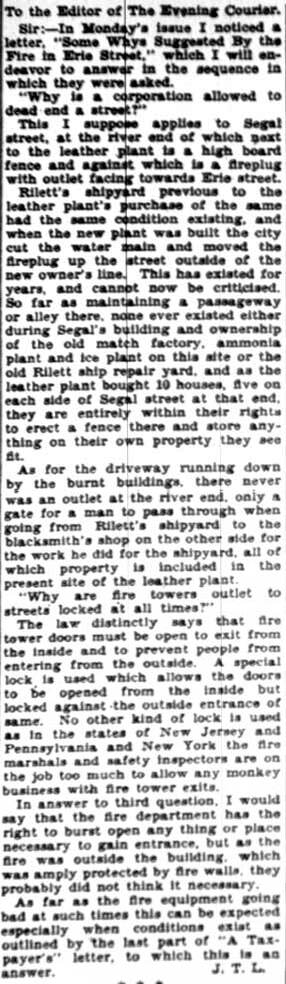
Letter to the Editor of The Evening Courier — February 1928 (full clipping)View transcription
To the Editor of The Evening Courier.
Sir: In Monday's issue I noticed a letter, "Some Whys Suggested By the Fire in Erie Street," which I will endeavor to answer in the sequence in which they were asked.
"Why is a corporation allowed to dead end a street?"
This I suppose applies to Segal street, at the river end of which next to the leather plant is a high board fence and against which is a fireplug with outlet facing towards Erie street. Rilett's shipyard previous to the leather plant's purchase of the same had the same condition existing, and when the new plant was built the city cut the water main and moved the fireplug up the street outside of the new owner's line. This has existed for years, and cannot now be criticised. So far as maintaining a passageway or alley there, none ever existed either during Segal's building and ownership of the old match factory, ammonia plant and ice plant on this site or the old Rilett ship repair yard, and as the leather plant bought 10 houses, five on each side of Segal street at that end, they are entirely within their rights to erect a fence there and store anything on their own property they see fit.
As for the driveway running down by the burnt buildings, there never was an outlet at the river end, only a gate for a man to pass through when going from Rilett's shipyard to the blacksmith's shop on the other side for the work he did for the shipyard, all of which property is included in the present site of the leather plant.
"Why are fire towers outlet to streets locked at all times?"
The law distinctly says that fire tower doors must be open to exit from the inside and to prevent people from entering from the outside. A special lock is used which allows the doors to be opened from the inside but locked against the outside entrance of same.
In answer to the third question, I would say that the fire department has the right to burst open anything or place necessary to gain entrance, but as the fire was outside the building, which was amply protected by fire walls, they probably did not think it necessary.
As far as the fire equipment going bad at such times this can be expected especially when conditions exist as outlined by the last part of "A Taxpayer's" letter, to which this is an answer.
J. T. L.
A reader (signing “J. T. L.”) responded to an earlier letter, “Some Whys Suggested By the Fire in Erie Street.” He explained that Segal street had a high board fence at the river end next to the leather plant, against which stood a fireplug; that the leather plant had bought ten houses on Segal street and was within its rights to fence and store on its own property; and that the driveway by the burnt buildings never had a river-end outlet, only a gate used when the property was Rilett's shipyard. He also addressed fire-tower locks and the fire department's right to force entry.
Fire-Fence Probe Refused by City
Camden Courier-Post — February 29, 1928
Fire-Fence Probe Refused by City — Camden Courier-Post, February 29, 1928 (full clipping)View transcription
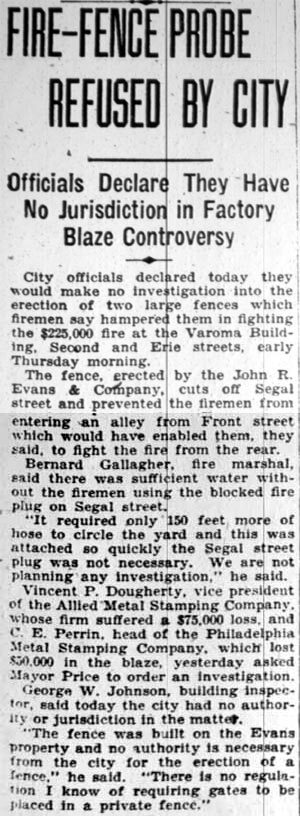
Fire-Fence Probe Refused by City
Officials Declare They Have No Jurisdiction in Factory Blaze Controversy
City officials declared today they would make no investigation into the erection of two large fences which firemen say hampered them in fighting the $225,000 fire at the Varoma Building, Second and Erie streets, early Thursday morning. The fence, erected by the John R. Evans & Company, cuts off Segal street and prevented the firemen from entering an alley from Front street which would have enabled them, they said, to fight the fire from the rear.
Bernard Gallagher, fire marshal, said there was sufficient water without the firemen using the blocked fire plug on Segal street. "It required only 150 feet more of hose to circle the yard and this was attached so quickly the Segal street plug was not necessary. We are not planning any investigation," he said.
Vincent P. Dougherty, vice president of the Allied Metal Stamping Company, whose firm suffered a $75,000 loss, and C. E. Perrin, head of the Philadelphia Metal Stamping Company, which lost $50,000 in the blaze, yesterday asked Mayor Price to order an investigation.
George W. Johnson, building inspector, said today the city had no authority or jurisdiction in the matter. "The fence was built on the Evans property and no authority is necessary from the city for the erection of a fence," he said. "There is no regulation I know of requiring gates to be placed in a private fence."
Officials Declare They Have No Jurisdiction in Factory Blaze Controversy
City officials declared they would make no investigation into the erection of the two large fences which firemen said hampered them. Bernard Gallagher, fire marshal, said there was sufficient water without the blocked Segal street plug: “It required only 150 feet more of hose to circle the yard… We are not planning any investigation.” George W. Johnson, building inspector, said the city had no authority or jurisdiction, as the fence was built on Evans property and no city authority was needed for a private fence.
John R. Evans & Company
Camden Courier-Post — March 12, 1930
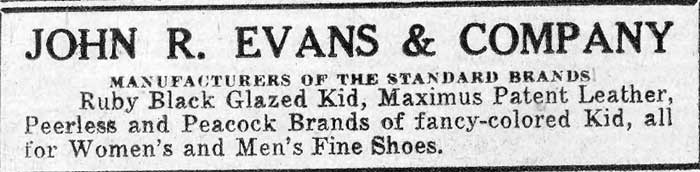
John R. Evans & Company advertisement: Manufacturers of the Standard Brands — Ruby Black Glazed Kid, Maximus Patent Leather, Peerless and Peacock BrandsView transcription
John R. Evans & Company — Manufacturers of the Standard Brands: Ruby Black Glazed Kid, Maximus Patent Leather, and the Peerless and Peacock Brands of fancy-colored Kid, all for Women's and Men's Fine Shoes.
John R. Evans & Company — Manufacturers of the Standard Brands: Ruby Black Glazed Kid, Maximus Patent Leather, and the Peerless and Peacock Brands of fancy-colored Kid, all for Women's and Men's Fine Shoes.
60 Overcome While at Work in RCA Victor; Probe Started
Camden Courier-Post — June 24, 1933
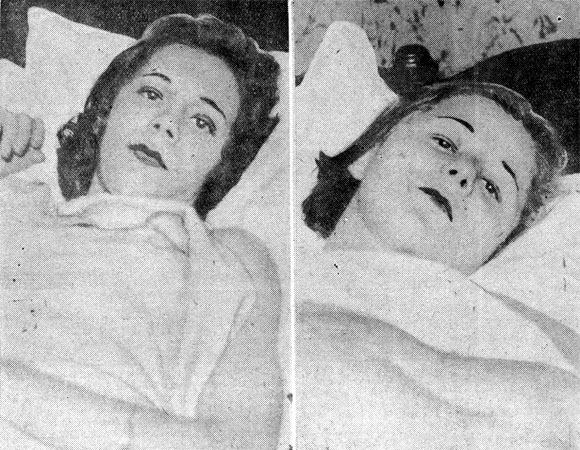
Two RCA Victor employees, Miss Clara Schaeffer and Miss Violetta Brown, confined to their beds after treatment at Cooper Hospital for ptomaine poisoningView transcription
Nearly 100 Camden factory and shipyard workers were poisoned after eating food contained in box lunches. More than 60 workers were stricken at the RCA Victor Company plants, others at the New York Shipbuilding Company, and at least three more were stricken at the leather plant of the John R. Evans Company, Second and Erie Streets. Dr. David D. Helm, city sanitary inspector, traced the ptomaine to egg sandwiches supplied by a Philadelphia box-lunch concern, the “Majestic Lunch,” whose Camden distribution was ordered stopped pending investigation.
Nearly 100 Camden factory and shipyard workers were poisoned after eating food contained in box lunches. More than 60 workers were stricken at the RCA Victor Company plants, others at the New York Shipbuilding Company, and at least three more were stricken at the leather plant of the John R. Evans Company, Second and Erie Streets. Dr. David D. Helm, city sanitary inspector, traced the ptomaine to egg sandwiches supplied by a Philadelphia box-lunch concern, the “Majestic Lunch,” whose Camden distribution was ordered stopped pending investigation.
Present for Pope Made in Camden
Camden Courier-Post — June 30, 1933
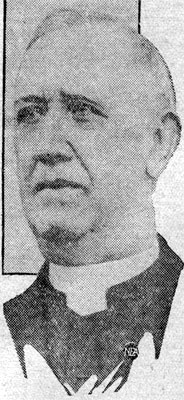
Rt. Rev. John J. Dunn, Bishop of New York City, en route to Rome bearing an album of RCA Victor religious records to Pope Pius XIView transcription
Records of Choir Singing Made by RCA Victor and Binding by Evans Co.
Two products of Camden were linked in a gift to Pope Pius XI: an album enclosing RCA Victor records of a Gregorian Requiem Mass sung by the Pius X School of Liturgical Music. The leather used in the specially made album — bound in white kid leather — was prepared by the John R. Evans Company, with the presentation inscription completed at the Victor plant in gold leaf. Rt. Rev. John J. Dunn, Bishop of New York, carried the set aboard the Conte di Savoia en route to an audience with the Pontiff.
Records of Choir Singing Made by RCA Victor and Binding by Evans Co.
Two products of Camden were linked in a gift to Pope Pius XI: an album enclosing RCA Victor records of a Gregorian Requiem Mass sung by the Pius X School of Liturgical Music. The leather used in the specially made album — bound in white kid leather — was prepared by the John R. Evans Company, with the presentation inscription completed at the Victor plant in gold leaf. Rt. Rev. John J. Dunn, Bishop of New York, carried the set aboard the Conte di Savoia en route to an audience with the Pontiff.
Blue Collar Work
By Robert A. Stanton
During the summer of 1942 I worked as a laborer at a large factory, and my experience there has affected my opinions on labor relations ever since.
The J. R. Evans Company Leather Factory at 2nd and Erie Streets in Camden, New Jersey was established in 1858, and employed many men to remove wool from sheep skins and tan them into leather. It was a smelly, gloomy, hard-working, no-nonsense place, but a lot of men made their living there. My job, along with several other 18-year-olds, was to hang tanned wet skins on hooks in a dryer, and bundle them up as they came out dry at the other end. The skins had previously been treated with a sulfur compound, the wool scraped off, washed and sold, and then tanned.
There was some razzing of “Little Joe,” the general foreman, who spoke several Slavic languages in order to deal with his many foreign-born workers, but there was no outward hostility. I classified this company as an old-time patronal firm where the owners looked out for their employees. In addition to a medical office with a nurse on duty, there were graphic signs on every wall showing what an anthrax infection looked like and what to do about it immediately.
We came to work before 7 a.m. At 9:30 the whistle blew and we all went to the cafeteria for cheap coffee and breakfast. At noon, work stopped for lunch, then again at 2:30 for another snack break, finally going home at 5. I think I made less than a dollar an hour, which wasn't too bad for those pre-war days. Late in the summer, word was passed around that an attempt would be made to unionize the factory, and we were invited to a meeting where Brother Goldberg from Union Headquarters in New York spoke to the many Evans workers.
The next week they went out on strike and the factory shut down for a long time. My buddy and I left for good because school was starting. Since then I have had many men working for me in chemical plants and I have always been concerned for their safety and welfare. I still agree that unions were needed to protect workers from heartless management — though I despise professional union organizers who generate class hatred to increase the size and prestige of their national union. (This is an abridged excerpt of Mr. Stanton's reminiscence; the full essay continues with his reflections on labor relations through the Industrial Revolution to the present.)
John R. Evans & Company Factory
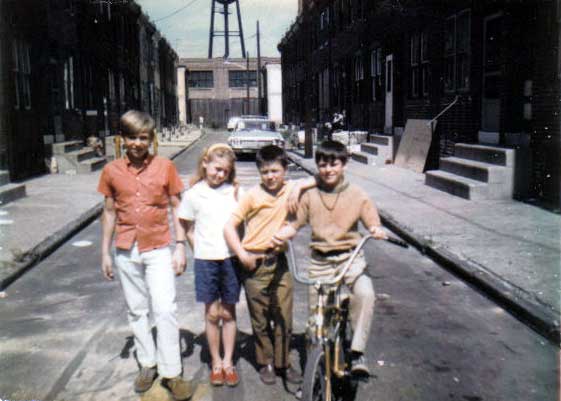
John R. Evans & Company factory seen north on Segal Street, summer of 1971 — Segal Street kids Floyd Miller Jr., Vennie Miller, Bobby Reed, and Frank Houser Jr.
The John R. Evans & Company factory, as seen looking north on Segal Street in the summer of 1971. Pictured are Segal Street children Floyd Miller Jr., Vennie Miller, Bobby Reed, and Frank Houser Jr. Photo courtesy of Floyd L. Miller Jr.
The Fire of December 19, 1971
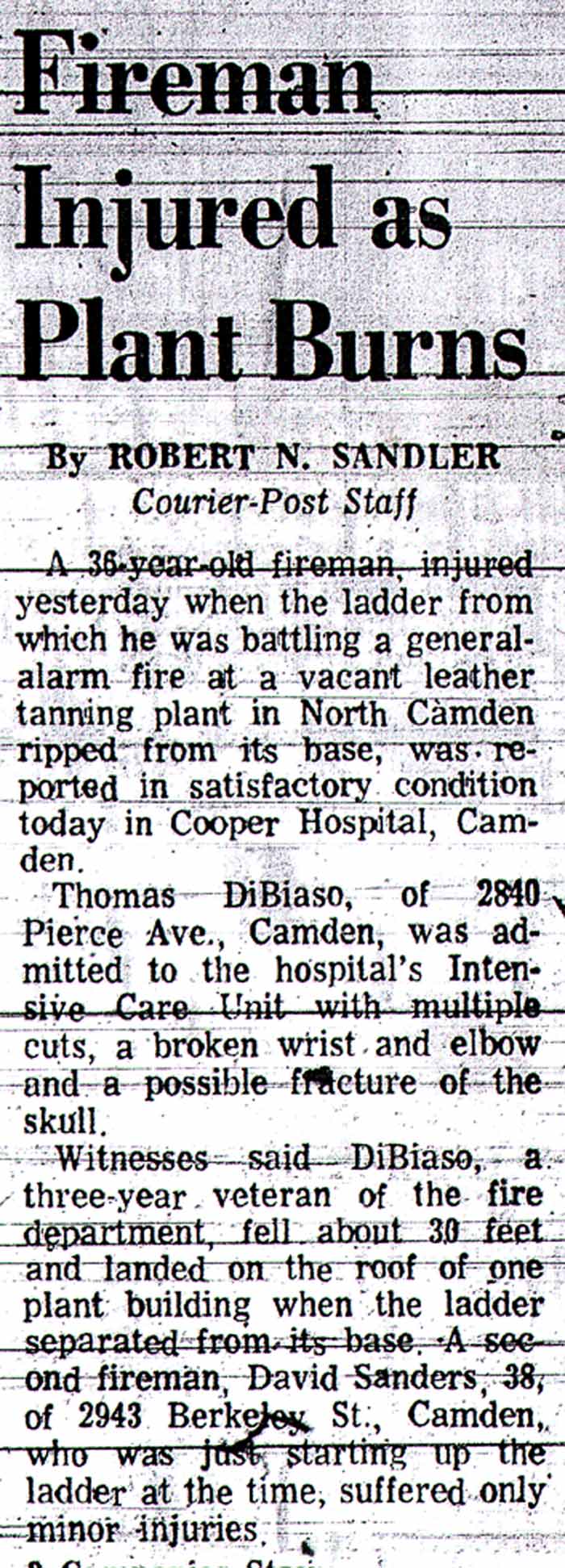
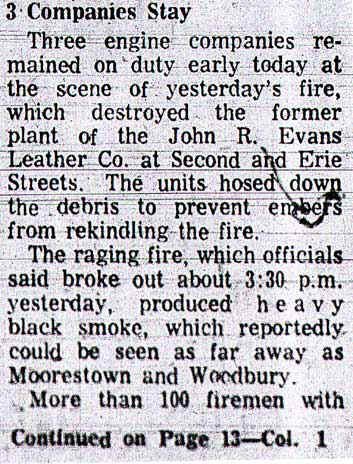
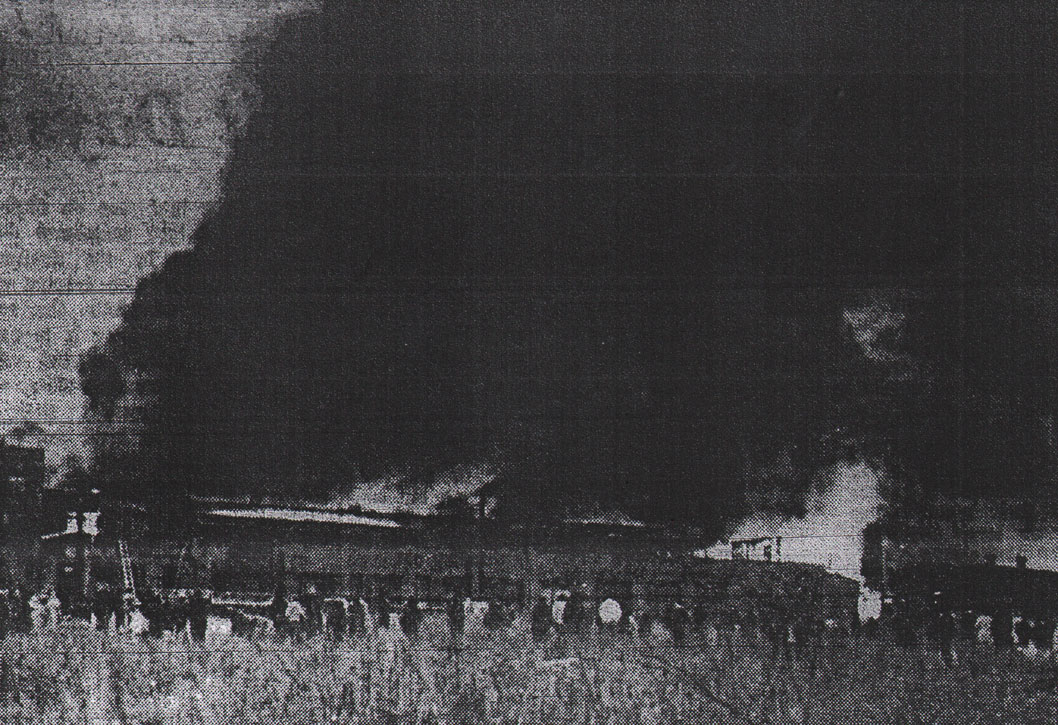
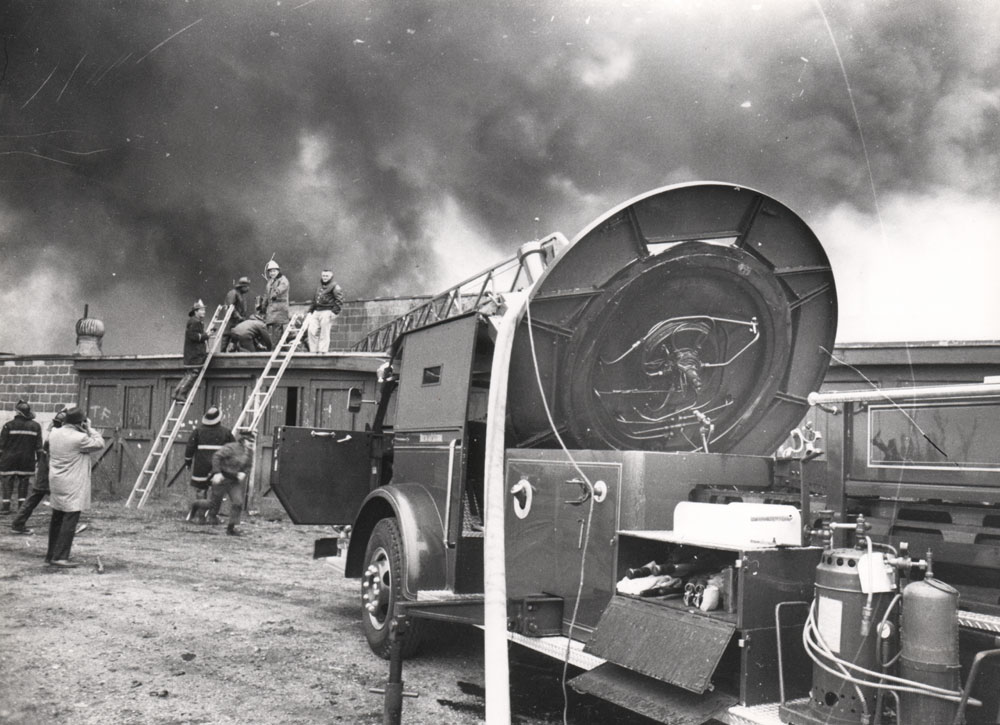
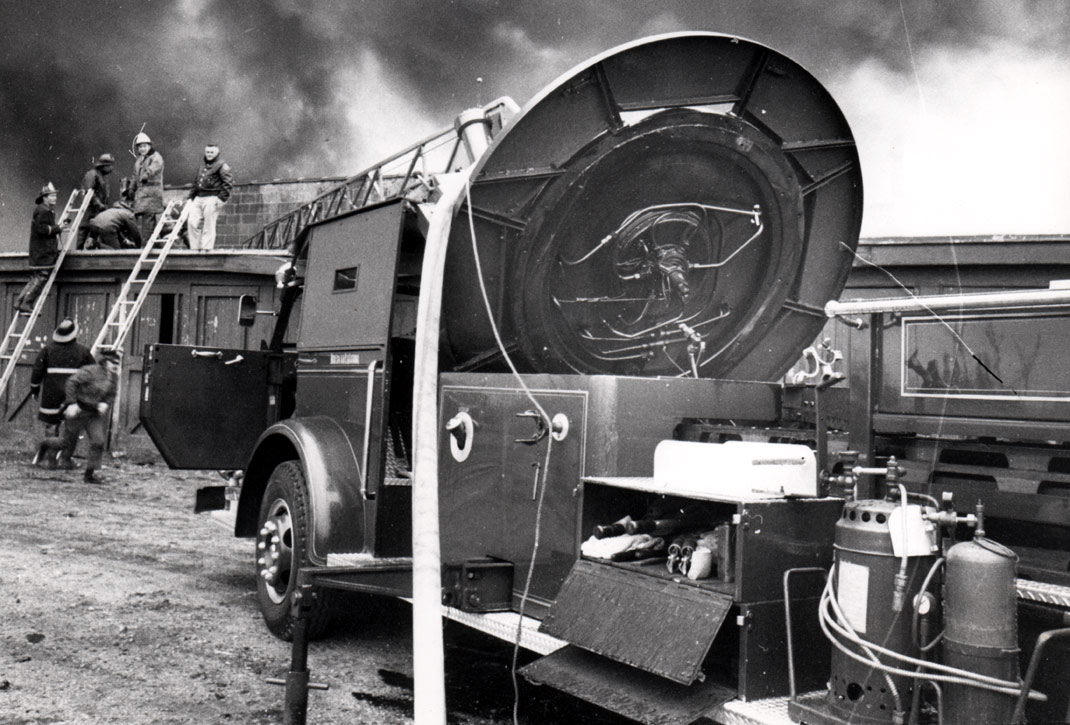
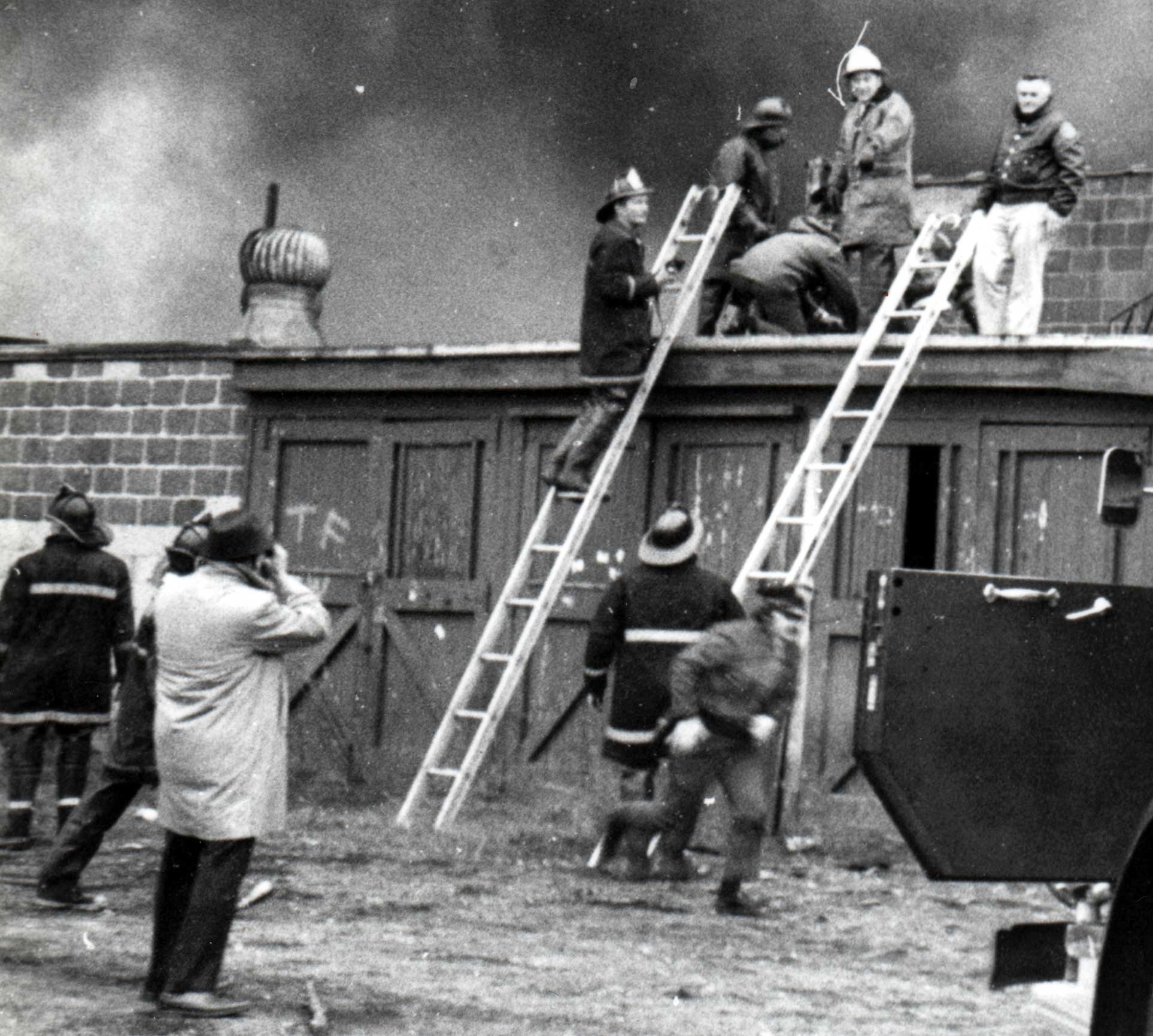
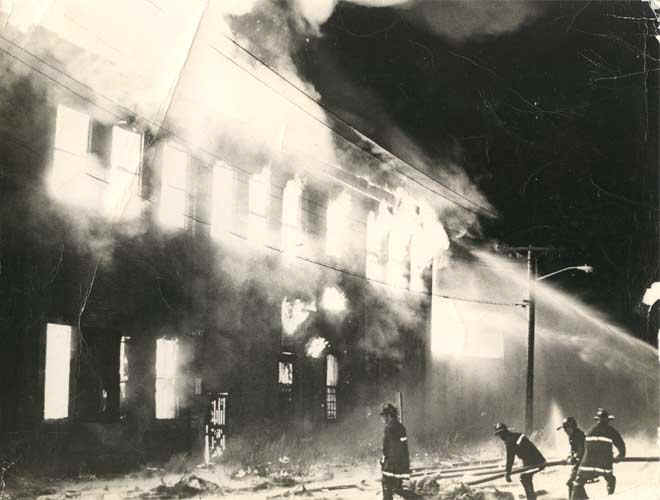
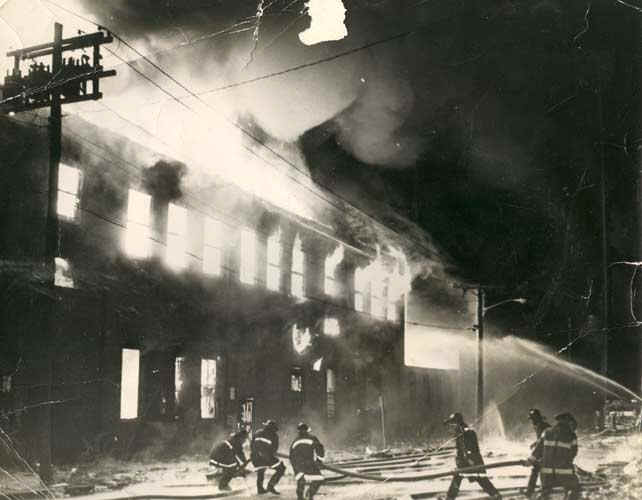
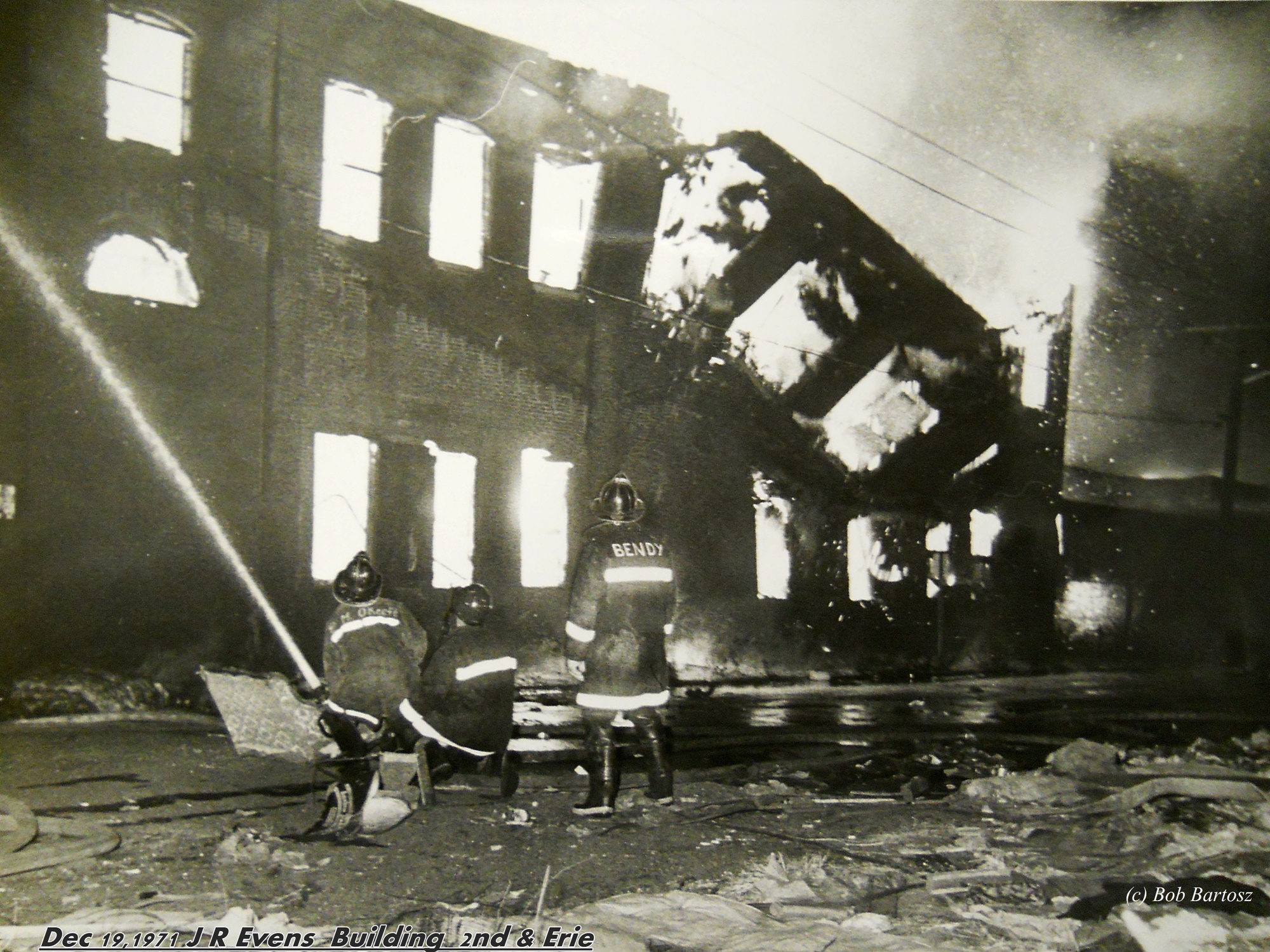
On December 19, 1971, at 3:39 P.M., Box 1415 was transmitted for a reported factory fire at the John R. Evans Leather Company, Second and Erie Streets, North Camden. As units of the 1st Battalion left quarters to respond, a huge, menacing column of black smoke could be seen looming to the north — visible as far away as Burlington County, over twenty miles from the city. First-arriving units transmitted second, third and fourth alarms in quick succession as fire spread rapidly through three blocks of hundred-year-old brick and frame buildings.
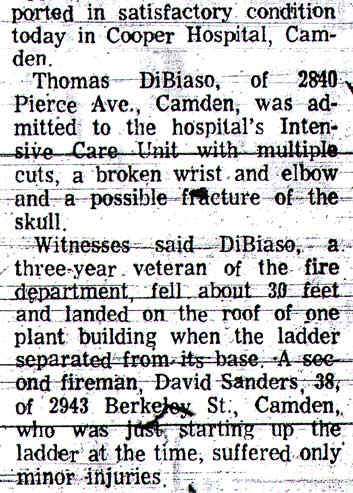
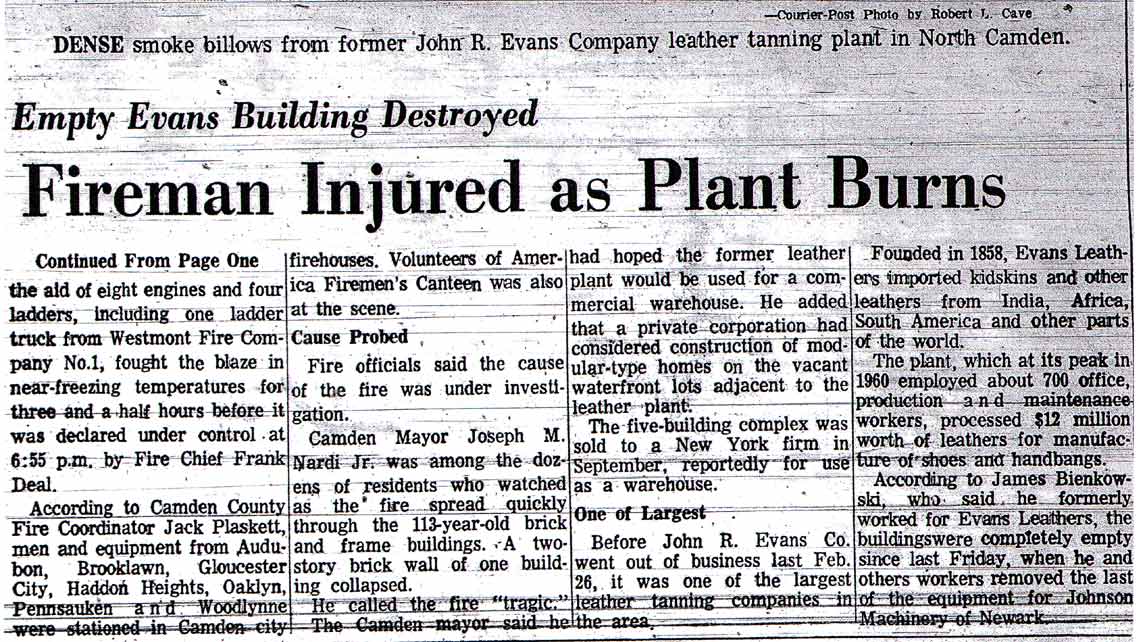
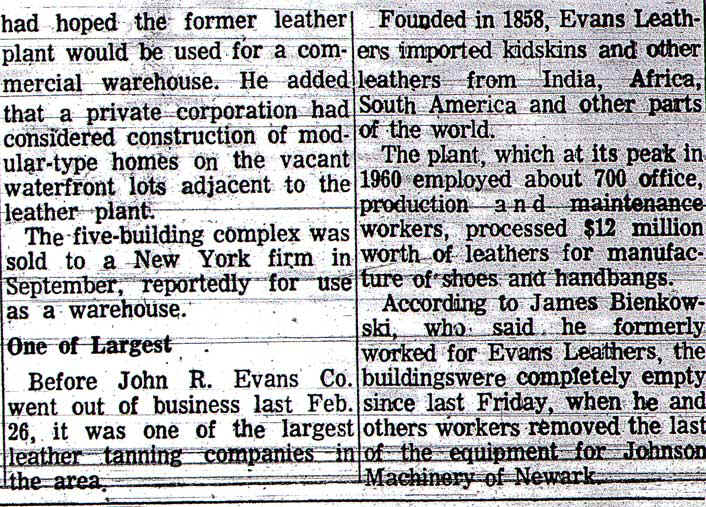
Numerous special calls for mutual aid were made as fire extended to nearby dwellings. The entire five-building complex was destroyed. This Camden landmark, founded in 1858, had closed just prior to the fire and had employed over 700 people. During the fire, Ladder Company 3 had its water tower in operation with the aerial raised to maximum extension. Without warning, the turntable sheared from its mount and lifted off the apparatus, plunging the ladder and Fire Fighter Thomas DiBiaso over fifty feet to the roof of an adjoining building. The turntable operator, Fire Fighter David Sanders, was also injured. Fire Fighter DiBiaso would be retired as a result of his disabling injuries. Five neighborhood juveniles were arrested and charged with setting the fire.
At 5:29 P.M. on August 23, 1972, fire would again strike the old leather factory, with disastrous results. Remembered as the Poets Row fire, a combination of high winds, low water pressure, apparatus awaiting parts, and a lack of manpower gave Camden arguably the greatest fire disaster the city had ever experienced. Flaming embers from the Evans buildings ignited homes in the Poets Row neighborhood of North Camden. All the homes on both sides of the 200 blocks of Milton Street and Burns Street were destroyed, as well as all the homes on the north side of the 200 block of Byron Street and several on the south side. A number of properties on Erie Street were also heavily damaged.
December 19, 1971 Fire — Photos
Camden Courier-Post — December 20, 1971
Courier-Post front page photo of the Evans Company fire, December 20, 1971View transcription
Camden Courier-Post, December 20, 1971 — dense smoke billows from the former John R. Evans Company leather tanning plant in North Camden. Photo by Robert Cave.
Courier-Post photo of the Evans Company fire, December 20, 1971View transcription
Camden Courier-Post, December 20, 1971 — dense smoke billows from the former John R. Evans Company leather tanning plant in North Camden. Photo by Robert Cave.
Courier-Post photo of the Evans Company fire, December 20, 1971View transcription
Camden Courier-Post, December 20, 1971 — dense smoke billows from the former John R. Evans Company leather tanning plant in North Camden. Photo by Robert Cave.
Dense smoke billows from the former John R. Evans Company leather tanning plant in North Camden. Photo by Robert Cave.View transcription
Camden Courier-Post, December 20, 1971 — dense smoke billows from the former John R. Evans Company leather tanning plant in North Camden. Photo by Robert Cave.
Courier-Post photo of the Evans Company fire, December 20, 1971View transcription
Camden Courier-Post, December 20, 1971 — dense smoke billows from the former John R. Evans Company leather tanning plant in North Camden. Photo by Robert Cave.
Courier-Post photo of the Evans Company fire — Jack Plaskett, Joseph M. Nardi, James BienkowskiView transcription
Camden Courier-Post, December 20, 1971 — dense smoke billows from the former John R. Evans Company leather tanning plant in North Camden. Photo by Robert Cave.
Camden Courier-Post, December 20, 1971 — dense smoke billows from the former John R. Evans Company leather tanning plant in North Camden. Photo by Robert Cave.
Ladder Company 3 at the Evans Fire
Ladder Company 3 gets water on the fire at the former John R. Evans Leather Company, December 19, 1971 — Firefighter Thomas J. DiBiaso operating the ladder nozzle. Photo by Bob Bartosz.
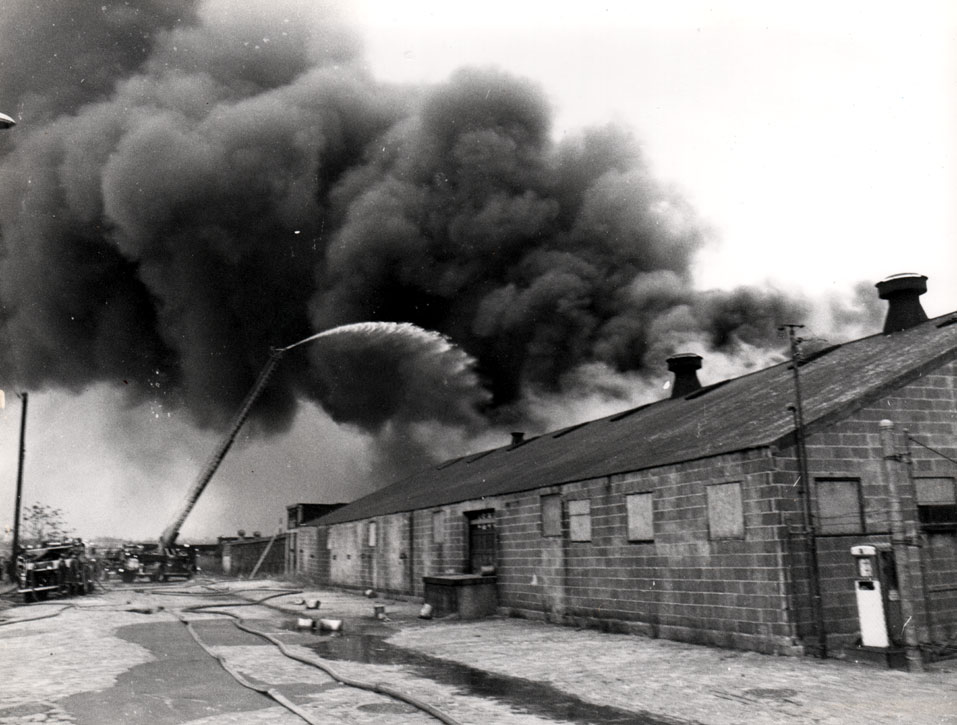
Ladder Company 3 (second-alarm truck) gets water on the fire at the former John R. Evans Leather Company leather tanning plant in North Camden on December 19, 1971. Firefighter Thomas J. DiBiaso is operating the ladder nozzle. This incident went to a fourth alarm. Photo by Bob Bartosz.
Photo taken moments after Ladder Company 3's aerial fell, severely injuring Firefighter Thomas J. DiBiaso. Photo by Bob Bartosz.
A photo taken moments after Ladder Company 3's aerial fell, severely injuring Firefighter Thomas J. DiBiaso. Photo by Bob Bartosz.
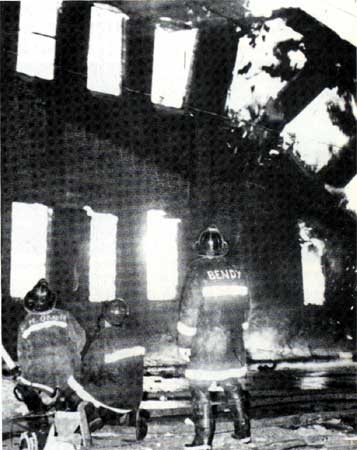
Evans Company fire, December 19, 1971. Photo by Bob Bartosz.Evans Company fire, December 19, 1971. Photo by Bob Bartosz.Evans Company fire, December 19, 1971 — taken shortly before the wall collapsed. Photo by Bob Bartosz.Evans Company fire, December 19, 1971 — shortly before the wall collapsed, as depicted on the cover of Fire Engineering magazine, March 1972. Photo by Bob Bartosz.
It took 3½ hours to bring the blaze under control. These photos were taken shortly before the wall collapsed, as also depicted on the cover of Fire Engineering magazine's March 1972 edition. Photos by Bob Bartosz.
Evans Company fire scene. Photo by Bob Bartosz.John R. Evans & Company factory wall collapsing during the December 19, 1971 fire
The John R. Evans & Company factory wall collapsing, December 19, 1971.
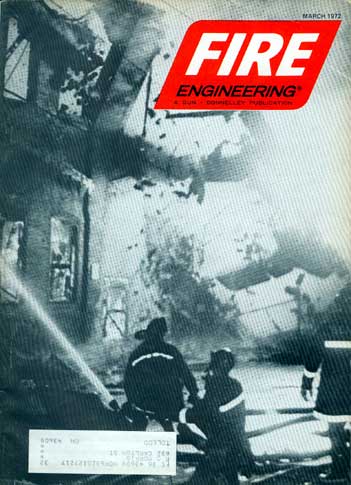
Fire Engineering Magazine — March 1972
Fire Engineering magazine, March 1972 cover featuring the John R. Evans Company fire of December 19, 1971. Photo by Bob Bartosz.
Fire Engineering magazine, March 1972 edition — “The Fire of December 19, 1971: John R. Evans & Company Plant Destroyed.” Cover photo by Bob Bartosz.
Aftermath
Camden Courier-Post — December 22, 1971
N. Camden Boys: 5 Juveniles Arrested in Plant Blaze — Camden Courier-Post, December 22, 1971 (full clipping)View transcription
N. Camden Boys: 5 Juveniles Arrested in Plant Blaze
Five North Camden boys are in the Camden County Children's Shelter at Lakeland following their arrests yesterday in connection with Sunday's general-alarm fire at a vacant leather tanning plant at Second and Erie Streets.
The boys, between the ages of 11 and 14, all live in the vicinity of the waterfront plant, police said.
Three of the juveniles are charged with malicious burning; two, with trespassing.
Face Judge Malandra
They will be arraigned before Camden County Juvenile Court Judge Angelo D. Malandra.
Camden Police Lt. John Giletto, head of the juvenile division, said the boys told police they and other juveniles had been using the former John R. Evans Co. plant as a clubhouse. They said they panicked and fled when a fire they started in the building Sunday got out of control, Giletto said.
N. Camden Boys: 5 Juveniles Arrested in Plant Blaze
Five North Camden boys, between the ages of 11 and 14, were placed in the Camden County Children's Shelter at Lakeland following their arrests in connection with the general-alarm fire at the vacant leather tanning plant at Second and Erie Streets. Three of the juveniles were charged with malicious burning; two with trespassing. Camden Police Lt. John Giletto, head of the juvenile division, said the boys told police they and other juveniles had been using the former John R. Evans Co. plant as a clubhouse and panicked and fled when a fire they started got out of control.