Camden Courier-Post, February 9, 1928View transcription
RECALLS HALF-CENTURY OF ROMANCE
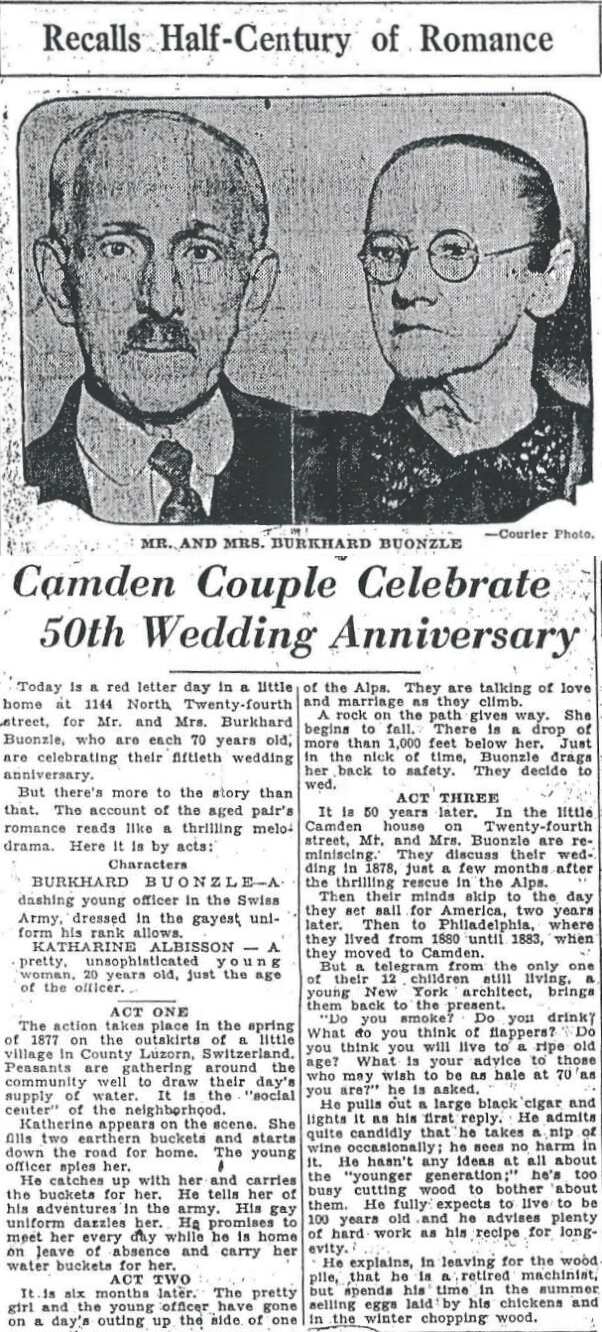
MR. AND MRS. BURKHARD BUONZLE [sic: Buenzle]
Recalls Half-Century of Romance
Today is a red letter day in a little home at 1144 North Twenty-fourth street, for Mr. and Mrs. Burkhard Buenzle, who are each 70 years old, are celebrating their fiftieth wedding anniversary.
But there's more to the story than that. The account of the aged pair's romance reads like a thrilling melodrama. Here it is by acts:
Characters
BURKHARD BUENZLE—A dashing young officer in the Swiss Army, dressed in the gayest uniform his rank allows.
KATHARINE ALBISSON—A pretty, unsophisticated young woman, 20 years old, just the age of the officer.
ACT ONE
The action takes place in the spring of 1877 on the outskirts of a little village in County Luzern, Switzerland. Peasants are gathering around the community well to draw their day's supply of water. It is the "social center" of the neighborhood.
Katharine appears on the scene. She fills two earthen buckets and starts down the road for home. The young officer spies her.
He catches up with her and carries the buckets for her. He tells her of his adventures in the army. His gay uniform dazzles her. He promises to meet her every day while he is home on leave of absence and carry her water buckets for her.
ACT TWO
It is six months later. The pretty girl and the young officer have gone on a day's outing up the side of one of the Alps. They are talking of love and marriage as they climb.
A rock on the path gives way. She begins to fall. There is a drop of more than 1,000 feet below her. Just in the nick of time, Buenzle drags her back to safety. They decide to wed.
ACT THREE
It is 50 years later. In the little Camden house on Twenty-fourth street, Mr. and Mrs. Buenzle are reminiscing. They discuss their wedding in 1878, just a few months after the thrilling rescue in the Alps.
Then their minds skip to the day they set sail for America, two years later. Then to Philadelphia, where they lived from 1880 until 1883, when they moved to Camden.
But a telegram from the only one of their 12 children still living, a young New York architect, brings them back to the present.
"Do you smoke? Do you drink? What do you think of flappers? Do you think you will live to a ripe old age? What is your advice to those who may wish to be as hale at 70 as you are?" he is asked.
He pulls out a large black cigar and lights it as his first reply. He admits quite candidly that he takes a nip of wine occasionally; he sees no harm in it. He hasn't any ideas at all about the "younger generation;" he's too busy cutting wood to bother about them. He fully expects to live to 100 years old and he advises plenty of hard work as his recipe for longevity.
He explains, in leaving for the wood pile, that he is a retired machinist, but spends his time in the summer selling eggs laid by his chickens and in the winter chopping wood.
Today is a red letter day in a little home at 1144 North Twenty-fourth street, for Mr. and Mrs. Burkhard Buenzle, who are each 70 years old, are celebrating their fiftieth wedding anniversary.
But there's more to the story than that. The account of the aged pair's romance reads like a thrilling melodrama. Here it is by acts:
Characters
BURKHARD BUENZLE—A dashing young officer in the Swiss Army, dressed in the gayest uniform his rank allows.
KATHARINE ALBISSON—A pretty, unsophisticated young woman, 20 years old, just the age of the officer.
Act One
The action takes place in the spring of 1877 on the outskirts of a little village in County Luzern, Switzerland. Peasants are gathering around the community well to draw their day's supply of water. It is the "social center" of the neighborhood.
Katharine appears on the scene. She fills two earthen buckets and starts down the road for home. The young officer spies her.
He catches up with her and carries the buckets for her. He tells her of his adventures in the army. His gay uniform dazzles her. He promises to meet her every day while he is home on leave of absence and carry her water buckets for her.
Act Two
It is six months later. The pretty girl and the young officer have gone on a day's outing up the side of one of the Alps. They are talking of love and marriage as they climb.
A rock on the path gives way. She begins to fall. There is a drop of more than 1,000 feet below her. Just in the nick of time, Buenzle drags her back to safety. They decide to wed.
Act Three
It is 50 years later. In the little Camden house on Twenty-fourth street, Mr. and Mrs. Buenzle are reminiscing. They discuss their wedding in 1878, just a few months after the thrilling rescue in the Alps.
Then their minds skip to the day they set sail for America, two years later. Then to Philadelphia, where they lived from 1880 until 1883, when they moved to Camden.
But a telegram from the only one of their 12 children still living, a young New York architect, brings them back to the present.
"Do you smoke? Do you drink? What do you think of flappers? Do you think you will live to a ripe old age? What is your advice to those who may wish to be as hale at 70 as you are?" he is asked.
He pulls out a large black cigar and lights it as his first reply. He admits quite candidly that he takes a nip of wine occasionally; he sees no harm in it. He hasn't any ideas at all about the "younger generation;" he's too busy cutting wood to bother about them. He fully expects to live to 100 years old and he advises plenty of hard work as his recipe for longevity.
He explains, in leaving for the wood pile, that he is a retired machinist, but spends his time in the summer selling eggs laid by his chickens and in the winter chopping wood.