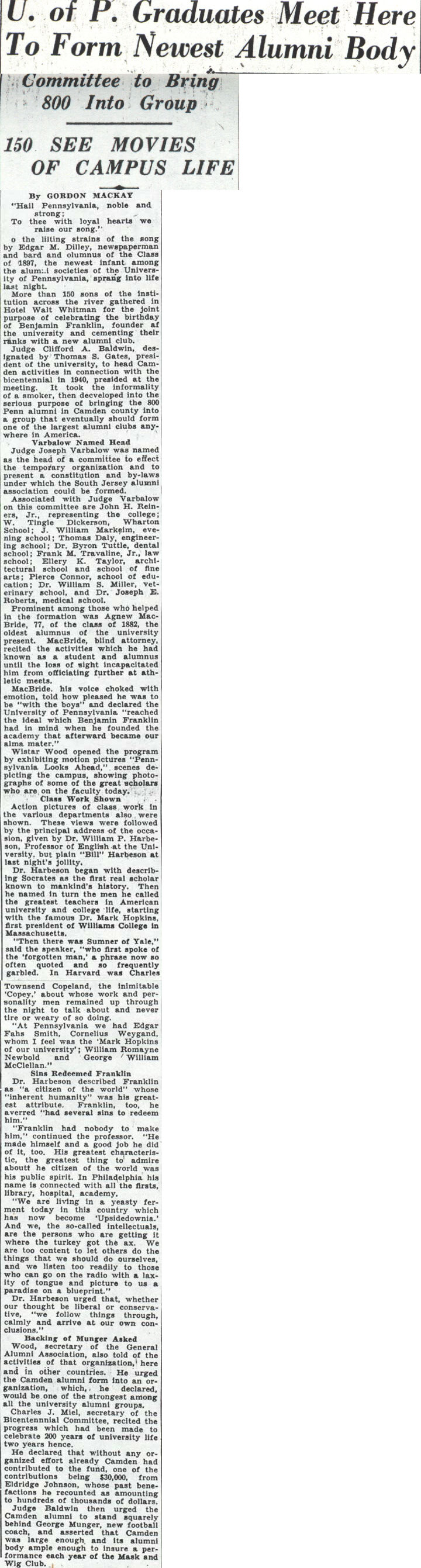
Camden Courier-Post, January 25, 1938View transcription
U. of P. Graduates Meet Here To Form Newest Alumni Body
Committee to Bring 800 Into Group
150 SEE MOVIES OF CAMPUS LIFE
By GORDON MACKAY
"Hail Pennsylvania, noble and strong;
To thee with loyal hearts we raise our song."
To the lilting strains of the song by Edgar M. Dilley, newspaperman and bard and olumnus of the Class of 1897, the newest infant among the alumni societies of the University of Pennsylvania, sprang into life last night.
More than 150 sons of the institution across the river gathered in Hotel Walt Whitman for the joint purpose of celebrating the birthday of Benjamin Franklin, founder af the university and cementing their ranks with a new alumni club.
Judge Clifford A. Baldwin, designated by Thomas S. Gates, president of the university, to head Camden activities in connection with the bicentennial in 1940, presided at the meeting. It took the informality of a smoker, then decveloped into the serious purpose of bringing the 800 Penn alumni in Camden county into a group that eventually should form one of the largest alumni clubs anywhere in America.
Varbalow Named Head
Judge Joseph Varbalow was named as the head of a committee to effect the temporary organization and to present a constitution and by-laws under which the South Jersey alumni association could be formed.
Associated with Judge Varbalow on this committee are John H. Reiners, Jr., representing the college; W. Tingle Dickerson, Wharton School; J. William Markeim, evening school; Thomas Daly, engineering school; Dr. Byron Tuttle, dental school; Frank M. Travaline, Jr., law school; Ellery K. Taylor, architectural school and school of fine arts; Pierce Connor, school of education; Dr. William S. Miller, veterinary school, and Dr. Joseph E. Roberts, medical school.
Prominent among those who helped in the formation was Agnew MacBride, 77, of the class of 1882, the oldest alumnus of the university present. MacBride, blind attorney, recited the activities which he had known as a student and alumnus until the loss of sight incapacitated him from officiating further at athletic meets.
MacBride, his voice choked with emotion, told how pleased he was to be "with the boys" and declared the University of Pennsylvania "reached the ideal which Benjamin Franklin had in mind when he founded the academy that afterward became our alma mater."
Wistar Wood opened the program by exhibiting motion pictures "Pennsylvania Looks Ahead," scenes depicting the campus, showing photographs of some of the great scholars who are on the faculty today.
Class Work Shown
Action pictures of class work in the various departments also were shown. These views were followed by the principal address of the occasion, given by Dr. William P. Harbeson, Professor of English at the University, but plain "Bill" Harbeson at last night's jollity.
Dr. Harbeson began with describing Socrates as the first real scholar known to mankind's history. Then he named in turn the men he called the greatest teachers in American university and college life, starting with the famous Dr. Mark Hopkins, first president of Williams College in Massachusetts.
"Then there was Sumner of Yale," said the speaker, "who first spoke of the 'forgotten man,' a phrase now so often quoted and so frequently garbled. In Harvard was Charles Townsend Copeland, the inimitable 'Copey,' about whose work and personality men remained up through the night to talk about and never tire or weary of so doing.
"At Pennsylvania we had Edgar Fahs Smith, Cornelius Weygand, whom I feel was the 'Mark Hopkins of our university'; William Romayne Newbold and George William McClellan."
Sins Redeemed Franklin
Dr. Harbeson described Franklin as "a citizen of the world" whose "inherent humanity" was his greatest attribute. Franklin, too, he averred "had several sins to redeem him."
"Franklin had nobody to make him," continued the professor. "He made himself and a good job he did of it, too. His greatest characteristic, the greatest thing to admire aboutt he citizen of the world was his public spirit. In Philadelphia his name is connected with all the firsts, library, hospital, academy.
"We are living in a yeasty ferment today in this country which has now become 'Upsidedownia.' And we, the so-called intellectuals, are the persons who are getting it where the turkey got the ax. We are too content to let others do the things that we should do ourselves, and we listen too readily to those who can go on the radio with a laxity of tongue and picture to us a paradise on a blueprint."
Dr. Harbeson urged that, whether our thought be liberal or conservative, "we follow things through, calmly and arrive at our own conclusions."
Backing of Munger Asked
Wood, secretary of the General Alumni Association, also told of the activities of that organization, here and in other countries. He urged the Camden alumni form into an organization, which, he declared, would be one of the strongest among all the university alumni groups.
Charles J. Miel, secretary of the Bicentennnial Committee, recited the progress which had been made to celebrate 200 years of university life two years hence.
He declared that without any organized effort already Camden had contributed to the fund, one of the contributions being $30,000, from Eldridge Johnson, whose past benefactions he recounted as amounting to hundreds of thousands of dollars.
Judge Baldwin then urged the Camden alumni to stand squarely behind George Munger, new football coach, and asserted that Camden was large enough and its alumni body ample enough to insure a performance each year of the Mask and Wig Club.
“Hail Pennsylvania, noble and strong; To thee with loyal hearts we raise our song.”
To the lilting strains of the song by Edgar M. Dilley, newspaperman and bard and olumnus of the Class of 1897, the newest infant among the alumni societies of the University of Pennsylvania, sprang into life last night.
More than 150 sons of the institution across the river gathered in Hotel Walt Whitman for the joint purpose of celebrating the birthday of Benjamin Franklin, founder af the university and cementing their ranks with a new alumni club.
Judge Clifford A. Baldwin, designated by Thomas S. Gates, president of the university, to head Camden activities in connection with the bicentennial in 1940, presided at the meeting. It took the informality of a smoker, then decveloped into the serious purpose of bringing the 800 Penn alumni in Camden county into a group that eventually should form one of the largest alumni clubs anywhere in America.
Varbalow Named Head
Judge Joseph Varbalow was named as the head of a committee to effect the temporary organization and to present a constitution and by-laws under which the South Jersey alumni association could be formed.
Associated with Judge Varbalow on this committee are John H. Reiners, Jr., representing the college; W. Tingle Dickerson, Wharton School; J. William Markeim, evening school; Thomas Daly [sic], engineering school; Dr. Byron Tuttle, dental school; Frank M. Travaline, Jr., law school; Ellery K. Taylor, architectural school and school of fine arts; Pierce Connor, school of education; Dr. William S. Miller, veterinary school, and Dr. Joseph E. Roberts, medical school.
Prominent among those who helped in the formation was Agnew MacBride, 77, of the class of 1882, the oldest alumnus of the university present. MacBride, blind attorney, recited the activities which he had known as a student and alumnus until the loss of sight incapacitated him from officiating further at athletic meets.
MacBride, his voice choked with emotion, told how pleased he was to be “with the boys” and declared the University of Pennsylvania “reached the ideal which Benjamin Franklin had in mind when he founded the academy that afterward became our alma mater.”
Wistar Wood opened the program by exhibiting motion pictures “Pennsylvania Looks Ahead,” scenes depicting the campus, showing photographs of some of the great scholars who are on the faculty today.
Class Work Shown
Action pictures of class work in the various departments also were shown. These views were followed by the principal address of the occasion, given by Dr. William P. Harbeson, Professor of English at the University, but plain “Bill” Harbeson at last night’s jollity.
Dr. Harbeson began with describing Socrates as the first real scholar known to mankind’s history. Then he named in turn the men he called the greatest teachers in American university and college life, starting with the famous Dr. Mark Hopkins, first president of Williams College in Massachusetts.
“Then there was Sumner of Yale,” said the speaker, “who first spoke of the ‘forgotten man,’ a phrase now so often quoted and so frequently garbled. In Harvard was Charles Townsend Copeland, the inimitable ‘Copey,’ about whose work and personality men remained up through the night to talk about and never tire or weary of so doing.
“At Pennsylvania we had Edgar Fahs Smith, Cornelius Weygand, whom I feel was the ‘Mark Hopkins of our university’; William Romayne Newbold and George William McClellan.”
Sins Redeemed Franklin
Dr. Harbeson described Franklin as “a citizen of the world” whose “inherent humanity” was his greatest attribute. Franklin, too, he averred “had several sins to redeem him.”
“Franklin had nobody to make him,” continued the professor. “He made himself and a good job he did of it, too. His greatest characteristic, the greatest thing to admire aboutt he citizen of the world was his public spirit. In Philadelphia his name is connected with all the firsts, library, hospital, academy.
“We are living in a yeasty ferment today in this country which has now become ‘Upsidedownia.’ And we, the so-called intellectuals, are the persons who are getting it where the turkey got the ax. We are too content to let others do the things that we should do ourselves, and we listen too readily to those who can go on the radio with a laxity of tongue and picture to us a paradise on a blueprint.”
Dr. Harbeson urged that, whether our thought be liberal or conservative, “we follow things through, calmly and arrive at our own conclusions.”
Backing of Munger Asked
Wood, secretary of the General Alumni Association, also told of the activities of that organization, here and in other countries. He urged the Camden alumni form into an organization, which, he declared, would be one of the strongest among all the university alumni groups.
Charles J. Miel, secretary of the Bicentennnial Committee, recited the progress which had been made to celebrate 200 years of university life two years hence.
He declared that without any organized effort already Camden had contributed to the fund, one of the contributions being $30,000, from Eldridge Johnson, whose past benefactions he recounted as amounting to hundreds of thousands of dollars.
Judge Baldwin then urged the Camden alumni to stand squarely behind George Munger, new football coach, and asserted that Camden was large enough and its alumni body ample enough to insure a performance each year of the Mask and Wig Club.