Hotel Walt Whitman
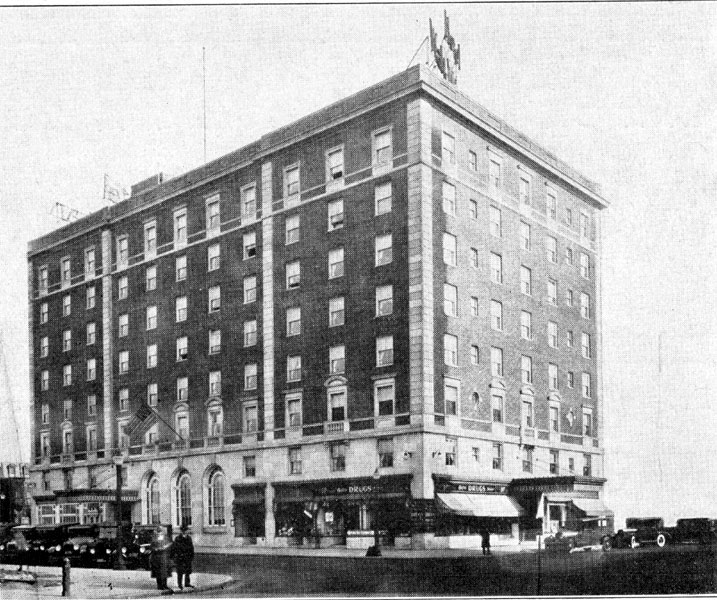
The Walt Whitman Hotel was a venture championed by the Greater Camden Movement, a coalition of business and civic leaders that began to coalesce shortly before and during World War I. They had proven highly effective in raising county-wide funds to support the American war effort. Post-war, their ambitious vision to invigorate economic recovery and hope hinged on the creation of a bridge linking Camden and Philadelphia, accompanied by a community hotel on Camden's side of the bridge. This plan also included the development of a road network stretching southeast through Camden County toward the Atlantic Ocean.
In 1920, Eldridge Johnson, President of the Victor Talking Machine Company of Camden, committed $100,000 toward the construction of the envisioned hotel, which would serve as the headquarters for the newly established Chamber of Commerce. The Camden Chamber of Commerce, led by LeRoy A. Goodwin, later appointed J. David Stern, owner of the Camden Courier, as the chairman of the Hotel Committee in 1923. Subsequently, the Community Hotel Corporation was formally incorporated in 1924.
A remarkable feat was accomplished in February 1924 when a committee of 370 Camden-based businessmen, spearheaded by James J. Scott, a partner at Strandwitz & Scott sheet metal works, successfully raised $1,250,000 within a span of six days. Scott, who would go on to become the treasurer of the nascent Community Hotel Corporation, played a pivotal role in procuring many of the hotel's furnishings. The fundraising and building committees boasted notable members such as William Strandwitz (Scott's partner), W. Leonard Hurley (of Hurley's Department Store), George A. Munger (of Munger & Long Department Store), Volney G. Bennett (a lumber merchant), Frank Hineline (of Camden Lime Company), Warren Webster (a heating manufacturer), and insurance and real estate agents David Baird Jr., Leon Todd, Ralph D. Baker, and Charles W. Austermuhl. Congressman Charles A. Wolverton also contributed to this endeavor. Additionally, Elmer Ellsworth Long and Andrew B.F. Smith, partners of Munger and Austermuhl, respectively, were deeply involved in the Greater Camden Movement.
A comprehensive account of the construction of the Walt Whitman Hotel was published by the Camden Chamber of Commerce in the September 1925 edition of Camden First, the official publication of the Chamber.
As the 1950s brought economic hardships to the City of Camden, the Walt Whitman Hotel experienced a decline in maintenance. In 1958, the Camden Chamber of Commerce, which had played a significant role in the hotel's construction and had been headquartered there for numerous years, made a noteworthy shift. Their annual gala was relocated to the newly established Cherry Hill Inn in the adjacent Delaware Township.
Over the preceding three years, several iconic Camden establishments, including Hurley's department store, the Stanley Theater, the Towers Theater, and the Camden Courier-Post, had either shuttered their doors or relocated to suburban locations. This ongoing trend ultimately led to the closure of the Walt Whitman Hotel itself. Intriguingly, one of the hotel's final proprietors was Joseph N. Hettel Jr., whose father, Joseph N. Hettel Sr., was an architect renowned for designing numerous banks, apartment buildings, and commercial structures in Camden.