Veteran of one war remembers casualty of yet another
View transcription
By Stan Bednarczyk, For the Courier-Post
I must have been 4 years old. Chester, my next-door neighbor, was 10 years older. He was one of the big guys and I always looked up to him and not just because of his height.
It was he who first addressed me as "mister." From no one else did that title hold more meaning. Then it became even more meaningful.
Chester asked me to make a muscle. When I flexed my skinny arm in response, he felt the phantom muscle and whistled in shocked amazement. Thus with the bending of an elbow and the strutting of a make-believe muscle man, Mr. Muscles was conceived.
Sometimes he would dare me to punch him in the arm and when I did he would fall to the sidewalk, act frightened and beg for mercy. During those times, I was much taken with myself.
Other times he would just grab me by my scrawny arms, raise me and, imitating a dog's growl, bury his face in my ticklish stomach. When I was rendered helpless, giggling silly with laughter, he would toss me into the air and catch my limp, delighted body. I continually protested, but because I had complete faith in him, I always came back for more. The trust of a child is pure gold.
These are some of the thoughts that enter my mind when I occasionally visit him among the rows of veterans' aged, white tombstones at Saint Joseph's Cemetery in Chews Landing. I think of what a special person he must have been to make time for skinny me when others seemed to brush me aside. I think of what a difference he might have made, what positive deeds he might have accomplished, what beautiful memories he might have breathed into future generations had not his life been so abruptly snuffed out in Italy during World War II. I think of what a fine father he might have become.
Memory is often indistinct, but I do know he was an altar boy and an athlete, a third baseman on the Falcons, a neighborhood sandlot baseball team. No organized, uniformed, fully equipped teams then. Just a group of baseball-loving kids with old bats and taped balls. They would each try to muster up 5-cent team dues to buy a 35-cent baseball cap, one at a time, for every member. Even if it took most of the summer, eventually everyone was sporting a hat with the initial F and they became a team — a proud one.
As the years went by, Chester, like so many others, had to trade in his team hat for an Army helmet.
A World War will do that.
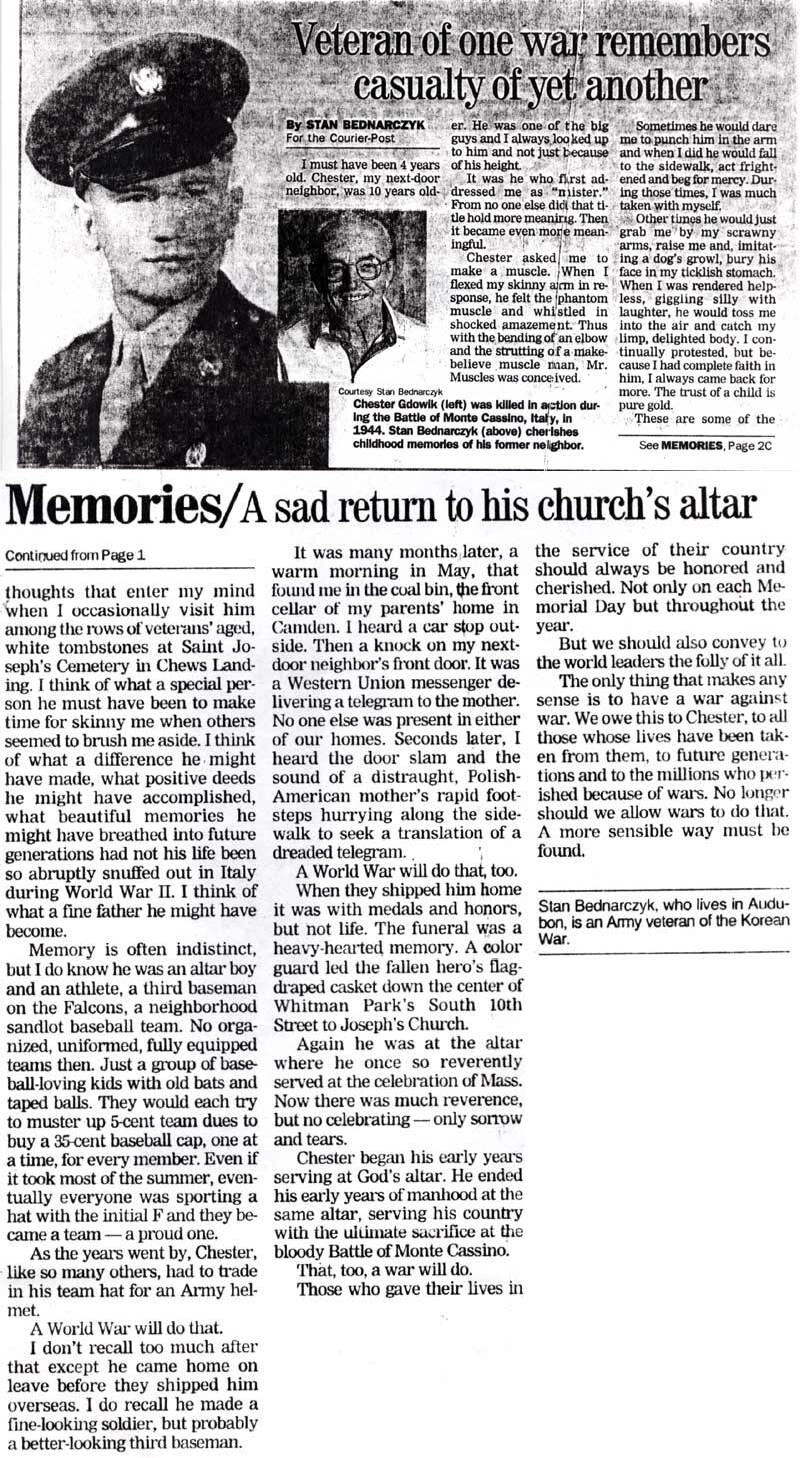
I don't recall too much after that except he came home on leave before they shipped him overseas. I do recall he made a fine-looking soldier, but probably a better-looking third baseman.
It was many months later, a warm morning in May, that found me in the coal bin, the front cellar of my parents' home in Camden. I heard a car stop outside. Then a knock on my next-door neighbor's front door. It was a Western Union messenger delivering a telegram to the mother. No one else was present in either of our homes. Seconds later, I heard the door slam and the sound of a distraught, Polish-American mother's rapid footsteps hurrying along the sidewalk to seek a translation of a dreaded telegram.
A World War will do that, too.
When they shipped him home it was with medals and honors, but not life. The funeral was a heavy-hearted memory. A color guard led the fallen hero's flag-draped casket down the center of Whitman Park's South 10th Street to Joseph's Church.
Again he was at the altar where he once so reverently served at the celebration of Mass. Now there was much reverence, but no celebrating — only sorrow and tears.
Chester began his early years serving at God's altar. He ended his early years of manhood at the same altar, serving his country with the ultimate sacrifice at the bloody Battle of Monte Cassino.
That, too, a war will do.
Those who gave their lives in the service of their country should always be honored and cherished. Not only on each Memorial Day but throughout the year.
But we should also convey to the world leaders the folly of it all.
The only thing that makes any sense is to have a war against war. We owe this to Chester, to all those whose lives have been taken from them, to future generations and to the millions who perished because of wars. No longer should we allow wars to do that. A more sensible way must be found.
Stan Bednarczyk, who lives in Audubon, is an Army veteran of the Korean War.
Photo caption, Camden Courier-Post, May 26, 2001 — Courtesy Stan Bednarczyk: Chester Gdowik (left) was killed in action during the Battle of Monte Cassino, Italy, in 1944. Stan Bednarczyk (above) cherishes childhood memories of his former neighbor.