People
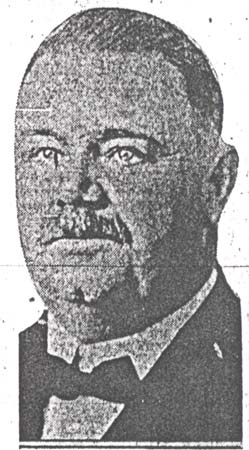
Edward S. Hyde
Edward S. Hyde rose through the Camden Police Department from patrolman to acting chief, served as a Camden County Freeholder, and died in 1930.
Tag
Edward S. Hyde rose through the Camden Police Department from patrolman to acting chief, served as a Camden County Freeholder, and died in 1930.
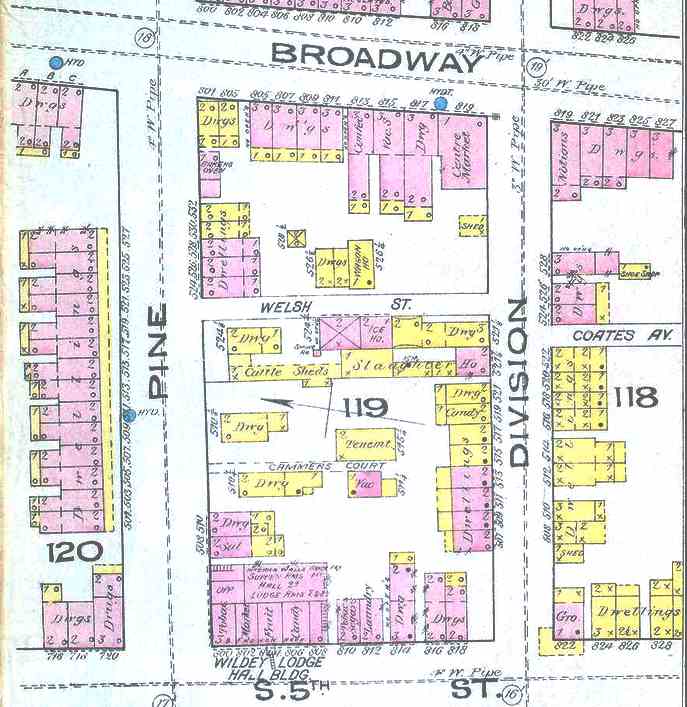
Coates Alley is a short street in Camden that originally ran parallel to Broadway and South 5th Street from Cherry Street north across Spruce Street to Division Street. Today it is one block long, running from Spruce Street to Division Street.

John Foster was a well-respected and influential figure in Camden's police force during the 1890s. He was born in Bloomfield, New Jersey, in the year 1859. In 1861, his family relocated to Camden, where he spent the majority of his formative years.
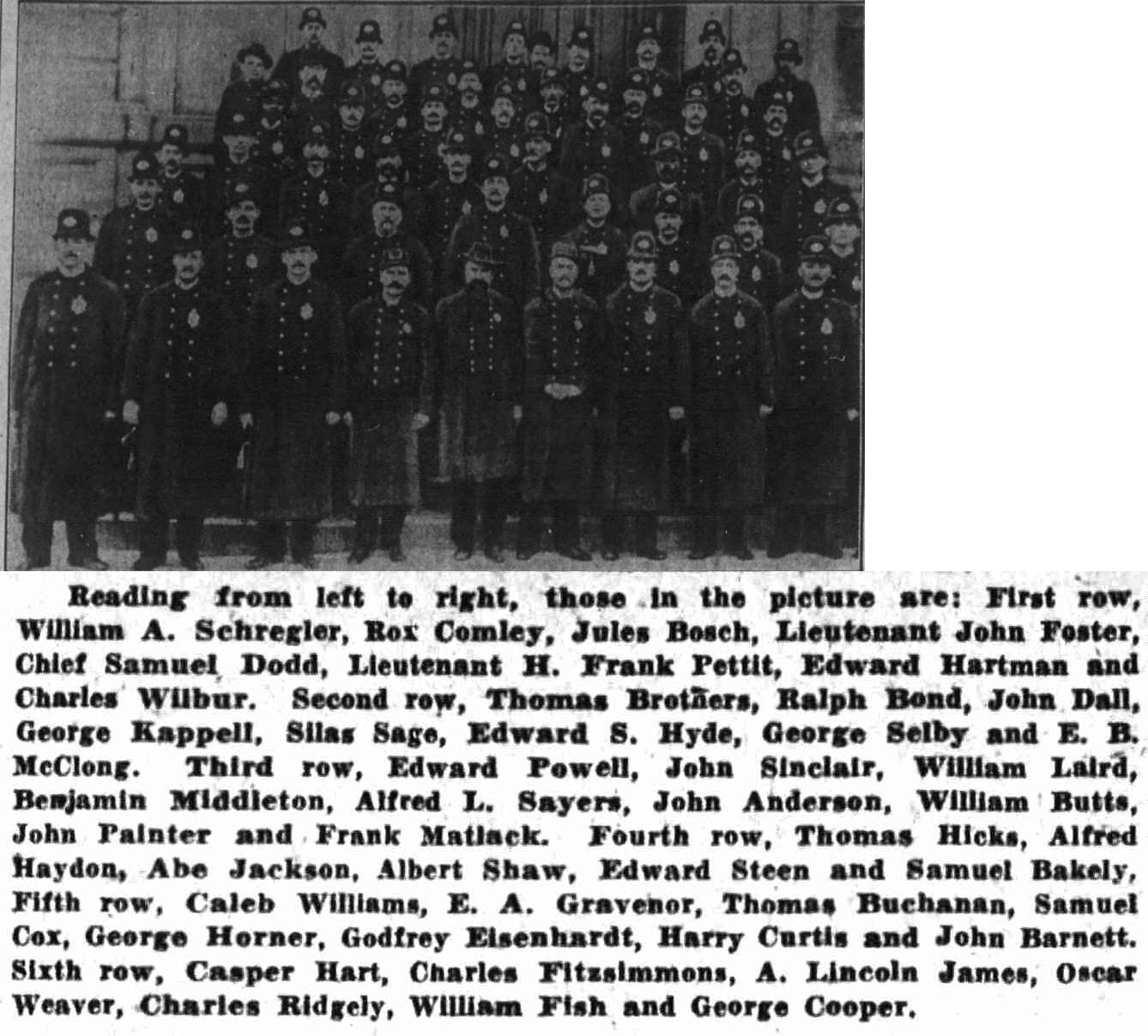
A 1930 Camden Courier-Post retrospective reprints a photograph of the Camden Police Department as it appeared in 1898, with every officer in the group identified — among them Edward S. Hyde.
A police motorcycle squad under Inspector Humes escorts the funeral of former police chief Edward S. Hyde, held at his Haddon Avenue home with burial in Harleigh Cemetery.

Camden held a Victory Jubilee parade and banquet on September 6, 1919, reviewed by Admiral Henry B. Wilson, honoring returning soldiers and sailors and the 135 Camden County men who died in the war.
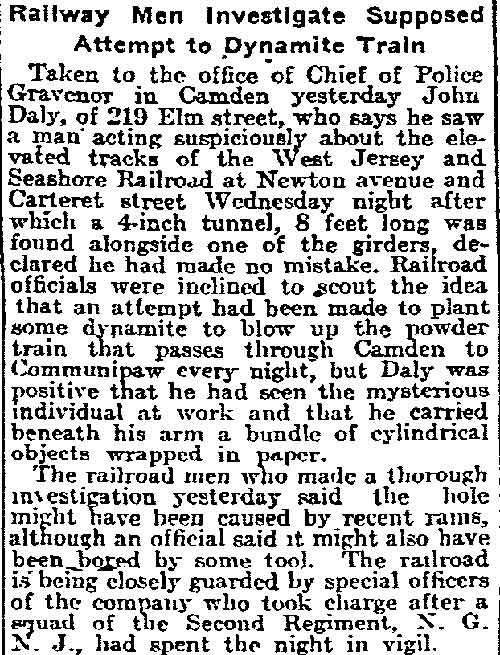
John Daly reported a suspicious man at the elevated West Jersey and Seashore Railroad tracks at Newton Avenue and Carteret Street, where a bored hole was found; railway men investigated a supposed dynamite attempt.
No Trace Yet Found of the Ashbridges Pal in Sensational and Tragic Escape From the County Prison on Monday Night FOOD SHUNNED BY YOUNG MURDERER Evidently in hiding, George E. Thompson, who escaped from prison with Wilson Ashbridge on Monday night after Murdering one jailor and wounding another, is still at liberty.
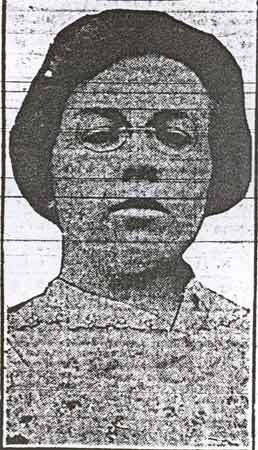
Mrs. Marian Ashbridge confesses to smuggling into the Camden County Jail — hidden in a basket of fruit — the revolver her husband used to kill jailor Isaac Hibbs and escape; she is held without bail on a charge of conspiracy.
Captured at the Keystone Hotel in Chester, Pennsylvania, fugitive murderer Wilson Ashbridge waives extradition and is driven back to Camden by Captain of Detectives William Schregler, his wife beside him.
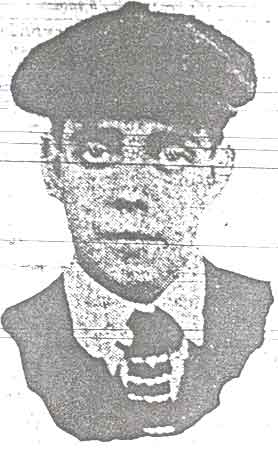
Wilson Ashbridge, slayer of Mrs. Elizabeth Dunbar, and forger George E. Thompson shoot their way out of the Camden County Jail with a smuggled revolver, killing keeper Isaac Hibbs and wounding Joseph Ellis; a general jail delivery is averted by police summoned by the wounded men.
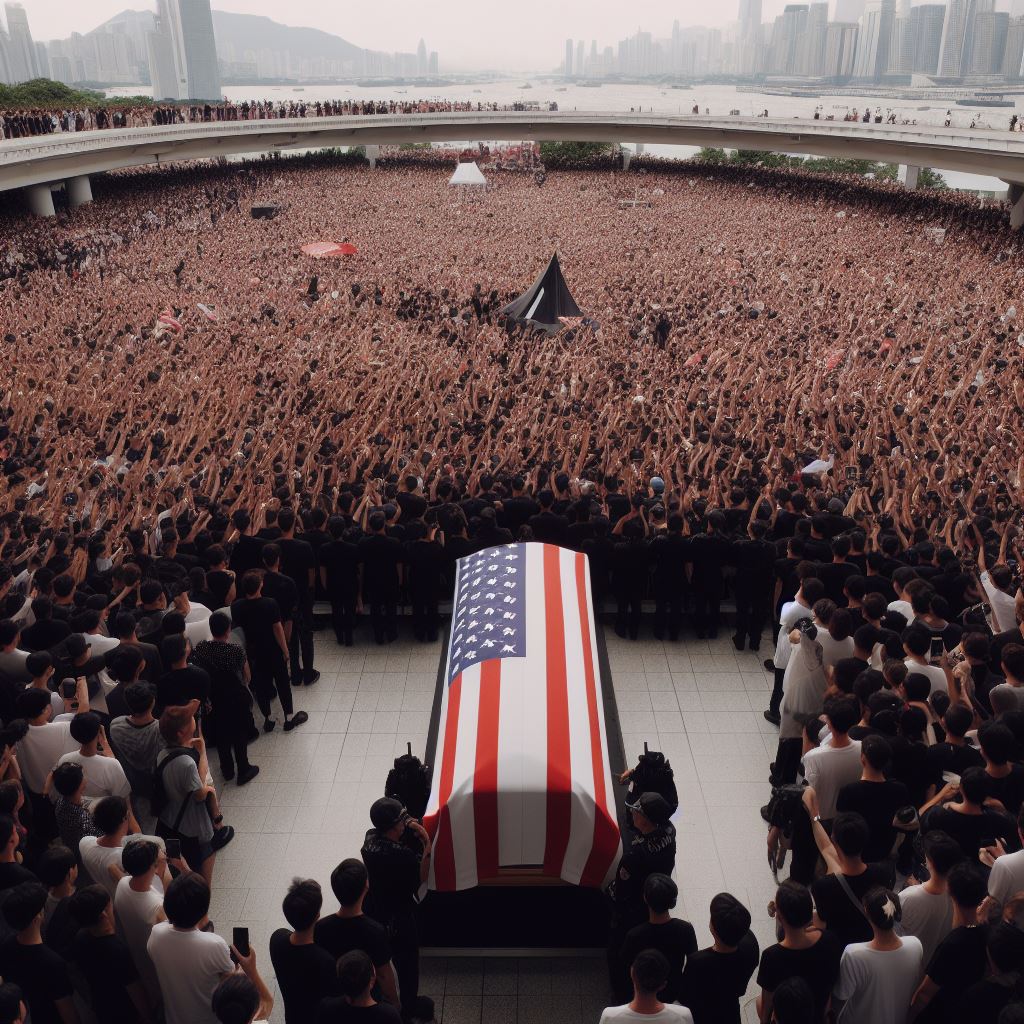
Camden Post-Telegram - May 10, 1914 Throngs Jam Court House While Body Lies in State for Two Hours.
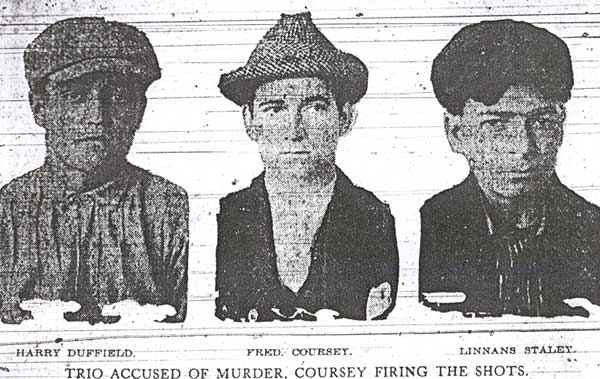
Fred Coursey and Harry Duffield collapse in Police Court as Detective John Painter recounts the robbery killing of 18-year-old Karl Kellmann at Twenty-seventh and Sherman streets; Linnans Staley is committed as a principal.

Hundreds of Houses Ruined by Violent Wind and Rain and two Persons May Die; Streets Strewn with Debris Two lives will probably be sacrificed, property valued at at least a hundred thousand dollars, was virtually destroyed and the northwest section of the city was laid in ruin when a storm of cyclonic intensity swept over Camden last night.
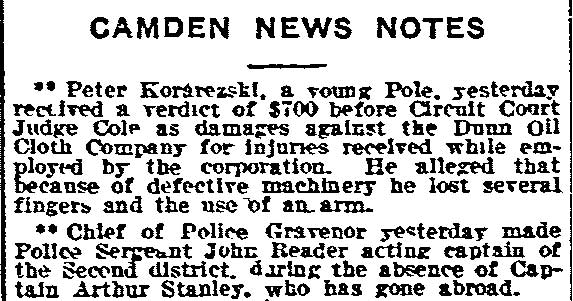
Camden briefs for May 19, 1911, reporting that Chief of Police Gravenor made Sergeant John Reader acting captain of the Second District during Captain Arthur Stanley's absence abroad.

Adolph Walker, 27, shot and killed his wife Anna at their home at 906 Coates Alley, then turned the revolver on himself.
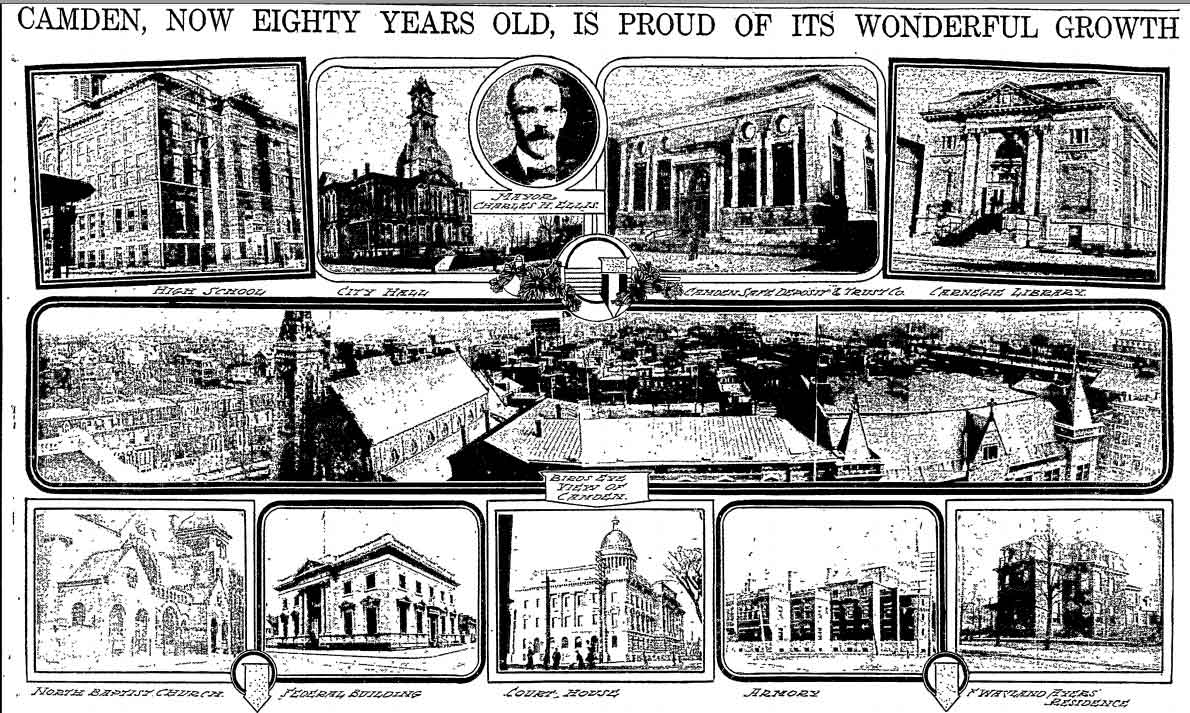
City on Saint Valentine's Day, Will Observe the Anniversary of Its Incorporation—Some Facts and Figures Concerning "Slow Town" Across the River Eighty years will have passed on Friday, February 14, since Camden became an incorporated city, and just now the citizens are looking back over those years and recalling with a pardonable pride the epochs that have made it a community of homes, of splendid industries and of clean, progressive government.
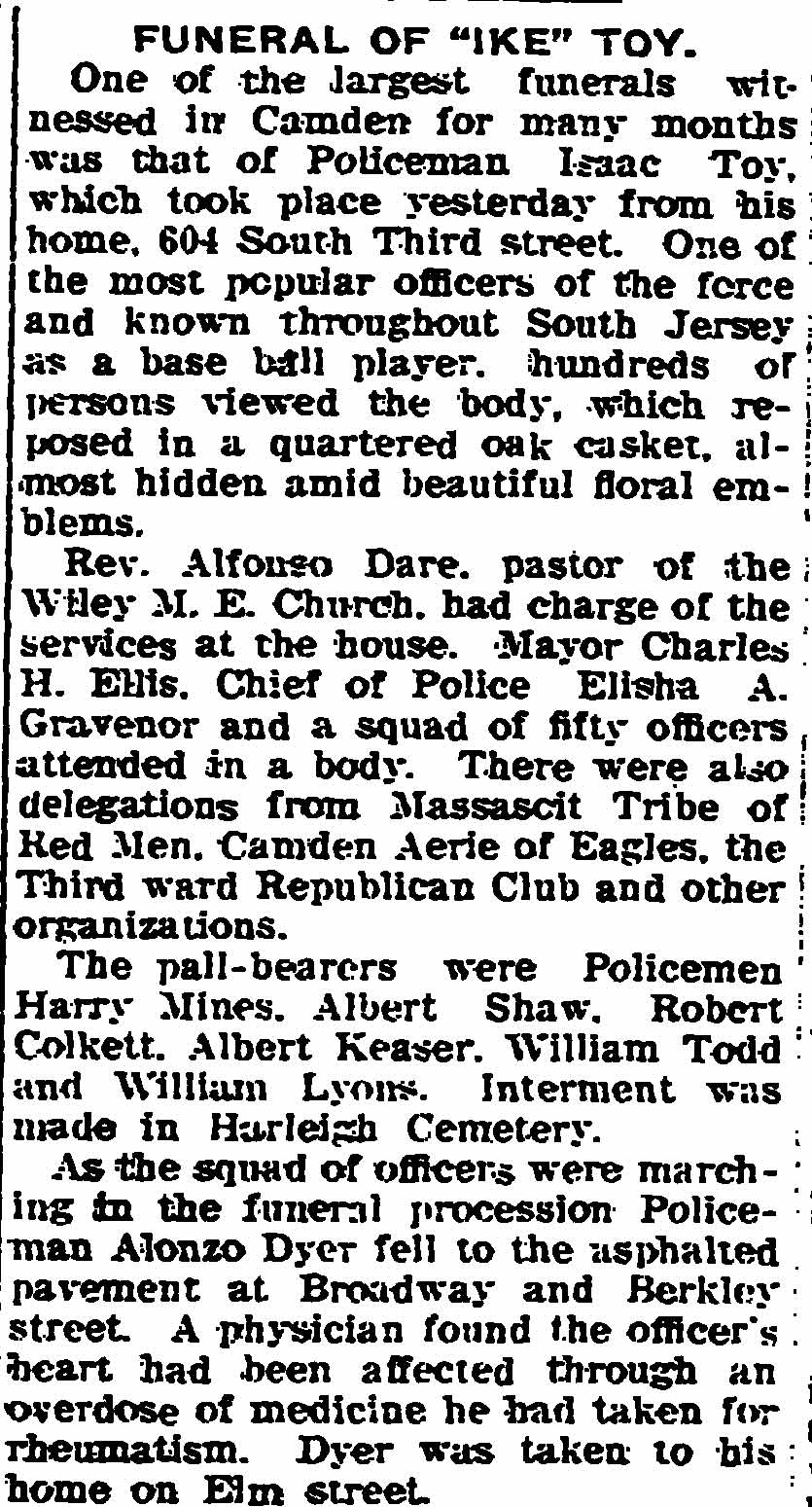
The Bridgeton Evening News describes the funeral of Camden Policeman Isaac "Ike" Toy, held from his home at 604 South Third Street and attended by Mayor Charles H. Ellis, Chief of Police Elisha A. Gravenor and fifty officers, with interment in Harleigh Cemetery. During the procession Policeman Alonzo Dyer collapsed at Broadway and Berkley Street.
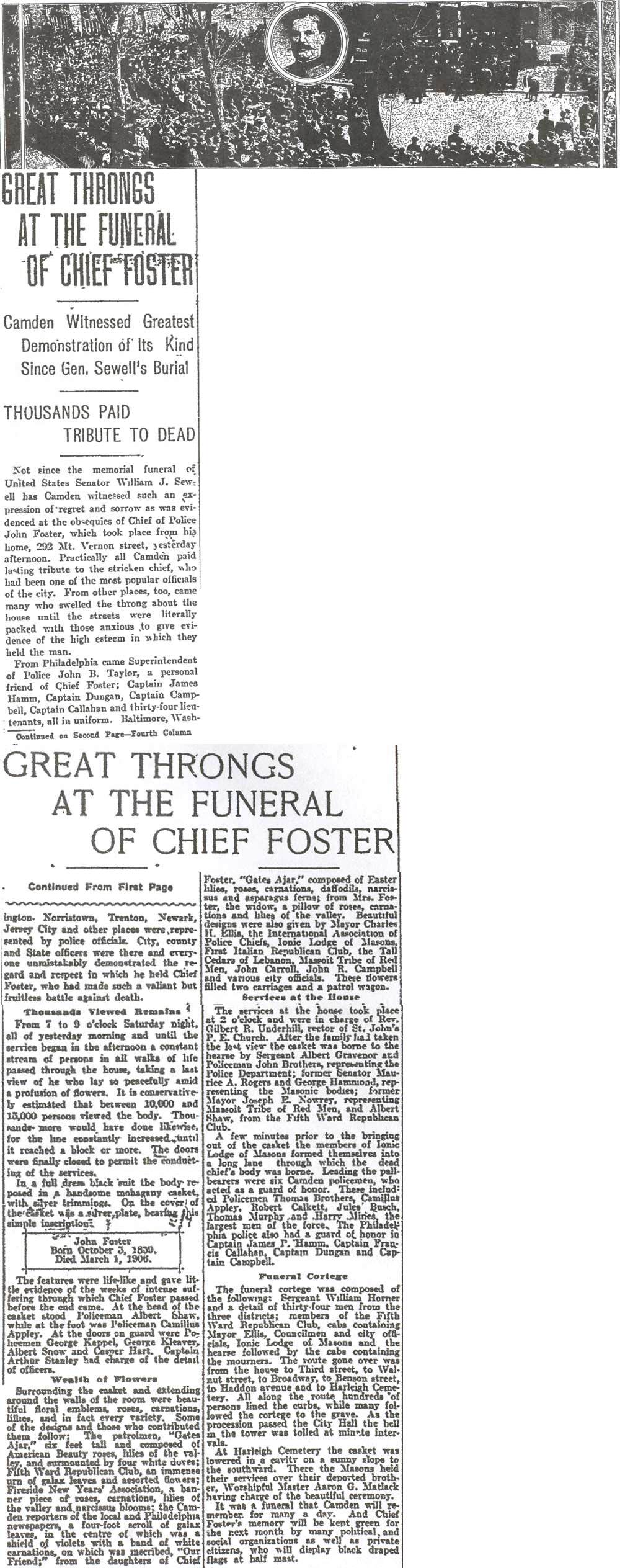
Thousands attended the funeral of Camden Chief of Police John Foster in March 1906; among the donors of floral tributes was John Carroll.
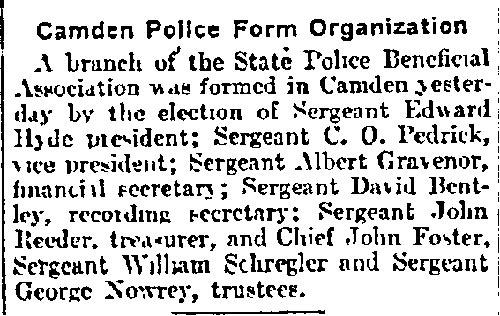
Camden police form a branch of the State Police Beneficial Association, electing Sergeant Edward Hyde president and Chief John Foster among the trustees.