Edward S. Hyde

1868 – 1930-04-13
Acting Chief of Police

Edward S. Hyde

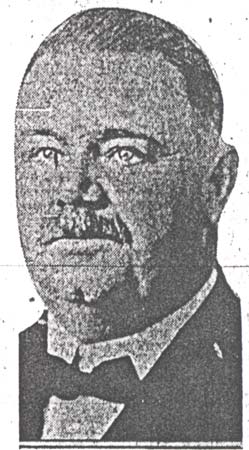
Portrait of Edward S. Hyde, Acting Chief of the Camden Police Department
Edward S. Hyde

Edward S. Hyde was born around 1868. He was appointed to the Camden Fire Department on March 28, 1893, and served as an extra man for one year until accepting an appointment to the Camden Police Department, which came on April 14, 1894. Promoted to sergeant five years later, he was elevated to captain on January 1, 1908, serving at police headquarters under Chief Elisha A. Gravenor. He was promoted to assistant chief in 1915, and upon Chief Gravenor's retirement was named acting chief of police, effective August 1, 1922. When the political winds shifted after the May 1923 election, Chief Hyde found himself serving under a new Public Safety Director, Commissioner Frank Hitchner, and on July 15, 1923, he was let go on pension, replaced as Chief of Police by James E. Tatem.
Hyde was politically active as a member of the Seventh Ward Republican Club and remained so after leaving the Police Department. He was elected to the Camden County Board of Freeholders from the Seventh Ward in 1928. He took ill the following year and died on April 13, 1930.

Edward Hyde married Minna Buzine. Her father, Samuel Buzine, was a charter member of the Camden Fire Department and served for many years as assistant chief under Samuel S. Elfreth. Minna's brother William Buzine and her uncle Lewis Buzine also served with the fire department, as did her brother-in-law Joseph F. Ernst. Another brother-in-law, James Roach, married to Minna's sister Clara, served with both the Fire and Police Departments and as bridge tender at the State Street Bridge. Hyde was survived by his widow, Mina B. Hyde, and three daughters — Mrs. Marion Garlan, Mrs. Mary Van Hart, and Emma Hyde. His funeral was held at the home, 832 Haddon Avenue, with burial in Harleigh Cemetery.

The Mayor Names

Camden Post, April 14, 1894
"The Mayor Names" article on Camden school board and police appointments, Camden Post, April 14, 1894
Camden Post, April 14, 1894
View transcription
THE MAYOR NAMES Four Members off the Board of Public Instruction. THREE WERE REAPPOINTED. His Honor also Announces Another Batch of New Policemen and Asks for the Resignation of the Democratic Hold-overs. Mayor Westcott this morning made the following appointments of members of the Board of Public Instruction: George D. Borton, D, First ward; Samuel Iszard, R, Second ward; Chas. H. Ellis, Jr., R, Sixth ward, and James Hanson, Jr., D, Seventh ward. Messrs. Borton, Iezard and Ellis are reappointments. Mr. Hanson succeeds Charles Hewston of the Seventh ward, whose term expires to-day. The new member is an oilcloth printer with a highly honorable record, his appointment giving great satisfaction all around. The Mayor also announced the following new appointments on the police force: First ward—James Elberson, Chas. Wilbur, Samuel H. Sheer. Third ward—John Sinclair, E. D. Steen. Fifth ward—Albert Shaw, Charles Fitzsimmons. Sixth ward—Abraham Jackson. Seventh ward—Alfred Sayres, Edward Hyde. Eighth ward—Thomas Buchanan, Jacob A. Hicks, the latter colored. No appointments were announced in the Second and Ninth wards. Policeman Tommy Reed, of the Second ward, sent in his resignation last night. Peall, of the Second, and Thomas, of the Third, are expected to follow suit to-day. In fact, the Mayor has asked for the resignations of all the holdovers of the Police Commission, with the exception of House Sergeant John Beard, of the Second ward, who, besides being a good officer, knows how to mind his p's and q's. The Mayor thinks he will have to dismiss Mullane and Painter, as they give no sign of submitting gracefully. Harry Miller, of the Third ward, will be allowed to remain until May 1st on account of the recent loss of his child. It is said that Charley Sink will not get there in the Ninth. Billy Fish is said to have the inside track. Wm. Ripley, of the Seventh ward, made a good and faithful policeman, and was fired like the rest, but it is said will not go back right away. Sam Sheer was a "cop" under ex-Mayor Ayres and ought to know the ropes. Harry Richmond, of the Fourth ward, will not resign. He says he will make them prefer charges. Well, Bob Miller was fired because he only had one eye. My! but what a lot of men there are in this town who would like to wear helmets!

Read the article: The Mayor Names

Crisp Camden News

Philadelphia Inquirer, April 25, 1894
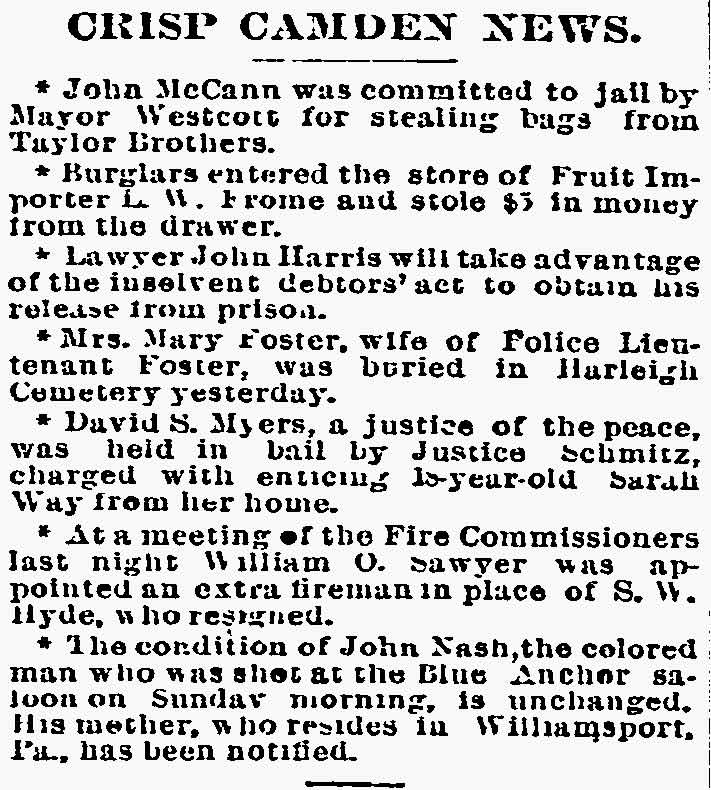
"Crisp Camden News" column, Philadelphia Inquirer, April 25, 1894, with a note on a new extra fireman
Philadelphia Inquirer, April 25, 1894
View transcription
CRISP CAMDEN NEWS. John McCann was committed to jail by Mayor Westcott for stealing bags from Taylor Brothers. Burglars entered the store of Fruit Importer L. W. Frome and stole $5 in money from the drawer. Lawyer John Harris will take advantage of the insolvent debtors' act to obtain his release from prison. Mrs. Mary Foster, wife of Police Lieutenant Foster, was buried in Harleigh Cemetery yesterday. David S. Myers, a justice of the peace, was held in bail by Justice Schmitz, charged with enticing 15-year-old Sarah Way from her home. At a meeting of the Fire Commissioners last night William O. Sawyer was appointed an extra fireman in place of S. W. Hyde, who resigned. The condition of John Nash, the colored man who was shot at the Blue Anchor saloon on Sunday morning, is unchanged. His mother, who resides in Williamsport, Pa., has been notified.

Read the article: Crisp Camden News

Camden Mystery More Involved

Philadelphia Inquirer, August 14, 1899
Newspaper clipping (crop 1 of 10): "Camden Mystery More Involved", Philadelphia Inquirer, August 14, 1899
Philadelphia Inquirer, August 14, 1899
View transcription
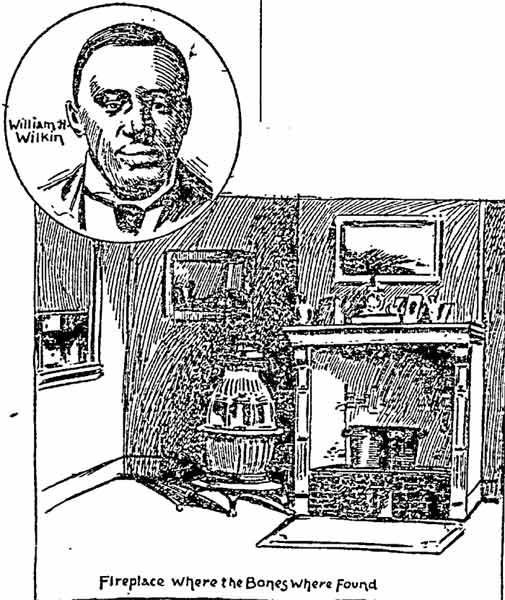
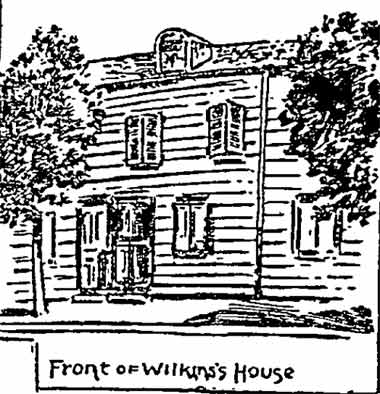
CAMDEN MYSTERY MORE INVOLVED Bones Found in the House in Which Mrs. Lillian Chambers Died AUTHORITIES AROUSED Wilkins, the Vocdoo Doctor, Under Arrest, and Investigation Being Made CARSON'S LAST WORK The Murdered Prosecuting Attorney Visited the House Just Before Leaving Camden The investigation following the death of Mrs. Lillian Chambers, of 706 North Eleventh street, Philadelphia, at the house of William H. Wilkins, colored fortune teller, planet reader, voodoo doctor and astrologist, at 825 Locust street, Camden, on Friday afternoon, has revealed what may be a clue to one of the most ghastly and horrible crimes known. Hidden within a concealed fireplace in the room where the "voodoo" received his dupes was found a great boiler filled with what Coroner and police think are human bones and flesh. Beneath it were the embers of a fire, in which other bones had been placed. The stench when the fireplace when opened was overpowering. On Friday afternoon the body of Mrs. Chambers was found in the rocking chair at Wilkins' house. The woman had left her home in the early morning, and when her husband, Henry Chambers, returned for his dinner he found his wife missing and the house locked up. A Chinaman, who occupies the store portion of the Chambers house, gave him the key, stating that Mrs. Chambers had left early in the morning, not stating where she was going. The Woman's Death Considerably worried, Chambers ate his dinner and hurried back to Baldwin's Locomotive Works, where he is employed as a laborer. On his way, however, he was met by his sister-in-law, Annie Stewart, and Wilkins, the fortune teller. Wilkins, in great excitement, told Chambers that Mrs. Chambers had been taken ill at his house and that he must at once go back with them. Chambers and the others immediately hurried across to Camden and to the Wilkins house, on Locust street. Wilkins entered first, being closely followed by Chambers. In the parlor of the squalid frame house in a rocking chair sat Mrs. Chambers, her arms outstretched, but perfectly motionless. Chambers rushed to her and threw his arms around her. The body fell forward. "She's cold. My God! they've killed my wife!" shrieked Chambers. He rushed into the street shouting "murder!" Policeman Harry Frisby pushed the frantic husband aside, and, laying his hand on the motionless woman's heart, found that she was dead. He immediately placed all in the house under arrest. Chief of Police Foster, after notifying Coroner Landes, began an investigation. Wilkins stated that he had never seen the Chambers woman until Friday, when he met her on the street sick. Taking her into the house he learned her name and address and had notified her people. This was before 12 o'clock, as Officer Frisby remembered seeing Wilkins and the Stewart woman going toward the ferry at 11.30. Coroner Landes, who arrived shortly after four o'clock in the afternoon, stated that the woman had then been dead from four to six hours. At the autopsy performed on Saturday afternoon by County Physician Jones it was found that death was due to a criminal operation. A Ghastly Find The house was searched from top to bottom. In the front room where the Chambers woman was found the police noticed a disagreeable odor. Apparently there was nothing to cause it, suddenly Captain Hanley and Sergeant Hyde pushed aside the stove that stood on one side of the room and exposed a fireplace, sealed with a strip of zinc. The zinc was torn aside. An odor which almost overpowered those present issued from this aperture. Within on two bars of iron was a great washboiler. In it, almost filling it to the top, was a mass of bones and flesh. Beneath it were the embers of a fire, among the ashes of which were a number of small charred bones. Coroner Landes ordered the contents of the boiler to be taken to the yard and emptied of the liquid, which was over them and which seemed to be some pickling fluid. As they were placed in another receptacle he was struck by their resemblance to human bones. He immediately ordered them taken to the Morgue. Yesterday Captain Stanley, Sergeant Hyde and the Coroner all reiterated their impression that the bones were those of human beings. Wilkins was questioned as to their nature. He said that it was an opossum that he had been cooking. And that was all he would say. His daughter, Louisa, was then questioned. She denied all knowledge of any bones being in the house. They had never had any opossum to cook, she told Chief of Police Foster. Carson's Last Act Strangely enough the investigation which resulted in the ghastly find was started by Assistant Prosecutor Carson before he left to take part in the reception to General Sewell. An Inquirer reporter noticing him leaving the room frequently, in which the body of Mrs. Chambers was found asked him what his reason was for so doing? He replied, "There is such a peculiar smell that I cannot stay in that room any length of time." "Do you think it comes from the body of Lillian Chambers?" asked the reporter. "I do not and I have given strict orders to have the house thoroughly searched by the police, and I expect they will find evidence of a murder," was his reply. Before leaving he left his address at Belmar with Chief Foster, with instructions to notify him at once if a find was made. Chief Foster heard of Mr. Carson's death shortly after the discovery of the remains in the washtub. Coroner Landes when seen yesterday expressed his intention of securing the services of Dr. Deever, the celebrated anatomist of the University of Pennsylvania, to examine the bones. "I do not wish to trust to my own impression," he said, "and will have Dr. Deever and probably another expert examine the bones The odor from them was simply indescribable. They had probably been hidden in the fireplace for weeks." Both Captain Stanley and Sergeant Hyde also spoke of their impression that the bones were of human beings, but had been instructed to say nothing until after the examination. Numbers of letters and photographs of women were found by the police. The contents of the letters they refuse to reveal until the inquest. Some of them, it was learned, however, were requests for spells to take away trouble, to bring back lovers or to put charms on others. A letter, which was found by an Inquirer reporter in the squalid parlor where the woman died, and the ghastly find was made, was from a Philadelphia woman, praying the "Dear doctor" to assist her lawyer by his charms in making her husband support her. There were others of like character. Just as soon as the bones found are in condition for examination, a rigid one will be made. It was in this same house that some time ago were found a number of baby's bones. When questioned Chambers denied to the police that he had ever known his wife to visit Camden, but the Stewart woman told them that Mrs. Chambers had made frequent trips across the river. The Wilkins house is closed and under the surveillance of the police. [Illustration, captioned:] Front of Wilkins's House [Illustration, captioned:] William H. Wilkin [Illustration, captioned:] Fireplace where the Bones where Found

Read the article: Camden Mystery More Involved

Philadelphia Inquirer, August 14, 1899
Newspaper clipping (crop 2 of 10): "Camden Mystery More Involved", Philadelphia Inquirer, August 14, 1899
Philadelphia Inquirer, August 14, 1899
View transcription
The investigation following the death of Mrs. Lillian Chambers, of 706 North Eleventh street, Philadelphia, at the house of William H. Wilkins, colored fortune teller, planet reader, voodoo doctor and astrologist, at 825 Locust street, Camden, on Friday afternoon, has revealed what may be a clue to one of the most ghastly and horrible crimes known. Hidden within a concealed fireplace in the room where the "voodoo" received his dupes was found a great boiler filled with what Coroner and police think are human bones and flesh. Beneath it were the embers of a fire, in which other bones had been placed. The stench when the fireplace when opened was overpowering. On Friday afternoon the body of Mrs. Chambers was found in the rocking chair at Wilkins' house. The woman had left her home in the early morning, and when her husband, Henry Chambers, returned for his dinner he found his wife missing and the house locked up. A Chinaman, who occupies the store portion of the Chambers house, gave him the key, stating that Mrs. Chambers had left early in the morning, not stating where she was going. The Woman's Death Considerably worried, Chambers ate his dinner and hurried back to Baldwin's Locomotive Works, where he is employed as a laborer. On his way, however, he was met by his sister-in-law, Annie Stewart, and Wilkins, the fortune teller. Wilkins, in great excitement, told Chambers

Philadelphia Inquirer, August 14, 1899
Newspaper clipping (crop 3 of 10): "Camden Mystery More Involved", Philadelphia Inquirer, August 14, 1899
Philadelphia Inquirer, August 14, 1899
View transcription
that Mrs. Chambers had been taken ill at his house and that he must at once go back with them. Chambers and the others immediately hurried across to Camden and to the Wilkins house, on Locust street. Wilkins entered first, being closely followed by Chambers. In the parlor of the squalid frame house in a rocking chair sat Mrs. Chambers, her arms outstretched, but perfectly motionless. Chambers rushed to her and threw his arms around her. The body fell forward. "She's cold. My God! they've killed my wife!" shrieked Chambers. He rushed into the street shouting "murder!" Policeman Harry Frisby pushed the frantic husband aside, and, laying his hand on the motionless woman's heart, found

Philadelphia Inquirer, August 14, 1899
Newspaper clipping (crop 4 of 10): "Camden Mystery More Involved", Philadelphia Inquirer, August 14, 1899
Philadelphia Inquirer, August 14, 1899
View transcription
that she was dead. He immediately placed all in the house under arrest. Chief of Police Foster, after notifying Coroner Landes, began an investigation. Wilkins stated that he had never seen the Chambers woman until Friday, when he met her on the street sick. Taking her into the house he learned her name and address and had notified her people. This was before 12 o'clock, as Officer Frisby remembered seeing Wilkins and the Stewart woman going toward the ferry at 11.30. Coroner Landes, who arrived shortly after four o'clock in the afternoon, stated that the woman had then been dead from four to six hours. At the autopsy performed on Saturday afternoon by County Physician Jones it was found

Philadelphia Inquirer, August 14, 1899

Newspaper drawings: a portrait of William H. Wilkin and the fireplace where the bones were found
Philadelphia Inquirer, August 14, 1899
View transcription
William H. Wilkin Fireplace Where the Bones Where Found

Philadelphia Inquirer, August 14, 1899

Newspaper clipping (crop 5 of 10): "Camden Mystery More Involved", Philadelphia Inquirer, August 14, 1899
Philadelphia Inquirer, August 14, 1899
View transcription
that death was due to a criminal operation. A Ghastly Find The house was searched from top to bottom. In the front room where the Chambers woman was found the police noticed a disagreeable odor. Apparently there was nothing to cause it, suddenly Captain Hanley and Sergeant Hyde pushed aside the stove that stood on one side of the room and exposed a fireplace, sealed with a strip of zinc. The zinc was torn aside. An odor which almost overpowered those present issued from this aperture. Within on two bars of iron was a great washboiler. In it, almost filling it to the top, was a mass of bones and flesh. Beneath it were the embers of a fire, among the ashes of which were a number of small charred bones. Coroner Landes ordered the contents of the boiler to be

Philadelphia Inquirer, August 14, 1899

Newspaper column from "Camden Mystery More Involved", Philadelphia Inquirer, August 14, 1899, on the bones and Wilkins's opossum story
Philadelphia Inquirer, August 14, 1899
View transcription
taken to the yard and emptied of the liquid, which was over them and which seemed to be some pickling fluid. As they were placed in another receptacle he was struck by their resemblance to human bones. He immediately ordered them taken to the Morgue. Yesterday Captain Stanley, Sergeant Hyde and the Coroner all reiterated their impression that the bones were those of human beings. Wilkins was questioned as to their nature. He said that it was an opossum that he had been cooking. And that was all he would say. His daughter, Louisa, was then questioned. She denied all knowledge of any bones being in the house. They had never had any opossum to cook, she told Chief of Police Foster. Carson's Last Act Strangely enough the investigation which resulted in the ghastly find was started by Assistant Prosecutor Carson

Philadelphia Inquirer, August 14, 1899

Newspaper line drawing of a two-story frame house with shuttered windows, captioned "Front of Wilkins's House"
Philadelphia Inquirer, August 14, 1899
View transcription
Front of Wilkins's House

Philadelphia Inquirer, August 14, 1899

Newspaper column from "Camden Mystery More Involved", Philadelphia Inquirer, August 14, 1899, on Carson's visit and Coroner Landes
Philadelphia Inquirer, August 14, 1899
View transcription
before he left to take part in the reception to General Sewell. An Inquirer reporter noticing him leaving the room frequently, in which the body of Mrs. Chambers was found asked him what his reason was for so doing? He replied, "There is such a peculiar smell that I cannot stay in that room any length of time." "Do you think it comes from the body of Lillian Chambers?" asked the reporter. "I do not and I have given strict orders to have the house thoroughly searched by the police, and I expect they will find evidence of a murder," was his reply. Before leaving he left his address at Belmar with Chief Foster, with instructions to notify him at once if a find was made. Chief Foster heard of Mr. Carson's death shortly after the discovery of the remains in the washtub. Coroner Landes when seen yesterday expressed his intention of securing the services of Dr. Deever, the celebrated anatomist of the University of Pennsylvania, to examine the bones. "I do not wish to trust to my own impression," he said, "and will have Dr. Deever and probably another expert examine the bones The odor from them was simply indescribable. They had probably been hidden in the fireplace for weeks."

Philadelphia Inquirer, August 14, 1899

Newspaper column from "Camden Mystery More Involved", Philadelphia Inquirer, August 14, 1899, on letters found and Chambers's denial
Philadelphia Inquirer, August 14, 1899
View transcription
Both Captain Stanley and Sergeant Hyde also spoke of their impression that the bones were of human beings, but had been instructed to say nothing until after the examination. Numbers of letters and photographs of women were found by the police. The contents of the letters they refuse to reveal until the inquest. Some of them, it was learned, however, were requests for spells to take away trouble, to bring back lovers or to put charms on others. A letter, which was found by an Inquirer reporter in the squalid parlor where the woman died, and the ghastly find was made, was from a Philadelphia woman, praying the "Dear doctor" to assist her lawyer by his charms in making her husband support her. There were others of like character. Just as soon as the bones found are in condition for examination, a rigid one will be made. It was in this same house that some time ago were found a number of baby's bones. When questioned Chambers denied to the police that he had ever known his wife to visit Camden, but the Stewart woman told them that Mrs. Chambers had made frequent trips across the river. The Wilkins house is closed and under the surveillance of the police.

Philadelphia Inquirer, July 20, 1900

Newspaper item "Raid Over in Camden", Philadelphia Inquirer, July 20, 1900
Philadelphia Inquirer, July 20, 1900
View transcription
Raid Over in Camden Police Captain Stanley and Sergeant Hyde, with a squad of officers, arrested two alleged disorderly houses on Pine street above Tenth, Camden, last night. The reputed proprietors, Charles Smith and Mary Bennett, together with thirteen inmates, were taken into custody and locked up for a hearing to-day.

Four Killed When Fireworks Blew Up

Philadelphia Inquirer, May 24, 1904
Headline of "Four Killed When Fireworks Blew Up", Philadelphia Inquirer, May 24, 1904
Philadelphia Inquirer, May 24, 1904
View transcription
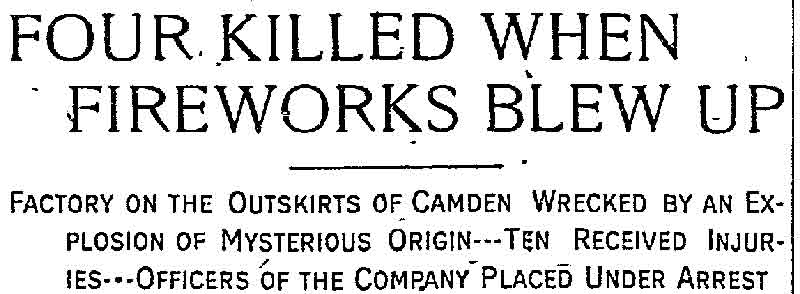
FOUR KILLED WHEN FIREWORKS BLEW UP Factory on the Outskirts of Camden Wrecked by an Explosion of Mysterious Origin---Ten Received Injuries---Officers of the Company Placed Under Arrest [Photograph, captioned:] MAIN BUILDING WRECKED BY THE EXPLOSION With a roar and concussion that shook buildings and shattered windows for miles around an explosion occurred at the Independent Fireworks Company, Ferry and Cooper avenues, Camden, yesterday morning about half-past 6 o'clock. Three Italians were blown to fragments, another died in the Cooper Hospital late last night and nine persons were more or less seriously injured. The Dead Are SINEONE TIERANTOZODI, aged 17 years, of 248 Division street, Camden. LEONARDO PINTO, aged 45 years, Tenth and Ferry avenue; expert workman. UNKNOWN ITALIAN, probably Joseph Logalla, of Philadelphia. UNKNOWN ITALIAN. Ten Were Injured The injured are: MICHAEL SCALONA, aged 52 years, of 109 Powelton avenue, Woodlynne, foreman of the factory, mangled thigh. Condition serious; Cooper Hospital. HANNAH PARKER, aged 16 years, 203 Haddon avenue, Stonetown, cut and bruised, concussion of the brain; Cooper Hospital. STELLA LEWIS, aged 18 years, 203 Haddon avenue, Stonetown, cut about face, head, arms and body by flying glass; Cooper Hospital. MARY ENGLE, aged 14 years, 1807 South Tenth street, lacerated face and chin and shock; Cooper Hospital. JULIUS ENGLE, aged 12 years, 1807 South Tenth street, cut, bruised and suffering from shock; Cooper Hospital. PETER KEARNEY, aged 15 years, of 653 Ferry avenue, contusion of back, head and face; taken home. JEROSA MONGELLO, aged 41 years, of 246 Division street, burned about legs; Cooper Hospital. TONY DINIGRO, aged 17 years, 657 Ferry avenue, right hand torn and leg injured; Cooper Hospital. UNKNOWN YOUNG MAN, cut about hands and face. The sight was appalling. The body of one of the victims was found a hundred yards from the scene of the explosion. Every thread of clothing had been torn from the body. Morgue Keeper O'Brien removed the remains to the morgue. A few minutes after the explosion the police were notified by Charles Dubell. A squad of officers under Captain Stanley and Sergeant Hyde were at once sent to the scene to keep the crowd away. The force of the explosion was terrific. The brick building occupied by the company, 30 by 40 feet, was twisted so badly that it will have to be torn down. A frame structure, known as the labeling building, was shattered as though splintered with an ax. Many of the packing boxes were broken by the concussion and the splintered wood was hurled hundreds of feet. Windows Broken Probably there is not a house in Wood Lynne but what suffered by broken windows. Twenty-one windows were wrecked at the home of R. A. Rockhill, 108 Wood Lynne avenue. The houses occupied by J. A. Diebert, 116 Wood Lynne avenue; Eberhardt Renning, 108 Wood Lynne avenue; Wilson Cunningham, 110 Wood Lynee avenue, and R. A. Raphal Cooper avenue, were shaken so violently that in some instances not only the windows but the sashes as well were knocked out. Jerosa Mongello probably had one of the narrowest escapes from death. He was working about the place when he suddenly felt himself hurled high in the air. He alighted in a recently plowed field, minus some clothing and suffering from burned legs. He was badly shocked but will recover. He was near the three other Italians who were blown to pieces. Miss Parker was just entering the labeling house when she was hurled with terrific force a dozen feet away. When found, she was sitting on the ground with a large wooden box resting on her head. She was delirious from fright and severe injuries when discovered. Hurled Through Doorway Tony Dinigro said he was working and all he knew there was a big noise. "Then I was hurled through a doorway," said he. "I don't know how I got home, I was so scared." Peter Kearney said he had just gone into the powder house to get ready for work when the explosion occurred. He was thrown into the street. According to these men both dynamite and powder were used by the concern, Kearney declaring he was employed to carry the explosive to the mixing plant. Had the explosion occured a few minutes later the loss of life would have been much greater. Just as the catastrophe occurred a trolley car loaded with female employes was within a block of the place. Inside of five minutes they would have been working in the labeling and storage rooms, which were shattered by the concussion. Placed Under Arrest Prosecutor Lloyd took charge of the case and County Detectives Smith and Cherry are at work in an effort to learn just what caused the explosion. While the management of the concern declares there was no powder, dynamite or nitro-glycerine in the buildings, neither Prosecutor Lloyd nor Coroner Litchfield is satisfied, and a most rigid investigation will be made. Coroner Litchfield will announce his jury to-day and a date on which an inquest will be held. Chief of Police Foster, on information received, made complaint against Herbert Weser, president; W. P. Teller, secretary; A. Walter Geller, treasurer, and Joseph Scanola, superintendent of the company, charging them with manslaughter. Weser and Scanola were arrested and held in $1500 bail each. The Gellers had not been arrested up to a late hour last night. Jerosa Mongella and Jean Viola, workmen, were also arrested by order of Coroner Litchfield. They were held in their own recognizance as witnesses. Cause of Explosion a Mystery There is considerable mystery as to the cause of the explosion. According to Joseph Scanola, superintendent, neither dynamite, nitro glycerine nor powder were used by them in the manufacture of fireworks. He said his father, Michael Scanola, was taking chloride of potash from a keg in a tin scoop when the explosion occurred. According to Scanola some unknown substance, probably sulphur, must have been on the scoop which, coming in contact with the potash, resulted in the explosion. The fireworks plant is located in the extreme southeast of Camden just across Ferry avenue from Wood Lynne. The residents of the latter place were about sitting down to breakfast when they were suddenly almost stunned by a deafening report. About the same time car No. 159, of the Camden and Suburban Railway Company, was passing, in charge of Motorman William Martin and Conductor Walter Ferguson. These, with the passengers, were badly shaken. Martin and Ferguson, with Wood Lynne residents, at once went to the scene of destruction. Applied for Work The Engle children had applied for work a few minutes before the explosion. Julius, who had secured a position, was about to start in when he was blinded by a flash and hurled in the air many feet away. His sister was knocked down by the concussion. Both were later picked up dazed. In a statement made by Joseph Scanola he said: "Father (Michael Scanola) told me that he was trying to scoop out a tin full of chloride of potash from a keg when the explosion occurred. If that is so the potash could not have been pure as it would have been impossible for such a thing to have happened. That is all I know about it and all I can tell." The office of the company is at 530 Walnut street, this city. The plant has been located at the present site about eighteen months. Prior to that time it was at Vineland. Owing to the approaching Fourth of July the place was working overtime, from 6 o'clock in the morning to 7 o'clock at night. There were thirty-five employes, mostly girls.

Read the article: Four Killed When Fireworks Blew Up

Philadelphia Inquirer, May 24, 1904
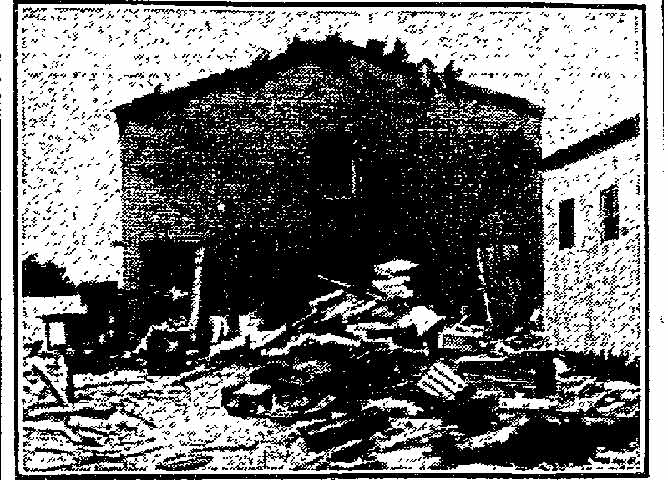
Photograph of the wrecked brick main building of the Independent Fireworks Company, Camden, after the 1904 explosion
Philadelphia Inquirer, May 24, 1904

Philadelphia Inquirer, May 24, 1904
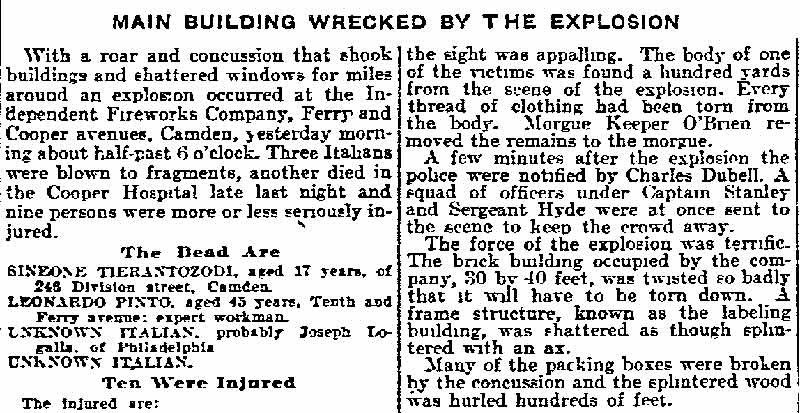
Opening columns of the Inquirer's May 24, 1904 report on the Camden fireworks factory explosion and its dead
Philadelphia Inquirer, May 24, 1904
View transcription
MAIN BUILDING WRECKED BY THE EXPLOSION With a roar and concussion that shook buildings and shattered windows for miles around an explosion occurred at the Independent Fireworks Company, Ferry and Cooper avenues, Camden, yesterday morning about half-past 6 o'clock. Three Italians were blown to fragments, another died in the Cooper Hospital late last night and nine persons were more or less seriously injured. The Dead Are SINEONE TIERANTOZODI, aged 17 years, of 248 Division street, Camden. LEONARDO PINTO, aged 45 years, Tenth and Ferry avenue; expert workman. UNKNOWN ITALIAN, probably Joseph Logalla, of Philadelphia. UNKNOWN ITALIAN. Ten Were Injured The injured are: the sight was appalling. The body of one of the victims was found a hundred yards from the scene of the explosion. Every thread of clothing had been torn from the body. Morgue Keeper O'Brien removed the remains to the morgue. A few minutes after the explosion the police were notified by Charles Dubell. A squad of officers under Captain Stanley and Sergeant Hyde were at once sent to the scene to keep the crowd away. The force of the explosion was terrific. The brick building occupied by the company, 30 by 40 feet, was twisted so badly that it will have to be torn down. A frame structure, known as the labeling building, was shattered as though splintered with an ax. Many of the packing boxes were broken by the concussion and the splintered wood was hurled hundreds of feet.

Philadelphia Inquirer, May 24, 1904

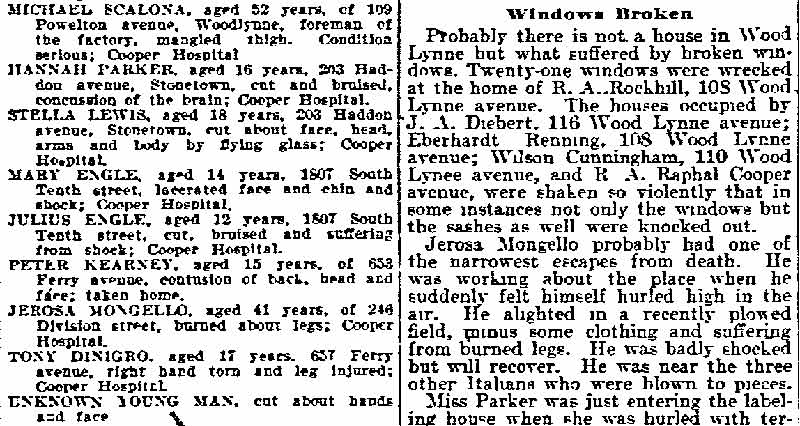
Newspaper column text listing the injured in the 1904 Camden fireworks factory explosion
Philadelphia Inquirer, May 24, 1904
View transcription
MICHAEL SCALONA, aged 52 years, of 109 Powelton avenue, Woodlynne, foreman of the factory, mangled thigh. Condition serious; Cooper Hospital. HANNAH PARKER, aged 16 years, 203 Haddon avenue, Stonetown, cut and bruised, concussion of the brain; Cooper Hospital. STELLA LEWIS, aged 18 years, 203 Haddon avenue, Stonetown, cut about face, head, arms and body by flying glass; Cooper Hospital. MARY ENGLE, aged 14 years, 1807 South Tenth street, lacerated face and chin and shock; Cooper Hospital. JULIUS ENGLE, aged 12 years, 1807 South Tenth street, cut, bruised and suffering from shock; Cooper Hospital. PETER KEARNEY, aged 15 years, of 653 Ferry avenue, contusion of back, head and face; taken home. JEROSA MONGELLO, aged 41 years, of 246 Division street, burned about legs; Cooper Hospital. TONY DINIGRO, aged 17 years, 657 Ferry avenue, right hand torn and leg injured; Cooper Hospital. UNKNOWN YOUNG MAN, cut about hands and face. Windows Broken Probably there is not a house in Wood Lynne but what suffered by broken windows. Twenty-one windows were wrecked at the home of R. A. Rockhill, 108 Wood Lynne avenue. The houses occupied by J. A. Diebert, 116 Wood Lynne avenue; Eberhardt Renning, 108 Wood Lynne avenue; Wilson Cunningham, 110 Wood Lynee avenue, and R. A. Raphal Cooper avenue, were shaken so violently that in some instances not only the windows but the sashes as well were knocked out. Jerosa Mongello probably had one of the narrowest escapes from death. He was working about the place when he suddenly felt himself hurled high in the air. He alighted in a recently plowed field, minus some clothing and suffering from burned legs. He was badly shocked but will recover. He was near the three other Italians who were blown to pieces. Miss Parker was just entering the labeling house when she was hurled with ter-

Philadelphia Inquirer, May 24, 1904

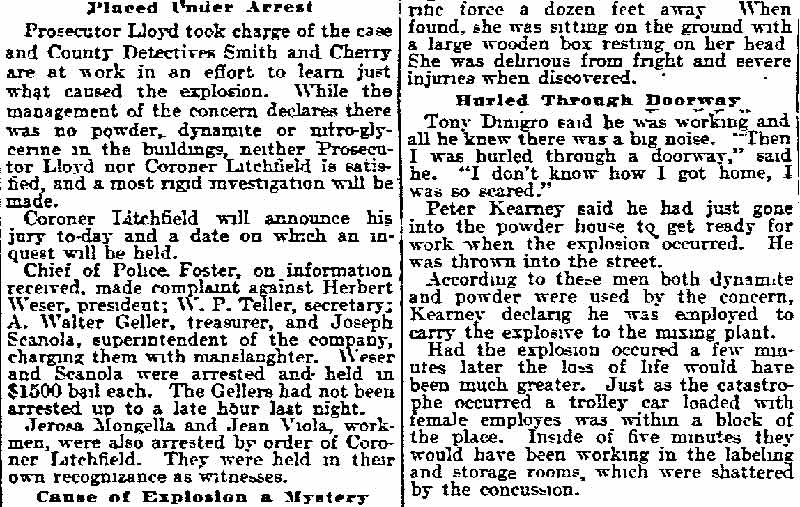
Newspaper column text on the arrests and witness accounts after the 1904 Camden fireworks factory explosion
Philadelphia Inquirer, May 24, 1904
View transcription
Placed Under Arrest Prosecutor Lloyd took charge of the case and County Detectives Smith and Cherry are at work in an effort to learn just what caused the explosion. While the management of the concern declares there was no powder, dynamite or nitro-glycerine in the buildings, neither Prosecutor Lloyd nor Coroner Litchfield is satisfied, and a most rigid investigation will be made. Coroner Litchfield will announce his jury to-day and a date on which an inquest will be held. Chief of Police Foster, on information received, made complaint against Herbert Weser, president; W. P. Teller, secretary; A. Walter Geller, treasurer, and Joseph Scanola, superintendent of the company, charging them with manslaughter. Weser and Scanola were arrested and held in $1500 bail each. The Gellers had not been arrested up to a late hour last night. Jerosa Mongella and Jean Viola, workmen, were also arrested by order of Coroner Litchfield. They were held in their own recognizance as witnesses. Cause of Explosion a Mystery rific force a dozen feet away. When found, she was sitting on the ground with a large wooden box resting on her head. She was delirious from fright and severe injuries when discovered. Hurled Through Doorway Tony Dinigro said he was working and all he knew there was a big noise. "Then I was hurled through a doorway," said he. "I don't know how I got home, I was so scared." Peter Kearney said he had just gone into the powder house to get ready for work when the explosion occurred. He was thrown into the street. According to these men both dynamite and powder were used by the concern, Kearney declaring he was employed to carry the explosive to the mixing plant. Had the explosion occured a few minutes later the loss of life would have been much greater. Just as the catastrophe occurred a trolley car loaded with female employes was within a block of the place. Inside of five minutes they would have been working in the labeling and storage rooms, which were shattered by the concussion.

Philadelphia Inquirer, May 24, 1904

Newspaper column text on the cause of the 1904 Camden fireworks factory explosion and the Engle children
Philadelphia Inquirer, May 24, 1904
View transcription
There is considerable mystery as to the cause of the explosion. According to Joseph Scanola, superintendent, neither dynamite, nitro glycerine nor powder were used by them in the manufacture of fireworks. He said his father, Michael Scanola, was taking chloride of potash from a keg in a tin scoop when the explosion occurred. According to Scanola some unknown substance, probably sulphur, must have been on the scoop which, coming in contact with the potash, resulted in the explosion. The fireworks plant is located in the extreme southeast of Camden just across Ferry avenue from Wood Lynne. The residents of the latter place were about sitting down to breakfast when they were suddenly almost stunned by a deafening report. About the same time car No. 159, of the Camden and Suburban Railway Company, was passing, in charge of Motorman William Martin and Conductor Walter Ferguson. These, with the passengers, were badly shaken. Martin and Ferguson, with Wood Lynne residents, at once went to the scene of destruction. When the rescuers had reached the spot Applied for Work The Engle children had applied for work a few minutes before the explosion. Julius, who had secured a position, was about to start in when he was blinded by a flash and hurled in the air many feet away. His sister was knocked down by the concussion. Both were later picked up dazed. In a statement made by Joseph Scanola he said: "Father (Michael Scanola) told me that he was trying to scoop out a tin full of chloride of potash from a keg when the explosion occurred. If that is so the potash could not have been pure as it would have been impossible for such a thing to have happened. That is all I know about it and all I can tell." The office of the company is at 530 Walnut street, this city. The plant has been located at the present site about eighteen months. Prior to that time it was at Vineland. Owing to the approaching Fourth of July the place was working overtime, from 6 o'clock in the morning to 7 o'clock at night. There were thirty-five employes, mostly girls.

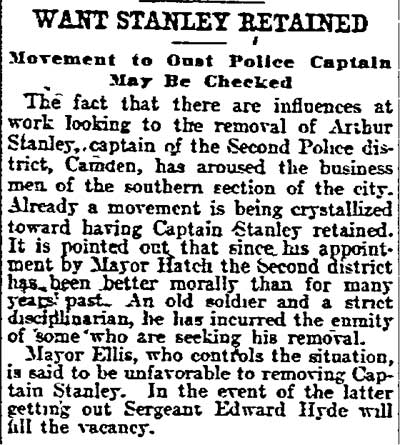
Want Stanley Retained

Philadelphia Inquirer, February 20, 1905
Newspaper clipping "Want Stanley Retained", Philadelphia Inquirer, February 20, 1905
Philadelphia Inquirer, February 20, 1905
View transcription
Want Stanley Retained Movement to Oust Police Captain May Be Checked The fact that there are influences at work looking to the removal of Arthur Stanley, captain of the Second Police district, Camden, has aroused the business men of the southern section of the city. Already a movement is being crystallized toward having Captain Stanley retained. It is pointed out that since his appointment by Mayor Hatch the Second district has been better morally than for many years past. An old soldier and a strict disciplinarian, he has incurred the enmity of some who are seeking his removal. Mayor Ellis, who controls the situation, is said to be unfavorable to removing Captain Stanley. In the event of the latter getting out Sergeant Edward Hyde will fill the vacancy.

Read the article: Want Stanley Retained

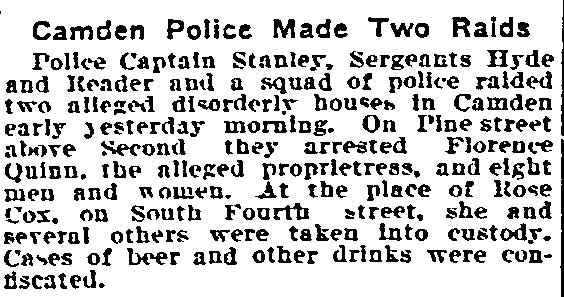
Camden Police Made Two Raids

Philadelphia Inquirer, August 20, 1906
Newspaper clipping "Camden Police Made Two Raids", Philadelphia Inquirer, August 20, 1906
Philadelphia Inquirer, August 20, 1906
View transcription
Camden Police Made Two Raids Police Captain Stanley, Sergeants Hyde and Reader and a squad of police raided two alleged disorderly houses in Camden early yesterday morning. On Pine street above Second they arrested Florence Quinn, the alleged proprietress, and eight men and women. At the place of Rose Cox, on South Fourth street, she and several others were taken into custody. Cases of beer and other drinks were confiscated.

Read the article: Camden Police Made Two Raids

Benson and Pinken Arrested for Disorderly House

Philadelphia Inquirer, August 27, 1906
Newspaper brief on the arrest of Zeke Benson and Cora Pinken, Philadelphia Inquirer, August 27, 1906
Philadelphia Inquirer, August 27, 1906
View transcription
•• Zeke Benson and Cora Pinken were arrested by Police Captain Stanley and Sergeant Hyde in Camden yesterday on a charge of maintaining a disorderly house at 734 Chestnut street. The complainant was Ella Hill, who, as well as the defendants, is colored.

Read the article: Benson and Pinken Arrested for Disorderly House

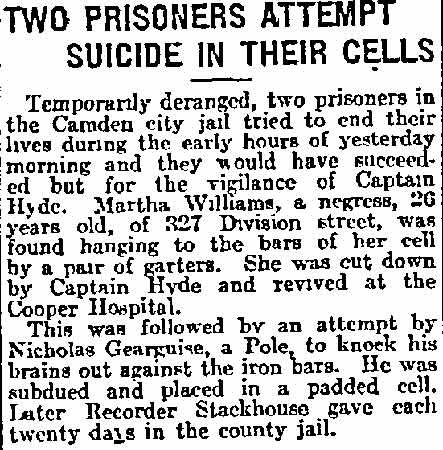
Two Prisoners Attempt Suicide in Their Cells

Philadelphia Inquirer, December 27, 1912
Newspaper clipping "Two Prisoners Attempt Suicide in Their Cells", Philadelphia Inquirer, December 27, 1912
Philadelphia Inquirer, December 27, 1912
View transcription
Two Prisoners Attempt Suicide in Their Cells Temporarily deranged, two prisoners in the Camden city jail tried to end their lives during the early hours of yesterday morning and they would have succeeded but for the vigilance of Captain Hyde. Martha Williams, a negress, 26 years old, of 327 Division street, was found hanging to the bars of her cell by a pair of garters. She was cut down by Captain Hyde and revived at the Cooper Hospital. This was followed by an attempt by Nicholas Gearguise, a Pole, to knock his brains out against the iron bars. He was subdued and placed in a padded cell. Later Recorder Stackhouse gave each twenty days in the county jail.

Read the article: Two Prisoners Attempt Suicide in Their Cells

$600,000 Will Be Spent on Camden

Philadelphia Inquirer, March 26, 1915
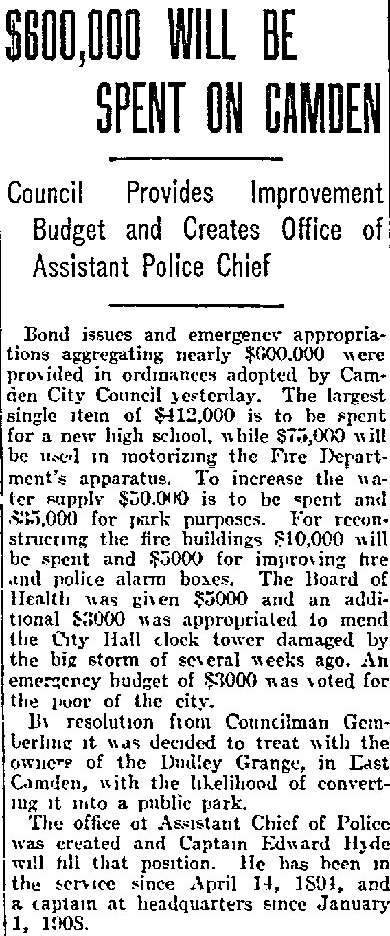
Newspaper clipping "$600,000 Will Be Spent on Camden", Philadelphia Inquirer, March 26, 1915
Philadelphia Inquirer, March 26, 1915
View transcription
$600,000 Will Be Spent on Camden Council Provides Improvement Budget and Creates Office of Assistant Police Chief Bond issues and emergency appropriations aggregating nearly $600,000 were provided in ordinances adopted by Camden City Council yesterday. The largest single item of $412,000 is to be spent for a new high school, while $75,000 will be used in motorizing the Fire Department's apparatus. To increase the water supply $50,000 is to be spent and $[?]5,000 for park purposes. For reconstructing the fire buildings $10,000 will be spent and $5000 for improving fire and police alarm boxes. The Board of Health was given $5000 and an additional $3000 was appropriated to mend the City Hall clock tower damaged by the big storm of several weeks ago. An emergency budget of $3000 was voted for the poor of the city. By resolution from Councilman Gemberling it was decided to treat with the owners of the Dudley Grange, in East Camden, with the likelihood of converting it into a public park. The office of Assistant Chief of Police was created and Captain Edward Hyde will fill that position. He has been in the service since April 14, 18[?]4, and a captain at headquarters since January 1, 1908.

Read the article: $600,000 Will Be Spent on Camden

Philadelphia Inquirer, March 26, 1915
Newspaper clipping on Camden's $600,000 budget and the new Assistant Police Chief post, Philadelphia Inquirer, March 26, 1915
Philadelphia Inquirer, March 26, 1915
View transcription
ment's apparatus. To increase the water supply $50,000 is to be spent and $[?]5,000 for park purposes. For reconstructing the fire buildings $10,000 will be spent and $5000 for improving fire and police alarm boxes. The Board of Health was given $5000 and an additional $3000 was appropriated to mend the City Hall clock tower damaged by the big storm of several weeks ago. An emergency budget of $3000 was voted for the poor of the city. By resolution from Councilman Gemberling it was decided to treat with the owners of the Dudley Grange, in East Camden, with the likelihood of converting it into a public park. The office of Assistant Chief of Police was created and Captain Edward Hyde will fill that position. He has been in the service since April 14, 18[?]4, and a captain at headquarters since January 1, 1908.

Murder Mystery at Third and Chestnut Streets

Philadelphia Inquirer, June 7, 1915
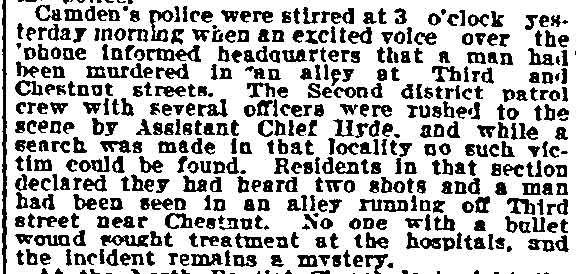
Newspaper brief on an unfounded murder report at Third and Chestnut Streets, Camden, Philadelphia Inquirer, June 7, 1915
Philadelphia Inquirer, June 7, 1915
View transcription
Camden's police were stirred at 3 o'clock yesterday morning when an excited voice over the 'phone informed headquarters that a man had been murdered in an alley at Third and Chestnut streets. The Second district patrol crew with several officers were rushed to the scene by Assistant Chief Hyde, and while a search was made in that locality no such victim could be found. Residents in that section declared they had heard two shots and a man had been seen in an alley running off Third street near Chestnut. No one with a bullet wound sought treatment at the hospitals, and the incident remains a mystery.

Read the article: Murder Mystery at Third and Chestnut Streets

Negro With Smallpox Discovered in Camden

Philadelphia Inquirer, January 6, 1916
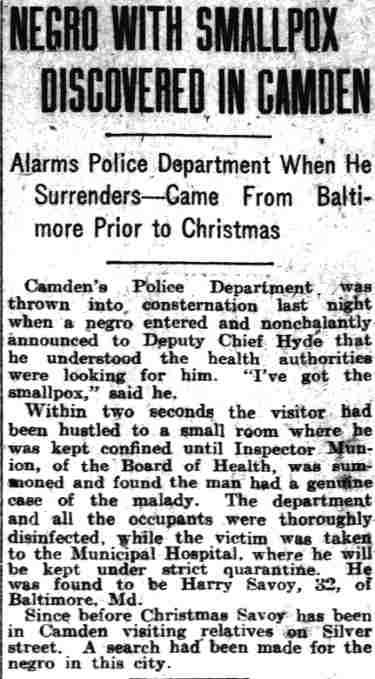
Newspaper clipping "Negro With Smallpox Discovered in Camden", Philadelphia Inquirer, January 6, 1916
Philadelphia Inquirer, January 6, 1916
View transcription
Negro With Smallpox Discovered in Camden Alarms Police Department When He Surrenders—Came From Baltimore Prior to Christmas Camden's Police Department was thrown into consternation last night when a negro entered and nonchalantly announced to Deputy Chief Hyde that he understood the health authorities were looking for him. "I've got the smallpox," said he. Within two seconds the visitor had been hustled to a small room where he was kept confined until Inspector Munion, of the Board of Health, was summoned and found the man had a genuine case of the malady. The department and all the occupants were thoroughly disinfected, while the victim was taken to the Municipal Hospital, where he will be kept under strict quarantine. He was found to be Harry Savoy, 32, of Baltimore, Md. Since before Christmas Savoy has been in Camden visiting relatives on Silver street. A search had been made for the negro in this city.

Read the article: Negro With Smallpox Discovered in Camden

Wilson Ashbridge, Camden Post-Telegram, July 18, 1916
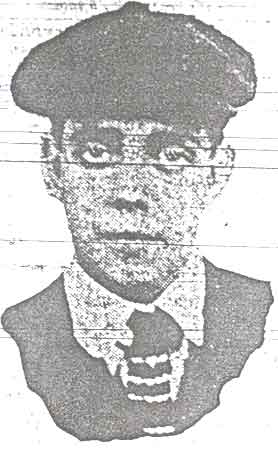
Portrait of Wilson Ashbridge
Wilson Ashbridge, Camden Post-Telegram, July 18, 1916

George E. Thompson, Camden Post-Telegram, July 18, 1916
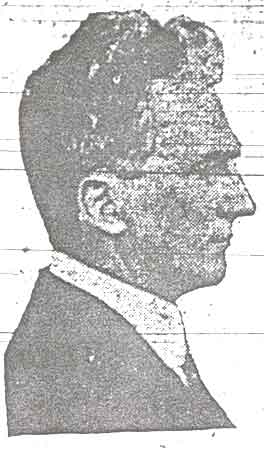
Portrait of George E. Thompson
George E. Thompson, Camden Post-Telegram, July 18, 1916

Mrs. Marion Ashbridge
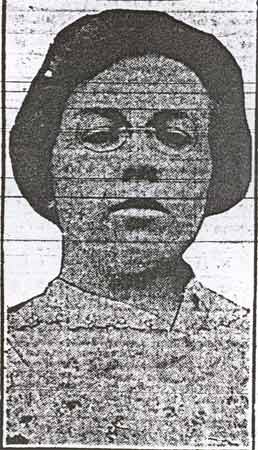
Portrait of Mrs. Marion Ashbridge
Mrs. Marion Ashbridge

Murderer and His Wife Are Caught at Chester Hotel

Camden Daily Courier, July 19, 1916
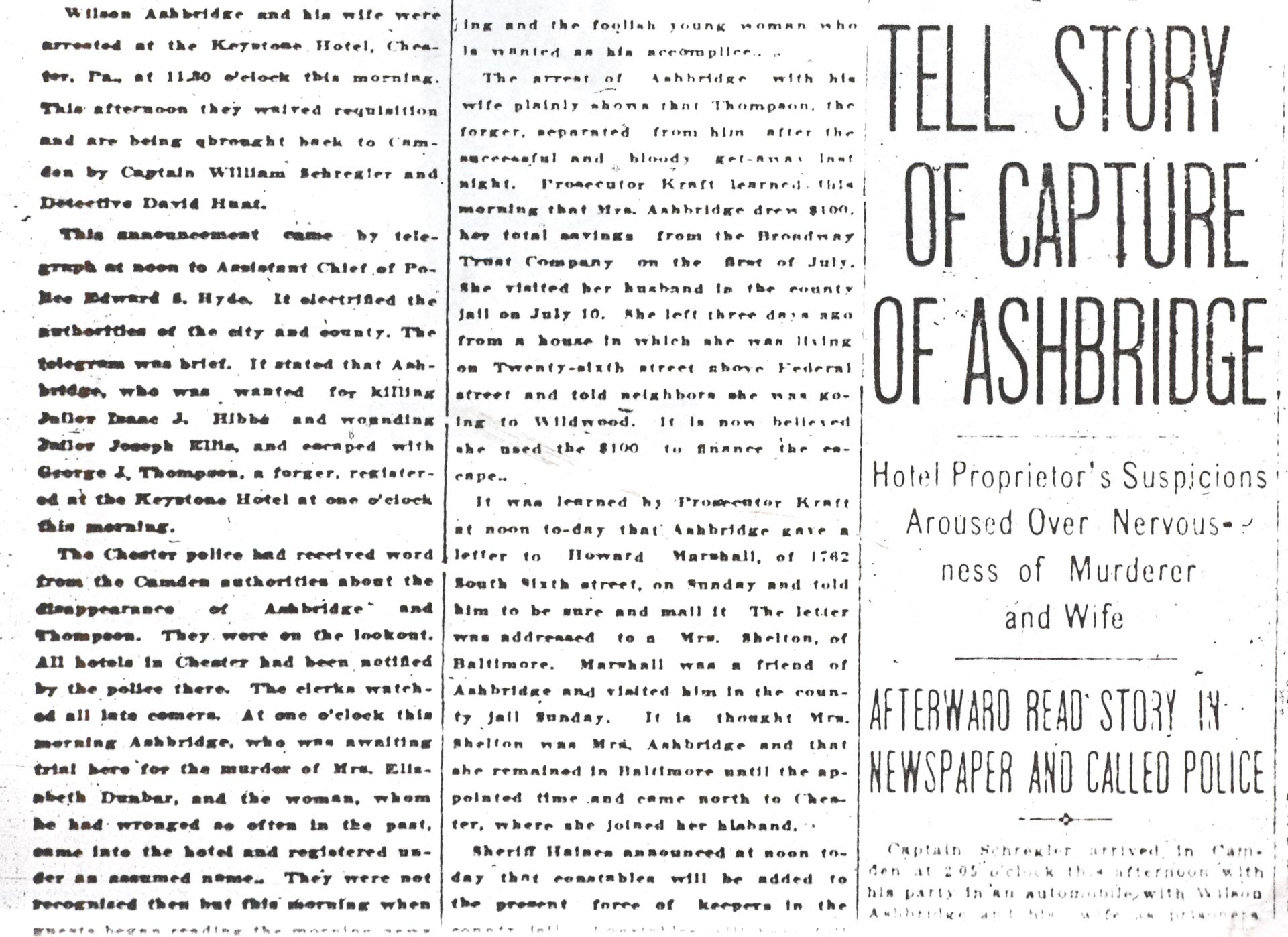
Newspaper clipping of three columns of text about the capture of Wilson Ashbridge and his wife at a Chester hotel, with the large headline Tell Story of Capture of Ashbridge
Camden Daily Courier, July 19, 1916
View transcription
Wilson Ashbridge and his wife were arrested at the Keystone Hotel, Chester, Pa., at 11:30 o'clock this morning. This afternoon they waived requisition and are being qbrought back to Camden by Captain William Schregler and Detective David Hunt. This announcement came by telegraph at noon to Assistant Chief of Police Edward S. Hyde. It electrified the authorities of the city and county. The telegram was brief. It stated that Ashbridge, who was wanted for killing Jailer Isaac J. Hibbs and wounding Jailer Joseph Ellis, and escaped with George J. Thompson, a forger, registered at the Keystone Hotel at one o'clock this morning. The Chester police had received word from the Camden authorities about the disappearance of Ashbridge and Thompson. They were on the lookout. All hotels in Chester had been notified by the police there. The clerks watched all late comers. At one o'clock this morning Ashbridge, who was awaiting trial here for the murder of Mrs. Elisabeth Dunbar, and the woman, whom he had wronged so often in the past, came into the hotel and registered under an assumed name. They were not recognized then but this morning when guests began reading the morning news ing and the foolish young woman who is wanted as his accomplice. The arrest of Ashbridge with his wife plainly shows that Thompson, the forger, separated from him after the successful and bloody get-away last night. Prosecutor Kraft learned this morning that Mrs. Ashbridge drew $100, her total savings from the Broadway Trust Company on the first of July. She visited her husband in the county jail on July 10. She left three days ago from a house in which she was living on Twenty-sixth street above Federal street and told neighbors she was going to Wildwood. It is now believed she used the $100 to finance the escape. It was learned by Prosecutor Kraft at noon to-day that Ashbridge gave a letter to Howard Marshall, of 17[?]2 South Sixth street, on Sunday and told him to be sure and mail it. The letter was addressed to a Mrs. Shelton, of Baltimore. Marshall was a friend of Ashbridge and visited him in the county jail Sunday. It is thought Mrs. Shelton was Mrs. Ashbridge and that she remained in Baltimore until the appointed time and came north to Chester, where she joined her hisband. Sheriff Haines announced at noon to-day that constables will be added to the present force of keepers in the [illegible] Tell Story of Capture of Ashbridge Hotel Proprietor's Suspicions Aroused Over Nervousness of Murderer and Wife Afterward Read Story in Newspaper and Called Police Captain Schregler arrived in Camden at 2:05 o'clock this afternoon with his party in an automobile, with Wilson Ashbridge and his wife as prisoners

Read the article: Murderer and His Wife Are Caught at Chester Hotel

Camden Hails Her Sons, Conquerors, at Victory Jubilee

Philadelphia Inquirer, September 7, 1919
Headline crop of "Camden Hails Her Sons, Conquerors, at Victory Jubilee", Philadelphia Inquirer, September 7, 1919
Philadelphia Inquirer, September 7, 1919
View transcription
CAMDEN HAILS HER SONS, CONQUERORS, AT VICTORY JUBILEE Battle Flags Wave in Triumph O'er Parade Reviewed by Admiral Gray Veterans of G. A. R. and Wounded Ride; Centopath Passes in Reverential Hush

Read the article: Camden Hails Her Sons, Conquerors, at Victory Jubilee

Philadelphia Inquirer, September 7, 1919
Opening paragraphs of the Philadelphia Inquirer's Camden Victory Jubilee report, September 7, 1919
Philadelphia Inquirer, September 7, 1919
View transcription
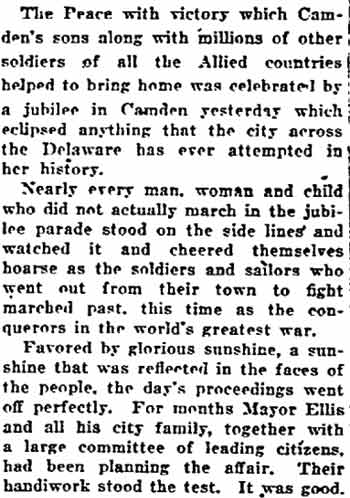
The Peace with victory which Camden's sons along with millions of other soldiers of all the Allied countries helped to bring home was celebrated by a jubilee in Camden yesterday which eclipsed anything that the city across the Delaware has ever attempted in her history. Nearly every man, woman and child who did not actually march in the jubilee parade stood on the side lines and watched it and cheered themselves hoarse as the soldiers and sailors who went out from their town to fight marched past, this time as the conquerors in the world's greatest war. Favored by glorious sunshine, a sunshine that was reflected in the faces of the people, the day's proceedings went off perfectly. For months Mayor Ellis and all his city family, together with a large committee of leading citizens, had been planning the affair. Their handiwork stood the test. It was good.

Philadelphia Inquirer, September 7, 1919
Newspaper column on Admiral Wilson's visit and the Camden jubilee cenotaph, Philadelphia Inquirer, September 7, 1919
Philadelphia Inquirer, September 7, 1919
View transcription
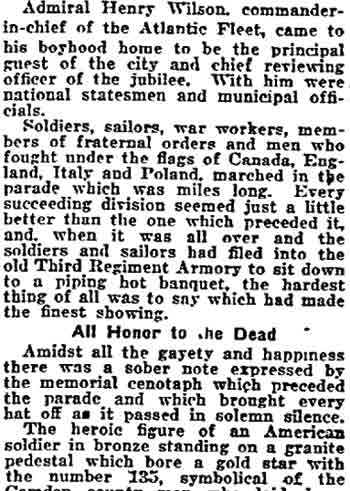
Admiral Henry Wilson, commander-in-chief of the Atlantic Fleet, came to his boyhood home to be the principal guest of the city and chief reviewing officer of the jubilee. With him were national statesmen and municipal officials. Soldiers, sailors, war workers, members of fraternal orders and men who fought under the flags of Canada, England, Italy and Poland, marched in the parade which was miles long. Every succeeding division seemed just a little better than the one which preceded it, and, when it was all over and the soldiers and sailors had filed into the old Third Regiment Armory to sit down to a piping hot banquet, the hardest thing of all was to say which had made the finest showing. All Honor to the Dead Amidst all the gayety and happiness there was a sober note expressed by the memorial cenotaph which preceded the parade and which brought every hat off as it passed in solemn silence. The heroic figure of an American soldier in bronze standing on a granite pedestal which bore a gold star with the number 135, symbolical of the

Philadelphia Inquirer, September 7, 1919
Newspaper column on the cenotaph and service men marching in Camden's Victory Jubilee, Philadelphia Inquirer, September 7, 1919
Philadelphia Inquirer, September 7, 1919
View transcription
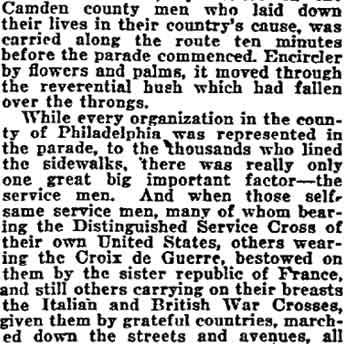
Camden county men who laid down their lives in their country's cause, was carried along the route ten minutes before the parade commenced. Encircler by flowers and palms, it moved through the reverential hush which had fallen over the throngs. While every organization in the county of Philadelphia was represented in the parade, to the thousands who lined the sidewalks, there was really only one great big important factor—the service men. And when those self-same service men, many of whom bearing the Distinguished Service Cross of their own United States, others wearing the Croix de Guerre, bestowed on them by the sister republic of France, and still others carrying on their breasts the Italian and British War Crosses, given them by grateful countries, marched down the streets and avenues, all

Philadelphia Inquirer, September 7, 1919
Newspaper column on service men, yeomanettes and Canadian and English veterans in the Camden jubilee parade, 1919
Philadelphia Inquirer, September 7, 1919
View transcription
the pent up emotion in thousands of hearts was let loose. It mattered not whether the men were officers or enlisted men, black or white, neat or untidy, they were all soldiers and they had done all that was asked of them. Their home town honored them. The men in blue and the women in blue, too, received a welcome not one whit less feeling than their brothers in khaki. They had a certain advantage over the doughboys, for they put half a dozen of the prettiest and smartest yoemanettes that ever wore Uncle Sam's uniform at the head of their division. The crowd simply had to be with them. Canada and England, too, had a detachment of men in line. About two dozen of these veterans, half of whom Continued on 2d Page, 2d Col.

Philadelphia Inquirer, September 7, 1919
Newspaper column on Red Cross women, Salvation Army lassies and fraternal orders marching in Camden's Victory Jubilee, 1919
Philadelphia Inquirer, September 7, 1919
View transcription
Camden Hails Her Sons, Conquerors, at Victory Jubilee Continued From First Page wore the ribbon of the Mons Star, showing that they were in service in France in 1914, were in line, and they marched snappily and smartly and drew their full modicum of pleasurable comments. Red Cross women, some of them grandmothers, others young girls still in their teens, marched in their snowy white uniforms with their crosses of red emblazoned on headcover and breast. Salvation Army lassies who had cooked doughnuts right up under the muzzles of the guns were there with Y. M. C. A. and Knights of Columbus workers. Elks, Masons, Knights Templar, Red Men, Moose and scores of other fraternal organizations turned out in all their glorious trappings and regalia.

Philadelphia Inquirer, September 7, 1919

Newspaper column on the Elks, Knights Templar and parade floats in Camden's Victory Jubilee, Philadelphia Inquirer, 1919
Philadelphia Inquirer, September 7, 1919
View transcription
The delegation of Elks, startling in their spic and span white uniforms, marched behind their own band like squads of veterans. A foretaste of what Philadelphia will see during the coming week was given when more than 100 Knights Templar, resplendent in their uniforms and swords and cocked hats with white ostrich feathers, marched in the second division of the parade. As the formation reached the reviewing stand near the Ninth Ward Republican Association they deployed into the formation of a cross, the symbol of their order, and marched past in this formation. Many gorgeous floats were in line, th Ninth Ward Republican Association having no less than five. All were artistic. The first was bedecked with growing flowers, while a beautiful young woman reprsenting "Peace" stood flanked by a soldier and sailor. The one following had a replica of the Liberty Bell with the inscription, "Peace on Earth, Good Will Towards men." Two soldiers rang the bell. Behind them marched a band playing "Onward Christian Soldiers" as the men marched on. Floats symbolical of every war activity were there. The Knights of Columbus showed a replica

Philadelphia Inquirer, September 7, 1919

Newspaper column on veterans of other wars, the wounded and officers of the service division in Camden's Victory Jubilee, 1919
Philadelphia Inquirer, September 7, 1919
View transcription
of their famous service hut which was the doughboy's home when he had no other. The veterans of other wars were not forgotten in this jubilee of the greatest war of all. Grand Army men whose gray locks bespoke their years rode in automobiles bearing the tattered colors of their old Civil War regiments. The soldiers of a later day, men of the Spanish-American War, were in line with their comrades. The wounded were there, too. They could not march in the parade, but they rode and their faces were smiling and their hearts were glad as they realized that this welcome was for them. Triumphal arches were erected at points along the route of the parade and the square at the courthouse was a mass of color. Among the officers in command of the sections of the service division were Lieutenant Colonel Samuel G. Barnard, of the 112th Field Artillery; Captain J. Walter Scott, former adjutant of the Third Regiment; Captains English, Richards and Dickinson, of Battery B; Lieutenant J. G. Williams, Ensign Beaston and Lieutenant William Opfermann, of the aviation corps.

Philadelphia Inquirer, September 7, 1919

Newspaper column headed "Battle Flags Wave Triumphant" on the start of the Camden Victory Jubilee parade, 1919
Philadelphia Inquirer, September 7, 1919
View transcription
Battle Flags Wave Triumphant Shortly after 1.30 o'clock James H. Long, chairman of the parade committee of the Victory Jubilee and Memorial Committee and marshal of the pageant, gave the order to march. The Lyric Band, which escorted nearly all of the troops to the terminal in the dark days of the war, was given the honor of heading the line. Chief of Police E. A. Gravenor and Assistant Chief of Police Edward S. Hyde led the parade, followed by a platoon of mounted policemen under Captain William E. Albert. Then came Marshal Long and his aides, who were: Frank E. Van Hart, William D. Sayrs, Jr., Frank Fithian, A. Benjamin Sparks, Kessel Webster, William Isgard, Robert D. Clow, Andrew B. F. Smith, William Lorrigan, Charles Austermuhl, David Doane, William C. Davis and William D. Vanaman. Directly behind the Lyric Band marched Mayor Charles H. Ellis at the head of the Victory Jubilee and Memorial Committee, of which he is chairman. And at the head of the division were the battle flags of the Twenty-ninth and Seventy-eighth divisions, on which General John J. Pershing personally pinned battle pennants during those me

Philadelphia Inquirer, September 7, 1919

Newspaper column on the engineers, 112th Field Artillery and 78th Division in Camden's Victory Jubilee parade, 1919
Philadelphia Inquirer, September 7, 1919
View transcription
morable days back in October in the Argonne forest. Behind the 4th marched the famous engineers, headed by Captain Keasby and Captain Beals Smuck. Three battle pennants were pinned to their flags, which never touched the ground while they were bridging the rivers in the Argonne under hellish shell fire for the doughboys to advance. Then came the 112th Field Artillery, Battery B's heroes of the border and of France, headed by Captain Charles Richards and Captain Dickinson. In the same section marched the Eleventh Machine Gun Battalion with its battle flags and pennants fluttering. There was another great cheer as the Seventy-eighth Division, New Jersey's Lightning boys, loomed into view. The heroes of the 311th Infantry, 303d Engineers, 307th, 308th and 309th Field Artillery and other regiments of that famous command were given a mighty ovation behind their battle flags, which led them in their assault on St. Mihiel and the day they attacked and captured Grand-Pre in the terrible conflict in the Argonne.

Philadelphia Inquirer, September 7, 1919

Newspaper column on the Marines, the naval contingent and Admiral Wilson's review in Camden's Victory Jubilee, 1919
Philadelphia Inquirer, September 7, 1919
View transcription
Behind them marched the Marines, headed by Lieutenant Monitor Watchman, of the Fifth Regiment, Second Division. With the Marines marched the regular army units, men who had served in as many as five battles and wore three and four gold service stripes on their sleeves. Then followed the naval contingent. They were commanded by Commander Francis W. Hoffman and Commander W. G. Hodgson. The order "eyes left" flashed along the line as each platoon drew near the reviewing stand and Admiral Wilson with his hand to his cap returned the salute. With the admiral on the stand were former United States Senator David Baird, Congressman William J. Browning, County Collector John S. Well, City Clerk W. D. Brown and others. At the armory a splendid banquet was served to the soldiers and sailors. For days past corps Red Cross workers had been preparing the good things to eat and the men did full justice to them. They marched in the armory where the food was spread on the tables and enjoyed themselves while

Philadelphia Inquirer, September 7, 1919

Newspaper column with Mayor Ellis's welcome speech at the Camden Victory Jubilee banquet, Philadelphia Inquirer, 1919
Philadelphia Inquirer, September 7, 1919
View transcription
bands played. After dinner there were speeches. Mayor Ellis in welcoming the men said: "This is one of the happiest moments of my life. I have waited patiently through months of trial for the glad day when I could bid you welcome to the City of Camden once again. "We are planning to erect a lasting memorial in memory of those heroes who gave their lives and in memory of the valiant deeds you performed on land and sea. "Camden will always cherish the memory of this day, rever the memory of your dead comrades and will inscribe your valiant deeds on that memorial. I bid you welcome in the name of the most patriotic little city in America. I thank you." Prosecutor Charles A. Wolverton welcomed the men on behalf of the county and paid a tribute to their valor recalling their wonderful victories of the Argonne and other battlefields of France.

Camden Merchant on Trial for Arson

Philadelphia Inquirer, October 20, 1922
Headline and opening paragraph of "Camden Merchant on Trial for Arson", Philadelphia Inquirer, October 20, 1922
Philadelphia Inquirer, October 20, 1922
View transcription
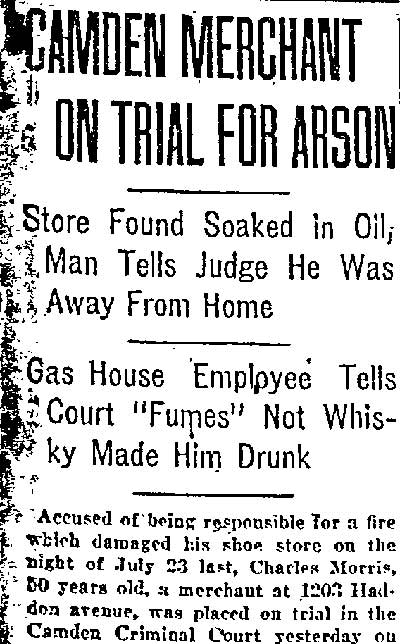
CAMDEN MERCHANT ON TRIAL FOR ARSON Store Found Soaked in Oil; Man Tells Judge He Was Away From Home Gas House Emplpyee Tells Court "Fumes" Not Whisky Made Him Drunk Accused of being responsible for a fire which damaged his shoe store on the night of July 23 last, Charles Morris, 50 years old, a merchant at 1203 Haddon avenue, was placed on trial in the Camden Criminal Court yesterday on

Read the article: Camden Merchant on Trial for Arson

Philadelphia Inquirer, October 20, 1922

Camden Merchant on Trial for Arson newspaper clipping, page 2
Philadelphia Inquirer, October 20, 1922
View transcription
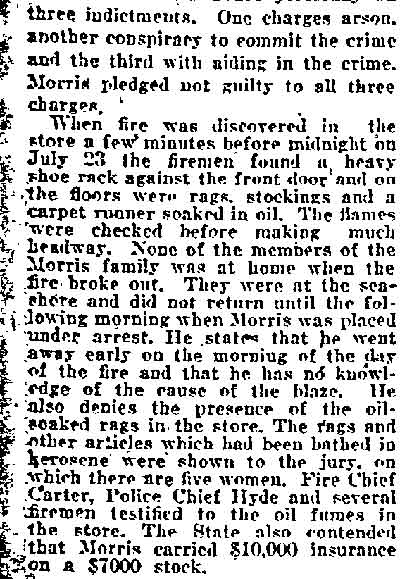
[illegible] three indictments. One charges arson, another conspiracy to commit the crime and the third with aiding in the crime. Morris pledged not guilty to all three charges, When fire was discovered in the store a few minutes before midnight on July 23 the firemen found a heavy shoe rack against the front door and on the floors were rags, stockings and a carpet runner soaked in oil. The flames were checked before making much headway. None of the members of the Morris family was at home when the fire broke out. They were at the seashore and did not return until the following morning when Morris was placed under arrest. He states that he went away early on the morning of the day of the fire and that he has no knowledge of the cause of the blaze. He also denies the presence of the oil-soaked rags in the store. The rags and other articles which had been bathed in kerosene were shown to the jury, on which there are five women. Fire Chief Carter, Police Chief Hyde and several firemen testified to the oil fumes in the store. The State also contended that Morris carried $10,000 insurance on a $7000 stock.

Chief of Camden Police Is Retired

Trenton Evening Times, June 27, 1923
Chief of Camden Police Is Retired, Trenton Evening Times, June 27, 1923
Trenton Evening Times, June 27, 1923
View transcription
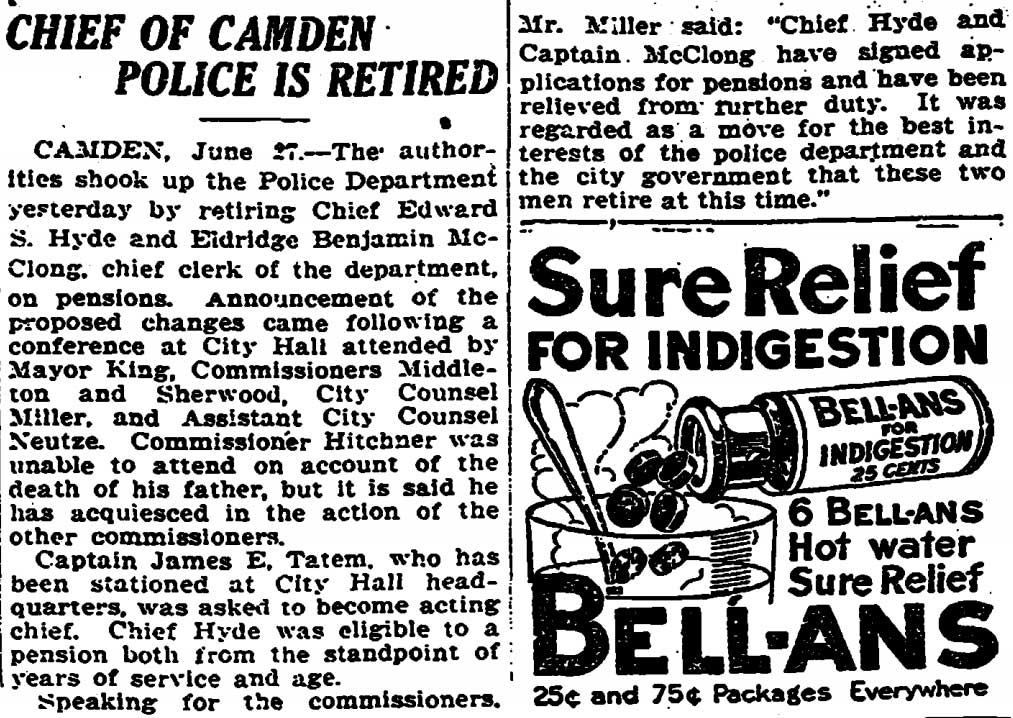
CHIEF OF CAMDEN POLICE IS RETIRED CAMDEN, June 27.—The authorities shook up the Police Department yesterday by retiring Chief Edward S. Hyde and Eidridge Benjamin McClong, chief clerk of the department, on pensions. Announcement of the proposed changes came following a conference at City Hall attended by Mayor King, Commissioners Middleton and Sherwood, City Counsel Miller, and Assistant City Counsel Neutze. Commissioner Hitchner was unable to attend on account of the death of his father, but it is said he has acquiesced in the action of the other commissioners. Captain James E. Tatem, who has been stationed at City Hall headquarters, was asked to become acting chief. Chief Hyde was eligible to a pension both from the standpoint of years of service and age. Speaking for the commissioners, Mr. Miller said: "Chief Hyde and Captain McClong have signed applications for pensions and have been relieved from further duty. It was regarded as a move for the best interests of the police department and the city government that these two men retire at this time." Sure Relief FOR INDIGESTION BELL-ANS FOR INDIGESTION 25 CENTS 6 BELL-ANS Hot water Sure Relief BELL-ANS 25¢ and 75¢ Packages Everywhere

Read the article: Chief of Camden Police Is Retired

Edward S. Hyde Dies; Former Police Chief

Camden Courier-Post, April 14, 1930
Edward S. Hyde Dies; Former Police Chief, Camden Courier-Post, April 14, 1930
Camden Courier-Post, April 14, 1930
View transcription
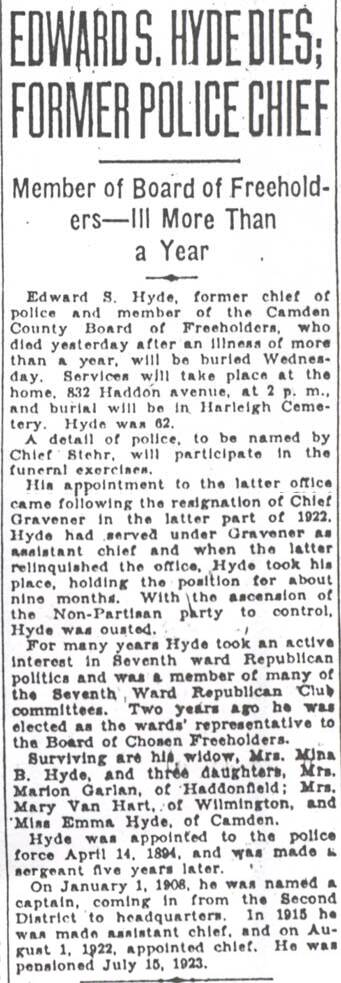
EDWARD S. HYDE DIES; FORMER POLICE CHIEF Member of Board of Freeholders—Ill More Than a Year Edward S. Hyde, former chief of police and member of the Camden County Board of Freeholders, who died yesterday after an illness of more than a year, will be buried Wednesday. Services will take place at the home, 832 Haddon avenue, at 2 p. m., and burial will be in Harleigh Cemetery. Hyde was 62. A detail of police, to be named by Chief Stehr, will participate in the funeral exercises. His appointment to the latter office came following the resignation of Chief Gravener in the latter part of 1922. Hyde had served under Gravener as assistant chief and when the latter relinquished the office, Hyde took his place, holding the position for about nine months. With the ascension of the Non-Partisan party to control, Hyde was ousted. For many years Hyde took an active interest in Seventh ward Republican politics and was a member of many of the Seventh Ward Republican Club committees. Two years ago he was elected as the wards' representative to the Board of Chosen Freeholders. Surviving are his widow, Mrs. Mina B. Hyde, and three daughters, Mrs. Marion Garlan, of Haddonfield; Mrs. Mary Van Hart, of Wilmington, and Miss Emma Hyde, of Camden. Hyde was appointed to the police force April 14, 1894, and was made a sergeant five years later. On January 1, 1908, he was named a captain, coming in from the Second District to headquarters. In 1915 he was made assistant chief, and on August 1, 1922, appointed chief. He was pensioned July 15, 1923.

Read the article: Edward S. Hyde Dies; Former Police Chief

Camden Cops of 32 Years Ago Valiant Crew Under 'Sam' Dodd

Camden Courier-Post, July 15, 1930
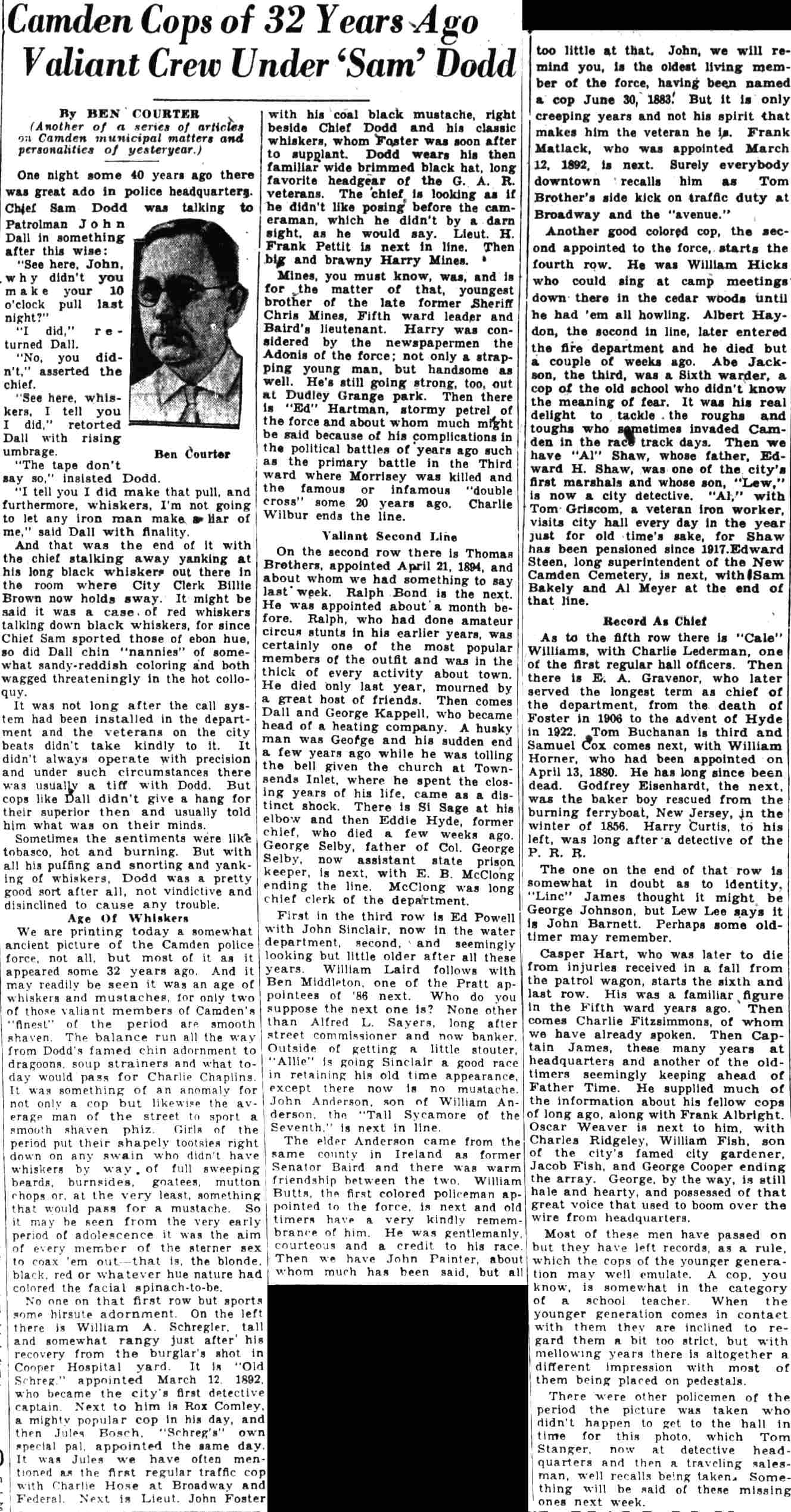
Courier-Post column on the Camden police force of 32 years earlier, with a portrait of writer Ben Courter
Camden Courier-Post, July 15, 1930
View transcription
Camden Cops of 32 Years Ago Valiant Crew Under 'Sam' Dodd By BEN COURTER (Another of a series of articles on Camden municipal matters and personalities of yesteryear.) One night some 40 years ago there was great ado in police headquarters. Chief Sam Dodd was talking to Patrolman John Dall in something after this wise: "See here, John, why didn't you make your 10 o'clock pull last night?" "I did," returned Dall. "No, you didn't," asserted the chief. "See here, whiskers, I tell you I did," retorted Dall with rising umbrage. Ben Courter "The tape don't say so," insisted Dodd. "I tell you I did make that pull, and furthermore, whiskers, I'm not going to let any iron man make a liar of me," said Dall with finality. And that was the end of it with the chief stalking away yanking at his long black whiskers out there in the room where City Clerk Billie Brown now holds sway. It might be said it was a case of red whiskers talking down black whiskers, for since Chief Sam sported those of ebon hue, so did Dall chin "nannies" of somewhat sandy-reddish coloring and both wagged threateningly in the hot colloquy. It was not long after the call system had been installed in the department and the veterans on the city beats didn't take kindly to it. It didn't always operate with precision and under such circumstances there was usually a tiff with Dodd. But cops like Dall didn't give a hang for their superior then and usually told him what was on their minds. Sometimes the sentiments were like tobasco, hot and burning. But with all his puffing and snorting and yanking of whiskers, Dodd was a pretty good sort after all, not vindictive and disinclined to cause any trouble. Age Of Whiskers We are printing today a somewhat ancient picture of the Camden police force, not all, but most of it as it appeared some 32 years ago. And it may readily be seen it was an age of whiskers and mustaches, for only two of those valiant members of Camden's "finest" of the period are smooth shaven. The balance run all the way from Dodd's famed chin adornment to dragoons, soup strainers and what today would pass for Charlie Chaplins. It was something of an anomaly for not only a cop but likewise the average man of the street to sport a smooth shaven phiz. Girls of the period put their shapely tootsies right down on any swain who didn't have whiskers by way of full sweeping beards, burnsides, goatees, mutton chops or, at the very least, something that would pass for a mustache. So it may be seen from the very early period of adolescence it was the aim of every member of the sterner sex to coax 'em out—that is, the blonde, black, red or whatever hue nature had colored the facial spinach-to-be. No one on that first row but sports some hirsute adornment. On the left there is William A. Schregler, tall and somewhat rangy just after his recovery from the burglar's shot in Cooper Hospital yard. It is "Old Schreg," appointed March 12, 1892, who became the city's first detective captain. Next to him is Rox Comley, a mighty popular cop in his day, and then Jules Bosch, "Schreg's" own special pal, appointed the same day. It was Jules we have often mentioned as the first regular traffic cop with Charlie Hose at Broadway and Federal. Next is Lieut. John Foster with his coal black mustache, right beside Chief Dodd and his classic whiskers, whom Foster was soon after to supplant. Dodd wears his then familiar wide brimmed black hat, long favorite headgear of the G. A. R. veterans. The chief is looking as if he didn't like posing before the cameraman, which he didn't by a darn sight, as he would say. Lieut. H. Frank Pettit is next in line. Then big and brawny Harry Mines. Mines, you must know, was, and is for the matter of that, youngest brother of the late former Sheriff Chris Mines, Fifth ward leader and Baird's lieutenant. Harry was considered by the newspapermen the Adonis of the force; not only a strapping young man, but handsome as well. He's still going strong, too, out at Dudley Grange park. Then there is "Ed" Hartman, stormy petrel of the force and about whom much might be said because of his complications in the political battles of years ago such as the primary battle in the Third ward where Morrisey was killed and the famous or infamous "double cross" some 20 years ago. Charlie Wilbur ends the line. Valiant Second Line On the second row there is Thomas Brothers, appointed April 21, 1894, and about whom we had something to say last week. Ralph Bond is the next. He was appointed about a month before. Ralph, who had done amateur circus stunts in his earlier years, was certainly one of the most popular members of the outfit and was in the thick of every activity about town. He died only last year, mourned by a great host of friends. Then comes Dall and George Kappell, who became head of a heating company. A husky man was George and his sudden end a few years ago while he was tolling the bell given the church at Townsends Inlet, where he spent the closing years of his life, came as a distinct shock. There is Si Sage at his elbow and then Eddie Hyde, former chief, who died a few weeks ago. George Selby, father of Col. George Selby, now assistant state prison keeper, is next, with E. B. McClong ending the line. McClong was long chief clerk of the department. First in the third row is Ed Powell with John Sinclair, now in the water department, second, and seemingly looking but little older after all these years. William Laird follows with Ben Middleton, one of the Pratt appointees of '86 next. Who do you suppose the next one is? None other than Alfred L. Sayers, long after street commissioner and now banker. Outside of getting a little stouter, "Allie" is going Sinclair a good race in retaining his old time appearance, except there now is no mustache. John Anderson, son of William Anderson, the "Tall Sycamore of the Seventh," is next in line. The elder Anderson came from the same county in Ireland as former Senator Baird and there was warm friendship between the two. William Butts, the first colored policeman appointed to the force, is next and old timers have a very kindly remembrance of him. He was gentlemanly, courteous and a credit to his race. Then we have John Painter, about whom much has been said, but all too little at that. John, we will remind you, is the oldest living member of the force, having been named a cop June 30, 1883. But it is only creeping years and not his spirit that makes him the veteran he is. Frank Matlack, who was appointed March 12, 1892, is next. Surely everybody downtown recalls him as Tom Brother's side kick on traffic duty at Broadway and the "avenue." Another good colored cop, the second appointed to the force, starts the fourth row. He was William Hicks who could sing at camp meetings down there in the cedar woods until he had 'em all howling. Albert Haydon, the second in line, later entered the fire department and he died but a couple of weeks ago. Abe Jackson, the third, was a Sixth warder, a cop of the old school who didn't know the meaning of fear. It was his real delight to tackle the roughs and toughs who sometimes invaded Camden in the race track days. Then we have "Al" Shaw, whose father, Edward H. Shaw, was one of the city's first marshals and whose son, "Lew," is now a city detective. "Al," with Tom Griscom, a veteran iron worker, visits city hall every day in the year just for old time's sake, for Shaw has been pensioned since 1917. Edward Steen, long superintendent of the New Camden Cemetery, is next, with Sam Bakely and Al Meyer at the end of that line. Record As Chief As to the fifth row there is "Cale" Williams, with Charlie Lederman, one of the first regular hall officers. Then there is E. A. Gravenor, who later served the longest term as chief of the department, from the death of Foster in 1906 to the advent of Hyde in 1922. Tom Buchanan is third and Samuel Cox comes next, with William Horner, who had been appointed on April 13, 1880. He has long since been dead. Godfrey Eisenhardt, the next, was the baker boy rescued from the burning ferryboat, New Jersey, in the winter of 1856. Harry Curtis, to his left, was long after a detective of the P. R. R. The one on the end of that row is somewhat in doubt as to identity. "Linc" James thought it might be George Johnson, but Lew Lee says it is John Barnett. Perhaps some old-timer may remember. Casper Hart, who was later to die from injuries received in a fall from the patrol wagon, starts the sixth and last row. His was a familiar figure in the Fifth ward years ago. Then comes Charlie Fitzsimmons, of whom we have already spoken. Then Captain James, these many years at headquarters and another of the old-timers seemingly keeping ahead of Father Time. He supplied much of the information about his fellow cops of long ago, along with Frank Albright. Oscar Weaver is next to him, with Charles Ridgeley, William Fish, son of the city's famed city gardener, Jacob Fish, and George Cooper ending the array. George, by the way, is still hale and hearty, and possessed of that great voice that used to boom over the wire from headquarters. Most of these men have passed on but they have left records, as a rule, which the cops of the younger generation may well emulate. A cop, you know, is somewhat in the category of a school teacher. When the younger generation comes in contact with them they are inclined to regard them a bit too strict, but with mellowing years there is altogether a different impression with most of them being placed on pedestals. There were other policemen of the period the picture was taken who didn't happen to get to the hall in time for this photo, which Tom Stanger, now at detective headquarters and then a traveling salesman, well recalls being taken. Something will be said of these missing ones next week.

Read the article: Camden Cops of 32 Years Ago Valiant Crew Under 'Sam' Dodd

Advertisement

Tag: edward-s-hyde

Baxter Street and Mount Ephraim Avenue

Baxter Street

Baxter Street (formerly Newton Street and locally known as "Hog Alley") ran from South 7th Street to Mount Ephraim Avenue in South Camden, notorious for decades as a hub of illegal activity; largely demolished, the 700 block survives as an overgrown alley.

South 2nd Street and Sycamore Street

Sycamore Street

Sycamore Street is one of Camden's "tree" streets, originally running east from Front Street to Haddon Avenue; its intersections at 7th, 8th and Louis Streets were hubs for different ethnic and cultural communities.

Scene of Camden Bombing

Ramona Gonzalez Street

Division Street runs across South Camden. In 1997, a portion of the street was renamed Ramona Gonzalez Street to honor a community leader; the remainder continues to be known as Division Street.

Sepia postcard photo of a damaged brick building and debris on a street, labeled "Camden Cyclone."

2nd Street

2nd Street extends north-south between Front Street and 3rd Street, running parallel to the Delaware River until Mechanic Street. In the early 1970s, several buildings were cleared on the east side of North 2nd Street below Mickle Street to make way for the Royal Court townhomes and Mickle Tower senior citizens apartment building.
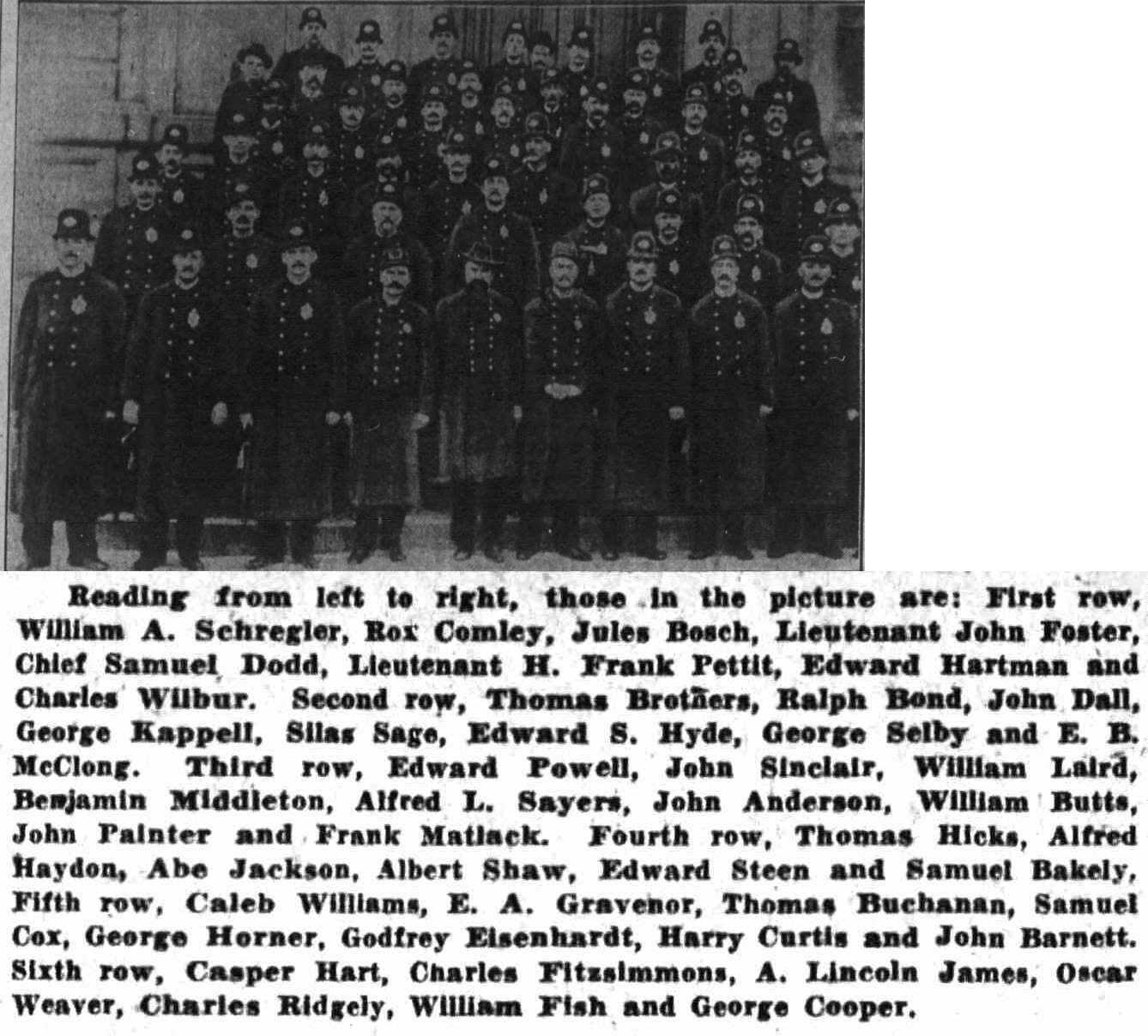
Camden Police Department group photograph from 1898, reprinted in the Camden Courier-Post

Here's Camden's Finest, With Whiskers, in 1898

A 1930 Camden Courier-Post retrospective reprints a photograph of the Camden Police Department as it appeared in 1898, with every officer in the group identified — among them Edward S. Hyde.

Courier-Post column on the Camden police force of 32 years earlier, with a portrait of writer Ben Courter

Camden Cops of 32 Years Ago Valiant Crew Under 'Sam' Dodd

Ben Courter's July 15, 1930 Camden Courier-Post column recalls Chief Samuel Dodd and his whiskered police force of about 1898, opening with an anecdote of Dodd and Patrolman John Dall and then naming the officers in each row of a group photograph.

Police Escort Funeral of Former Chief Hyde

A police motorcycle squad under Inspector Humes escorts the funeral of former police chief Edward S. Hyde, held at his Haddon Avenue home with burial in Harleigh Cemetery.

Courier-Post obituary headline "Edward S. Hyde Dies; Former Police Chief," April 14, 1930

Edward S. Hyde Dies; Former Police Chief

Edward S. Hyde, former Camden chief of police and member of the county Board of Freeholders, dies after an illness of more than a year; services will be held at his Haddon Avenue home with burial in Harleigh Cemetery.

Clipping headlined "Chief of Camden Police Is Retired," with a Bell-ans indigestion advertisement beside it

Chief of Camden Police Is Retired

Camden authorities retire Police Chief Edward S. Hyde and chief clerk Eldridge Benjamin McClong on pensions; Captain James E. Tatem is asked to become acting chief.

Changes Ordered In Camden Police

Changes Ordered in Camden Police

The police committee of Camden City Council directed Solicitor Bleakly to draft an ordinance partially reorganizing the Police Department, reducing the number of captains to one and retiring seven veteran officers on pension.

Headline and opening paragraph of "Camden Merchant on Trial for Arson", Philadelphia Inquirer, October 20, 1922

Camden Merchant on Trial for Arson

Charles Morris, a merchant at 1203 Haddon Avenue, went on trial in Camden Criminal Court on arson, conspiracy and aiding indictments over a July 23 fire at his shoe store; Fire Chief Carter and Police Chief Hyde testified to oil fumes in the store.

Action on Camden Saloons Denied

Assistant Chief Edward S. Hyde, temporarily heading the Camden police department, denies that patrolmen listing the names of saloon patrons — a Federal Prohibition enforcement measure — are acting under any police orders.
Fireman being tended to - AI Stock Photo

Police to Probe $200,000 Kaighn Ave. Fire

Mayor Charles H. Ellis ordered an investigation into the $200,000 fire that destroyed the Economy Store and adjoining buildings at 427-429 Kaighn Avenue, injuring five Camden firemen — one of them, Captain Martin B. Carrigan, critically.

Camden Courier clipping, Underworld Life Exposed as Hall Is Given Grilling, January 12, 1922

Underworld Life Exposed as Hall Is Given Grilling

Camden policeman Ira Hall is dismissed by the City Council police committee after a hearing on vice conditions in the Third and Fifth wards, including testimony about a $250 robbery of a soldier at 229 Pine Street.
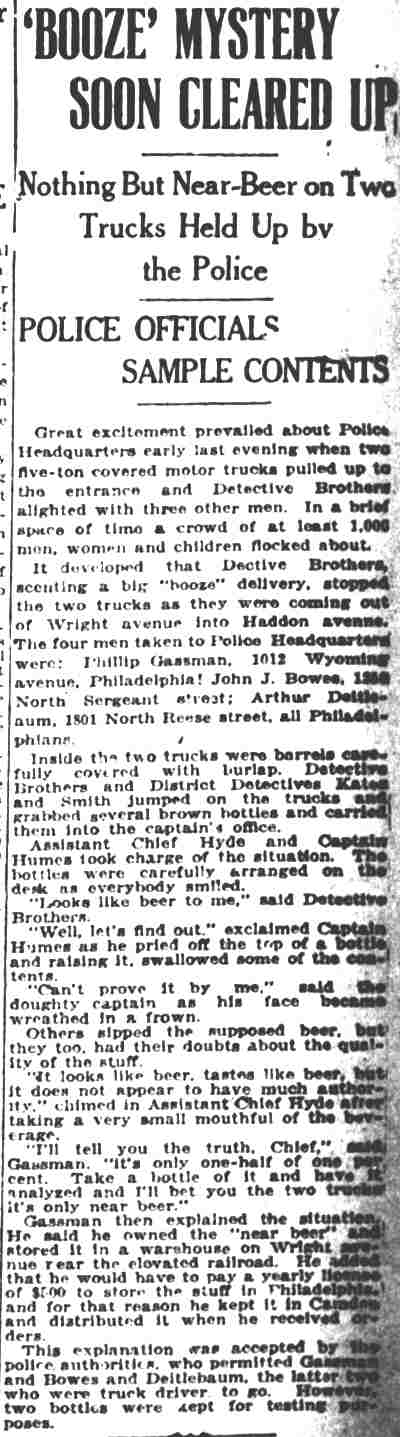
charlesthumes-072621-1b.jpg

'Booze' Mystery Soon Cleared Up

Detective Brothers stops two five-ton trucks suspected of a big Prohibition-era liquor delivery; Assistant Chief Hyde and Captain Humes take charge, only to find the bottles hold nothing but near-beer.

Camden Hails Her Sons, Conquerors, at Victory Jubilee

Camden Hails Her Sons, Conquerors, at Victory Jubilee

Camden held a Victory Jubilee parade and banquet on September 6, 1919, reviewed by Admiral Henry B. Wilson, honoring returning soldiers and sailors and the 135 Camden County men who died in the war.
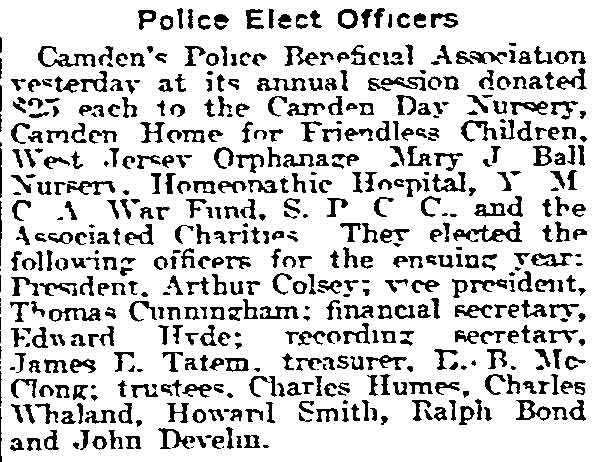
charlesthumes-120417-inq.jpg

Police Elect Officers

The Camden Police Beneficial Association makes charitable donations at its annual session and elects officers for the year, including Edward Hyde as financial secretary.

Newspaper clipping of three columns of text about the capture of Wilson Ashbridge and his wife at a Chester hotel, with the large headline Tell Story of Capture of Ashbridge

Murderer and His Wife Are Caught at Chester Hotel

Wilson Ashbridge and his wife are arrested at the Keystone Hotel in Chester, Pa., after the jailbreak in which Jailer Isaac J. Hibbs was killed, and are brought back to Camden by Captain William Schregler and Detective David Hunt.

Portrait of Wilson Ashbridge

Murderer and Forger Escape Jail After Shooting Keepers, Killing One

Wilson Ashbridge, slayer of Mrs. Elizabeth Dunbar, and forger George E. Thompson shoot their way out of the Camden County Jail with a smuggled revolver, killing keeper Isaac Hibbs and wounding Joseph Ellis; a general jail delivery is averted by police summoned by the wounded men.

Newspaper clipping "Negro With Smallpox Discovered in Camden", Philadelphia Inquirer, January 6, 1916

Negro With Smallpox Discovered in Camden

A man surrenders at Camden police headquarters announcing to Deputy Chief Hyde that he has smallpox; he is confined and removed to the Municipal Hospital under quarantine.

Newspaper brief on an unfounded murder report at Third and Chestnut Streets, Camden, Philadelphia Inquirer, June 7, 1915

Murder Mystery at Third and Chestnut Streets

A 3 a.m. telephone report of a murder in an alley at Third and Chestnut streets sends the Second district patrol, under Assistant Chief Hyde, to the scene — but no victim is ever found.

Newspaper clipping "$600,000 Will Be Spent on Camden", Philadelphia Inquirer, March 26, 1915

$600,000 Will Be Spent on Camden

Camden City Council adopts bond issues and appropriations of nearly $600,000 — including a new high school and Fire Department motorization — and creates the office of Assistant Police Chief.
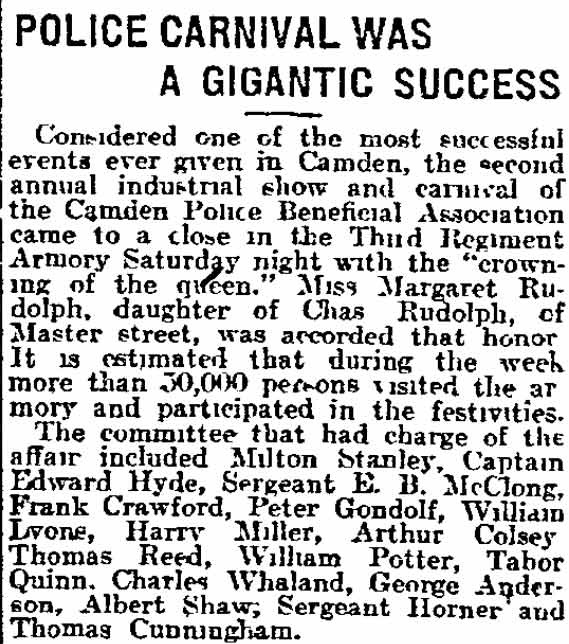
ebmcclong-021614-inq.jpg

Police Carnival was a Gigantic Success

The second annual industrial show and carnival of the Camden Police Beneficial Association draws more than 50,000 to the Third Regiment Armory; Captain Edward Hyde served on the organizing committee.
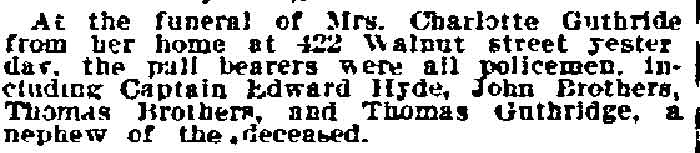
Newspaper clipping "Two Prisoners Attempt Suicide in Their Cells", Philadelphia Inquirer, December 27, 1912

Two Prisoners Attempt Suicide in Their Cells

Two prisoners in the Camden city jail attempt to take their own lives; the vigilance of Captain Hyde saves them, and both are given twenty days by Recorder Stackhouse.
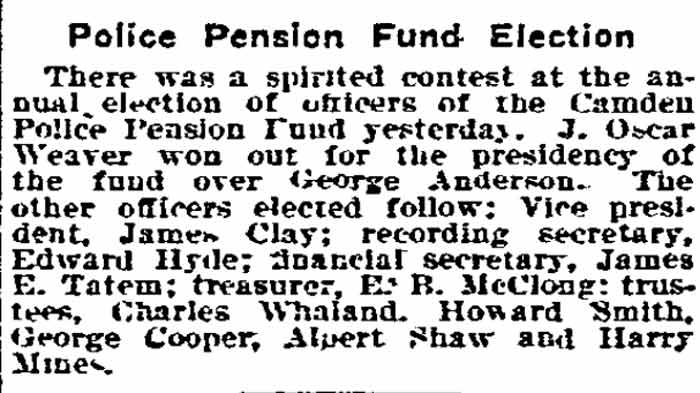
ebmcclong-011410-inq.jpg

Police Pension Fund Election

J. Oscar Weaver wins the presidency of the Camden Police Pension Fund over George Anderson in a spirited annual election; Edward Hyde is elected recording secretary.
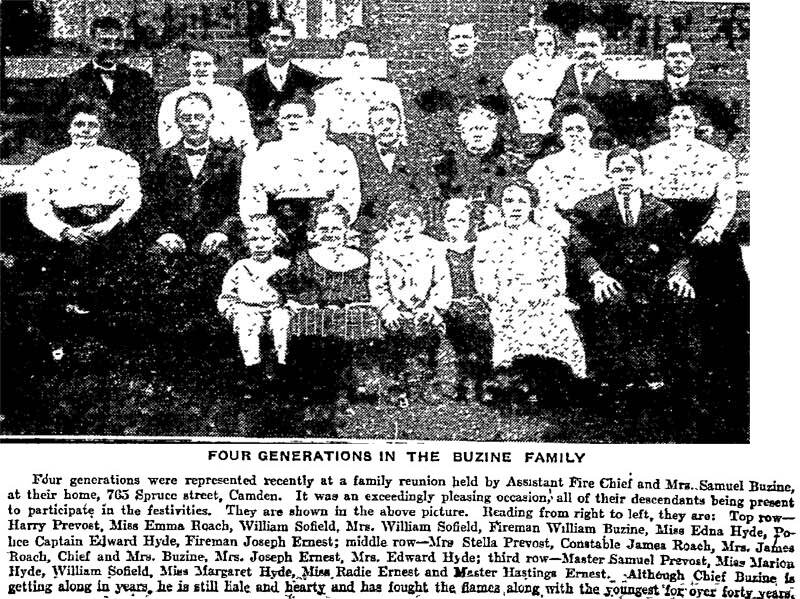
sambuzine-120509-inq-1b.jpg

Four Generations in the Buzine Family

Four generations gather at a family reunion held by Assistant Fire Chief Samuel Buzine and his wife; the group includes Police Captain Edward Hyde, who married into the Buzine family.
Newspaper column "Camden News Notes" with eight short local items, Philadelphia Inquirer, Dec. 9, 1908.

Camden News Notes

A column of Camden news items, including the nomination of officers for the Camden Police Pension Fund — with Edward Hyde nominated recording secretary — the funeral of George Bird, and the death of William Baldwin of 510 Kaighn Avenue.
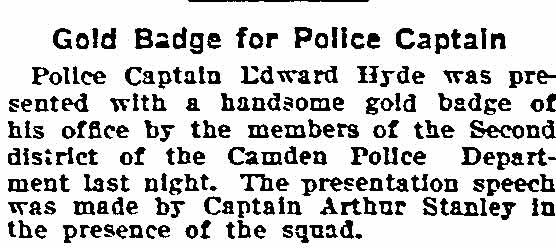
Gold Badge for Police Captain newspaper clipping

Gold Badge for Police Captain

Police Captain Edward Hyde was presented with a gold badge of his office by the men of Camden's Second District; Captain Arthur Stanley made the presentation speech.
charlesthumes-010108-inq-1.jpg

Camden Increases Its Police Force

Mayor Ellis adds twenty-five officers to the Camden police force and orders several promotions, elevating Edward Hyde and A. Lincoln James from sergeants to captains.

Newspaper clipping "Camden Police Made Two Raids", Philadelphia Inquirer, August 20, 1906

Camden Police Made Two Raids

Captain Stanley, Sergeants Hyde and Reader, and a police squad raid two alleged disorderly houses in Camden, arresting the proprietors and confiscating cases of beer.
Feltze arrested as Navy deserter — Philadelphia Inquirer, August 2, 1905

Feltze Arrested as Navy Deserter

John M. Feltze, 22, of 904 Carbon Street was arrested at his parents' home as a deserter from the United States Navy.

Newspaper clipping "Want Stanley Retained", Philadelphia Inquirer, February 20, 1905

Want Stanley Retained

Business men of southern Camden move to block the removal of Police Captain Arthur Stanley; were he ousted, Sergeant Edward Hyde would fill the vacancy.
johnfoster-102504-phillyinq.jpg

Camden Police Form Organization

Camden police form a branch of the State Police Beneficial Association, electing Sergeant Edward Hyde president and Chief John Foster among the trustees.
Six Hurt by Falling Walls, Philadelphia Inquirer clipping, July 30, 1904

Six Hurt by Falling Walls

Six workmen are hurt when storm-weakened walls collapse at Park's storage warehouse on Haddon Avenue; Sergeant of Police Hyde, who lived nearby, sends in the emergency call and the men are taken to Cooper Hospital.

Headline of "Four Killed When Fireworks Blew Up", Philadelphia Inquirer, May 24, 1904

Four Killed When Fireworks Blew Up

An explosion of mysterious origin wrecked the Independent Fireworks Company plant at Ferry and Cooper avenues in Camden, killing four workmen and injuring others; officers of the company were arrested on manslaughter charges.

Headline 'No Clue to Bandits, But Suspects Spotted', Philadelphia Inquirer, December 14, 1903.

No Clue to Bandits, But Suspects Spotted

Camden police were left without a clue after five armed men held up the State Street bridge tender, blew up a safe, and terrorized the outskirts of East Camden. Chief John Foster and his detectives chased leads as far as Elizabeth, New Jersey, without result.
vanb-1701-071903-inq.jpg

Thieves Took to the Swamp

Four men attempting to rob William Rudolph's bottling works at Van Buren and Vanhook streets flee into Lane Ditch Swamp; police, including Sergeant Hyde, surround it but abandon the search after an hour.
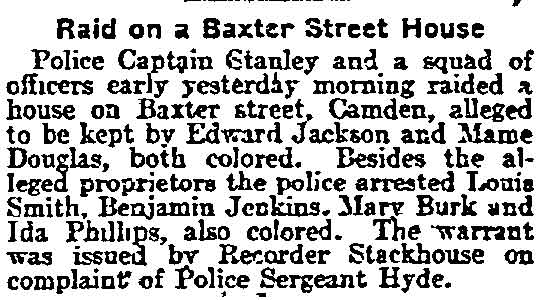
Raid on a Baxter Street House, Philadelphia Inquirer, May 25, 1903

Raid on a Baxter Street House

Captain Stanley and officers raid a Baxter Street house alleged to be kept by Edward Jackson and Mame Douglas; six arrested.
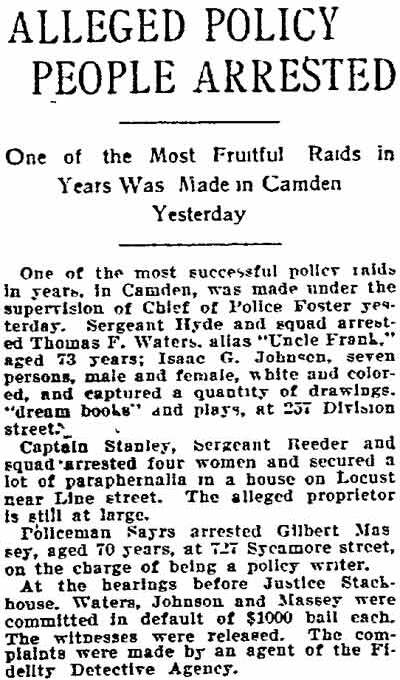
Newspaper clipping: "Alleged Policy People Arrested", Philadelphia Inquirer, June 16, 1901

Alleged Policy People Arrested

A major policy (numbers) raid in Camden, supervised by Chief of Police Foster with Sergeant Hyde's squad, nets nine arrests and a quantity of drawings and "dream books" at 257 Division Street.
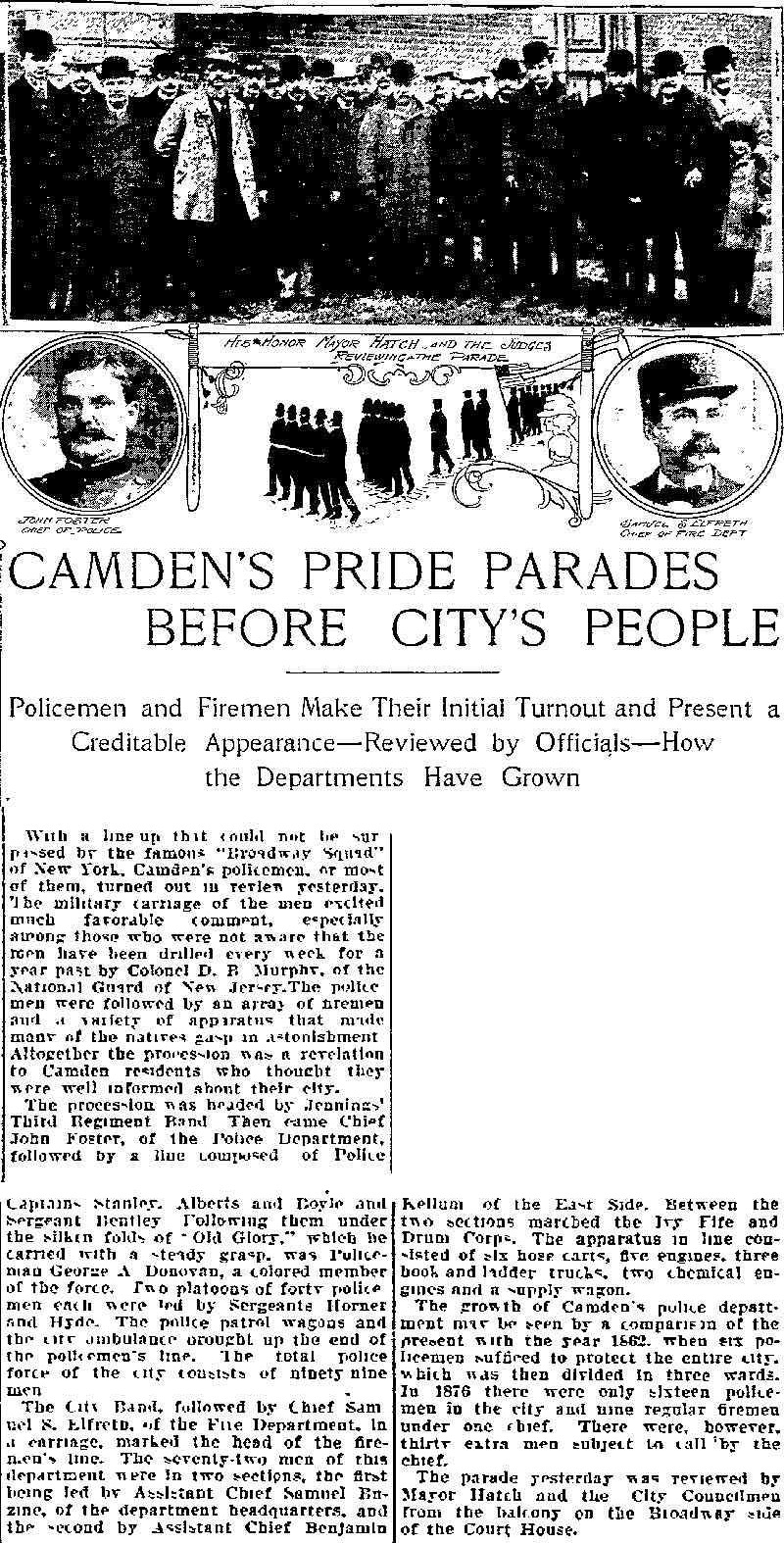
arthurstanley-022301-inq-1.jpg

Camden's Pride Parades Before City's People

Camden's policemen and firemen make their first formal turnout in review, drilled to a military carriage; the Philadelphia Inquirer describes the procession, its officers, and the growth of the departments since 1862.
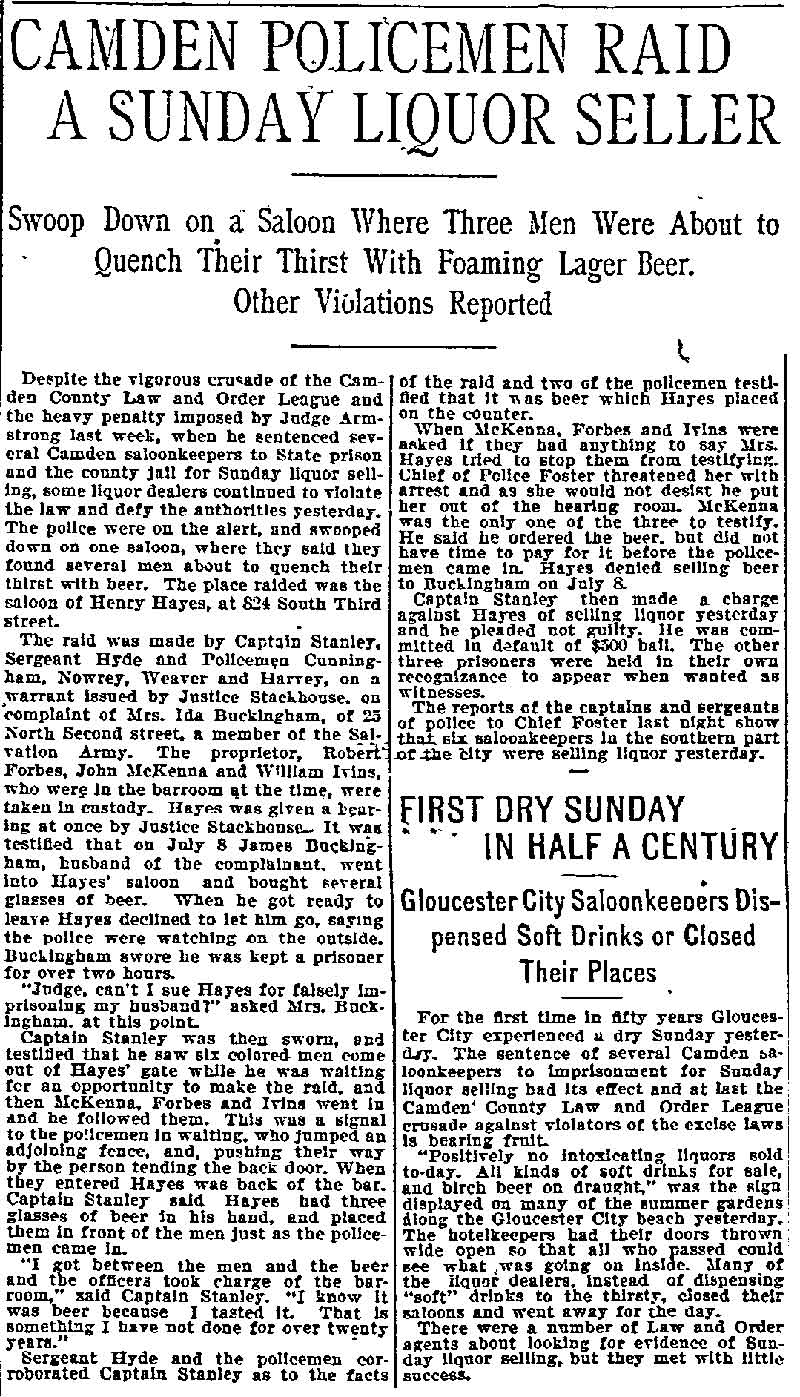
Philadelphia Inquirer clipping: Camden policemen raid a Sunday liquor seller; Gloucester City's first dry Sunday

Camden Policemen Raid a Sunday Liquor Seller

Acting on a complaint, Captain Stanley and Sergeant Hyde raid Henry Hayes' saloon on South Third Street for Sunday liquor selling; Hayes is committed in default of bail.
Raid Over in Camden newspaper clipping

Raid Over in Camden

Police Captain Stanley and Sergeant Hyde raid two alleged disorderly houses on Pine Street above Tenth, arresting the reputed proprietors and thirteen inmates.

Newspaper clipping (crop 1 of 10): "Camden Mystery More Involved", Philadelphia Inquirer, August 14, 1899

Camden Mystery More Involved

The investigation into the death of Mrs. Lillian Chambers at the Locust Street house of William H. Wilkins, a Camden fortune teller and "voodoo doctor," led police to a boiler of suspected human bones hidden behind a sealed fireplace.

arthurstanley-072899-inq-1b.jpg

Evil Doers Quake

Mayor Cooper B. Hatch launches a campaign against Camden's speak-easies; the first raid, led by Captain Stanley and Sergeant Hyde, seizes a house full of liquor, while saloonkeepers are fined for operating gambling machines.
williamharvey-101498-dailytelegram.jpg

His Wife Must Suffer

Harry McNeil, a frequent visitor to the Camden Police Court, is arrested by Officer Hyde for drunkenness after a spree through the saloons of the Fifth and Eighth wards.
ebmcclong-070697-inq-1.jpg

Two Men Shot in a Race Riot in Camden

A race riot in South Camden's Seventh Ward leaves two men wounded; police, including Policemen Hyde and McClung, exchange pistol fire with the combatants and make several arrests.
Hat Thieves Caught, Camden Daily Courier, December 18, 1896

Hat Thieves Caught

Police Officer Hyde captures Charles Monroe and Alfred Robinson of 705 Baxter Street for stealing two hats from William Ross at Fourth and Kaighn Avenue.

Advertisement

Comments