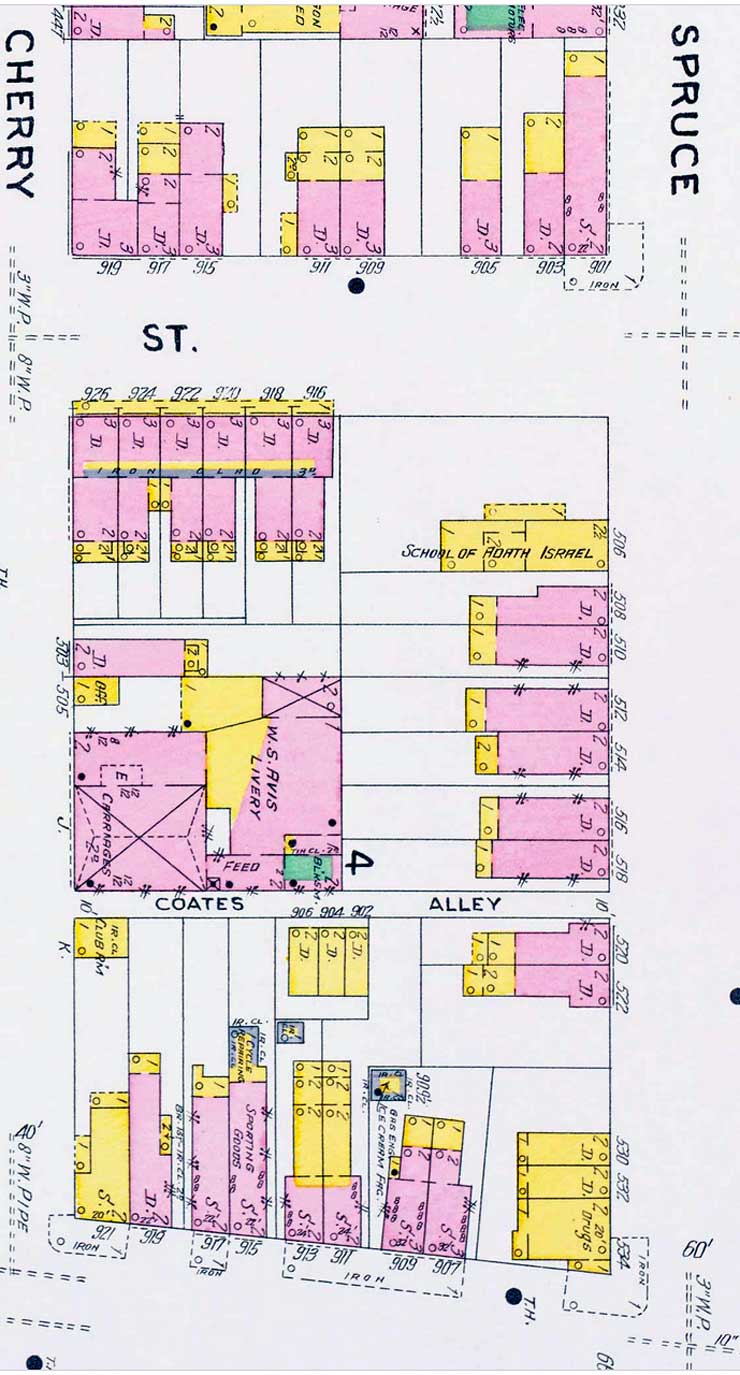
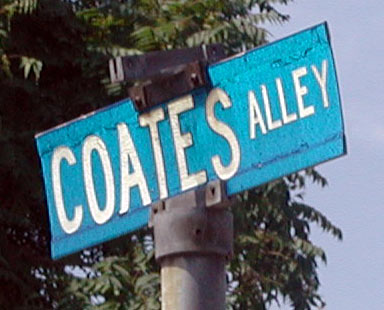
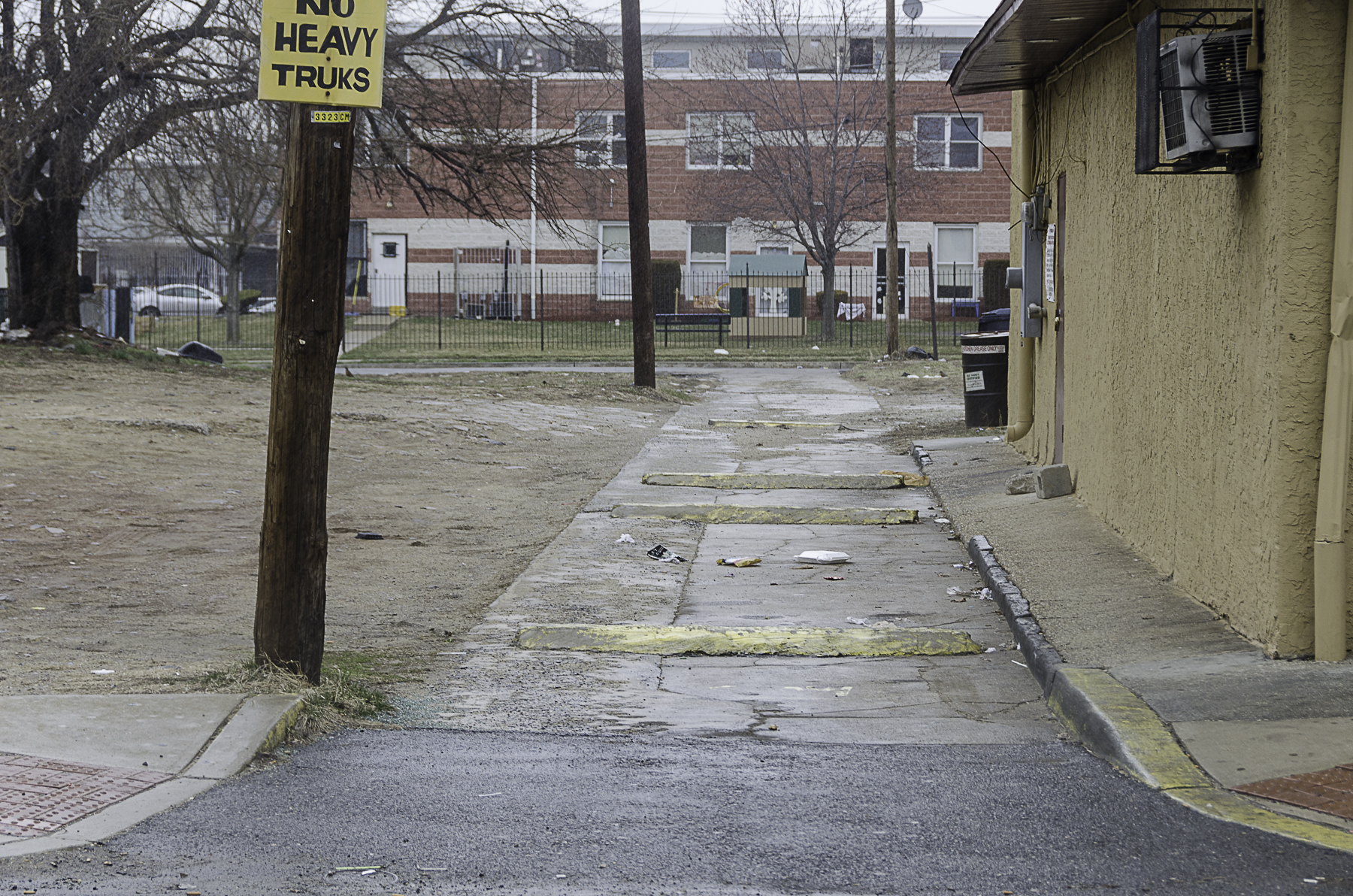
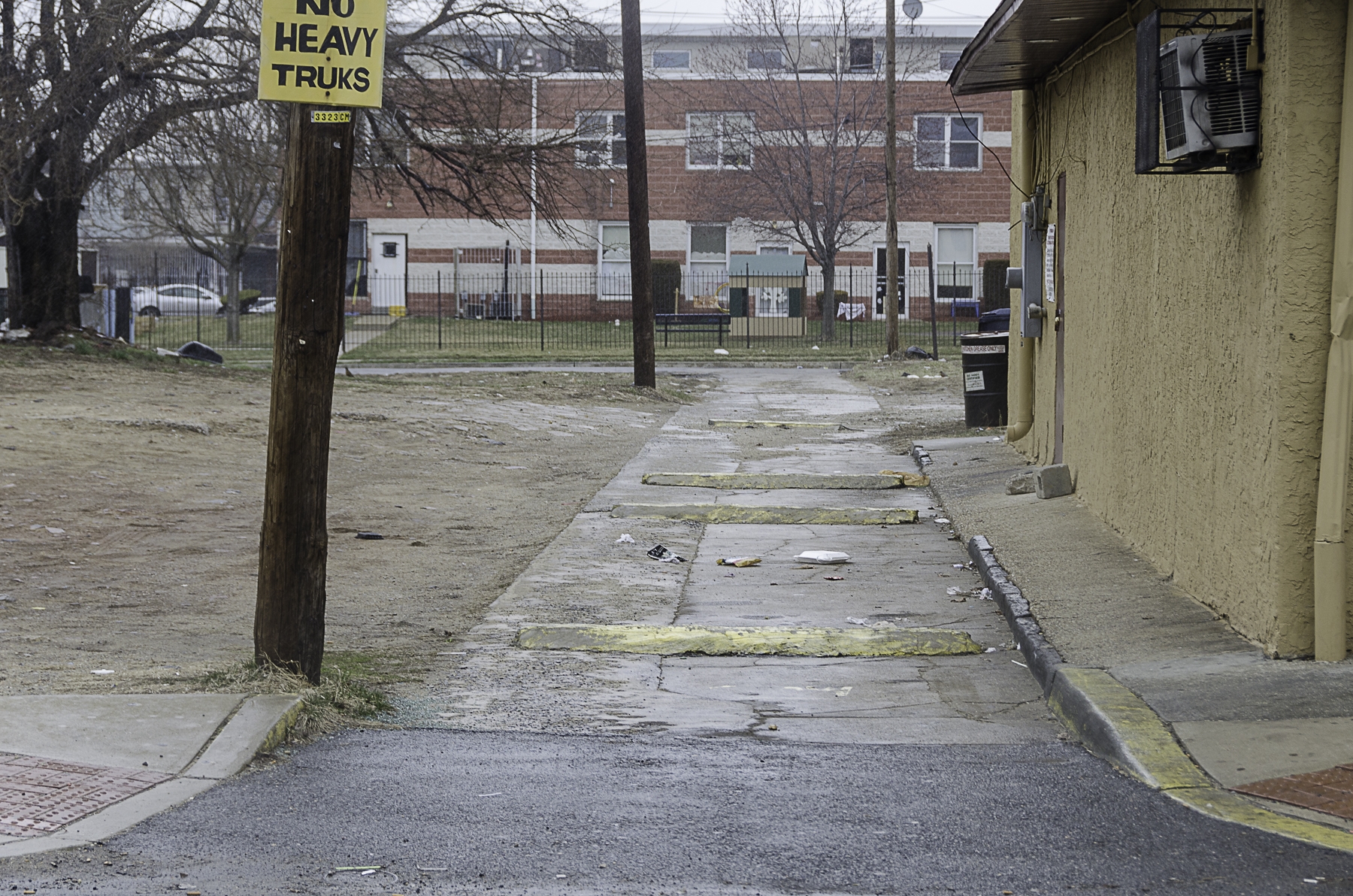
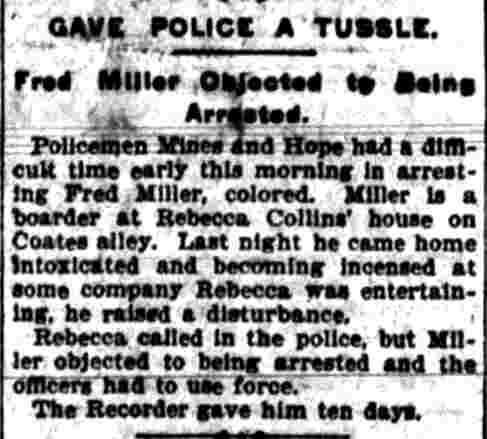
Coates Alley was originally a two block street that ran parallel to Broadway and South 5th Street from Cherry Street north across Spruce Street to Division Street, where it ends. Today Coates Alley is only one block long, running from Spruce Street to Division Street.
Coates Alley is sometimes confused with Coates Avenue, originally known as Daubman Alley, which was a one block street that ran parallel to Broadway and South 5th Street from 510 Cherry Street south to 512 Walnut Street. The two similarly named throughways do not, however, line up and are, or rather were, distinct and separate streets. A similar circumstance existed for a time when Welsh Street, sometimes referred to as Welch Street, another non-contiguous street that ran from Division Street north to Pine Street was sometimes referred to as Coates Avenue.
Adding to the confusion was the existence of Coates Court, a short alley that ran north from 313 Division Street for about half a block before it dead-ended. Coates Court had three dwellings on it, with at least one occupied as late as 1931. By 1940 these were no longer listed in City Directories, although Coates Court itself was still being mentioned as late as 1947.
Coates Avenue was possibly named for Camden businessman John Coates, who parlayed a bricklaying business into real estate and investments, and was one of Camden’s wealthiest men when he passed in 1903. Daubman Alley appears to have been named after Jacob C. Daubman, who was Sheriff of Camden County from 1874 to 1878 and who was prominent in real estate and other civic affairs.
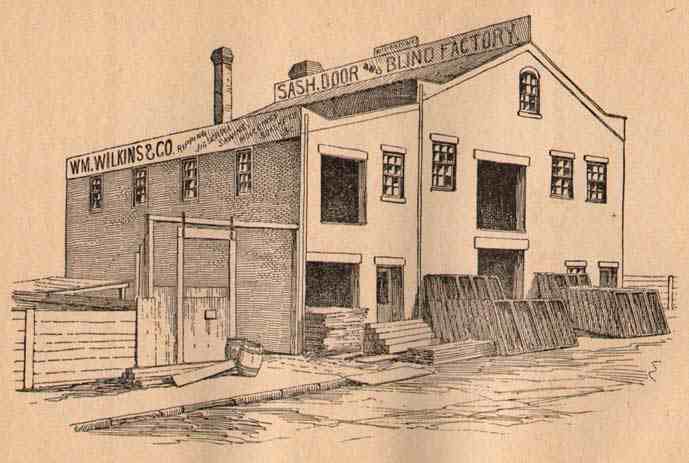
No addresses using Daubman Alley as an address seem to have appeared in Camden City Directories. A building is shown in the 1906 Sanborn Map with addresses of 510½ and 510⅓ Cherry Street, which appear to have been previously used by the W. H. Wilkins & Company, who engaged in a lumber and mill work business at 513-515-517 Cherry Street and who also utilized a property building across the street at 506-510 Cherry Street.
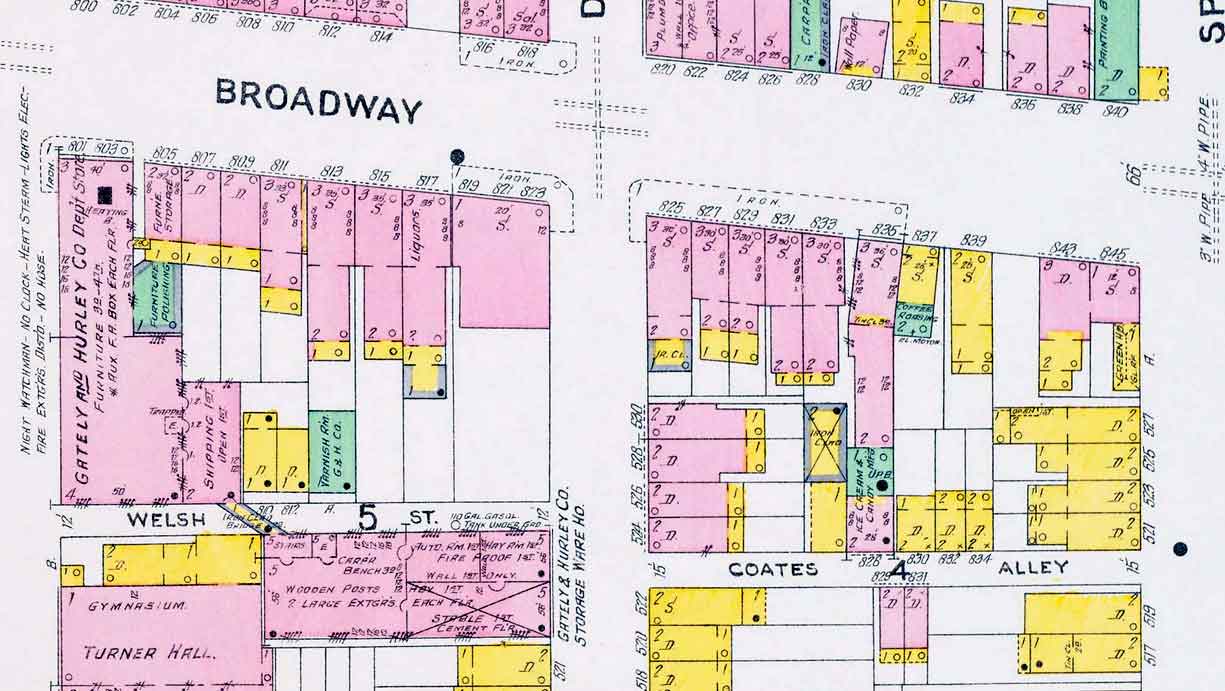
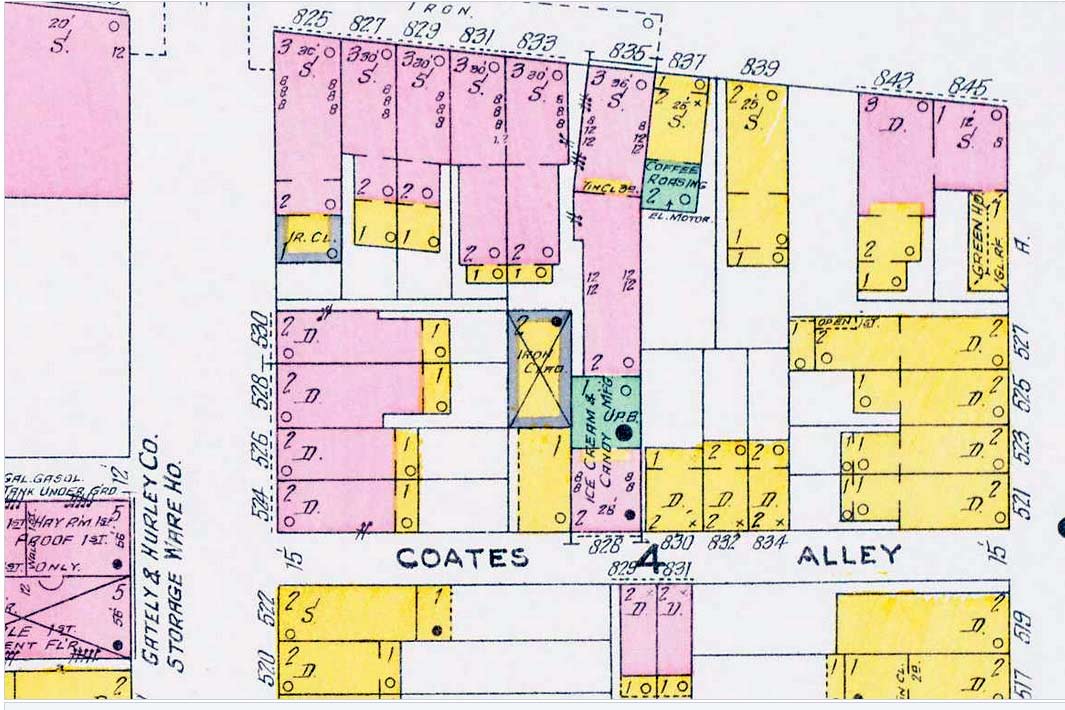
As early as 1904 Daubman Alley was used to make deliveries to the rear of 933-935 Broadway, the site of the N. Fuhrman Company furniture store, which operated there as late as 1945. The N. Fuhrman Company built a storage warehouse on the west side of Coates Avenue (Daubman Alley) at some point after 1906. The Red, White & Blue Thrift Store operated in the N. Fuhrman Company’s Broadway building and utilized Coates Avenue into the early 1980s.
In September of 1932, Courier-Post reporter E. Allen Hughes wrote a three part series of articles about the small streets, alleys, courts and places of Camden, including Coates Alley and Coates Avenue.
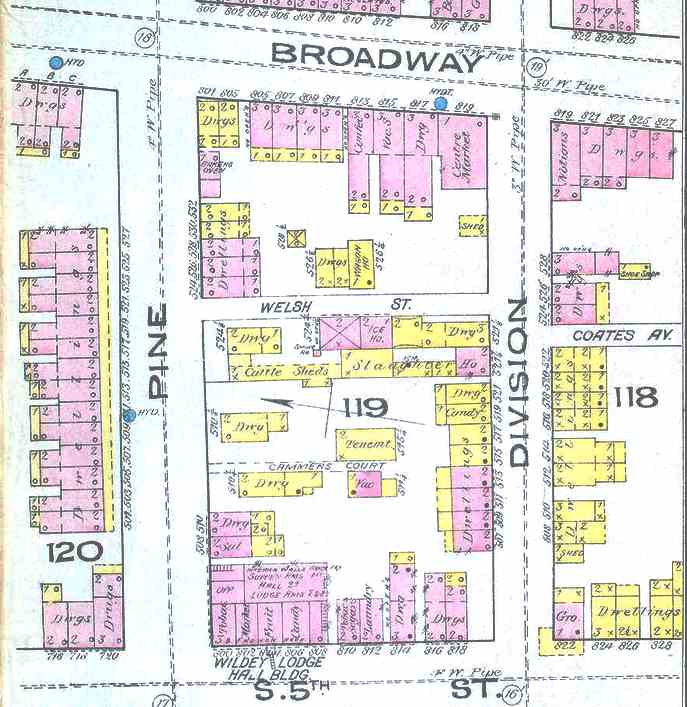
The rest of Coates Alley was not depicted in the 1885 Map.
Coates Avenue (present-day Coates Alley) and Welsh Street — 1885 Sanborn Map.
Coates Avenue (present-day Coates Alley) and Welsh Street — 1885 Sanborn Map.View transcription
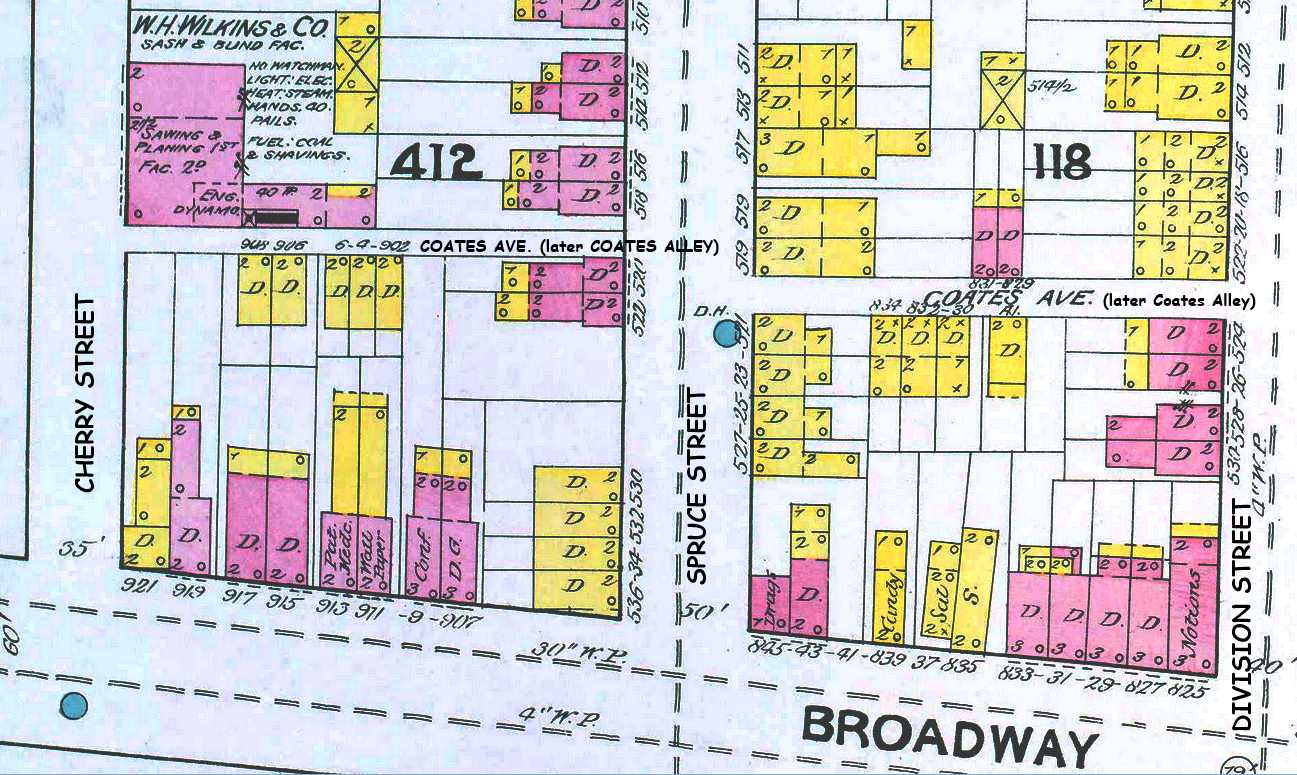
The blocks of present-day Coates Avenue, then known as Daubman Alley, were not depicted in the 1891 Map. Coates Alley, then known as Coates Avenue, was shown.
Philadelphia Inquirer, November 2, 1908View transcription
Murders Wife Who Threatened to Leave
West Indian Shot Woman at Their Home in Camden, Then Turned Revolver on Himself
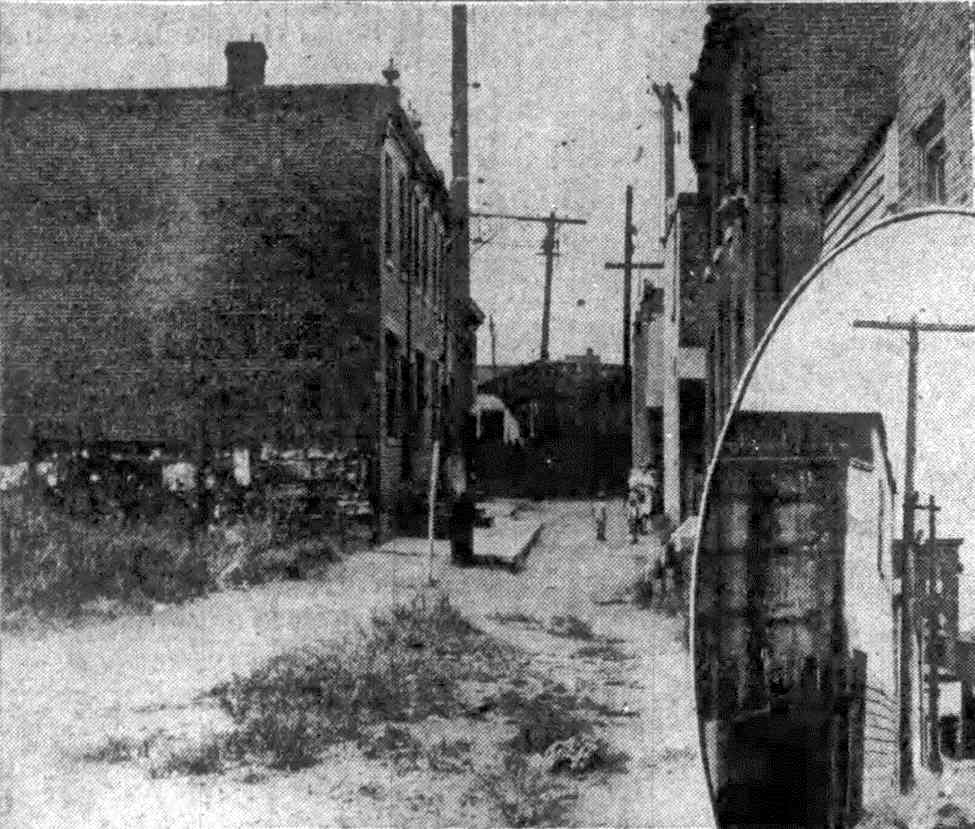
Angered because his wife Anna declared she was going to leave him, Adolph Walker, 27 years old, a West Indian, shot and killed the woman at their home, 906 Coates' alley, Camden, yesterday afternoon. Then the murderer turned the revolver on himself and shot himself in the left temple. Walker was taken to the Cooper Hospital, where it was stated that his chances for recovery were slight.
Just before lapsing into unconsciousness Walker was able to gasp out the following statement to Chief of Police Gravener:
"My wife deceived me. She went out all last night and didn't come home until 7 o'clock this morning. We had a quarrel about it and then my wife told me she was going to leave. She said she was going to kill me first and then I went upstairs, got my revolver, went down and shot her. Then I shot myself."
It was shortly before 1 o'clock that those living in the immediate vicinity were startled to hear two revolver shots. Little attention was paid to the occurrence, however, until Charles Olden, of 520 Spruce street, the side of whose home borders on Coates' alley, saw Walker lying in the middle of the small thoroughfare. He managed to rise to his feet, although there was a gaping wound in his head. He was just about to speak when Policeman Matlack, who had been apprised of the shooting, took him in custody, subsequently sending him to the hospital.
Police Captain Stanley and several officers went to the house in which the Walkers lived when they found the woman lying on the kitchen floor dead. She had a bullet wound through the right temple. There was every evidence that Walker and his wife had been desperately struggling before the shooting. A table was upset and broken dishes were scattered all about the place. According to the police there was a woman in the case and the quarrels resulted from the murdered woman's jealousy.
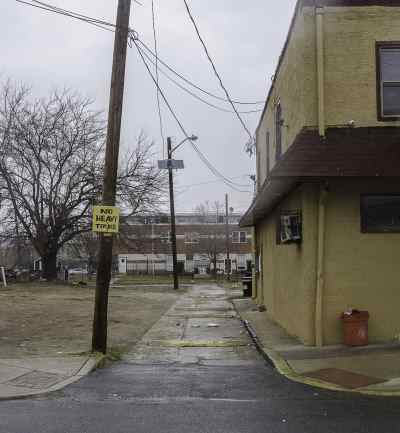
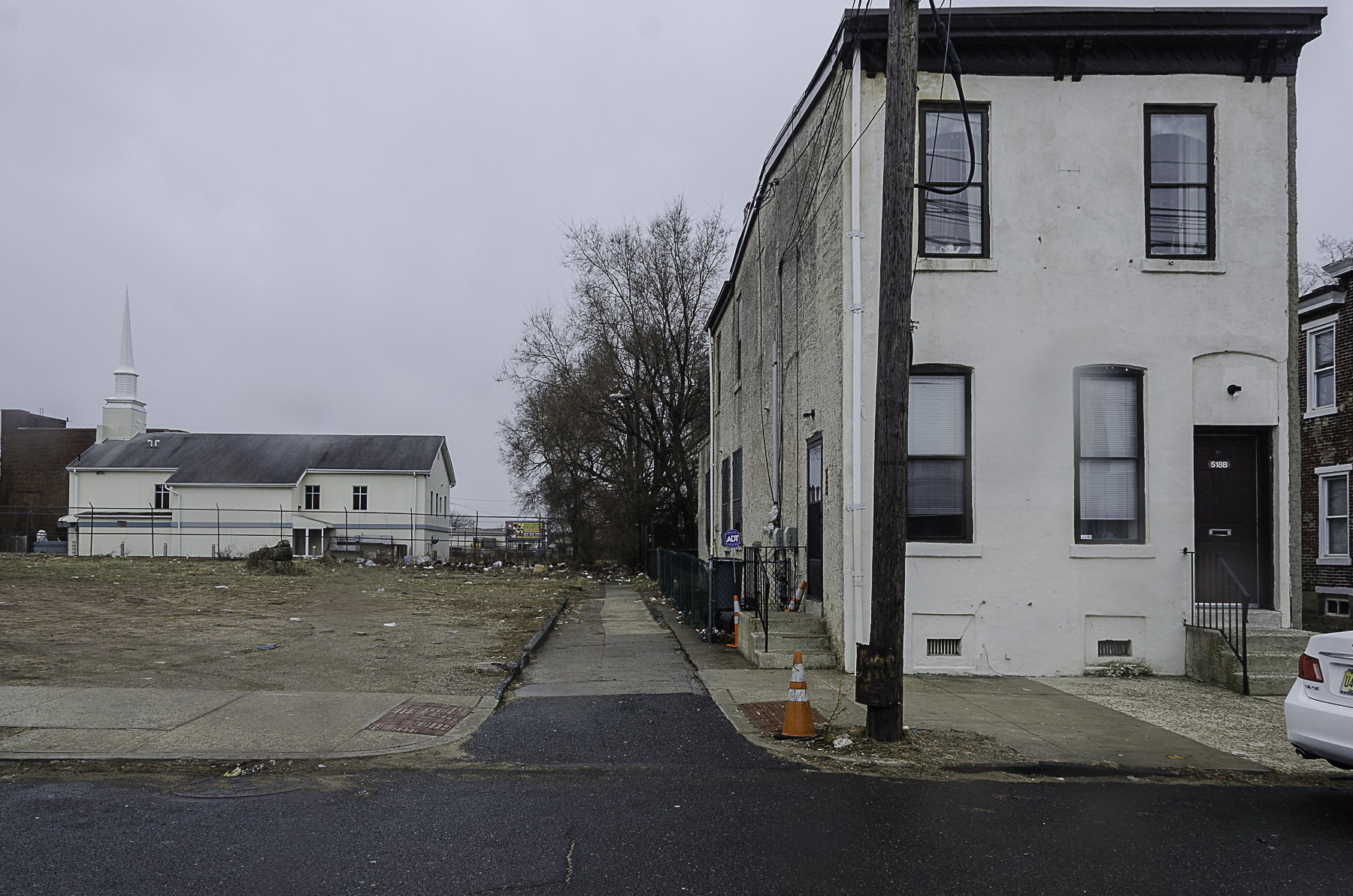
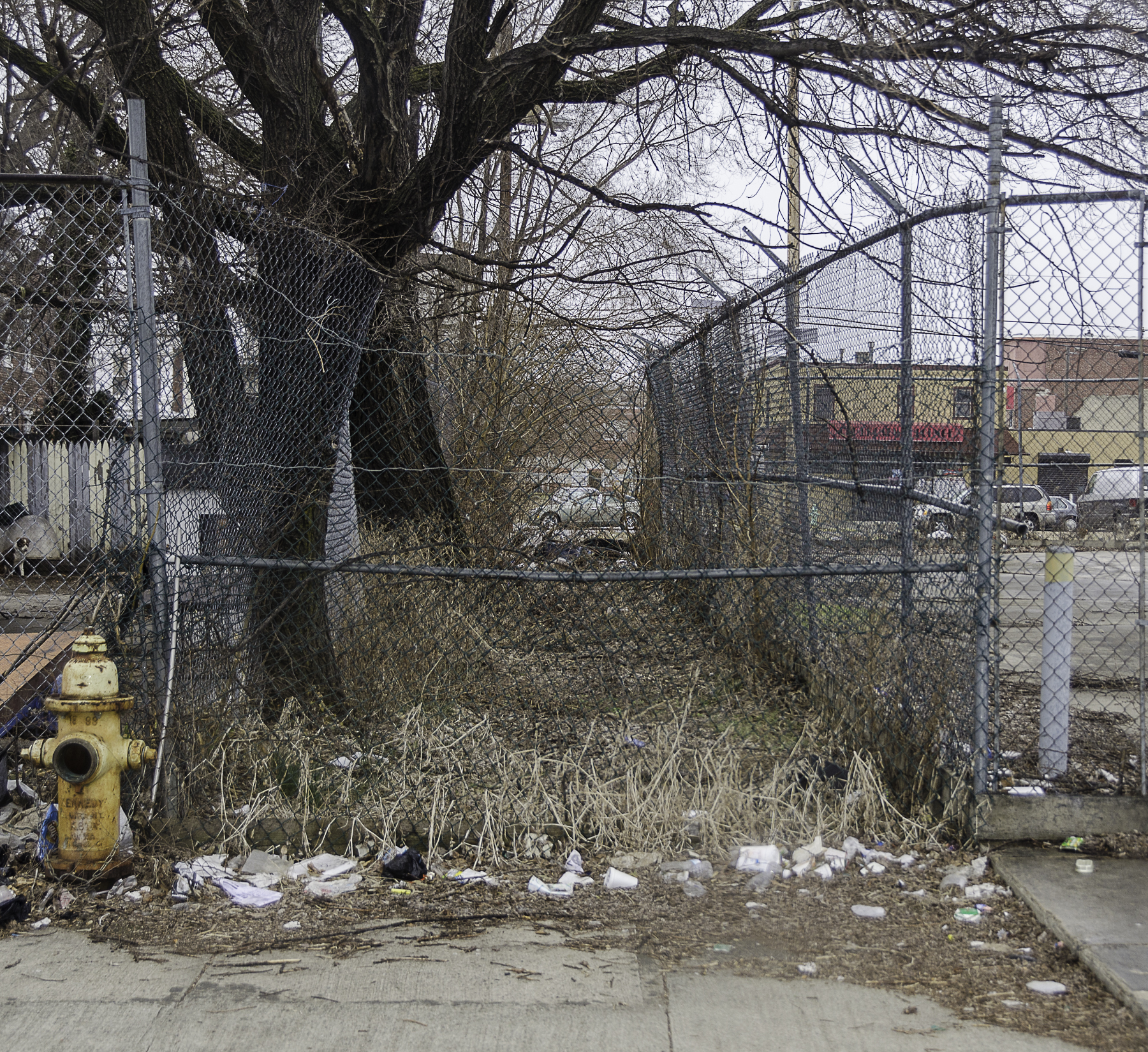
Looking north on Coates Alley from Cherry Street, March 19, 2014.
Looking north on Coates Alley from Cherry Street, March 19, 2014.View transcription
18 99
KENNEDY
[illegible]
[illegible]
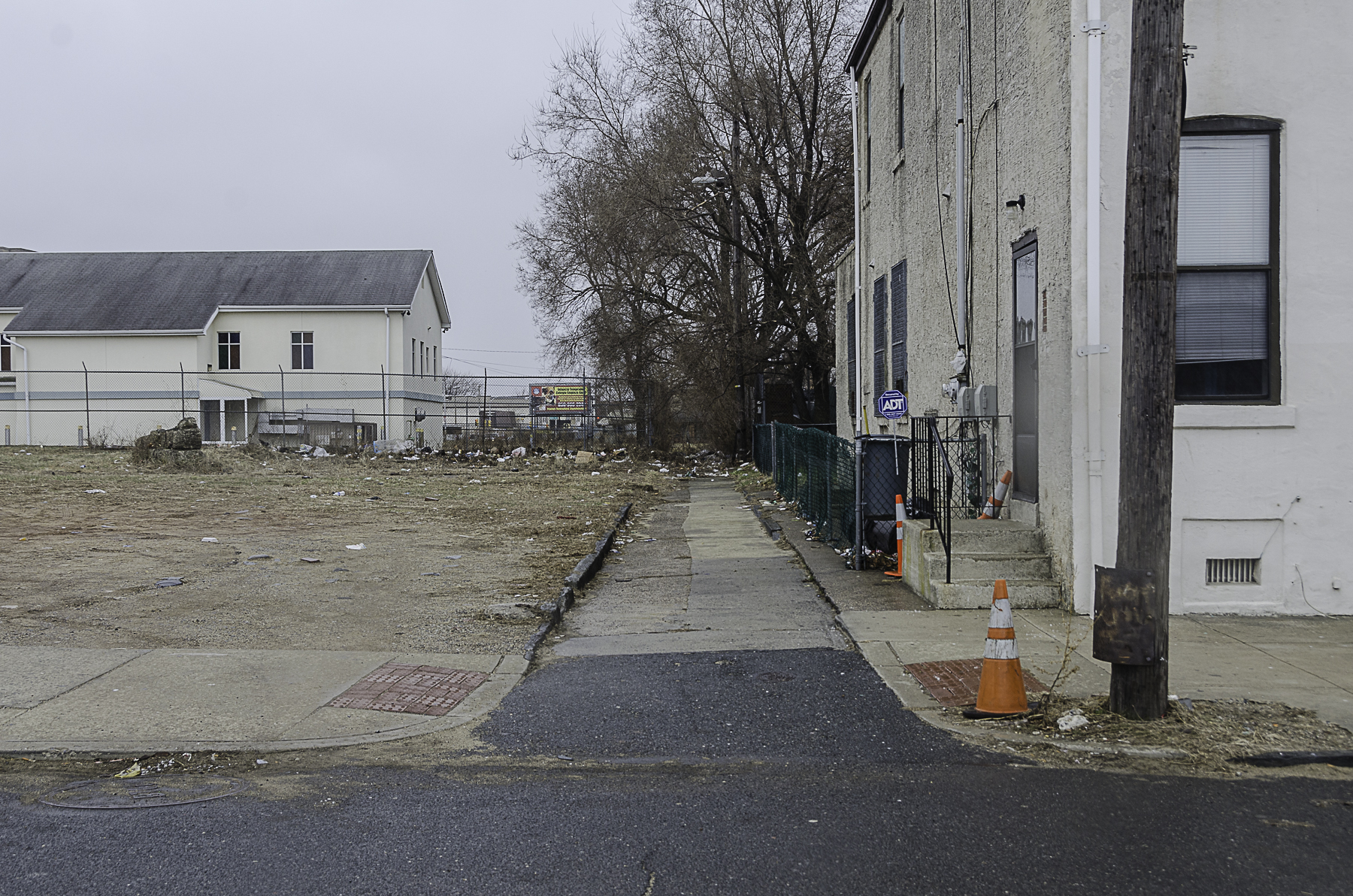
Looking north on Coates Alley from Cherry Street, March 19, 2014.
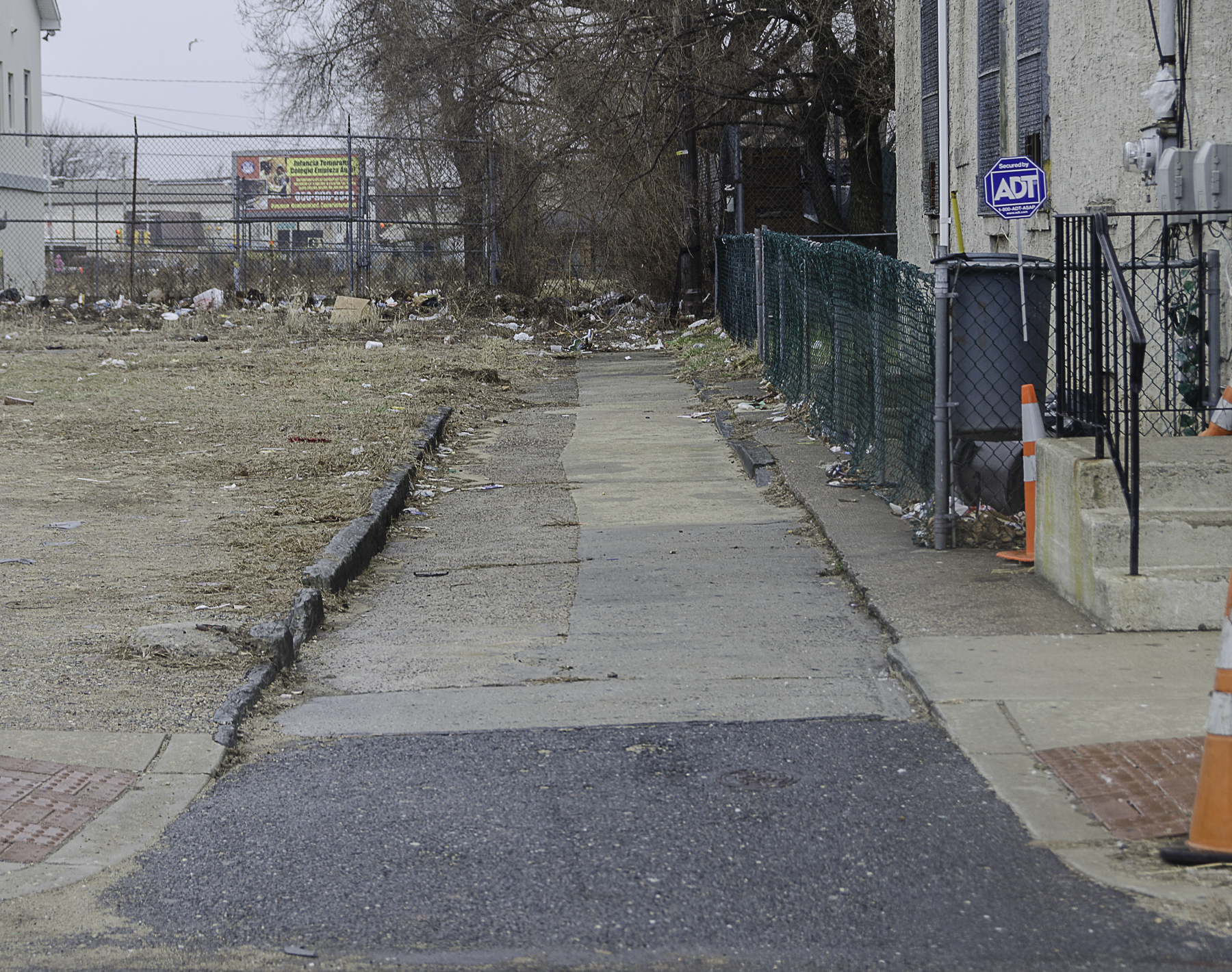
Looking north on Coates Alley from Cherry Street, March 19, 2014.
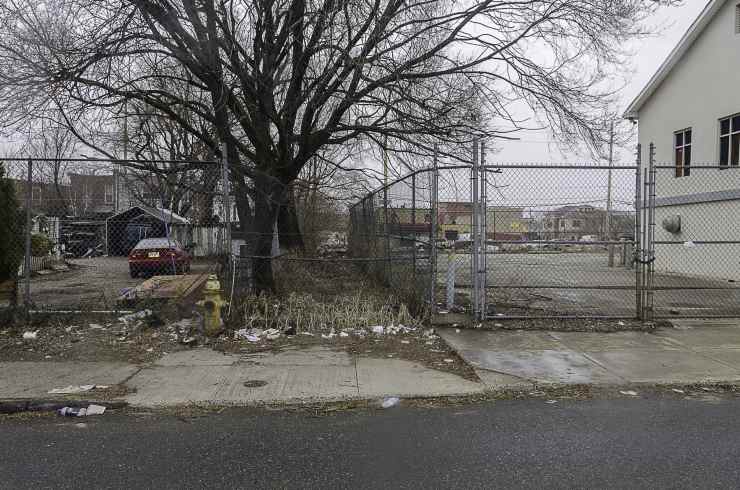
Northwest corner of Cherry Street & Coates Alley. 513-515-517 Cherry Street, home of W.H. Wilkins & Company (lumber & millwork), 1885–1896; James F. Davis (lumber & millwork), 1897; William S. Avis (stables), 1899–1921; James D. Freeston (stables), 1915–1921; U.S. Postal Service garage, 507 Cherry Street, 1924.
Northwest corner of Cherry Street & Coates Alley. 513-515-517 Cherry Street, home of W.H. Wilkins & Company (lumber & millwork), 1885–1896; James F. Davis (lumber & millwork), 1897; William S. Avis (stables), 1899–1921; James D. Freeston (stables), 1915–1921; U.S. Postal Service garage, 507 Cherry Street, 1924.View transcription
WM. WILKINS & CO. [illegible]
[illegible]
SASH, DOOR AND BLIND FACTORY