The 'Ghost Sniper' of Camden, 1927–1928
Newspaper accounts from January and February 1928 chronicling the mysterious "phantom sniper" who terrorized Camden and South Jersey, shooting at buses, autos and storefronts for months without capture.
Tag

Newspaper accounts from January and February 1928 chronicling the mysterious "phantom sniper" who terrorized Camden and South Jersey, shooting at buses, autos and storefronts for months without capture.

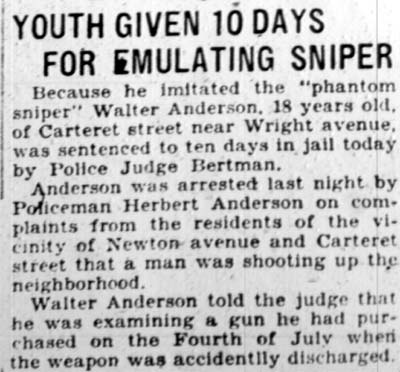
Walter Anderson, 18, of Carteret Street near Wright Avenue, was sentenced to ten days in jail by Police Judge Bertman for imitating the "phantom sniper" near Newton Avenue and Carteret Street.

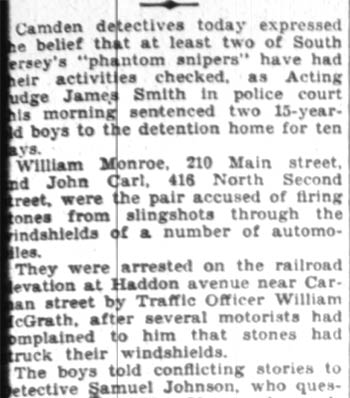
Two 15-year-old boys were sentenced to ten days in the detention home for firing slingshot stones through automobile windshields, while Pitman residents chased another mysterious gunner and Camden police briefly held a suspect at the bridge plaza.

Reports of three more shootings credited to the phantom sniper, at Atco, Gloucester and Pennsauken, brought the mysterious gunman's score close to the 50-mark.

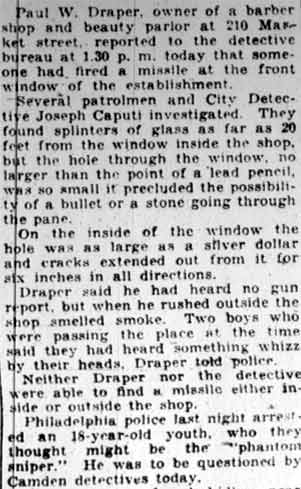
Barber Paul W. Draper reported that a missile pierced the front window of his shop at 210 Market Street, leaving a pencil-point hole but no bullet. Philadelphia police had arrested an 18-year-old youth they thought might be the "phantom sniper."

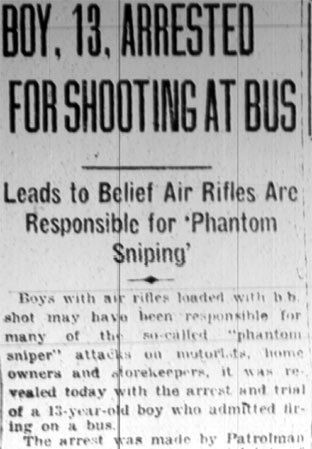
The arrest of a 13-year-old boy who admitted firing on a P.R.T. bus at Penn and Tenth streets led to the belief that boys with air rifles may be responsible for many of the "phantom sniper" attacks.

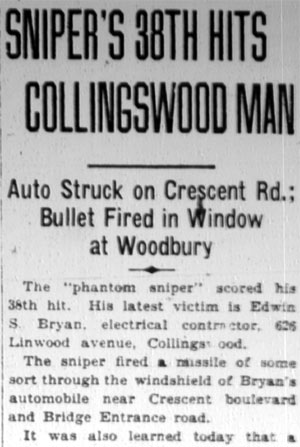
The "phantom sniper" scored his 38th hit through the windshield of Collingswood electrical contractor Edwin S. Bryan's car near Crescent boulevard, and a .44-calibre bullet was fired through a window of a Woodbury home.

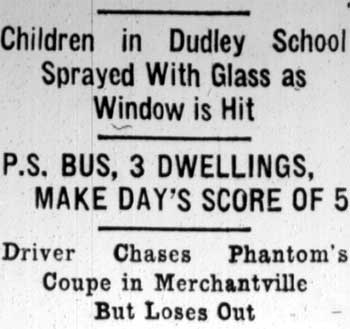
The "phantom sniper" fired through a first-grade classroom window at the Dudley Grammar School, showering pupils with glass, and scored four more hits overnight in Merchantville, Magnolia Heights and Bellmawr, bringing his total to 35.

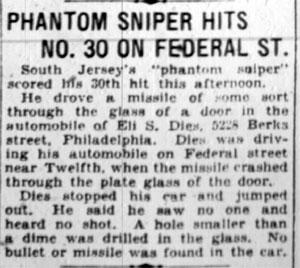
The "phantom sniper" scored his 30th hit when a missile drilled a hole smaller than a dime through a door glass of Eli S. Dies's automobile on Federal street near Twelfth; no shot was heard and no missile was found.

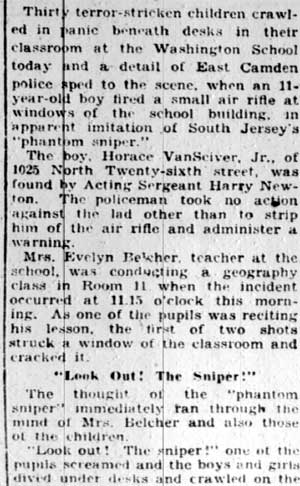
Thirty children dived beneath their desks at the Washington School when an 11-year-old boy fired an air rifle at the classroom windows, while county and city detectives split sharply over whether one "phantom sniper" was behind more than two dozen shootings.

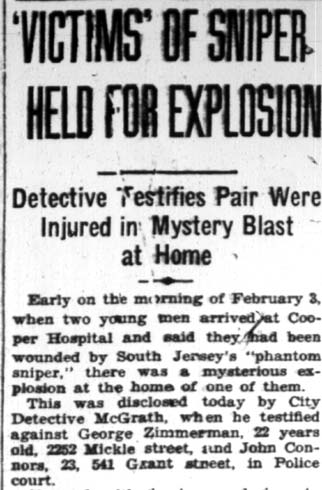
The Camden Courier-Post of February 13, 1928 reports that George Zimmerman and John Connors, who had claimed they were wounded by the "phantom sniper" near the Federal street bridge, were held for the grand jury on charges of having explosives after City Detective McGrath testified to a mysterious blast at Zimmerman's home.

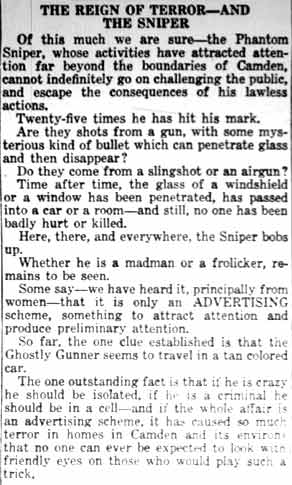
A Camden Courier-Post editorial on the Phantom Sniper, who had hit his mark twenty-five times, asking whether his shots came from a gun, a slingshot or an airgun and noting the one clue so far: a tan colored car.

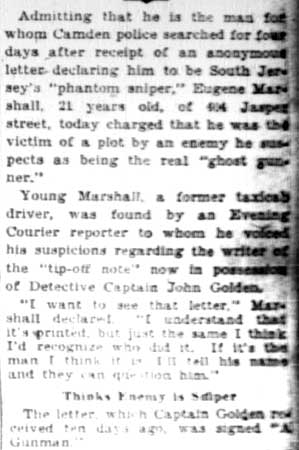
Eugene Marshall, 21, of 404 Jasper Street, admitted he was the man Camden police sought after an anonymous letter named him the "phantom sniper," but charged he was framed by an enemy he believed to be the real sniper. The same day a fire-alarm box at Kaighn Avenue and Hyde Park was drilled, and a weekend shot narrowly missed Joseph Carone.

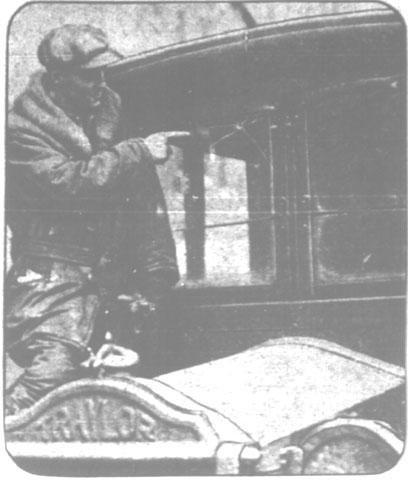
Within three hours, South Jersey's "phantom sniper" drilled the windshields of two motor trucks on South Broadway; photographs show drivers George Murphy and Nathan Brodsky.

The "phantom sniper" struck for the twenty-fifth time when a missile cracked the side window of a Public Service taxicab at Front and State streets, as police followed the clue of a tan automobile and weighed theories of an exhaust-pipe or compressed-air gun.

South Jersey's "phantom sniper" fired his twenty-first shot, drilling the plate glass door of Benjamin Donde's shop at 1201 Mt. Ephraim Avenue. County detectives were assigned to the manhunt.

South Jersey's "phantom sniper" pierces the windshield of Camden jeweler Abe Fuhrman's car at Haddon and Walnut, a day after a shot through the Collingswood window of broker William H. Turnbull left no missile behind.

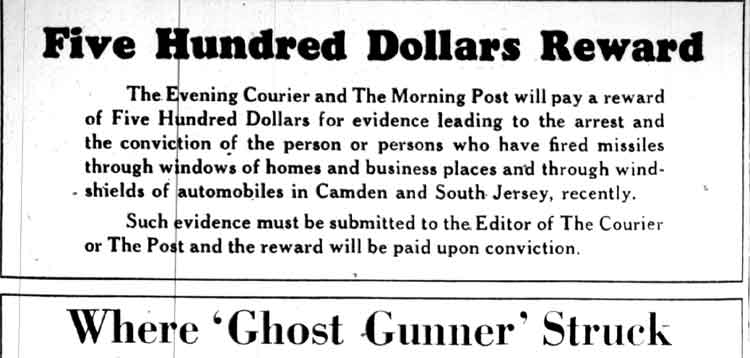
The Evening Courier and The Morning Post offer a $500 reward for evidence leading to the arrest and conviction of whoever fired missiles through windows and windshields in Camden and South Jersey.

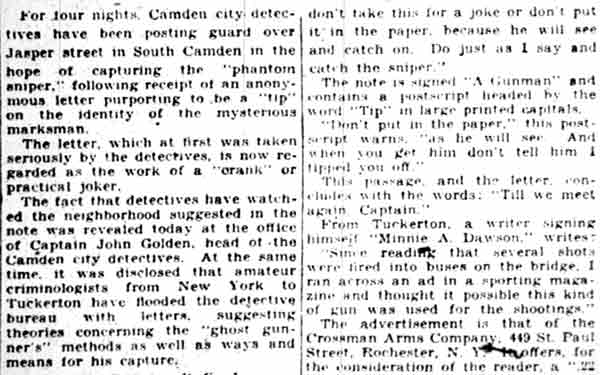
For four nights Camden detectives watched Jasper street after an anonymous "tip" from a "friend of the sniper," now regarded as the work of a crank or practical joker, while amateur criminologists flooded the detective bureau with theories and air gun advertisements.

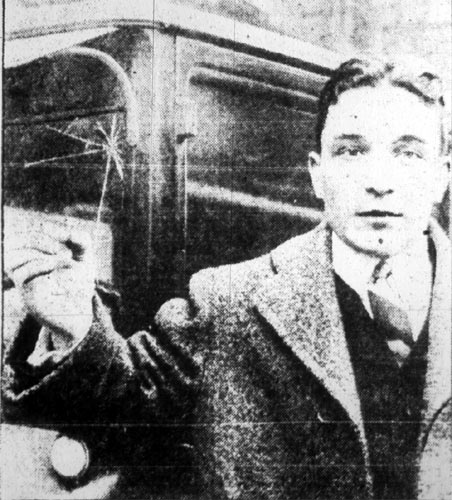
Camden Courier-Post photographs of Leon Fuhrman holding the screw fired at his father Abe Fuhrman's car, and of William H. Turnbull, whose Collingswood home was fired upon, February 9, 1928.

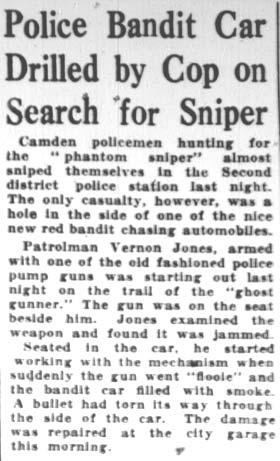
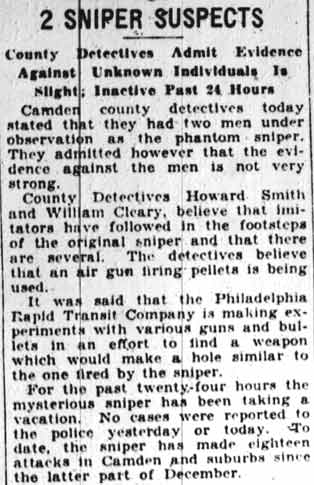
Patrolman Vernon Jones, setting out after the "phantom sniper," accidentally fired a jammed pump gun through the side of a new police bandit car; county detectives said they had two men under observation, though the evidence was slight.

Camden county detectives said they had two men under observation as the phantom sniper, but admitted the evidence against them was slight; the sniper had made eighteen attacks since late December.

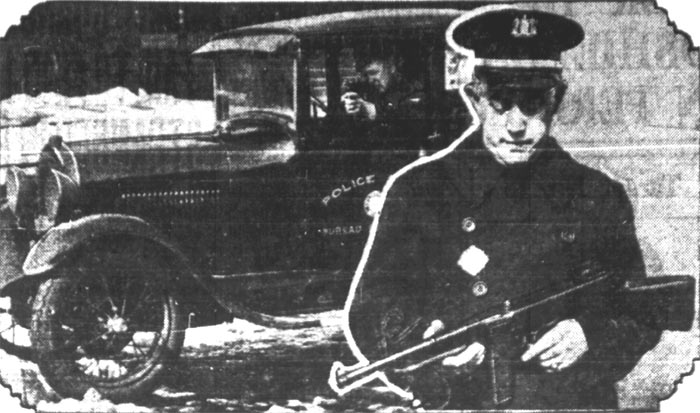
Camden police put six machine guns, mounted in new bandit-chasing automobiles, into operation against the "Phantom Sniper" in February 1928; the photograph shows Arthur Colsey holding one of the guns.

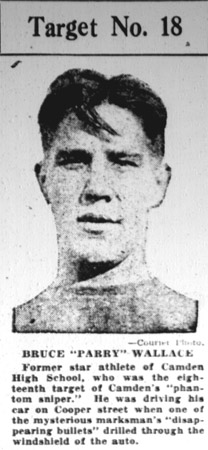
Bruce "Parry" Wallace, former Camden High School athlete, was the eighteenth target of Camden's "phantom sniper" when a bullet struck his car windshield on Cooper Street.

Camden Courier-Post, February 6, 1928: Camden's "phantom sniper" fires on two more automobiles and a pedestrian, Audubon is in terror over unexplained shots, and two boys with air rifles are fined for firing at a train.

Chief of Police James E. Tatem announced that six new automatic rifles, able to fire a 20-shot magazine in a few seconds, had arrived for Camden's bandit-chasing squads and would be mounted in the district bandit-chasing coupes.

With orders to "shoot on sight" issued to suburban police hunting South Jersey's "phantom sniper," a man giving a fake name reported a 16th shooting that investigators could not verify, while a 15th victim came forward separately in Collingswood.

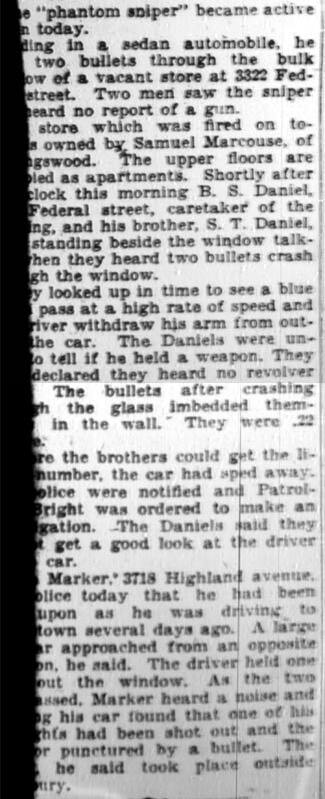
The "phantom sniper" fired two .22 bullets through the window of a vacant store at 3322 Federal Street, and a Highland Avenue man reported a car light shot out days earlier. Camden Courier-Post, January 31, 1928.

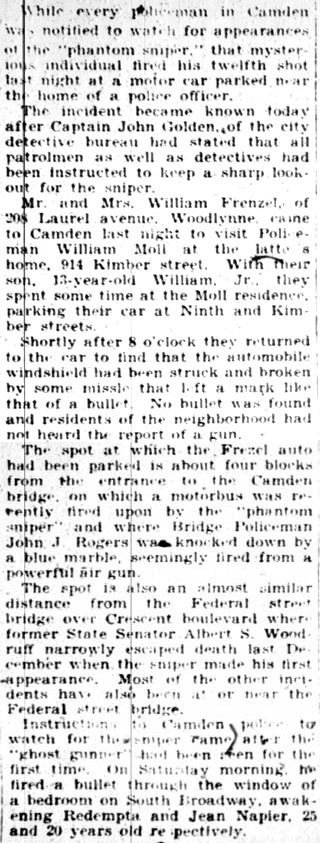
Camden's "phantom sniper" fired a twelfth shot that broke the windshield of a car parked at Ninth and Kimber streets, near the home of Policeman William Moll at 914 Kimber Street.

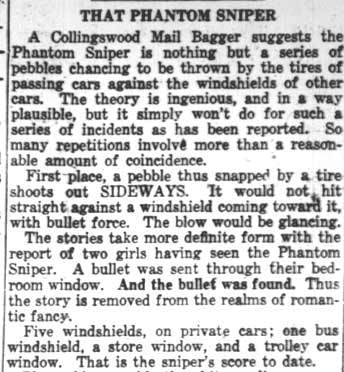
A Camden Courier-Post editorial rejects a Collingswood reader's pebble theory, tallies the Phantom Sniper's score to date and suggests offering a reward for his capture.
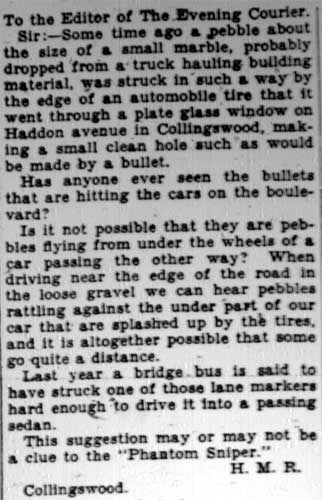
A Collingswood reader, signing H. M. R., suggests to the Evening Courier that the "Phantom Sniper" shots may be pebbles flung from under passing car tires, like one that holed a plate glass window on Haddon avenue in Collingswood.

Two sisters, Redempta and Jean Napier, saw a tall man with a gun flee after a .32 caliber bullet crashed through their bedroom window, the first time the "phantom sniper" had been seen, while a bullet-like missile pierced the window of a Merchantville trolley car.

Camden's "phantom sniper" fired a missile through the plate glass door of Gottlob Mayer's store at 868 North Twenty-seventh Street in Cramer Hill; as in the other cases, no bullet was found inside and no report of a gun was heard.

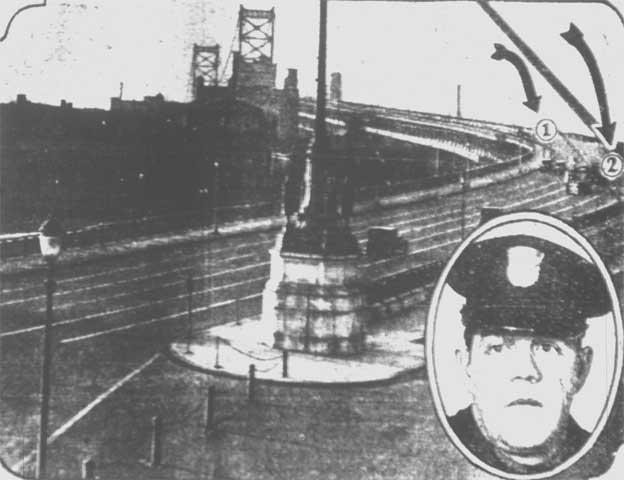
Camden and bridge police hunted a "phantom sniper" after a bus windshield was pierced on the Camden Bridge and Bridge Policeman John J. Rodgers was struck and knocked down by a blue marble fired from a slingshot or air gun.