Boy, Air Rifle Terrorize School
Camden Courier-Post, February 14, 1928
View transcription
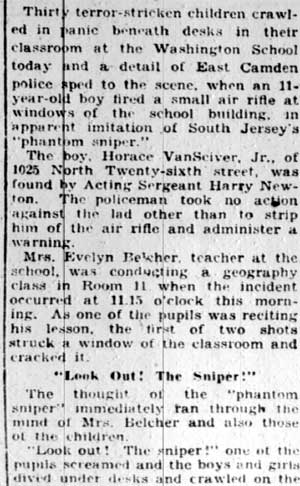
Thirty terror-stricken children crawled in panic beneath desks in their classroom at the Washington School today and a detail of East Camden police sped to the scene, when an 11-year-old boy fired a small air rifle at windows of the school building, in apparent imitation of South Jersey's "phantom sniper."
The boy, Horace VanSciver, Jr., of 1025 North Twenty-sixth street, was found by Acting Sergeant Harry Newton. The policeman took no action against the lad other than to strip him of the air rifle and administer a warning.
Mrs. Evelyn Belcher, teacher at the school, was conducting a geography class in Room 11 when the incident occurred at 11.15 o'clock this morning. As one of the pupils was reciting his lesson, the first of two shots struck a window of the classroom and cracked it.
"Look Out! The Sniper!"
The thought of the "phantom sniper" immediately ran through the mind of Mrs. Belcher and also those of the children.
"Look out! The sniper!" one of the pupils screamed and the boys and girls dived under desks and crawled on the
Camden Courier-Post, February 14, 1928
View transcription
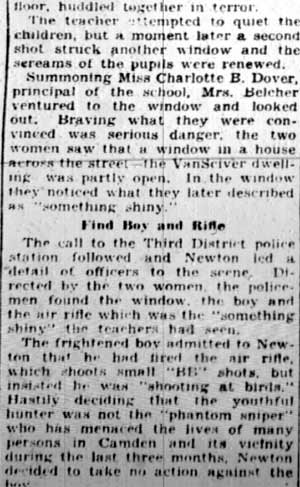
floor, huddled together in terror.
The teacher attempted to quiet the children, but a moment later a second shot struck another window and the screams of the pupils were renewed.
Summoning Miss Charlotte B. Dover, principal of the school, Mrs. Belcher ventured to the window and looked out. Braving what they were convinced was serious danger, the two women saw that a window in a house across the street—the VanSciver dwelling—was partly open. In the window they noticed what they later described as "something shiny."
Find Boy and Rifle
The call to the Third District police station followed and Newton led a detail of officers to the scene. Directed by the two women, the policemen found the window, the boy and the air rifle which was the "something shiny" the teachers had seen.
The frightened boy admitted to Newton that he had fired the air rifle, which shoots small "BB" shots, but insisted he was "shooting at birds." Hastily deciding that the youthful hunter was not the "phantom sniper" who has menaced the lives of many persons in Camden and its vicinity during the last three months, Newton decided to take no action against the boy.
Camden Courier-Post, February 14, 1928
View transcription
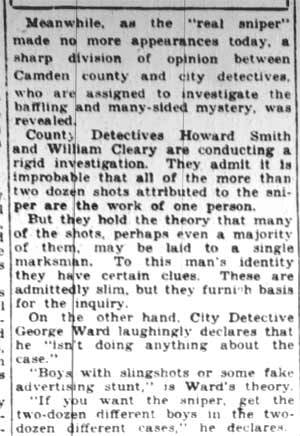
Meanwhile, as the "real sniper" made no more appearances today, a sharp division of opinion between Camden county and city detectives, who are assigned to investigate the baffling and many-sided mystery, was revealed.
County Detectives Howard Smith and William Cleary are conducting a rigid investigation. They admit it is improbable that all of the more than two dozen shots attributed to the sniper are the work of one person.
But they hold the theory that many of the shots, perhaps even a majority of them, may be laid to a single marksman. To this man's identity they have certain clues. These are admittedly slim, but they furnish basis for the inquiry.
On the other hand, City Detective George Ward laughingly declares that he "isn't doing anything about the case."
"Boys with slingshots or some fake advertising stunt," is Ward's theory.
"If you want the sniper, get the two-dozen different boys in the two-dozen different cases," he declares.
Camden Courier-Post, February 14, 1928
View transcription
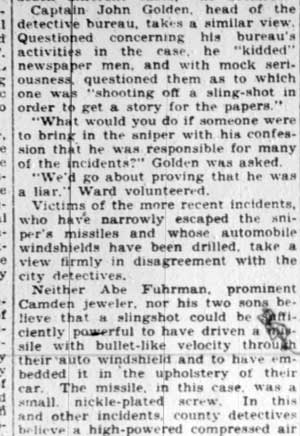
Captain John Golden, head of the detective bureau, takes a similar view. Questioned concerning his bureau's activities in the case, he "kidded" newspaper men, and with mock seriousness questioned them as to which one was "shooting off a sling-shot in order to get a story for the papers."
"What would you do if someone were to bring in the sniper with his confession that he was responsible for many of the incidents?" Golden was asked.
"We'd go about proving that he was a liar," Ward volunteered.
Victims of the more recent incidents, who have narrowly escaped the sniper's missiles and whose automobile windshields have been drilled, take a view firmly in disagreement with the city detectives.
Neither Abe Fuhrman, prominent Camden jeweler, nor his two sons believe that a slingshot could be sufficiently powerful to have driven a missile with bullet-like velocity through their auto windshield and to have embedded it in the upholstery of their car. The missile, in this case, was a small, nickle-plated screw. In this and other incidents, county detectives believe a high-powered compressed air
Camden Courier-Post, February 14, 1928
View transcription
gun was used.
Scouts Taxi Incident
Detective Ward also attempted to minimize the incident of last Saturday when a Public Service taxicab, driven by Thomas Harrington, of Mount Ephraim avenue, was fired upon at Front and Cooper streets.
"We questioned the passenger in the cab," Ward said, "and he said the window apparently had been broken by a piece of ice thrown from the wheel of the taxi."
This passenger is Donald Reid, of 49 State street. He did advance the theory of the ice, but only after he had refused to tell newspapermen his name and had pleaded that he had reasons for not wanting any publicity in the matter.
George Falkenstein, general manager of the cab company, investigated and found there was no ice on the street.
Meantime, two other appearances of
Camden Courier-Post, February 14, 1928
View transcription
the sniper were listed today by county detectives. In one of the two—which occurred last Saturday but became known only today—a 14-year-old boy was struck by a missile which he believes came from a tan-colored coupe.
He is Thomas Miller, 14 years old, of 2913 High street. Playing with other children at Thirtieth and Cramer
Camden Courier-Post, February 14, 1928
View transcription
streets he felt a sharp pain in the calf of his leg and saw the automobile. None of the other children had slingshots or other means for hurling small missiles.
Last night, fear of the "phantom sniper" created panic in the home of W. Russell Scudder, when two missiles struck windows of his home at 15 Strawbridge avenue, Westmont.
Scudder, a Philadelphia commission merchant, heard two sharp reports outside his home, about 9 p. m., a moment after his children had gone to bed. At the same instant a window in the dining room cracked in every direction. After quieting his wife and children, who started in alarm at the sound, Scudder called police.
With Policeman William Gorman, of the Westmont force, the householder made a search of the vicinity, but found no one. Inspection of the window showed that the missiles had not penetrated the glass, but had struck it with enough force to crack it.
The policeman said he believed boys with sling shots, possibly motivated by the actions of the sniper, were to blame. A number of pebbles, suitable for use in sling shots, were found on the lawn outside.
Advertisement