Government
Jenning's Band
Jennings' Band, originally known as the National Cornet Band, was a well-known musical group in Camden from the 1880s until America's entry into World War I in 1917.
Tag
Jennings' Band, originally known as the National Cornet Band, was a well-known musical group in Camden from the 1880s until America's entry into World War I in 1917.
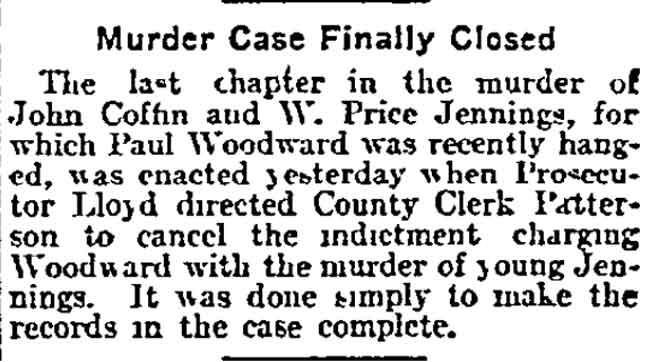
Philadelphia Inquirer, January 17, 1903: Prosecutor Lloyd directed County Clerk Patterson to cancel the indictment charging Paul Woodward with the murder of young Jennings, a formality to complete the records after Woodward was hanged.
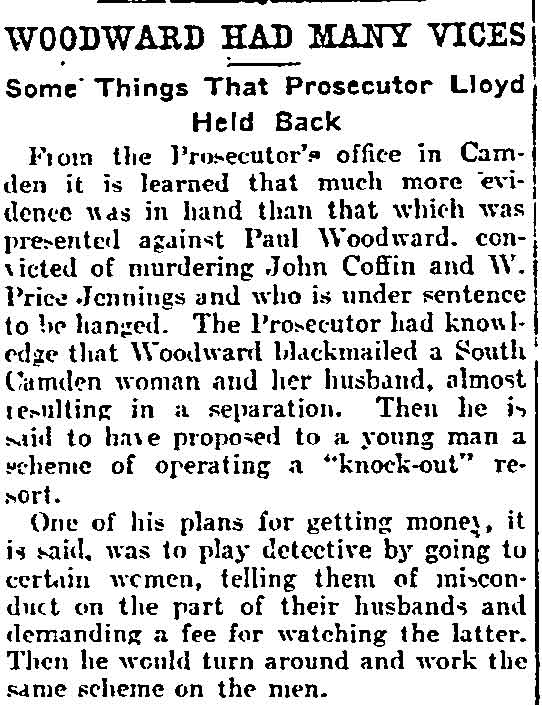
Philadelphia Inquirer, November 29, 1902: Camden County Prosecutor Frank T. Lloyd held back evidence against convicted murderer Paul Woodward.
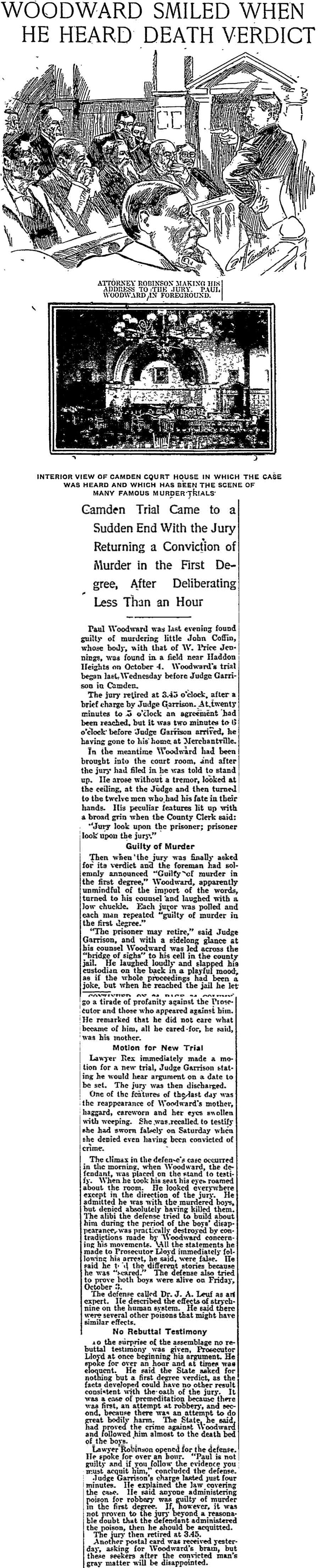
Paul Woodward smiled when a Camden jury, after deliberating less than an hour, found him guilty of first-degree murder in the poisoning of little John Coffin, following Prosecutor Lloyd's argument and Judge Garrison's four-minute charge.

At the Camden murder trial of Paul Woodward, a drug clerk testifies to selling him strychnine and jail inmate David J. Horgan tells of a confession, while relatives of John Coffin and W. Price Jennings give damaging testimony.
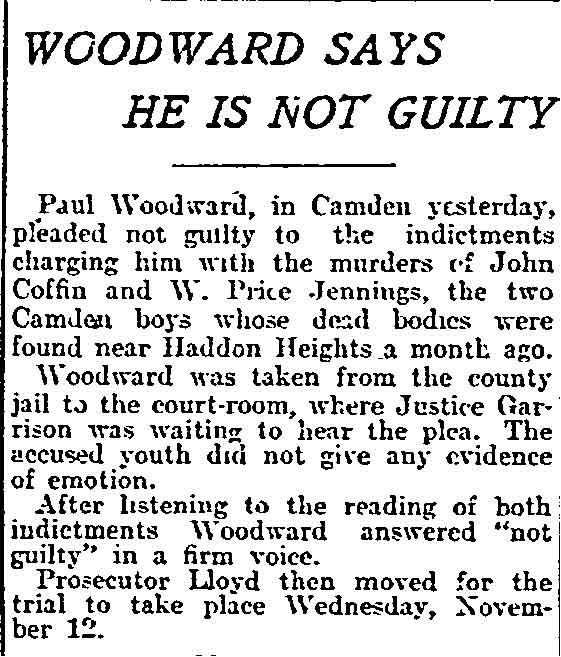
Philadelphia Inquirer, November 1, 1902: Paul Woodward pleads not guilty in Camden to the indictments for the murders of John Coffin and W. Price Jennings.
Philadelphia Inquirer, October 19, 1902: Chemist George M. Beringer reports to Prosecutor Lloyd that he found enough morphia in the stomachs of John Houseman Coffin and Walter Price Jennings to kill a man; the trial of Paul Woodward is expected in early November.
Philadelphia Inquirer, October 15, 1902: Paul Woodward, accused of murdering Camden boys John Coffin and W. Price Jennings, may be indicted within a day or two as Prosecutor Lloyd goes before the grand jury.
Philadelphia Inquirer, October 14, 1902: Prosecutor Lloyd wants a speedy trial of Paul Woodward, jailed in Camden for the deaths of John Coffin and W. Price Jennings; Woodward has no counsel yet and may be defended by Edwin Hillman.

Philadelphia Inquirer, October 11, 1902: Paul Woodward's mother and two boarders are arrested as witnesses in the Coffin and Jennings murders, and lawyer Annie Irving Keeler is retained to defend him.

"Beyond all question the murderer of these little boys is now in jail and the public's anxiety can now be allayed," said Prosecutor Frank T. Lloyd last night in making the first important statement concerning the tragedy of last week, when John Coffin and W. Price Jennings, two Camden lads, were murdered in an uncultivated field near Haddon Heights.

It is now generally believed that the Camden county authorities have succeeded in establishing a clear case against young Paul Woodward, who is in the county jail, charged with the crime of taking away the lives of little John Coffin and Price Jennings.
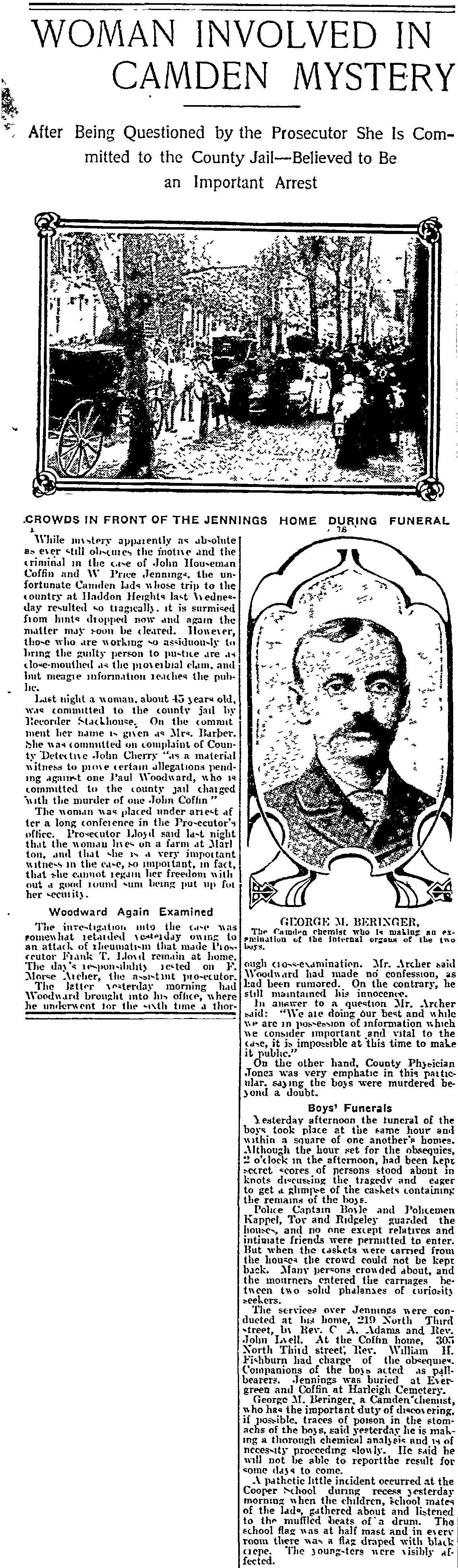
While mystery apparently as absolute as ever still obscures the motive and the criminal in the case of John Houseman Coffin and W. Price Jennings, the unfortunate Camden lads whose trip to the country at Haddon Heights last Wednesday resulted so tragically, it is surmised from hints dropped now and again the matter may soon be cleared.
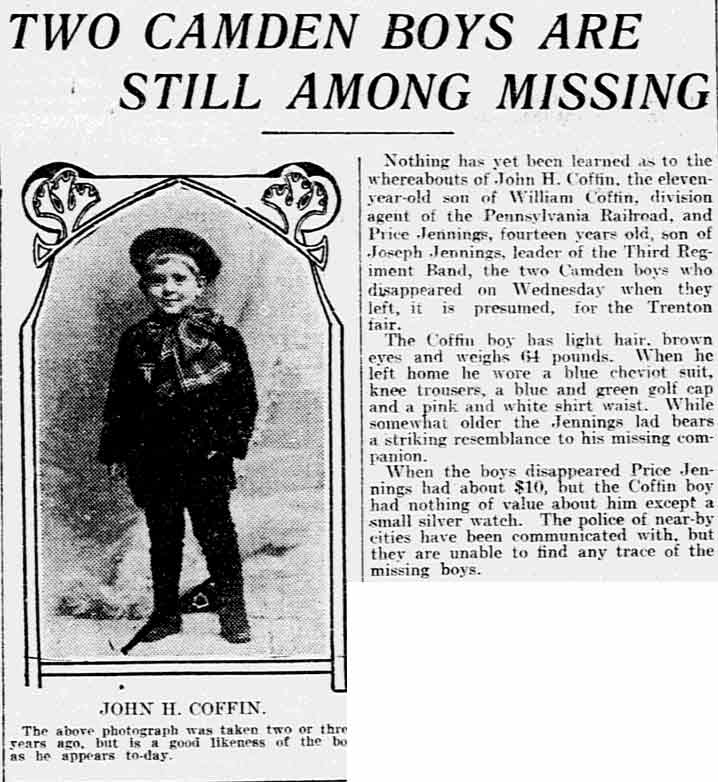
Nothing has yet been learned as to the whereabouts of John H. Coffin, the eleven-year-old son of William Coffin, division agent of the Pennsylvania Railroad, and Price Jennings, fourteen years old, son of Joseph Jennings, leader of the Third Regiment Band, the two Camden boys who disappeared on Wednesday when they left, it is presumed, for the Trenton fair.
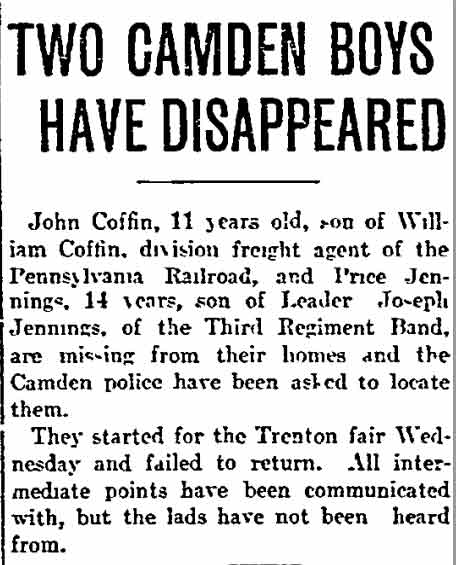
John Coffin, 11 years old, son of William Coffin, division freight agent of the Pennsylvania Railroad, and Price Jennings, 14 years, son of Leader Joseph Jennings, of the Third Regiment Band, are missing from their homes and the Camden police have been asked to locate them.