Woodward Smiled When He Heard Death Verdict
Philadelphia Inquirer, November 18, 1902
View transcription
Woodward Smiled When He Heard Death Verdict
Camden Trial Came to a Sudden End With the Jury Returning a Conviction of Murder in the First Degree, After Deliberating Less Than an Hour
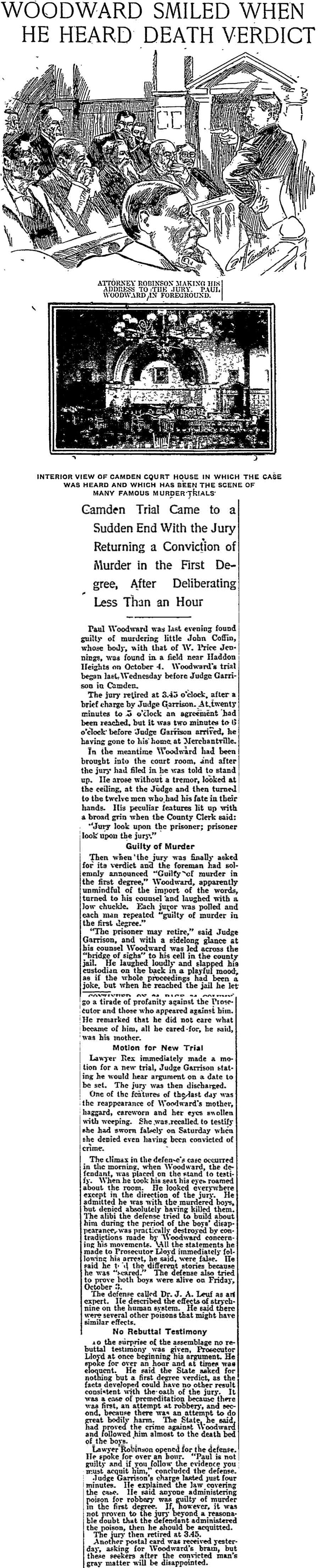
Attorney Robinson Making His Address to the Jury. Paul Woodward in Foreground.
Interior View of Camden Court House in Which the Case Was Heard and Which Has Been the Scene of Many Famous Murder Trials.
Paul Woodward was last evening found guilty of murdering little John Coffin, whose body, with that of W. Price Jennings, was found in a field near Haddon Heights on October 4. Woodward's trial began last Wednesday before Judge Garrison in Camden.
The jury retired at 3.45 o'clock, after a brief charge by Judge Garrison. At twenty minutes to 5 o'clock an agreement had been reached, but it was two minutes to 6 o'clock before Judge Garrison arrived, he having gone to his home at Merchantville.
In the meantime Woodward had been brought into the court room, and after the jury had filed in he was told to stand up. He arose without a tremor, looked at the ceiling, at the Judge and then turned to the twelve men who had his fate in their hands. His peculiar features lit up with a broad grin when the County Clerk said:
"Jury look upon the prisoner; prisoner look upon the jury."
Guilty of Murder
Then when the jury was finally asked for its verdict and the foreman had solemnly announced "Guilty of murder in the first degree," Woodward, apparently unmindful of the import of the words, turned to his counsel and laughed with a low chuckle. Each juror was polled and each man repeated "guilty of murder in the first degree."
"The prisoner may retire," said Judge Garrison, and with a sidelong glance at his counsel Woodward was led across the "bridge of sighs" to his cell in the county jail. He laughed loudly and slapped his custodian on the back in a playful mood, as if the whole proceedings had been a joke, but when he reached the jail he let go a tirade of profanity against the Prosecutor and those who appeared against him. He remarked that he did not care what became of him, all he cared for, he said, was his mother.
Motion for New Trial
Lawyer Rex immediately made a motion for a new trial, Judge Garrison stating he would hear argument on a date to be set. The jury was then discharged.
One of the features of the last day was the reappearance of Woodward's mother, haggard, careworn and her eyes swollen with weeping. She was recalled to testify she had sworn falsely on Saturday when she denied even having been convicted of crime.
The climax in the defense's case occurred in the morning, when Woodward, the defendant, was placed on the stand to testify. When he took his seat his eyes roamed about the room. He looked everywhere except in the direction of the jury. He admitted he was with the murdered boys, but denied absolutely having killed them. The alibi the defense tried to build about him during the period of the boys' disappearance, was practically destroyed by contradictions made by Woodward concerning his movements. All the statements he made to Prosecutor Lloyd immediately following his arrest, he said, were false. He said he told the different stories because he was "scared." The defense also tried to prove both boys were alive on Friday, October 3.
The defense called Dr. J. A. Leuf as an expert. He described the effects of strychnine on the human system. He said there were several other poisons that might have similar effects.
No Rebuttal Testimony
To the surprise of the assemblage no rebuttal testimony was given, Prosecutor Lloyd at once beginning his argument. He spoke for over an hour and at times was eloquent. He said the State asked for nothing but a first degree verdict, as the facts developed could have no other result consistent with the oath of the jury. It was a case of premeditation because there was first, an attempt at robbery, and second, because there was an attempt to do great bodily harm. The State, he said, had proved the crime against Woodward and followed him almost to the death bed of the boys.
Lawyer Robinson opened for the defense. He spoke for over an hour. "Paul is not guilty and if you follow the evidence you must acquit him," concluded the defense.
Judge Garrison's charge lasted just four minutes. He explained the law covering the case. He said anyone administering poison for robbery was guilty of murder in the first degree. If, however, it was not proven to the jury beyond a reasonable doubt that the defendant administered the poison, then he should be acquitted.
The jury then retired at 3.45.
Another postal card was received yesterday, asking for Woodward's brain, but these seekers after the convicted man's gray matter will be disappointed.
Advertisement