Camden Cops of 32 Years Ago Valiant Crew Under 'Sam' Dodd
Camden Courier-Post, July 15, 1930
View transcription
Camden Cops of 32 Years Ago Valiant Crew Under 'Sam' Dodd
By BEN COURTER
(Another of a series of articles on Camden municipal matters and personalities of yesteryear.)
One night some 40 years ago there was great ado in police headquarters. Chief Sam Dodd was talking to Patrolman John Dall in something after this wise:
"See here, John, why didn't you make your 10 o'clock pull last night?"
"I did," returned Dall.
"No, you didn't," asserted the chief.
"See here, whiskers, I tell you I did," retorted Dall with rising umbrage.
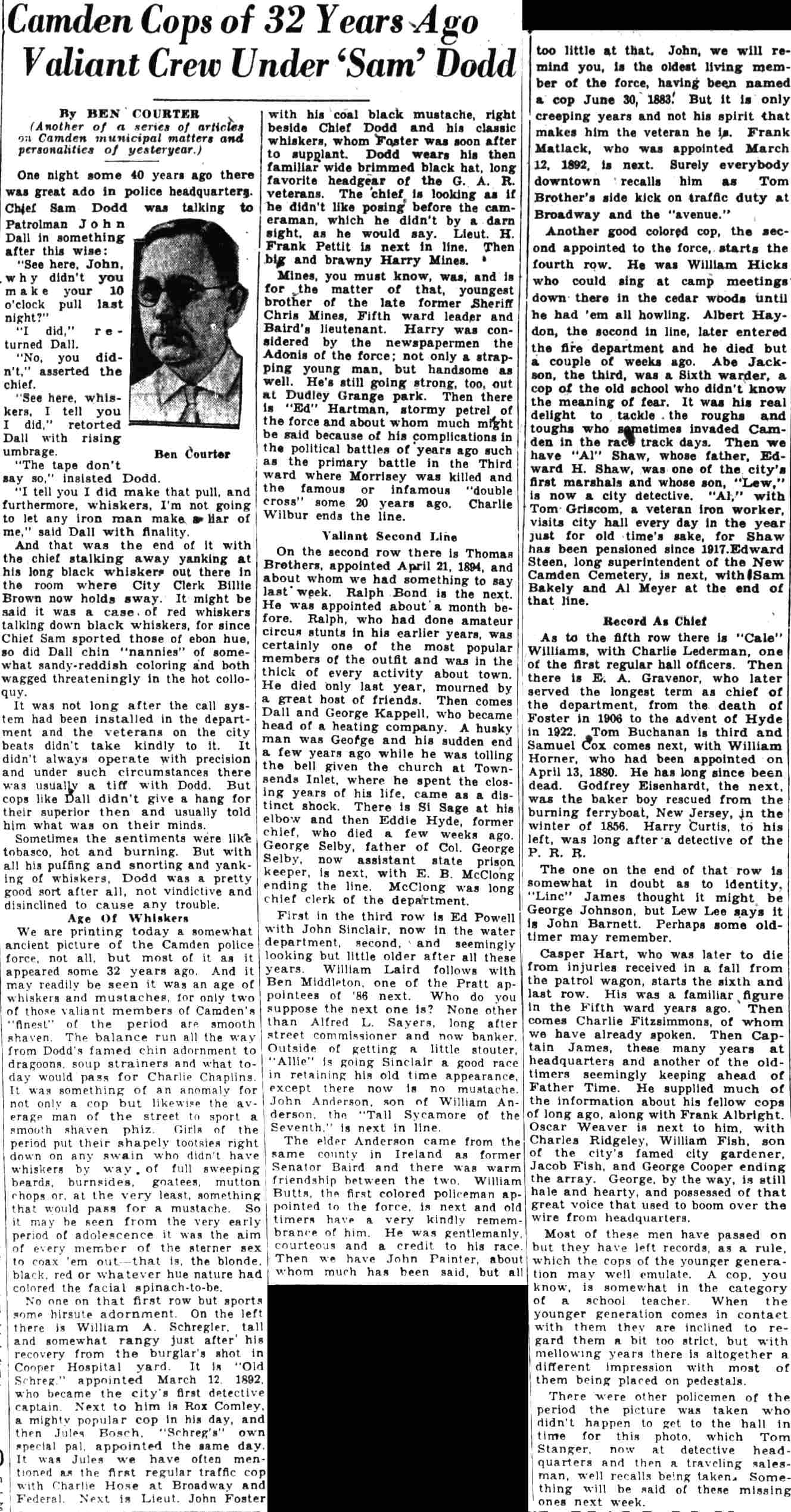
Ben Courter
"The tape don't say so," insisted Dodd.
"I tell you I did make that pull, and furthermore, whiskers, I'm not going to let any iron man make a liar of me," said Dall with finality.
And that was the end of it with the chief stalking away yanking at his long black whiskers out there in the room where City Clerk Billie Brown now holds sway. It might be said it was a case of red whiskers talking down black whiskers, for since Chief Sam sported those of ebon hue, so did Dall chin "nannies" of somewhat sandy-reddish coloring and both wagged threateningly in the hot colloquy.
It was not long after the call system had been installed in the department and the veterans on the city beats didn't take kindly to it. It didn't always operate with precision and under such circumstances there was usually a tiff with Dodd. But cops like Dall didn't give a hang for their superior then and usually told him what was on their minds.
Sometimes the sentiments were like tobasco, hot and burning. But with all his puffing and snorting and yanking of whiskers, Dodd was a pretty good sort after all, not vindictive and disinclined to cause any trouble.
Age Of Whiskers
We are printing today a somewhat ancient picture of the Camden police force, not all, but most of it as it appeared some 32 years ago. And it may readily be seen it was an age of whiskers and mustaches, for only two of those valiant members of Camden's "finest" of the period are smooth shaven. The balance run all the way from Dodd's famed chin adornment to dragoons, soup strainers and what today would pass for Charlie Chaplins. It was something of an anomaly for not only a cop but likewise the average man of the street to sport a smooth shaven phiz. Girls of the period put their shapely tootsies right down on any swain who didn't have whiskers by way of full sweeping beards, burnsides, goatees, mutton chops or, at the very least, something that would pass for a mustache. So it may be seen from the very early period of adolescence it was the aim of every member of the sterner sex to coax 'em out—that is, the blonde, black, red or whatever hue nature had colored the facial spinach-to-be.
No one on that first row but sports some hirsute adornment. On the left there is William A. Schregler, tall and somewhat rangy just after his recovery from the burglar's shot in Cooper Hospital yard. It is "Old Schreg," appointed March 12, 1892, who became the city's first detective captain. Next to him is Rox Comley, a mighty popular cop in his day, and then Jules Bosch, "Schreg's" own special pal, appointed the same day. It was Jules we have often mentioned as the first regular traffic cop with Charlie Hose at Broadway and Federal. Next is Lieut. John Foster with his coal black mustache, right beside Chief Dodd and his classic whiskers, whom Foster was soon after to supplant. Dodd wears his then familiar wide brimmed black hat, long favorite headgear of the G. A. R. veterans. The chief is looking as if he didn't like posing before the cameraman, which he didn't by a darn sight, as he would say. Lieut. H. Frank Pettit is next in line. Then big and brawny Harry Mines.
Mines, you must know, was, and is for the matter of that, youngest brother of the late former Sheriff Chris Mines, Fifth ward leader and Baird's lieutenant. Harry was considered by the newspapermen the Adonis of the force; not only a strapping young man, but handsome as well. He's still going strong, too, out at Dudley Grange park. Then there is "Ed" Hartman, stormy petrel of the force and about whom much might be said because of his complications in the political battles of years ago such as the primary battle in the Third ward where Morrisey was killed and the famous or infamous "double cross" some 20 years ago. Charlie Wilbur ends the line.
Valiant Second Line
On the second row there is Thomas Brothers, appointed April 21, 1894, and about whom we had something to say last week. Ralph Bond is the next. He was appointed about a month before. Ralph, who had done amateur circus stunts in his earlier years, was certainly one of the most popular members of the outfit and was in the thick of every activity about town. He died only last year, mourned by a great host of friends. Then comes Dall and George Kappell, who became head of a heating company. A husky man was George and his sudden end a few years ago while he was tolling the bell given the church at Townsends Inlet, where he spent the closing years of his life, came as a distinct shock. There is Si Sage at his elbow and then Eddie Hyde, former chief, who died a few weeks ago. George Selby, father of Col. George Selby, now assistant state prison keeper, is next, with E. B. McClong ending the line. McClong was long chief clerk of the department.
First in the third row is Ed Powell with John Sinclair, now in the water department, second, and seemingly looking but little older after all these years. William Laird follows with Ben Middleton, one of the Pratt appointees of '86 next. Who do you suppose the next one is? None other than Alfred L. Sayers, long after street commissioner and now banker. Outside of getting a little stouter, "Allie" is going Sinclair a good race in retaining his old time appearance, except there now is no mustache. John Anderson, son of William Anderson, the "Tall Sycamore of the Seventh," is next in line.
The elder Anderson came from the same county in Ireland as former Senator Baird and there was warm friendship between the two. William Butts, the first colored policeman appointed to the force, is next and old timers have a very kindly remembrance of him. He was gentlemanly, courteous and a credit to his race. Then we have John Painter, about whom much has been said, but all too little at that. John, we will remind you, is the oldest living member of the force, having been named a cop June 30, 1883. But it is only creeping years and not his spirit that makes him the veteran he is. Frank Matlack, who was appointed March 12, 1892, is next. Surely everybody downtown recalls him as Tom Brother's side kick on traffic duty at Broadway and the "avenue."
Another good colored cop, the second appointed to the force, starts the fourth row. He was William Hicks who could sing at camp meetings down there in the cedar woods until he had 'em all howling. Albert Haydon, the second in line, later entered the fire department and he died but a couple of weeks ago. Abe Jackson, the third, was a Sixth warder, a cop of the old school who didn't know the meaning of fear. It was his real delight to tackle the roughs and toughs who sometimes invaded Camden in the race track days. Then we have "Al" Shaw, whose father, Edward H. Shaw, was one of the city's first marshals and whose son, "Lew," is now a city detective. "Al," with Tom Griscom, a veteran iron worker, visits city hall every day in the year just for old time's sake, for Shaw has been pensioned since 1917. Edward Steen, long superintendent of the New Camden Cemetery, is next, with Sam Bakely and Al Meyer at the end of that line.
Record As Chief
As to the fifth row there is "Cale" Williams, with Charlie Lederman, one of the first regular hall officers. Then there is E. A. Gravenor, who later served the longest term as chief of the department, from the death of Foster in 1906 to the advent of Hyde in 1922. Tom Buchanan is third and Samuel Cox comes next, with William Horner, who had been appointed on April 13, 1880. He has long since been dead. Godfrey Eisenhardt, the next, was the baker boy rescued from the burning ferryboat, New Jersey, in the winter of 1856. Harry Curtis, to his left, was long after a detective of the P. R. R.
The one on the end of that row is somewhat in doubt as to identity. "Linc" James thought it might be George Johnson, but Lew Lee says it is John Barnett. Perhaps some old-timer may remember.
Casper Hart, who was later to die from injuries received in a fall from the patrol wagon, starts the sixth and last row. His was a familiar figure in the Fifth ward years ago. Then comes Charlie Fitzsimmons, of whom we have already spoken. Then Captain James, these many years at headquarters and another of the old-timers seemingly keeping ahead of Father Time. He supplied much of the information about his fellow cops of long ago, along with Frank Albright. Oscar Weaver is next to him, with Charles Ridgeley, William Fish, son of the city's famed city gardener, Jacob Fish, and George Cooper ending the array. George, by the way, is still hale and hearty, and possessed of that great voice that used to boom over the wire from headquarters.
Most of these men have passed on but they have left records, as a rule, which the cops of the younger generation may well emulate. A cop, you know, is somewhat in the category of a school teacher. When the younger generation comes in contact with them they are inclined to regard them a bit too strict, but with mellowing years there is altogether a different impression with most of them being placed on pedestals.
There were other policemen of the period the picture was taken who didn't happen to get to the hall in time for this photo, which Tom Stanger, now at detective headquarters and then a traveling salesman, well recalls being taken. Something will be said of these missing ones next week.
Advertisement