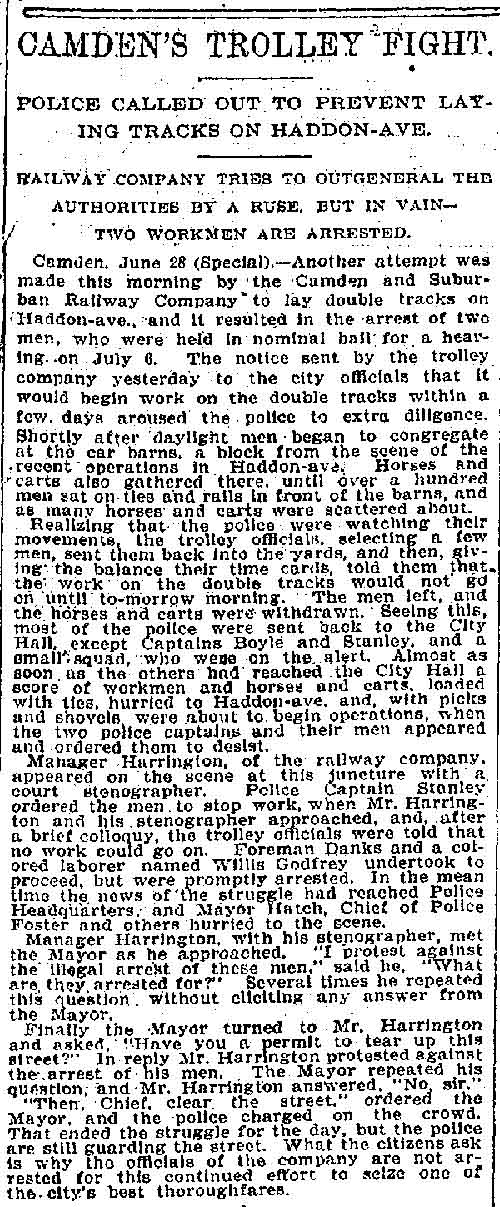
New York Herald-Tribune, June 29, 1899View transcription
CAMDEN'S TROLLEY FIGHT.
POLICE CALLED OUT TO PREVENT LAYING TRACKS ON HADDON-AVE.
RAILWAY COMPANY TRIES TO OUTGENERAL THE AUTHORITIES BY A RUSE, BUT IN VAIN—TWO WORKMEN ARE ARRESTED.
Camden, June 28 (Special).—Another attempt was made this morning by the Camden and Suburban Railway Company to lay double tracks on Haddon-ave., and it resulted in the arrest of two men, who were held in nominal bail for a hearing on July 6. The notice sent by the trolley company yesterday to the city officials that it would begin work on the double tracks within a few days aroused the police to extra diligence. Shortly after daylight men began to congregate at the car barns, a block from the scene of the recent operations in Haddon-ave. Horses and carts also gathered there, until over a hundred men sat on ties and rails in front of the barns, and as many horses and carts were scattered about.
Realizing that the police were watching their movements, the trolley officials, selecting a few men, sent them back into the yards, and then, giving the balance their time cards, told them that the work on the double tracks would not go on until to-morrow morning. The men left, and the horses and carts were withdrawn. Seeing this, most of the police were sent back to the City Hall, except Captains Boyle and Stanley, and a small squad, who were on the alert. Almost as soon as the others had reached the City Hall a score of workmen and horses and carts, loaded with ties, hurried to Haddon-ave. and, with picks and shovels, were about to begin operations, when the two police captains and their men appeared and ordered them to desist.
Manager Harrington, of the railway company, appeared on the scene at this juncture with a court stenographer. Police Captain Stanley ordered the men to stop work, when Mr. Harrington and his stenographer approached, and, after a brief colloquy, the trolley officials were told that no work could go on. Foreman Danks and a colored laborer named Willis Godfrey undertook to proceed, but were promptly arrested. In the mean time the news of the struggle had reached Police Headquarters, and Mayor Hatch, Chief of Police Foster and others hurried to the scene.
Manager Harrington, with his stenographer, met the Mayor as he approached. "I protest against the illegal arrest of these men," said he. "What are they arrested for?" Several times he repeated this question, without eliciting any answer from the Mayor.
Finally the Mayor turned to Mr. Harrington and asked, "Have you a permit to tear up this street?" In reply Mr. Harrington protested against the arrest of his men. The Mayor repeated his question, and Mr. Harrington answered, "No, sir."
"Then, Chief, clear the street," ordered the Mayor, and the police charged on the crowd. That ended the struggle for the day, but the police are still guarding the street. What the citizens ask is why the officials of the company are not arrested for this continued effort to seize one of the city's best thoroughfares.
Police Called Out to Prevent Laying Tracks on Haddon-Ave. — Railway Company Tries to Outgeneral the Authorities by a Ruse, But in Vain — Two Workmen Are Arrested
Camden, June 28 (Special).—Another attempt was made this morning by the Camden and Suburban Railway Company to lay double tracks on Haddon-ave., and it resulted in the arrest of two men, who were held in nominal bail for a hearing on July 6. The notice sent by the trolley company yesterday to the city officials that it would begin work on the double tracks within a few days aroused the police to extra diligence. Shortly after daylight men began to congregate at the car barns, a block from the scene of the recent operations in Haddon-ave. Horses and carts also gathered there, until over a hundred men sat on ties and rails in front of the barns, and as many horses and carts were scattered about.
Realizing that the police were watching their movements, the trolley officials, selecting a few men, sent them back into the yards, and then, giving the balance their time cards, told them that the work on the double tracks would not go on until to-morrow morning. The men left, and the horses and carts were withdrawn. Seeing this, most of the police were sent back to the City Hall, except Captains Boyle and Stanley, and a small squad, who were on the alert. Almost as soon as the others had reached the City Hall a score of workmen and horses and carts, loaded with ties, hurried to Haddon-ave. and, with picks and shovels, were about to begin operations, when the two police captains and their men appeared and ordered them to desist.
Manager Harrington, of the railway company, appeared on the scene at this juncture with a court stenographer. Police Captain Stanley ordered the men to stop work, when Mr. Harrington and his stenographer approached, and, after a brief colloquy, the trolley officials were told that no work could go on. Foreman Danks and a colored laborer named Willis Godfrey undertook to proceed, but were promptly arrested. In the mean time the news of the struggle had reached Police Headquarters, and Mayor Hatch, Chief of Police Foster and others hurried to the scene.
Manager Harrington, with his stenographer, met the Mayor as he approached. "I protest against the illegal arrest of these men," said he, "What are they arrested for?" Several times he repeated this question, without eliciting any answer from the Mayor.
Finally the Mayor turned to Mr. Harrington and asked, "Have you a permit to tear up this street?" In reply Mr. Harrington protested against the arrest of his men. The Mayor repeated his question, and Mr. Harrington answered, "No, sir."
"Then, Chief, clear the street," ordered the Mayor, and the police charged on the crowd. That ended the struggle for the day, but the police are still guarding the street. What the citizens ask is why the officials of the company are not arrested for this continued effort to seize one of the city's best thoroughfares.