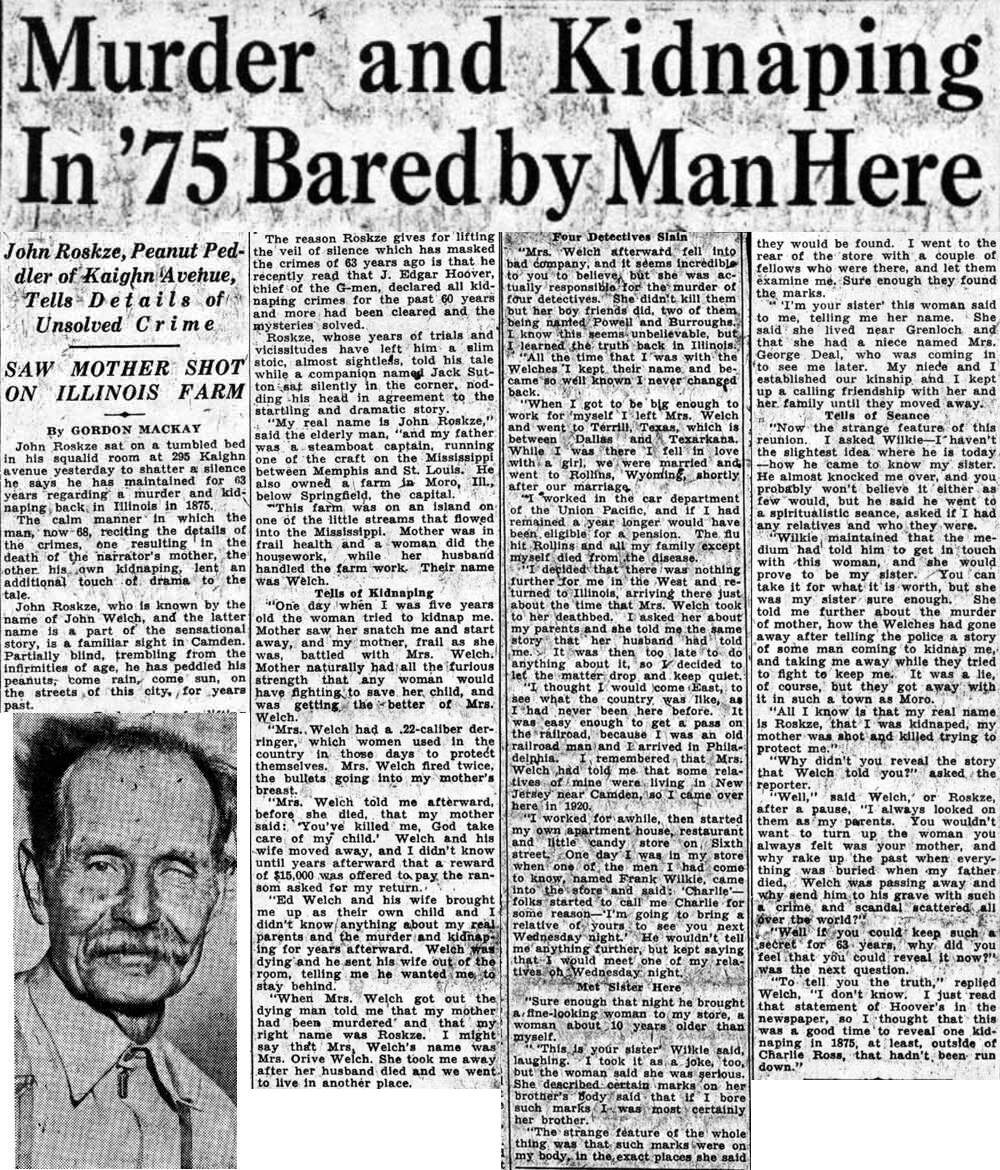
Camden Courier-Post, January 22, 1938View transcription
Murder and Kidnaping In '75 Bared by Man Here
John Roskze, Peanut Peddler of Kaighn Avenue, Tells Details of Unsolved Crime
SAW MOTHER SHOT ON ILLINOIS FARM
By GORDON MACKAY
John Roskze sat on a tumbled bed in his squalid room at 295 Kaighn avenue yesterday to shatter a silence he says he has maintained for 63 years regarding a murder and kidnaping back in Illinois in 1875.
The calm manner in which the man, now 68, reciting the details of the crimes, one resulting in the death of the narrator's mother, the other his own kidnaping, lent an additional touch of drama to the tale.
John Roskze, who is known by the name of John Welch, and the latter name is a part of the sensational story, is a familiar sight in Camden. Partially blind, trembling from the infirmities of age, he has peddled his peanuts, come rain, come sun, on the streets of this city, for years past.
The reason Roskze gives for lifting the veil of silence which has masked the crimes of 63 years ago is that he recently read that J. Edgar Hoover, chief of the G-men, declared all kidnaping crimes for the past 60 years and more had been cleared and the mysteries solved.
Roskze, whose years of trials and vicissitudes have left him a slim stoic, almost sightless, told his tale while a companion named Jack Sutton sat silently in the corner, nodding his head in agreement to the startling and dramatic story.
"My real name is John Roskze," said the elderly man, "and my father was a steamboat captain, running one of the craft on the Mississippi between Memphis and St. Louis. He also owned a farm in Moro, Ill., below Springfield, the capital.
"This farm was on an island on one of the little streams that flowed into the Mississippi. Mother was in frail health and a woman did the housework, while her husband handled the farm work. Their name was Welch.
Tells of Kidnaping
"One day when I was five years old the woman tried to kidnap me. Mother saw her snatch me and start away, and my mother, frail as she was, battled with Mrs. Welch. Mother naturally had all the furious strength that any woman would have fighting to save her child, and was getting the better of Mrs. Welch.
"Mrs. Welch had a .22-caliber derringer, which women used in the country in those days to protect themselves. Mrs. Welch fired twice, the bullets going into my mother's breast.
"Mrs. Welch told me afterward, before she died, that my mother said: 'You've killed me, God take care of my child.' Welch and his wife moved away, and I didn't know until years afterward that a reward of $15,000 was offered to pay the ransom asked for my return.
"Ed Welch and his wife brought me up as their own child and I didn't know anything about my real parents and the murder and kidnaping for years afterward. Welch was dying and he sent his wife out of the room, telling me he wanted me to stay behind.
"When Mrs. Welch got out the dying man told me that my mother had been murdered and that my right name was Roskze. I might say that Mrs. Welch's name was Mrs. Orive Welch. She took me away after her husband died and we went to live in another place.
Four Detectives Slain
"Mrs. Welch afterward fell into bad company, and it seems incredible to you to believe, but she was actually responsible for the murder of four detectives. She didn't kill them but her boy friends did, two of them being named Powell and Burroughs. I know this seems unbelievable, but I learned the truth back in Illinois.
"All the time that I was with the Welches I kept their name and became so well known I never changed back.
"When I got to be big enough to work for myself I left Mrs. Welch and went to Terrill, Texas, which is between Dallas and Texarkana. While I was there I fell in love with a girl, we were married and went to Rollins, Wyoming, shortly after our marriage.
"I worked in the car department of the Union Pacific, and if I had remained a year longer would have been eligible for a pension. The flu hit Rollins and all my family except myself died from the disease.
"I decided that there was nothing further for me in the West and returned to Illinois, arriving there just about the time that Mrs. Welch took to her deathbed. I asked her about my parents and she told me the same story that her husband had told me. It was then too late to do anything about it, so I decided to let the matter drop and keep quiet.
"I thought I would come East, to see what the country was like, as I had never been here before. It was easy enough to get a pass on the railroad, because I was an old railroad man and I arrived in Philadelphia. I remembered that Mrs. Welch had told me that some relatives of mine were living in New Jersey near Camden, so I came over here in 1920.
"I worked for awhile, then started my own apartment house, restaurant and little candy store on Sixth street. One day I was in my store when one of the men I had come to know, named Frank Wilkie, came into the store and said: 'Charlie'—folks started to call me Charlie for some reason—'I'm going to bring a relative of yours to see you next Wednesday night.' He wouldn't tell me anything further, but kept saying that I would meet one of my relatives on Wednesday night.
Met Sister Here
"Sure enough that night he brought a fine-looking woman to my store, a woman about 10 years older than myself.
"'This is your sister' Wilkie said, laughing. I took it as a joke, too, but the woman said she was serious. She described certain marks on her brother's body said that if I bore such marks I was most certainly her brother.
"The strange feature of the whole thing was that such marks were on my body, in the exact places she said they would be found. I went to the rear of the store with a couple of fellows who were there, and let them examine me. Sure enough they found the marks.
"'I'm your sister' this woman said to me, telling me her name. She said she lived near Grenloch and that she had a niece named Mrs. George Deal, who was coming in to see me later. My niece and I established our kinship and I kept up a calling friendship with her and her family until they moved away.
Tells of Seance
"Now the strange feature of this reunion. I asked Wilkie—I haven't the slightest idea where he is today—how he came to know my sister. He almost knocked me over, and you probably won't believe it either as few would, but he said he went to a spiritualistic seance, asked if I had any relatives and who they were.
"Wilkie maintained that the medium had told him to get in touch with this woman, and she would prove to be my sister. You can take it for what it is worth, but she was my sister sure enough. She told me further about the murder of mother, how the Welches had gone away after telling the police a story of some man coming to kidnap me, and taking me away while they tried to fight to keep me. It was a lie, of course, but they got away with it in such a town as Moro.
"All I know is that my real name is Roskze, that I was kidnaped, my mother was shot and killed trying to protect me."
"Why didn't you reveal the story that Welch told you?" asked the reporter.
"Well," said Welch, or Roskze, after a pause, "I always looked on them as my parents. You wouldn't want to turn up the woman you always felt was your mother, and why rake up the past when everything was buried when my father died. Welch was passing away and why send him to his grave with such a crime and scandal scattered all over the world?"
"Well if you could keep such a secret for 63 years, why did you feel that you could reveal it now?" was the next question.
"To tell you the truth," replied Welch, "I don't know. I just read that statement of Hoover's in the newspaper, so I thought that this was a good time to reveal one kidnaping in 1875, at least, outside of Charlie Ross, that hadn't been run down."
John Roskze, Peanut Peddler of Kaighn Avenue, Tells Details of Unsolved Crime
John Roskze sat on a tumbled bed in his squalid room at 295 Kaighn avenue yesterday to shatter a silence he says he has maintained for 63 years regarding a murder and kidnaping back in Illinois in 1875.
The calm manner in which the man, now 68, reciting the details of the crimes, one resulting in the death of the narrator's mother, the other his own kidnaping, lent an additional touch of drama to the tale.
John Roskze, who is known by the name of John Welch, and the latter name is a part of the sensational story, is a familiar sight in Camden. Partially blind, trembling from the infirmities of age, he has peddled his peanuts, come rain, come sun, on the streets of this city, for years past.
The reason Roskze gives for lifting the veil of silence which has masked the crimes of 63 years ago is that he recently read that J. Edgar Hoover, chief of the G-men, declared all kidnaping crimes for the past 60 years and more had been cleared and the mysteries solved.
Roskze, whose years of trials and vicissitudes have left him a slim stoic, almost sightless, told his tale while a companion named Jack Sutton sat silently in the corner, nodding his head in agreement to the startling and dramatic story.
"My real name is John Roskze," said the elderly man, "and my father was a steamboat captain, running one of the craft on the Mississippi between Memphis and St. Louis. He also owned a farm in Moro, Ill., below Springfield, the capital.
"This farm was on an island on one of the little streams that flowed into the Mississippi. Mother was in frail health and a woman did the housework, while her husband handled the farm work. Their name was Welch.
Tells of Kidnaping
"One day when I was five years old the woman tried to kidnap me. Mother saw her snatch me and start away, and my mother, frail as she was, battled with Mrs. Welch. Mother naturally had all the furious strength that any woman would have fighting to save her child, and was getting the better of Mrs. Welch.
"Mrs. Welch had a .22-caliber derringer, which women used in the country in those days to protect themselves. Mrs. Welch fired twice, the bullets going into my mother's breast.
"Mrs. Welch told me afterward, before she died, that my mother said: 'You've killed me, God take care of my child.' Welch and his wife moved away, and I didn't know until years afterward that a reward of $15,000 was offered to pay the ransom asked for my return.
"Ed Welch and his wife brought me up as their own child and I didn't know anything about my real parents and the murder and kidnaping for years afterward. Welch was dying and he sent his wife out of the room, telling me he wanted me to stay behind.
"When Mrs. Welch got out the dying man told me that my mother had been murdered and that my right name was Roskze. I might say that Mrs. Welch's name was Mrs. Orive Welch. She took me away after her husband died and we went to live in another place.
Four Detectives Slain
"Mrs. Welch afterward fell into bad company, and it seems incredible to you to believe, but she was actually responsible for the murder of four detectives. She didn't kill them but her boy friends did, two of them being named Powell and Burroughs. I know this seems unbelievable, but I learned the truth back in Illinois.
"All the time that I was with the Welches I kept their name and became so well known I never changed back.
"When I got to be big enough to work for myself I left Mrs. Welch and went to Terrill, Texas, which is between Dallas and Texarkana. While I was there I fell in love with a girl, we were married and went to Rollins, Wyoming, shortly after our marriage.
"I worked in the car department of the Union Pacific, and if I had remained a year longer would have been eligible for a pension. The flu hit Rollins and all my family except myself died from the disease.
"I decided that there was nothing further for me in the West and returned to Illinois, arriving there just about the time that Mrs. Welch took to her deathbed. I asked her about my parents and she told me the same story that her husband had told me. It was then too late to do anything about it, so I decided to let the matter drop and keep quiet.
"I thought I would come East, to see what the country was like, as I had never been here before. It was easy enough to get a pass on the railroad, because I was an old railroad man and I arrived in Philadelphia. I remembered that Mrs. Welch had told me that some relatives of mine were living in New Jersey near Camden, so I came over here in 1920.
"I worked for awhile, then started my own apartment house, restaurant and little candy store on Sixth street. One day I was in my store when one of the men I had come to know, named Frank Wilkie, came into the store and said: 'Charlie'—folks started to call me Charlie for some reason—'I'm going to bring a relative of yours to see you next Wednesday night.' He wouldn't tell me anything further, but kept saying that I would meet one of my relatives on Wednesday night.
Met Sister Here
"Sure enough that night he brought a fine-looking woman to my store, a woman about 10 years older than myself.
"'This is your sister' Wilkie said, laughing. I took it as a joke, too, but the woman said she was serious. She described certain marks on her brother's body said that if I bore such marks I was most certainly her brother.
"The strange feature of the whole thing was that such marks were on my body, in the exact places she said they would be found. I went to the rear of the store with a couple of fellows who were there, and let them examine me. Sure enough they found the marks.
"'I'm your sister' this woman said to me, telling me her name. She said she lived near Grenloch and that she had a niece named Mrs. George Deal, who was coming in to see me later. My niece and I established our kinship and I kept up a calling friendship with her and her family until they moved away.
Tells of Seance
"Now the strange feature of this reunion. I asked Wilkie—I haven't the slightest idea where he is today—how he came to know my sister. He almost knocked me over, and you probably won't believe it either as few would, but he said he went to a spiritualistic seance, asked if I had any relatives and who they were.
"Wilkie maintained that the medium had told him to get in touch with this woman, and she would prove to be my sister. You can take it for what it is worth, but she was my sister sure enough. She told me further about the murder of mother, how the Welches had gone away after telling the police a story of some man coming to kidnap me, and taking me away while they tried to fight to keep me. It was a lie, of course, but they got away with it in such a town as Moro.
"All I know is that my real name is Roskze, that I was kidnaped, my mother was shot and killed trying to protect me."
"Why didn't you reveal the story that Welch told you?" asked the reporter.
"Well," said Welch, or Roskze, after a pause, "I always looked on them as my parents. You wouldn't want to turn up the woman you always felt was your mother, and why rake up the past when everything was buried when my father died. Welch was passing away and why send him to his grave with such a crime and scandal scattered all over the world?"
"Well if you could keep such a secret for 63 years, why did you feel that you could reveal it now?" was the next question.
"To tell you the truth," replied Welch, "I don't know. I just read that statement of Hoover's in the newspaper, so I thought that this was a good time to reveal one kidnaping in 1875, at least, outside of Charlie Ross, that hadn't been run down."