Terrific Explosion of a Locomotive
Camden New Republic, December 27, 1873
View transcription
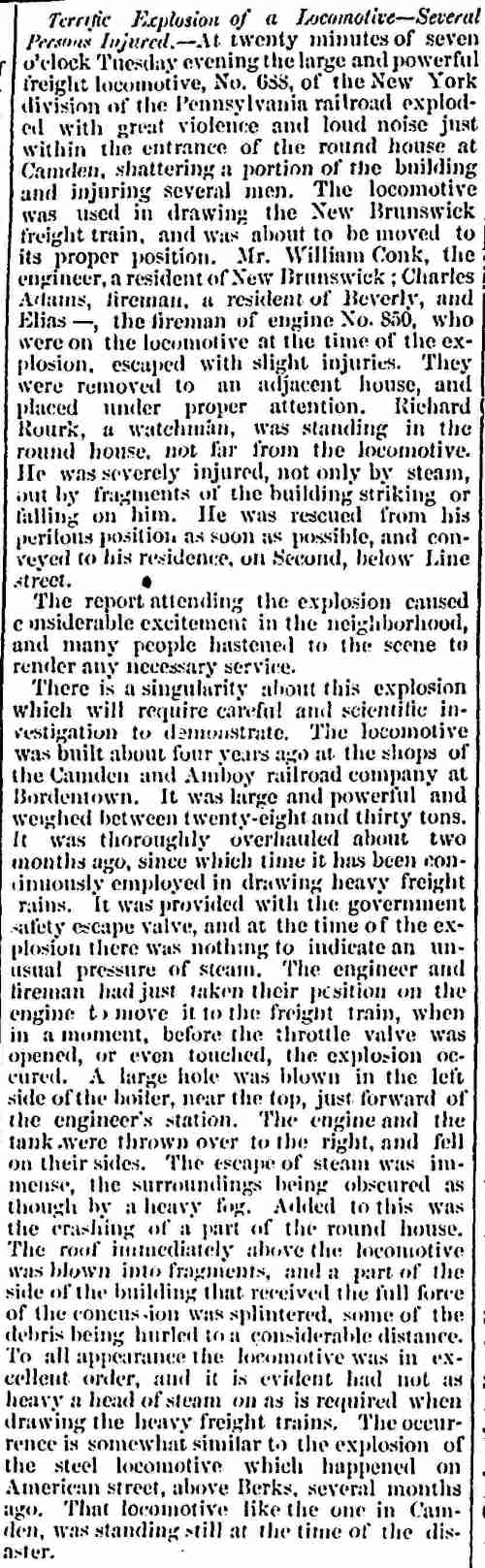
Terrific Explosion of a Locomotive—Several Persons Injured.
At twenty minutes of seven o'clock Tuesday evening the large and powerful freight locomotive, No. 688, of the New York division of the Pennsylvania railroad exploded with great violence and loud noise just within the entrance of the round house at Camden, shattering a portion of the building and injuring several men. The locomotive was used in drawing the New Brunswick freight train, and was about to be moved to its proper position. Mr. William Conk, the engineer, a resident of New Brunswick; Charles Adams, fireman, a resident of Beverly, and Elias —, the fireman of engine No. 850, who were on the locomotive at the time of the explosion, escaped with slight injuries. They were removed to an adjacent house, and placed under proper attention. Richard Rourk, a watchman, was standing in the round house, not far from the locomotive. He was severely injured, not only by steam, but by fragments of the building striking or falling on him. He was rescued from his perilous position as soon as possible, and conveyed to his residence, on Second, below Line street.
The report attending the explosion caused considerable excitement in the neighborhood, and many people hastened to the scene to render any necessary service.
There is a singularity about this explosion which will require careful and scientific investigation to demonstrate. The locomotive was built about four years ago at the shops of the Camden and Amboy railroad company at Bordentown. It was large and powerful and weighed between twenty-eight and thirty tons. It was thoroughly overhauled about two months ago, since which time it has been continuously employed in drawing heavy freight trains. It was provided with the government safety escape valve, and at the time of the explosion there was nothing to indicate an unusual pressure of steam. The engineer and fireman had just taken their position on the engine to move it to the freight train, when in a moment, before the throttle valve was opened, or even touched, the explosion occured. A large hole was blown in the left side of the boiler, near the top, just forward of the engineer's station. The engine and the tank were thrown over to the right, and fell on their sides. The escape of steam was immense, the surroundings being obscured as though by a heavy fog. Added to this was the crashing of a part of the round house. The roof immediately above the locomotive was blown into fragments, and a part of the side of the building that received the full force of the concussion was splintered, some of the debris being hurled to a considerable distance. To all appearance the locomotive was in excellent order, and it is evident had not as heavy a head of steam on as is required when drawing the heavy freight trains. The occurrence is somewhat similar to the explosion of the steel locomotive which happened on American street, above Berks, several months ago. That locomotive like the one in Camden, was standing still at the time of the disaster.
Fatal Result.—On Wednesday Coroner Armstrong empannelled a jury of scientific men to inquire into the cause of the boiler explosion at the depot, in this city, on last Tuesday evening. The inquest was held on the body of Richard Rourke, who received injuries causing his death about ten o'clock on the evening of the mishap. The jury rendered a verdict that Rourke came to his death from injuries received from the explosion of the boiler of engine No. 688, and that no blame is attached to the company or its employes. Rourke, after receiving his wounds, was taken to his residence, 708 South Second street, where he died about three hours after the accident. He had taken the place of the regular watchman, who was sick. He was fifty years old and leaves a wife and seven children.
Camden New Republic, December 27, 1873
View transcription
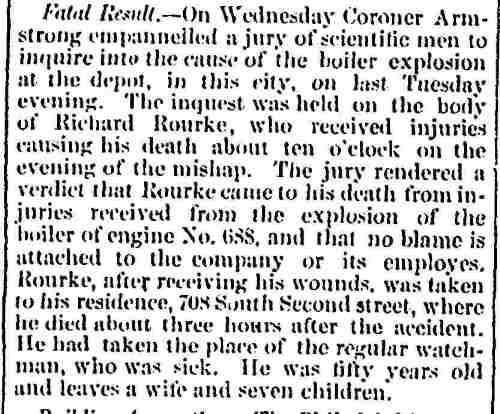
Fatal Result.—On Wednesday Coroner Armstrong empanneled a jury of scientific men to inquire into the cause of the boiler explosion at the depot, in this city, on last Tuesday evening. The inquest was held on the body of Richard Rourke, who received injuries causing his death about ten o'clock on the evening of the mishap. The jury rendered a verdict that Rourke came to his death from injuries received from the explosion of the boiler of engine No. 688, and that no blame is attached to the company or its employes. Rourke, after receiving his wounds, was taken to his residence, 708 South Second street, where he died about three hours after the accident. He had taken the place of the regular watchman, who was sick. He was fifty years old and leaves a wife and seven children.
[illegible]
Advertisement