Herman Rhode (Buddy “Nature Boy” Rogers)
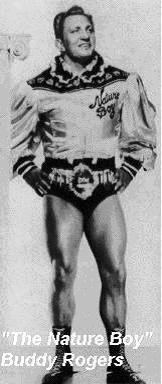
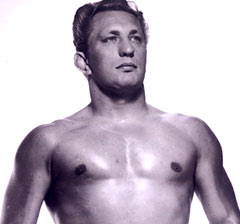
Buddy Rogers was born Herman G. Rohde Jr. to Herman and Freda Rohde in Camden, New Jersey, on February 20, 1921. Both his parents were born in Germany. In 1920 his father was working as a machinist at the Samuel Langston Company in Camden’s Eighth Ward; ten years later he was a stationary engineer at the Camden Brewery at 6th and Bulson Streets. Young Herman was the baby of the family — his father was 49 and his mother Freda 37 at his birth. In 1930 the Rohde family lived at 2033 Arlington Street in Camden’s Eighth Ward, in the shadow of the Howland Croft & Sons Co. mill and a short walk from the brewery.
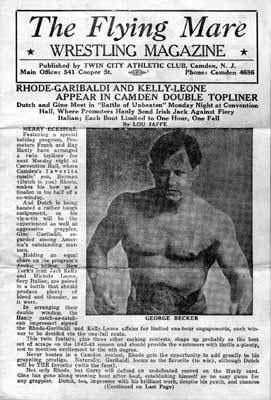
He began wrestling in 1939 as Dutch Rogers, and wrestled in the Camden area under his own name, Herman “Dutch” Rohde. His father passed away on December 5th of that year. Realizing that marketing meant as much in wrestling as what took place in the ring, Herman Rohde took on the name Buddy Rogers, dyed his hair blond, and let it all hang out.
Herman C. Rohde — Buddy Rogers — appears in the 1947 Camden City Directory, which shows he had married and was working as a policeman in Camden. Along with wife Ella he was still living at 2033 Arlington Street. Also at home were his widowed mother Freda and older brother John.
The new invention, television, was about to sweep the country. Wrestling became a staple during the first fifteen years or so of the new medium, and Nature Boy Buddy Rogers — with his dyed hair, flamboyant costumes, and bad behavior — became the sport’s first televised star.
The Nature Boy
Hard to believe, but The Original Nature Boy was born in the city of Camden, NJ. Buddy Rogers — real name Herman Rohde — was born February 20, 1921, and made his pro debut in July 1939 under the ring name Dutch Rogers, and even wrestled under his own name. Knowing he would need a name and an image to distinguish himself from every other wrestler, he took the name of movie star Buddy Rogers in 1941, dyed his hair platinum blond, and in short order became the Nature Boy, taking the tag from Nat King Cole’s hit record — “there was a boy, a strange enchanted boy.”
To further establish himself, Rogers made sure the fans despised him every night in every town he competed in. His character was an arrogant, flamboyantly dressed villain who competed in both the tag team and singles divisions. He was so well received by the fans that promoters kept him as a champion, in one form or another, in their territory.
In 1961, Rogers reached the very top of wrestling when he won the NWA World Championship from Pat O’Connor at old Comiskey Park in Chicago in front of 34,000 fans. His reign lasted over two years, drawing sellout crowds hoping to see him lose the belt to one of their favorites. He was defeated in 1963 by Lou Thesz after a single fall — itself a controversy, as title matches were then best-of-three-falls. Promoters in the Northeastern United States were so furious that they withdrew from the NWA and formed the World Wide Wrestling Federation (now WWE), and named Rogers their first champion. Through this unusual series of events, Rogers became the first man to hold both the NWA and WWWF title belts — a feat not matched until January 1992, by another Nature Boy, Ric Flair.
Rogers held the WWWF title until he faced Bruno Sammartino on May 17, 1963, at Madison Square Garden. It was said Rogers had suffered a heart attack a few weeks before the match; in reality he was a transitional champion who had never won the belt in the ring — it had simply been awarded to him — and this was the first opportunity to get it around Sammartino’s waist. Rogers retired from the ring a few months later.
Rogers resurfaced in the 1970s as a manager for less charismatic wrestlers of the time such as Jimmy Snuka, John Studd, and Ken Patera. He stepped into the ring again in July 1979 to face Ric Flair in a battle of the Nature Boys, losing by submission. According to legend, Flair idolized Rogers and copied his entire gimmick — the ring robes, grand entrances, blond hair, ego, and finishing maneuver, the Figure-Four leglock.
When he finally retired from wrestling for good, just prior to the rise of “Hulkamania,” he took a job as a casino manager. Remarkably, at the age of 70, Rogers was set to challenge wrestling’s third Nature Boy, Buddy Landel, but suffered a massive stroke and passed away on June 26, 1992.
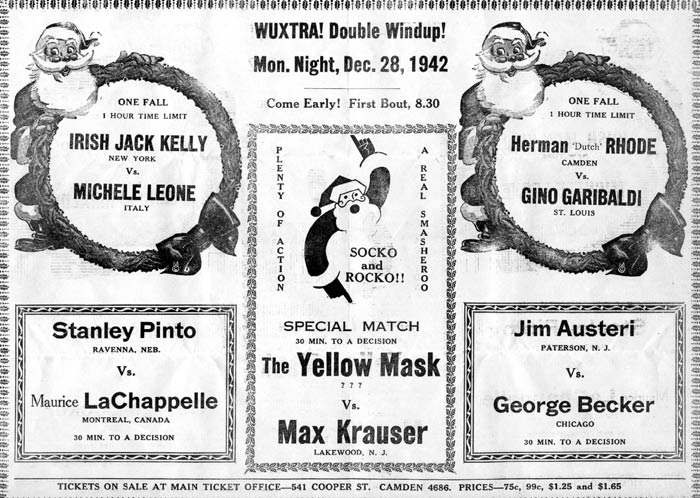
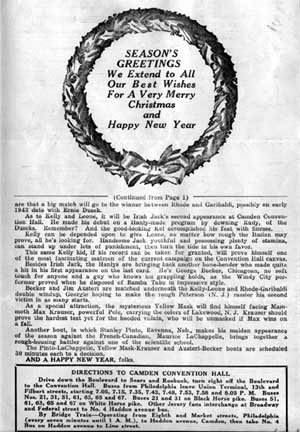
Herman “Dutch” Rohde in Camden, 1942
WWE Hall of Fame
Buddy Rogers was never demure in broadcasting his attributes. So in 1961, when he dethroned Pat O’Connor for the National Wrestling Alliance (NWA) World Title in front of 38,622 fans at Chicago’s Comiskey Park, the original “Nature Boy” couldn’t resist getting on the microphone and heaping praise on himself. Said the smug Rogers, “To a nicer guy, it couldn’t happen.”
This was Rogers’ style throughout his career, a manner that grated on the wrestlers behind the scenes as much as it did on the spectators. But the inaugural WWE Champion seemed to care little about how he was perceived. He legitimately was great, and even his harshest detractors could do nothing to change that.
Rogers was a former Camden, New Jersey police officer who took the name “Nature Boy” from a popular song. In the 1950s he received national exposure while wrestling from Chicago on the old DuMont Network. With his platinum blond locks, rich tan, haughty strut, and Figure-Four leglock, Rogers stood out. His services were sought all over the country and are credited with galvanizing business in struggling promotions; his 1961 match with O’Connor set attendance and gate records that would not be surpassed for two decades.
In early 1963 he lost the NWA Championship to Lou Thesz in Toronto. While most U.S. promotions recognized the title switch, Vincent J. McMahon — father of later WWE owner Vincent K. McMahon — and his partner Toots Mondt cried foul, insisting the NWA title could only change hands in a two-out-of-three-falls match. They declared the single-fall result invalid and claimed Rogers had won a tournament to become titlist of their new company, which would eventually morph into World Wrestling Entertainment.
Rogers did not wear the crown for long. On May 17, 1963, Bruno Sammartino defeated him in 48 seconds at Madison Square Garden. Rogers claimed he’d suffered a heart attack shortly before the match; Sammartino said the dethroned king was simply making excuses. Rogers then vanished from sight, turning up briefly in different promotions before reappearing in 1979 in North Carolina, heckling and then attacking a new “Nature Boy,” Ric Flair, in the Mid-Atlantic territory.
The “battle of the Nature Boys” was a pivotal moment in Flair’s career. “Slick Ric” admitted to emulating many of Rogers’ mannerisms and ring moves; when Flair beat his idol with a Figure-Four in Greensboro, he earned the right to proclaim, “To be The Man, you have to beat The Man.” In the 1980s, Rogers returned to WWE hosting an interview segment, Rogers’ Corner, and briefly managed “Superfly” Jimmy Snuka.
Tributes
Buddy Rogers was an out-and-out star. He had a knack for what we call ring showmanship. No one was better than Buddy Rogers. Buddy Rogers owned every moment in the ring. You’d watch him and forget he had an opponent.
— Lillian Ellison (The Fabulous Moolah), The Fabulous Moolah: First Goddess of the Squared Circle (2002)
Buddy was so flamboyant. He had a great physique and was very charismatic. Buddy was also very reliable. A tremendous athlete — far and away one of the best athletes ever in the business. And very smart, in the ring and outside the ring.
— Vincent K. McMahon, WWE Legends (2006)
I’m not sure a lot of stories about Buddy Rogers are true. But I’m glad to say that THAT Nature Boy did the right thing for THIS Nature Boy. The one thing I learned from the experience was to judge people by the way they treat you.
— Ric Flair, To Be The Man… (2004)
Tag: herman-rhode-aka-buddy-nature-boy-rogers

Arlington Street
Arlington Street in South Camden ran one block and virtually disappeared after demolition in 2004. The street was home to working-class families, the General Gas Mantle factory (which caused thorium contamination), and became an EPA Superfund site in 1996.
Binder Family Memory of Arlington Street
John "Chick" Binder recalls growing up at 2030 Arlington Street through the World War II years — the Rohde family across the street, air-raid drills, and V-J Day on a now-vanished block.
Regl Family Memory of Arlington Street
John Regl traces nearly fifty years of his family's history at 2054 Arlington Street, from his great-grandfather's arrival from Hungary in 1906 to the family's departure in 1958.
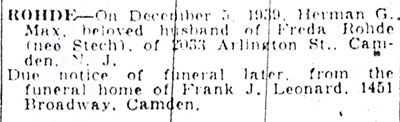
Herman G. Rohde
Death notice of Herman G. Rohde of 2033 Arlington Street, who died December 5, 1939 — father of the professional wrestler Herman "Dutch" Rohde, better known as "Nature Boy" Buddy Rogers.