William G. Kairer Sr.
William G. Kairer Sr. was a well-known and respected businessman in Camden in the 1880s and 1890s. He was born around 1839, and was in the bakery business in Camden as early as 1869.
The 1869 City Directory shows him at 616 South 5th Street. By 1872 he had moved to 703 Federal Street, and was still there when the 1874 Directory was compiled. William G. Kairer Sr. married twice and was widowed twice. His first wife, Margaret W. “Maggie” Godshall, gave him two sons, William G. Kairer Jr. and Charles Kairer, before dying of tuberculosis on May 9, 1872 in Camden. His second marriage, to Ella Hopper, sadly also ended when she died in 1886 at the age of 34, but not before bearing at least three children: Frank Granville Kairer, and daughters Elizabeth Gertrude Kairer and Adda Kairer. Daughter Adda also died before reaching adulthood.
By 1877 William G. Kairer had moved to South Camden, setting up home and business at 416–418 Line Street. This address was his residence when the census was taken in 1880. Late in 1892 or in 1893 he moved to a recently built home at 429 Beckett Street, at the corner of Beckett and Avon Street, in South Camden with his son William G. Kairer Jr., his daughter-in-law Frances “Fannie” Fithian Kairer, grandson Howard Kairer, and a servant, Annie McCuen. On December 4, 1893 William G. Kairer Sr. was murdered by Nicholas Theodore “Theodore” Lambert, who had broken into his home with the intent of robbing it.
William G. Kairer Sr. was buried at Evergreen Cemetery in Camden after services held at his home. Theodore Lambert was arrested, tried, and after numerous appeals, executed at the Camden County Jail on December 19, 1895 for murdering Mr. Kairer.
After settling the estate, William G. Kairer Jr. remained in business at 416–418 Line Street until 1900, when the building was badly damaged by fire. Camden Courier-Post reporter Benjamin W. Courter wrote in 1928 that it was later rented as a warehouse for the Gately & Hurley department store, known after 1904 simply as Hurley's Department Store, after its owner, William Leonard Hurley.
Death Notice — Maggie W. Kairer
Philadelphia Inquirer — May 13, 1872
View transcription
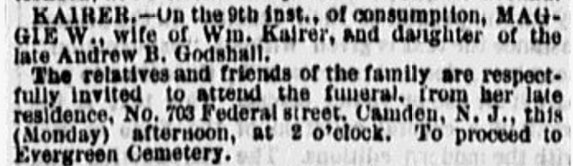
KAIRER. — On the 9th inst., of consumption, MAGGIE W., wife of Wm. Kairer, and daughter of the late Andrew B. Godshall.
The relatives and friends of the family are respectfully invited to attend the funeral, from her late residence, No. 703 Federal Street, Camden, N.J., this (Monday) afternoon, at 2 o'clock. To proceed to Evergreen Cemetery.
429 Beckett Street
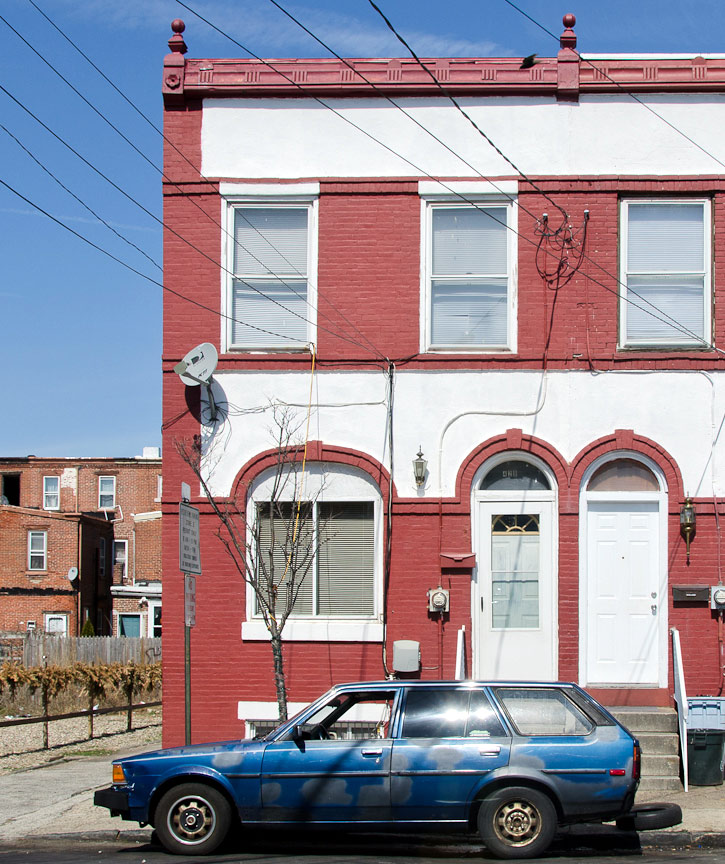
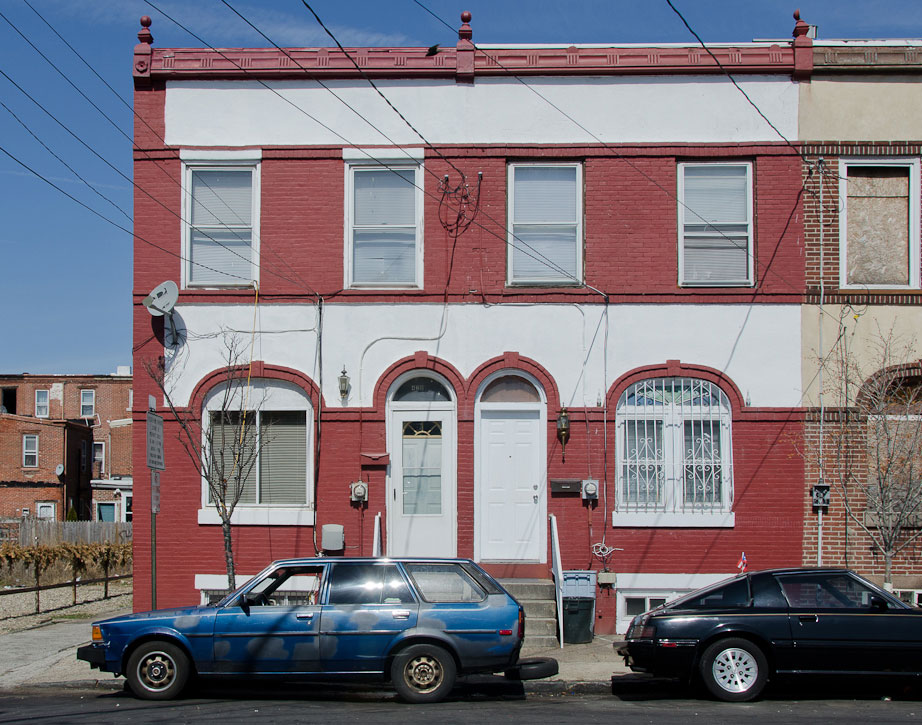
The Kairer home at 429 Beckett Street, at the corner of Beckett and Avon Streets, photographed March 14, 2012.
Shot Dead in His Home by a Burglar
Philadelphia Inquirer — December 5, 1893

View transcription
Thrilling Encounter of a Camden Baker and His Son With a Robber, Who Killed the Father. Three Shots Through a Window and William G. Kairer Moaned and Died.
The murderer believed to be a colored man who pawned his victim's watch — police working on a clue in Philadelphia — the son's story.
William G. Kairer, Sr., a well-to-do Camden baker, was aroused from slumber yesterday morning by the visit of a burglar. A few minutes later he fell dead, with a bullet from the robber's revolver lodged in his body. The murderer escaped, but the police are at work on a clue which promises to lead to his identification and arrest.
The scene of the murder is a two-story brick house, 429 Beckett street, where the victim resided with his married son, William G. Kairer, Jr. The other occupants of the house were the son's wife and child, and a servant, Annie McCuen. The house is on the north side of Beckett street, at the corner of Avon street.
The only witness of the shooting is young Mr. Kairer, who stood by his father's side and held him in his arms until he died. He occupied the front bedroom in the second story and his father the rear room. This is his story:
“The door opening into my bed room from the hall sticks at the top and the rasping noise made as the door was forced open awakened me about ten minutes before 5 o'clock. As I opened my eyes I saw a man's arm and part of his body in the doorway. I jumped out of bed and yelled ‘Man in the house!’
“The burglar ran toward the stairway and I ran in pursuit. Turning quickly at the head of the stairs he grasped one of the bars of the railing to steady himself. I reached over the railing and struck at him with my fist. The man swayed and escaped the blow, and in doing so wrenched out the bar. He dashed down stairs. It was so dark that I could not tell whether the man was white or black.
“My father was awakened by the noise. He lit a match and, without stopping to dress, we hurried down stairs. The door leading into the kitchen, the door of the inclosed shed and the gate opening on Avon street were all open. The burglar had evidently escaped. Spread out in the shed we found a shawl ready to wrap plunder in.
“Returning to the dining room we lit the gas and looked around to see what had been taken. The silverware on the table had apparently not been disturbed. We noticed that the gas was burning low in the parlor and the lower sash of the one big parlor window was raised, although the inside blinds were closed.
Three Shots Quickly Fired.
“There is a wide doorway between the parlor and dining room, hung with a portiere. My father was standing in this doorway facing the parlor window, and I was at his left side and slightly in his rear, when the inside blinds of the parlor window were suddenly dashed open and I saw three flashes in quick succession.
“My father gave a groan, staggered and was about to fall when I caught him in my arms. I laid him gently on the floor, pillowed his head on my arm and implored him to speak to me. He moaned feebly for a few minutes, gave a gasp and died. I cannot describe my father's murderer, for I merely caught a glimpse of him in the darkness.”
The family of William H. Upton, next door, were aroused by the shots. Mrs. Upton and her daughter ran to the front window and saw a man skip across Beckett street and then walk leisurely down White street. Mr. Upton ran into Kairer's house and found the parlor filled with smoke and young Mr. Kairer supporting his dying father. L. R. Weldy, a milkman serving a customer on Line street, heard the shots and ran into Beckett street, but saw nothing of the murderer.
Work of the Police.
The scene of the murder is not far from No. 1 Patrol House, and the police were soon at the house. They found one of the burglar's bullets imbedded in the ceiling immediately above the spot where the murdered man stood. Another had broken the globe on the chandelier in the dining room and imbedded itself in the rear wall. The third had entered Mr. Kairer's body near the centre of the breast. The county physician found death was apparently due to internal hemorrhage from the cutting of a main artery.
At first it was thought the murderer had secured no plunder except fifty cents taken from a child's savings bank. About three hours after the tragedy young Mr. Kairer notified the police that his father's gold watch was missing, taken from a vest lying on a washstand in his father's bedroom. Under a blanket near-by was $600 which the burglar missed. At a Philadelphia pawnshop the watch was recovered about noon; it had been pledged ten minutes before the police notified the pawnbroker by a colored man supposed to be the murderer.
This description of the man is given: about 35 years old; very dark; five feet eight inches in height; heavily built, weighing probably 175 pounds; very thick neck; big nose and heavy lips. County Detective Gallagher and Lieutenant Smith came over from Camden late at night to get an accurate description.
The Victim Well Known.
William G. Kairer, Sr., the murdered man, was well known in Camden, where he had been in business as a cracker baker for many years. His two sons, William G., Jr., aged 28, and Charles, aged 25, aided in carrying on the business at 416 and 418 Line street. There was another son, Frank, 14, who had started for a boarding school, and a daughter, 19, who recently married Thomas White of West Philadelphia.
The deceased was a leading member of the First M. E. Church and was active in evangelical work. He frequently conducted Sunday morning religious services at the city or county jail and took an interest in the Salvation Army. He was a member of Pottawatomie Tribe of Red Men, Fidelity Lodge No. 3 of the Ancient Order United Workmen, the Odd Fellows, and the Legion of the Red Cross.
The Camden police arrested three colored men who resembled the description. Theodore Lambert, who answered in nearly every particular, was arrested in the Eighth ward and admitted having committed a recent robbery. The other two suspects were Louis Riley and Joseph B. Stevenson, picked up in South Camden.
Shot and Killed by a Burglar
New York Herald — December 5, 1893

View transcription
Brutal Murder of William G. Kairer, a Prominent Business Man of Camden, N.J. — Fired Through the Window. Colored Man Under Arrest.
Mr. Kairer's sons live with him at No. 429 Beckett street. One of them, who bears the same name as the father, is married and is also interested in the business. Soon after half-past four o'clock this morning the younger Kairer says he was aroused from sleep by the turning of his door knob. He sprang from the bed and threw open the door. In the dark he could distinguish a man's form half way down the staircase. At the same moment the father left his room and started down stairs ahead of the son.
The young man wrenched one of the rungs from the baluster and made a pass at the burglar's head, but the father being between them he missed his mark. The burglar fled through the kitchen door, which he had left open for this purpose.
Fell Into His Son's Arms.
The younger Kairer started in pursuit, but returned and entered the parlor, following his father, whose notice had been attracted by the wind blowing through an open window. They had just remarked upon the singular fact that the window was open while the inside shutters were closed, when the shutters flew open with a bang that broke the catches. The elder Kairer stepped toward the window. There was a flash and a report, followed by two more in quick succession, and the father staggered and fell into his son's arms. Within five minutes he breathed his last.
The burglar had evidently entered the house by the front window and opened the back door to permit a speedy escape. On the floor was a large shawl placed to receive the silverware on the table. He had made up his mind to seek more plunder upstairs and, in attempting to enter the younger Kairer's room, had awakened him.
A Possible Clew.
The police at first said nothing was missing but fifty cents out of a toy bank. Late this afternoon it was given out that the dead man's gold watch had been taken from his room. The watch had already been pawned in a Philadelphia pawn shop by a colored man who gave the name of Kuserickfon. The pawnbroker's description: “Black, thirty-five years old, five feet eight inches high, heavy built, weighs 175 pounds, thick neck, large nose, thick lips, small side whiskers.”
There is much speculation as to why the shots should have been fired after the burglar had successfully made his escape. One theory held by the police is that there were two men, one inside and one outside. Another opinion is that Kairer recognized the burglar, who shot to kill, believing that “dead men tell no tales.”
A Man of Prominence.
Few men in Camden were better known or more highly respected than the dead man. He was a member of the First Methodist Episcopal Church, the Ancient Order of United Workmen, Odd Fellows and Red Men, and had been in business in this city for many years. He was fifty-four years old and a widower, leaving three sons and a married daughter. Had the assassin been within reach at six o'clock this morning there is every probability that lynch law would have been applied by the hundreds of workingmen who discussed the murder on their way to work.
An Arrest Made.
The police believe they have the murderer, but there is no absolute certainty. Theodore Lambert is the name the man gave. He was arrested in the Eighth ward to-night and answers the pawnbroker's description, even to the wearing of a nickel watch chain, but his clothing is different. He is very black, has small side whiskers, and weighs about 175 pounds. He admitted to the police he had been concerned in a number of robberies in Camden, but denied all connection with the Kairer case.
One of a Long Series.
The tragedy comes as a climax to a long series of robberies that have created a mimic reign of terror in Camden. In most cases the entrance has been by the front window and the escape by the back door, both left open, the work usually done between three and five o'clock in the morning. Yesterday morning the houses of William A. Gilbert and William Snyder, not far from Kairer's, were both entered. J. Scott Veasey, of North Eighth street, heard someone in his room a short time ago and frightened the burglar, who ran down stairs and fired two pistol shots into the window casing.
Kairer's Slayer Still at Large
Philadelphia Inquirer — December 6, 1893

View transcription
Camden Police Thought They Had the Right Man, But Were Mistaken. Their Capture Not the Man Who Pawned the Victim's Watch.
When the Camden police arrested Theodore Lambert they thought they had the murderer of cracker baker William Kairer. They held to this belief until late yesterday afternoon, when it was suddenly dispelled. The only clue to the identity of the murderer started from the pawn shop of Ellis Silberstein, 123 North Ninth street, Philadelphia, where the murdered man's gold watch was pledged five hours after the crime. The watch bore the murdered man's initials and was worth at least $75, but $15 was asked on it.
Arrested an Ex-Convict.
Lambert has a bad record. He was sent to the New Jersey State Reform School when he was 15 years old, and has served several terms in State prison, released a few months ago after serving three years for robbing a house on Mickle street. He was arrested at 1883 South Ninth street, and the police also took into custody Joseph B. Stevens and Levin Riley. The police felt sure Lambert was the man until the pawnbroker's clerk came over late in the afternoon and said emphatically he had never seen him before.
Lambert confessed having been implicated in several recent robberies, where the work of one man was shown by filth being smeared on the walls; Lambert said he did this for luck. He admitted he was on the street at half-past 3 o'clock Monday morning, a little over an hour before Kairer's residence was entered. He will be held for robbing a school house and for stealing a watch. County Physician Iszard's post-mortem found the bullet had entered at the breast, passed through the heart, and lodged in the spinal column.
Death Notice — William Kairer
Philadelphia Inquirer — December 6, 1893
View transcription
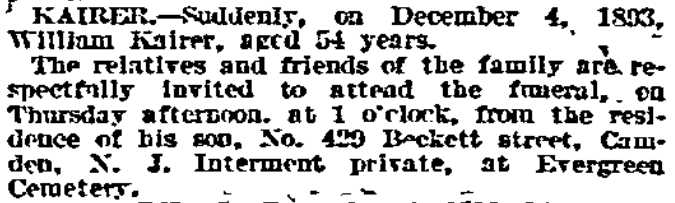
KAIRER. — Suddenly, on December 4, 1893, William Kairer, aged 54 years.
The relatives and friends of the family are respectfully invited to attend the funeral, on Thursday afternoon, at 1 o'clock, from the residence of his son, No. 429 Beckett street, Camden, N.J. Interment private, at Evergreen Cemetery.
The Camden Murder
Washington D.C. Evening Star — December 6, 1893
View transcription
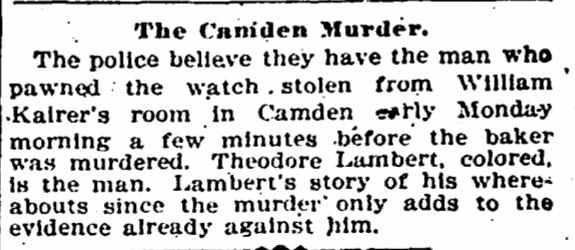
The police believe they have the man who pawned the watch stolen from William Kairer's room in Camden early Monday morning a few minutes before the baker was murdered. Theodore Lambert, colored, is the man. Lambert's story of his whereabouts since the murder only adds to the evidence already against him.
Camden's Latest Murder
Bridgeton Evening News — December 7, 1893
View transcription
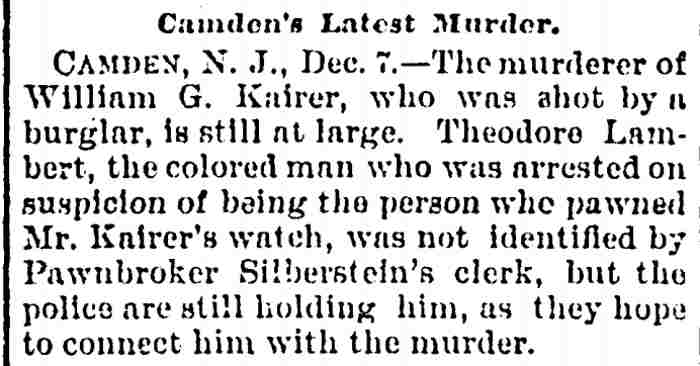
CAMDEN, N.J., Dec. 7. — The murderer of William G. Kairer, who was shot by a burglar, is still at large. Theodore Lambert, the colored man who was arrested on suspicion of being the person who pawned Mr. Kairer's watch, was not identified by Pawnbroker Silberstein's clerk, but the police are still holding him, as they hope to connect him with the murder.
No Light on the Kairer Murder
Philadelphia Inquirer — December 8, 1893

View transcription
“Shot by an Unknown Man” the Verdict of the Coroner's Jury. Funeral Services Over the Remains of the Murdered Baker.
The closing scenes in Camden's latest tragedy were enacted yesterday. In the morning an inquest was held and in the afternoon the body of William G. Kairer, Sr., was buried. The inquest was held by Coroner Hopper in the court house, and a morbid crowd was present to hear the son tell how his father was shot down at his side.
Testimony at the Inquest.
William G. Kairer, Jr., after a violent fit of weeping, took the witness stand and told how he was awakened by the burglar, the scuffle on the stairs, and how the front blinds were dashed open and his father was shot down. He was certain the shots were fired from outside the house. The only person who testified to seeing the murderer was Miss Flora Upton, who lives at 432 Beckett street, next door. She saw him walking rapidly away after the shots were fired, describing him only as of medium height, stout and wearing a dark coat. The jury brought in a verdict that Kairer “came to his death from a pistol shot wound at the hand of a person or persons unknown.”
Funeral of the Victim.
Hundreds of persons passed through the house, 429 Beckett street, and gazed at the corpse, which lay in the room where the deceased was shot. Rev. J. B. Graw, D.D., pastor of the First M. E. Church, conducted the funeral services. The pall-bearers were A. F. Davies, Charles Parker, N. G. Stowell and C. T. Pierce. Delegations were present from Pottawatomie Tribe of the Improved Order of Red Men, Fidelity Lodge of the Ancient Order United Workmen, and the Legion of the Red Cross. The body was interred in Evergreen Cemetery.
The Police Commissioners authorized a reward of $500 for information leading to arrest and conviction, making $1000 in rewards. Theodore Lambert is still held in custody but has not been connected with the crime. Sergeant John A. Smith last night arrested a colored man named Isaac Cox on suspicion of being the man who pawned the watch.
Lambert Held for Robbery
Philadelphia Inquirer — December 10, 1893
View transcription
Must Answer Two Charges — New Clue in the Kairer Case.
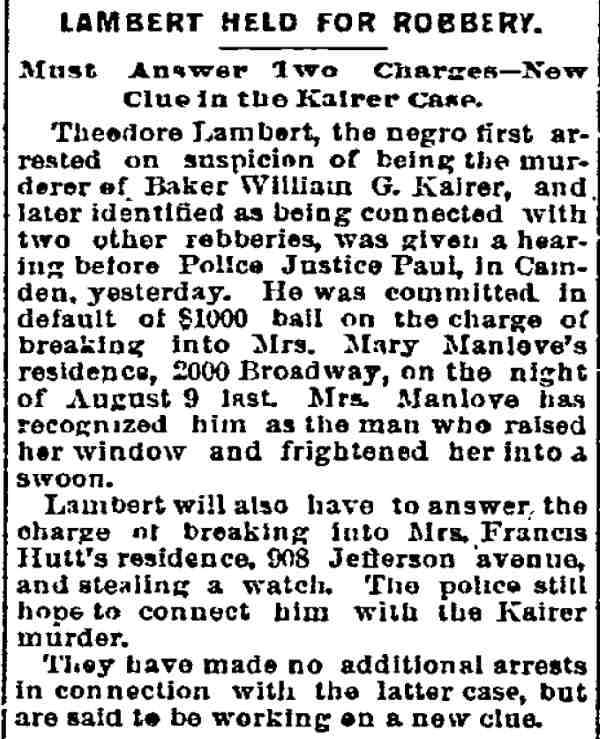
Theodore Lambert, the negro first arrested on suspicion of being the murderer of baker William G. Kairer, and later identified as connected with two other robberies, was given a hearing before Police Justice Paul in Camden yesterday, and held in $300 bail each on two charges of robbery. Lambert is accused of stealing a watch and a purse from Mrs. Frances Hutt, of 908 Jefferson avenue, and a watch from Mrs. Mary Manlove, of 1014 Plum street. He was committed to jail in default of bail. Detective Taggart, who has the Kairer murder case in hand, said he had received some new information and was confident the case would be cleared up before long.
Three Suspects Arrested
Philadelphia Inquirer — December 11, 1893
View transcription
Third District Police Think They Have the Murderer of Baker William Kairer.
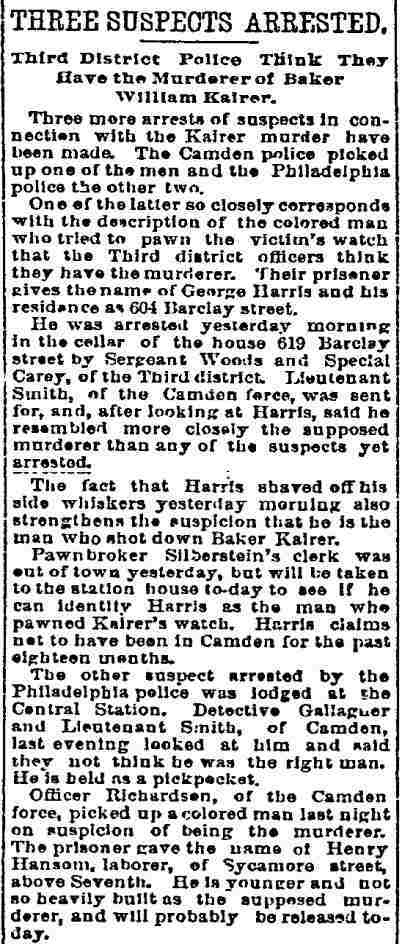
Three more arrests of suspects in connection with the Kairer murder have been made. One of the men, arrested by the Philadelphia police, so closely corresponds with the description of the colored man who tried to pawn the victim's watch that the Third district officers think they have the murderer. Their prisoner gives the name of George Harris and his residence as 604 Barclay street. He was arrested in the cellar of 619 Barclay street by Sergeant Woods and Special Carey. Lieutenant Smith, of the Camden force, said he resembled the supposed murderer more closely than any of the suspects yet arrested. The fact that Harris shaved off his side whiskers also strengthens the suspicion.
Pawnbroker Silberstein's clerk was out of town but will be taken to the station house to identify Harris. Officer Richardson of the Camden force picked up a colored man giving the name of Henry Hansom, laborer, of Sycamore street, but he is younger and not so heavily built as the supposed murderer and will probably be released.
Another Kairer Suspect
Shenandoah PA Evening Herald — December 11, 1893
View transcription
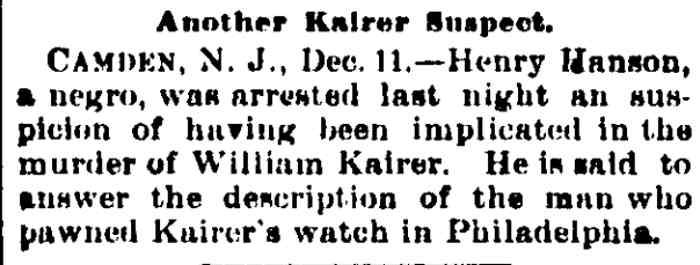
CAMDEN, N.J., Dec. 11. — Henry Hanson, a negro, was arrested last night on suspicion of having been implicated in the murder of William Kairer. He is said to answer the description of the man who pawned Kairer's watch in Philadelphia.
Charged With the Kairer Murder
Trenton Evening Times — December 11, 1893
View transcription
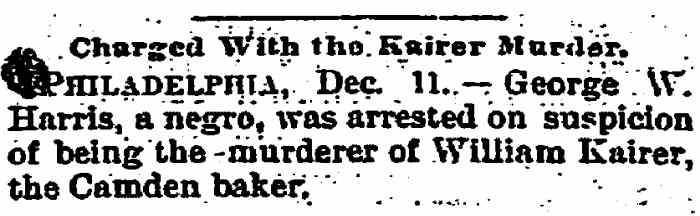
PHILADELPHIA, Dec. 11. — George W. Harris, a negro, was arrested on suspicion of being the murderer of William Kairer, the Camden baker.
Camden's Latest Murder
Washington PA Semiweekly Observer — December 11, 1893
View transcription
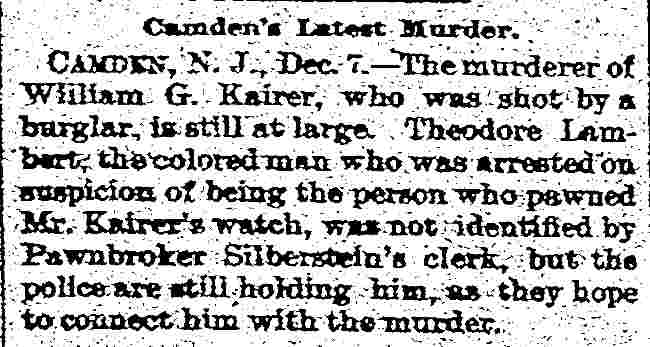
CAMDEN, N.J., Dec. 7. — The murderer of William G. Kairer, who was shot by a burglar, is still at large. Theodore Lambert, the colored man who was arrested on suspicion of being the person who pawned Mr. Kairer's watch, was not identified by Pawnbroker Silberstein's clerk, but the police are still holding him, as they hope to connect him with the murder.
Lambert Moved to County Prison
Philadelphia Inquirer — December 19, 1893
View transcription
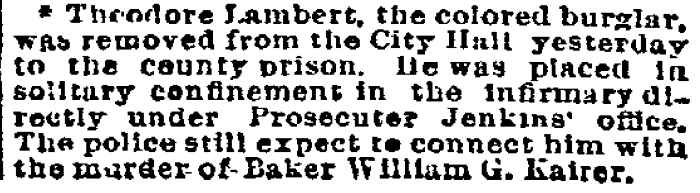
Theodore Lambert, the colored burglar, was removed from the City Hall yesterday to the county prison. He was placed in solitary confinement in the infirmary directly under Prosecutor Jenkins' office. The police still expect to connect him with the murder of baker William G. Kairer.
Continue Reading
For the full story of the investigation, trial, and execution of Theodore Lambert for the murder of William G. Kairer Sr., see the Theodore Lambert page.
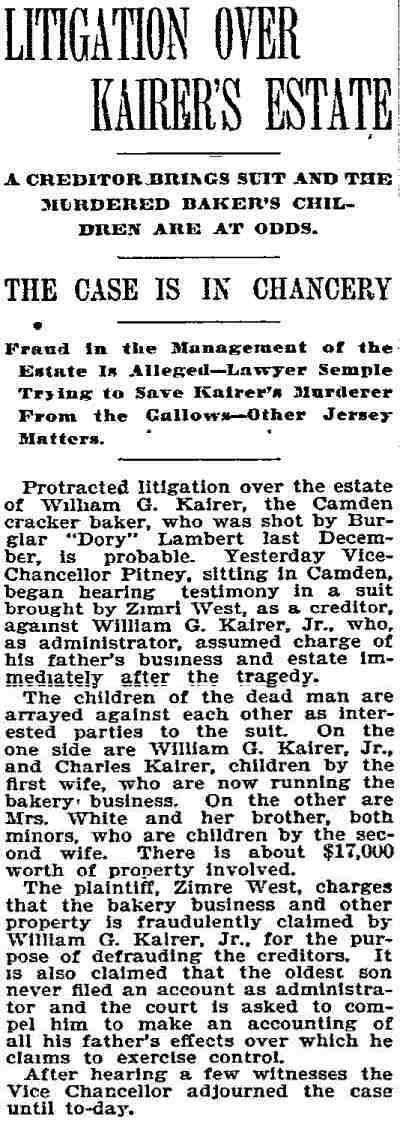
Litigation Over Kairer's Estate
Philadelphia Inquirer — November 20, 1894
View transcription
A Creditor Brings Suit and the Murdered Baker's Children Are at Odds. The Case Is in Chancery.
Protracted litigation over the estate of William G. Kairer, the Camden cracker baker shot by burglar “Dory” Lambert last December, is probable. Yesterday Vice-Chancellor Pitney, sitting in Camden, began hearing testimony in a suit brought by Zimri West, as a creditor, against William G. Kairer, Jr., who, as administrator, assumed charge of his father's business and estate after the tragedy.
The children of the dead man are arrayed against each other. On one side are William G. Kairer, Jr., and Charles Kairer, children by the first wife, now running the bakery business. On the other are Mrs. White and her brother, both minors, children by the second wife. About $17,000 worth of property is involved. The plaintiff charges that the bakery business and other property is fraudulently claimed by William G. Kairer, Jr., to defraud the creditors, and asks the court to compel an accounting.
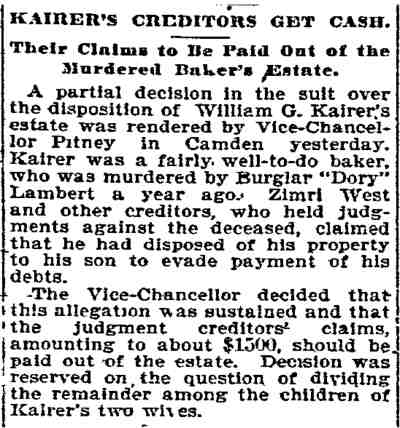
Kairer's Creditors Get Cash
Philadelphia Inquirer — December 18, 1894
View transcription
Their Claims to Be Paid Out of the Murdered Baker's Estate.
A partial decision in the suit over the disposition of William G. Kairer's estate was rendered by Vice-Chancellor Pitney in Camden yesterday. Zimri West and other creditors, who held judgments against the deceased, claimed he had disposed of his property to his son to evade payment of his debts. The Vice-Chancellor decided this allegation was sustained and that the judgment creditors' claims, amounting to about $1500, should be paid out of the estate. Decision was reserved on dividing the remainder among the children of Kairer's two wives.
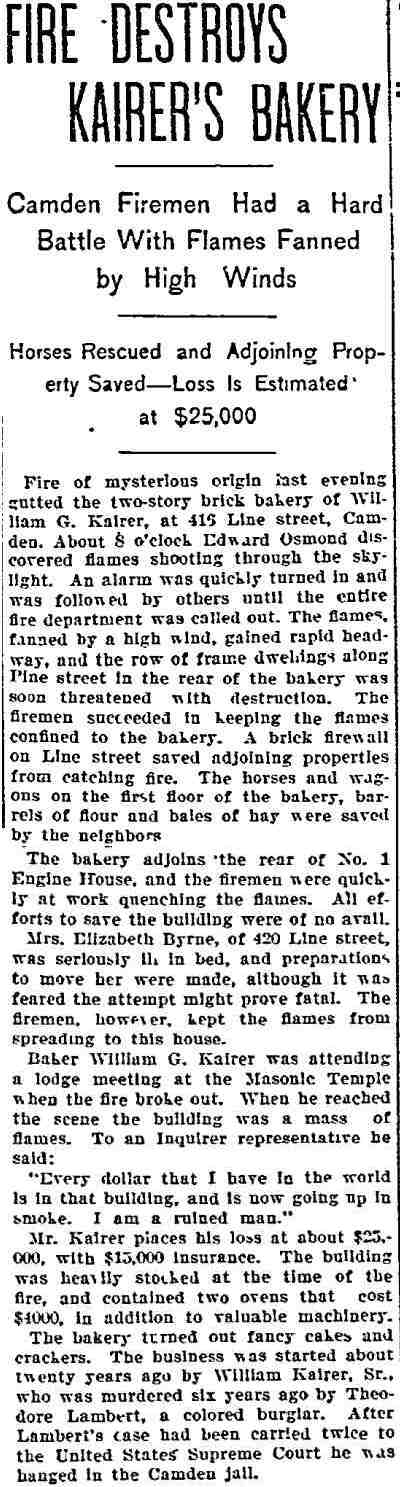
Fire Destroys Kairer's Bakery
Philadelphia Inquirer — January 27, 1900
View transcription
Camden Firemen Had a Hard Battle With Flames Fanned by High Winds. Loss Is Estimated at $25,000.
Fire of mysterious origin last evening gutted the two-story brick bakery of William G. Kairer, at 415 Line street, Camden. About 8 o'clock Edward Osmond discovered flames shooting through the skylight. An alarm was quickly turned in and followed by others until the entire fire department was called out. The flames, fanned by a high wind, gained rapid headway, and the row of frame dwellings along Pine street in the rear of the bakery was soon threatened. The firemen kept the flames confined to the bakery; a brick firewall on Line street saved adjoining properties. The horses and wagons on the first floor, barrels of flour and bales of hay were saved by the neighbors.
Baker William G. Kairer was attending a lodge meeting at the Masonic Temple when the fire broke out. When he reached the scene the building was a mass of flames. “Every dollar that I have in the world is in that building, and is now going up in smoke. I am a ruined man,” he said. Mr. Kairer placed his loss at about $25,000, with $15,000 insurance. The business was started about twenty years ago by William Kairer, Sr., who was murdered six years ago by Theodore Lambert, a colored burglar. After Lambert's case had been carried twice to the United States Supreme Court he was hanged in the Camden jail.