Carpenter Street

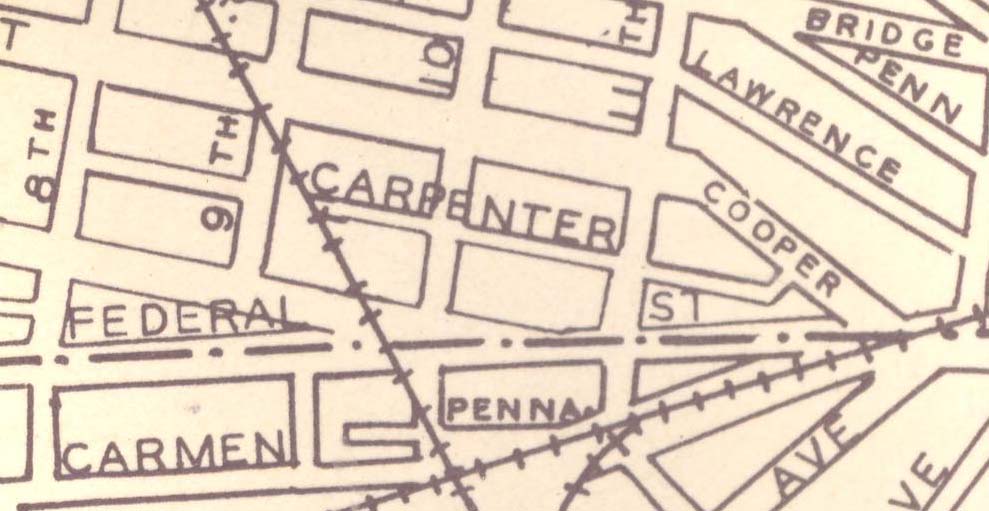
Carpenter Street first appears in Camden city directories in 1867, absent from the 1863–1864 directory. Originally a narrow street, it ran from 118 North 8th Street eastward until it intersected with Cooper Street, where Cooper angles toward its intersection with Federal Street near the Cooper River bridges. An alley next to 1129 Carpenter Street provided access to Cooper Street.
Carpenter Street at one time was interrupted at North 9th Street by the Hollingshead Factory and a railroad crossing. The Hollingshead Factory was destroyed on July 30, 1940 in a spectacular fire. Several homes in the 900 block of Carpenter Street went up in flames with the factory. By 1947, only one family living on Carpenter Street in 1924 remained.
In later years, most of Carpenter Street beyond North 9th Street was razed to make way for Interstate 676. Today, virtually all that remains is the 800 block, with no buildings still standing. For many years, Carpenter Street was best known as "the alley behind the Towne Park Motel."
Carpenter Street — 1946
800 Block of Carpenter Street
900 Block of Carpenter Street
1000 Block of Carpenter Street
1100 Block of Carpenter Street
Tag: carpenter-street
Harry E. Harker
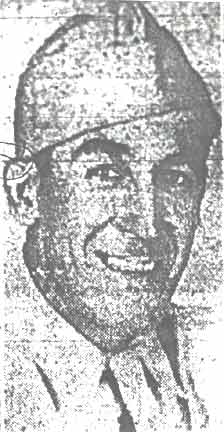
Harry E. Harker of Blackwood, NJ served as a Private in Company C, 133rd Infantry Regiment, 34th Infantry Division. He was killed April 20, 1944 during the defense of the Anzio beachhead in Italy and is buried at Beverly National Cemetery, Beverly, NJ.
11th Street
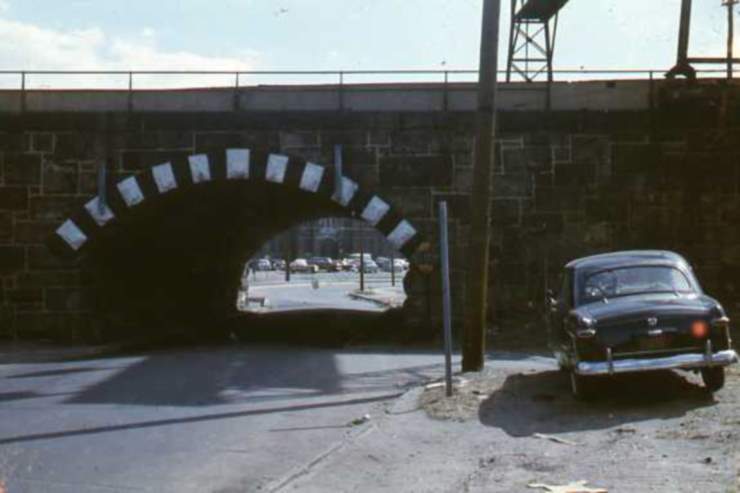
Eleventh Street ran north from Market Street through to Pearl Street. Over time, North 11th Street was erased block by block, until only a short segment between Penn and Linden Streets survives. South 11th Street is a connecting road with no residential addresses.
Burns Street
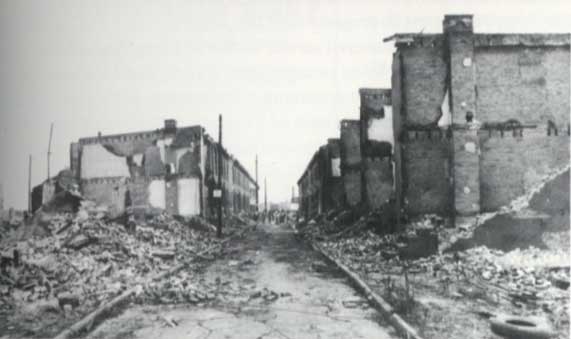
Burns Street was in Camden's Poet's Row neighborhood, named for Robert Burns. Three blocks of row homes built in the 1890s, all destroyed in the catastrophic Poet's Row fire of August 1972.
Orris W. Smith
Orris W. Smith was born in Camden on September 8, 1920, to Edward and Catherine Smith. The 1924 City Directory lists the family at 1113 Carpenter Street .

Sycamore Street
Sycamore Street is one of Camden's "tree" streets, originally running east from Front Street to Haddon Avenue; its intersections at 7th, 8th and Louis Streets were hubs for different ethnic and cultural communities.

Richman Alley
Richman Alley, documented in the 1946 Camden City Directory, was situated "from Cooper to Carpenter , East of North 11th ." Regrettably, this area, as depicted in the maps below, was cleared to facilitate the construction of Interstate 676.
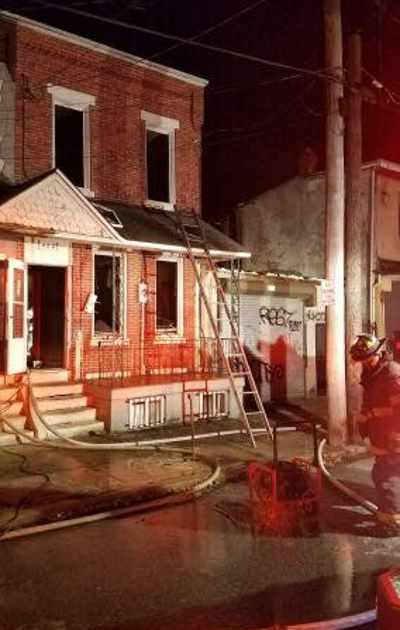
Berkley Street
Berkley Street was originally spelled Berkeley Street, named for Lord Berkeley, who co-owned the colony of New Jersey from 1664 to 1674. East of Broadway it was known as Hamilton Street until 1882. This page covers occupants from the 200 block through the 3000 block.
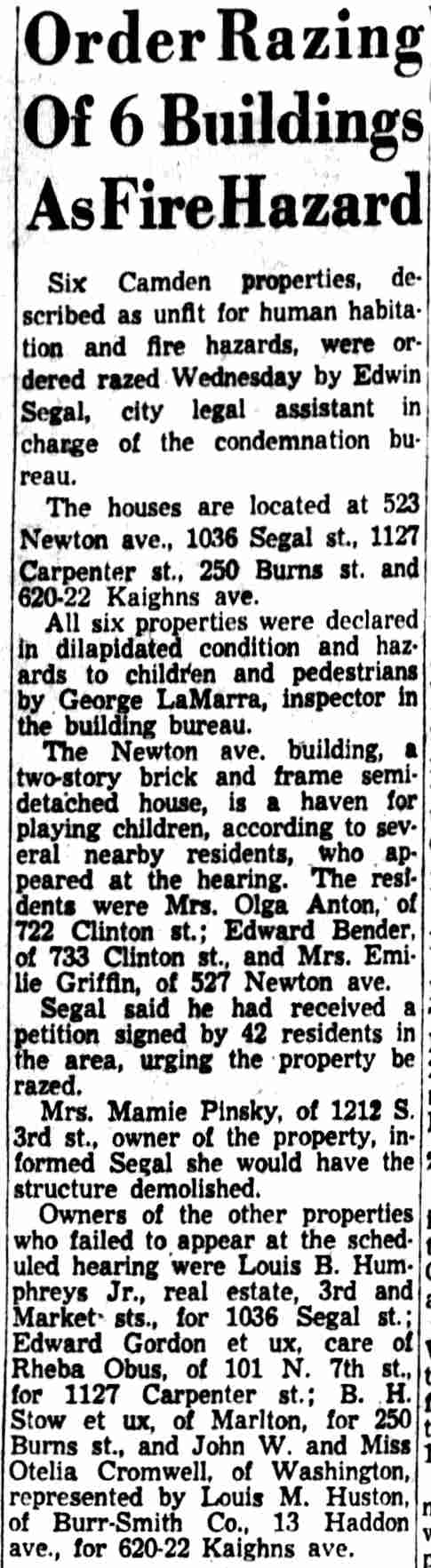
Order Razing of 6 Buildings as Fire Hazard
Six Camden properties on Newton Avenue, Segal Street, Carpenter Street, 250 Burns Street, and Kaighn Avenue were ordered demolished as unfit for habitation and fire hazards.
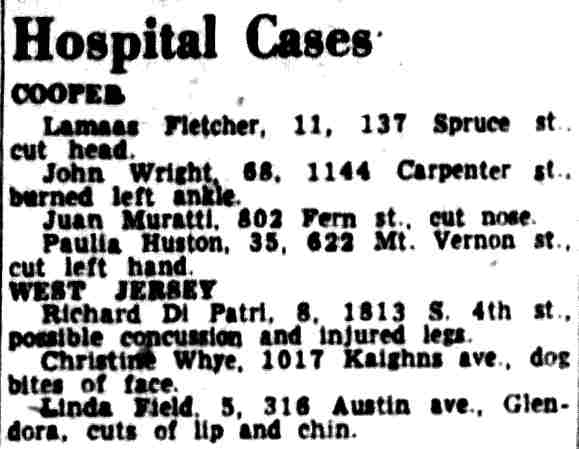
Hospital Cases
Cooper and West Jersey hospital cases reported in the Camden Courier-Post of February 15, 1956, including Christine Whye of 1017 Kaighns Avenue, treated for dog bites of the face.
Quit by Nagging Wife, Man Wins Decree Here
Divorce was recommended for Allen Stokes, whose wife left him for Philadelphia, while decision was reserved in the suit of Mrs. Martha Scully of 1089 Thurman Street against her husband, Henry, of Carpenter Street.

Von Nieda Opposes 'Parking Lot' Plan
Mayor Frederick von Nieda denied approving the Camden Housing Advisory Committee's recommendation to raze 20 blocks of houses for public parking in North and South Camden, and opposed razing the two veterans' homes at Broadway and Benson street.
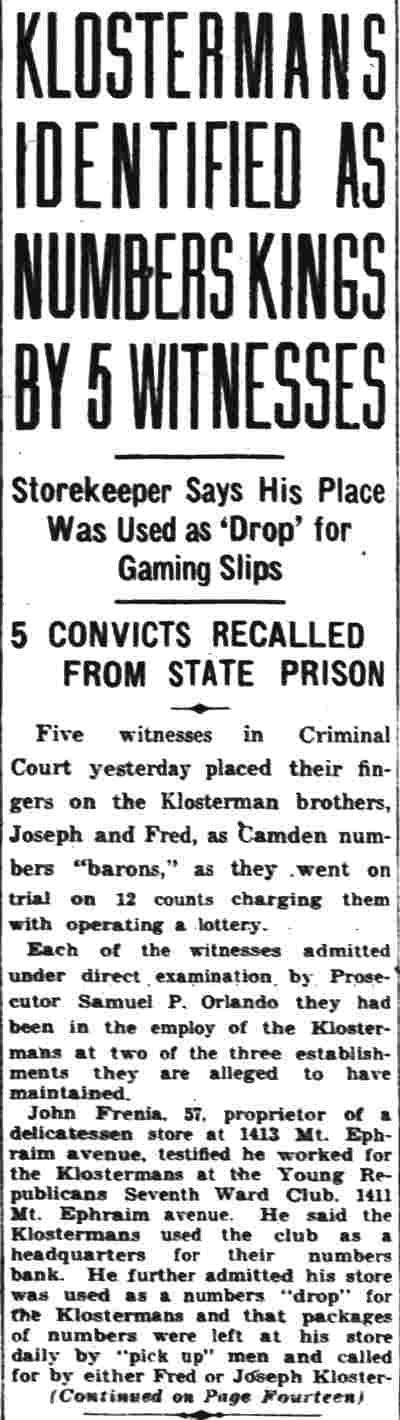
Klostermans Identified as Numbers Kings by 5 Witnesses
At the second trial of Fred and Joseph Klosterman on 12 lottery counts, five witnesses testified they had worked for the brothers' numbers bank, while five convicted numbers writers, among them Walter Hart of 1245 Thurman Street, were returned from state prison to testify.
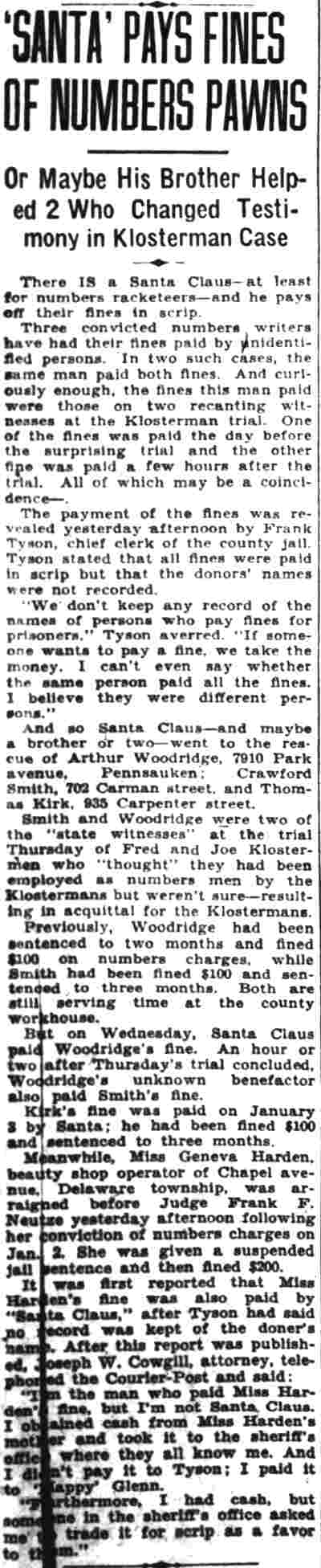
‘Santa’ Pays Fines of Numbers Pawns
Unidentified benefactors paid in scrip the fines of three convicted numbers writers, including Crawford Smith of 702 Carman Street and Arthur Woodridge, two state witnesses whose wavering testimony led to the acquittal of Fred and Joe Klosterman.
Judge Pancoast Proves to 21 That Honesty Is Best Policy
Police Judge Garfield Pancoast sentenced Emil Hatter to 50 days and two men found in his speakeasy — including Edward Mackay of 531 Ray Street — to 60 days each after they denied buying drinks there.
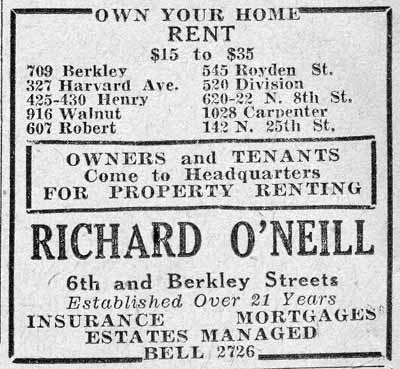
Richard O'Neill Real Estate Advertisement
Camden Courier-Post advertisement, March 28, 1932, for Richard O'Neill, 6th and Berkley Streets, offering houses to rent for $15 to $35.
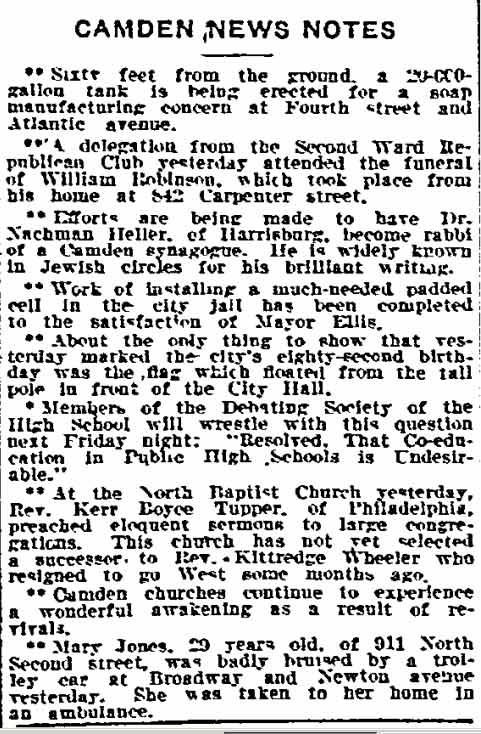
Camden News Notes — February 14, 1910
Camden briefs for February 14, 1910, including efforts to bring Dr. Nachman Heller of Harrisburg to a Camden synagogue as rabbi, a new padded cell in the city jail, and Mary Jones of 911 North Second Street bruised by a trolley car at Broadway and Newton Avenue.

New Buildings Going Up
Camden Daily Courier - November 15, 1890 Many Houses Now Being Erected Camden builders do not seem to be deterred by the fear of financial panic or an idea that the McKinley bill presages disaster in business.
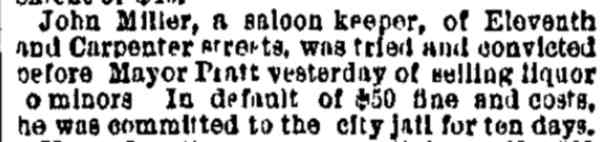
Meiler Tried for Selling Liquor to Minors
Saloon keeper John Meiler of Eleventh and Carpenter Streets, Camden, was tried and convicted for selling liquor to minors and sentenced to ten days in jail.