
People
Paul A. Woodward
Paul A. Woodward, a resident of 221 Benson Street , committed the murder of two young boys by poisoning them on October 1, 1902. He was the son of Thomas and Bella Woodward.
Tag
Paul A. Woodward, a resident of 221 Benson Street , committed the murder of two young boys by poisoning them on October 1, 1902. He was the son of Thomas and Bella Woodward.
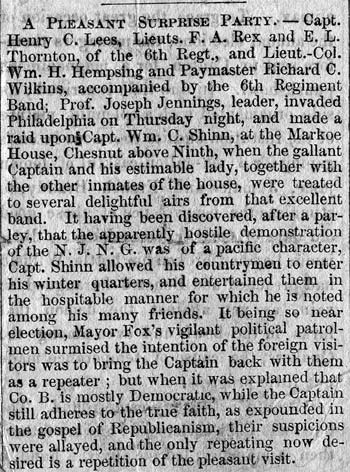
Jennings' Band, originally known as the National Cornet Band, was a well-known musical group in Camden from the 1880s until America's entry into World War I in 1917.

Third Street runs north and south, parallel to the Delaware River, through North and South Camden, featuring notable corner buildings like the Security Trust Building at 301 Market Street and the Mickle Tower Apartment House at 200 Mickle Boulevard.
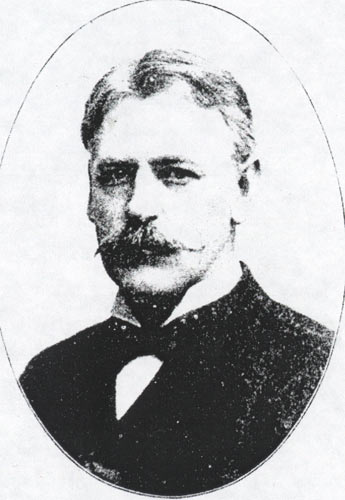
Frank T. Lloyd (1859–1951) was a Camden printer turned lawyer who served in the New Jersey Assembly, as Camden County Prosecutor, as a Circuit Court judge from 1906 and as a New Jersey Supreme Court Justice from 1924 until his retirement in 1938.
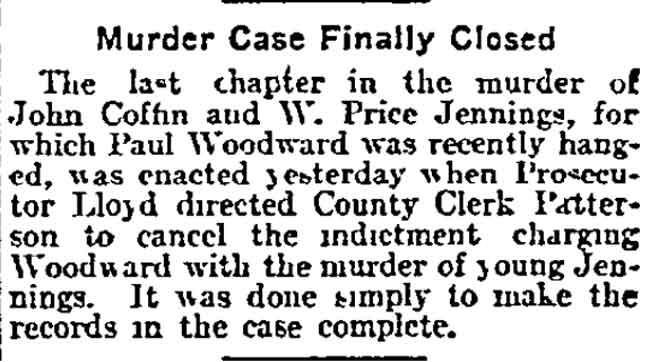
Philadelphia Inquirer, January 17, 1903: Prosecutor Lloyd directed County Clerk Patterson to cancel the indictment charging Paul Woodward with the murder of young Jennings, a formality to complete the records after Woodward was hanged.
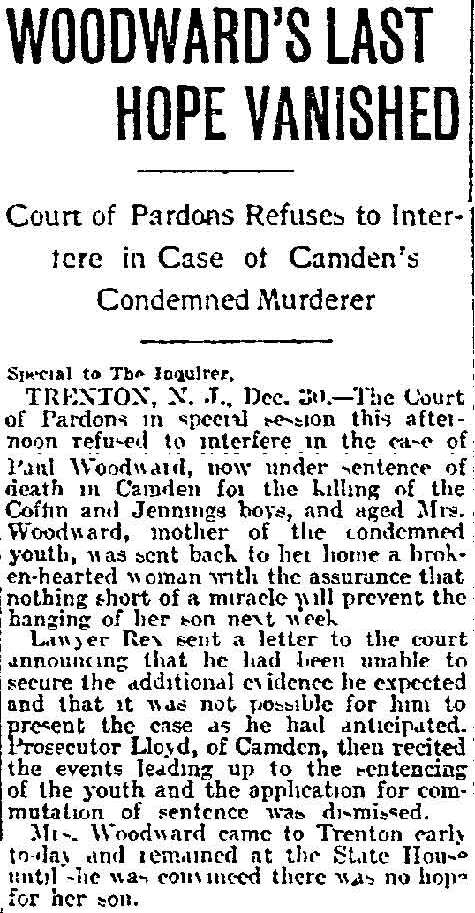
Philadelphia Inquirer, December 31, 1902: the Court of Pardons in Trenton refuses to interfere in the case of Camden's condemned murderer Paul Woodward.
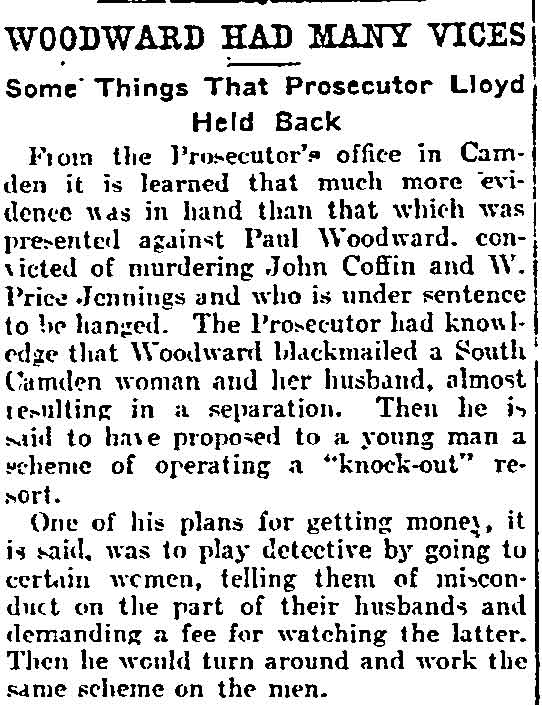
Philadelphia Inquirer, November 29, 1902: Camden County Prosecutor Frank T. Lloyd held back evidence against convicted murderer Paul Woodward.
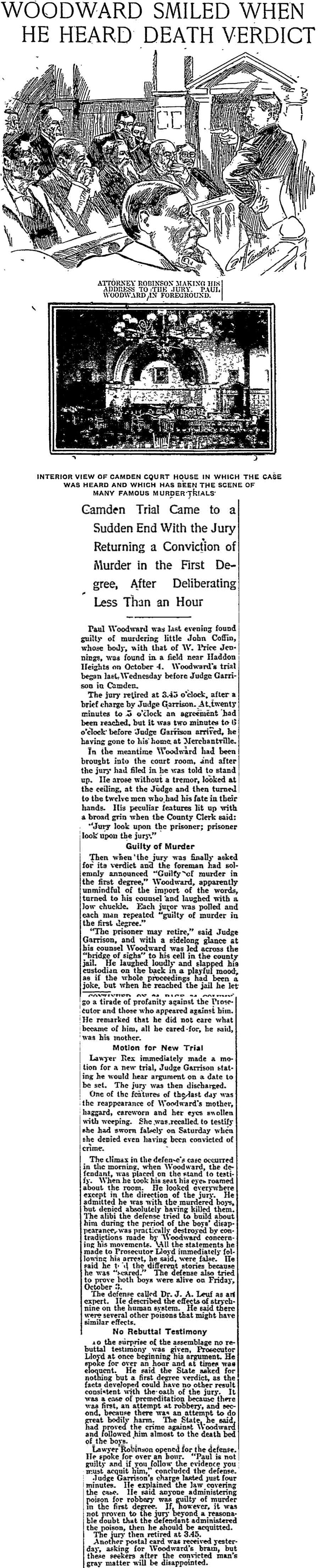
Paul Woodward smiled when a Camden jury, after deliberating less than an hour, found him guilty of first-degree murder in the poisoning of little John Coffin, following Prosecutor Lloyd's argument and Judge Garrison's four-minute charge.
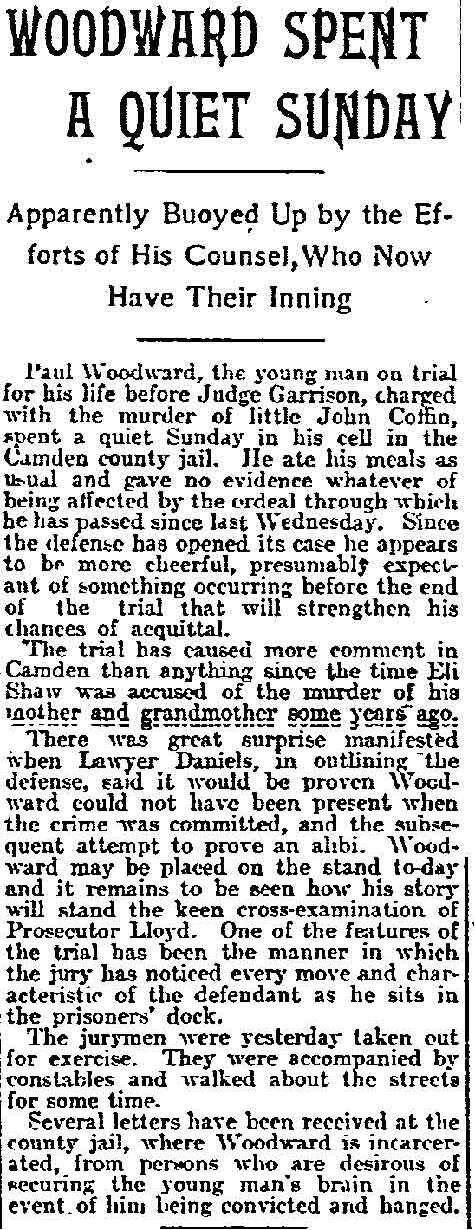
Philadelphia Inquirer, November 17, 1902: Paul Woodward, on trial in Camden for the murder of John Coffin, spent a quiet Sunday in the county jail while the defense opened its case.

At the Camden murder trial of Paul Woodward, a drug clerk testifies to selling him strychnine and jail inmate David J. Horgan tells of a confession, while relatives of John Coffin and W. Price Jennings give damaging testimony.
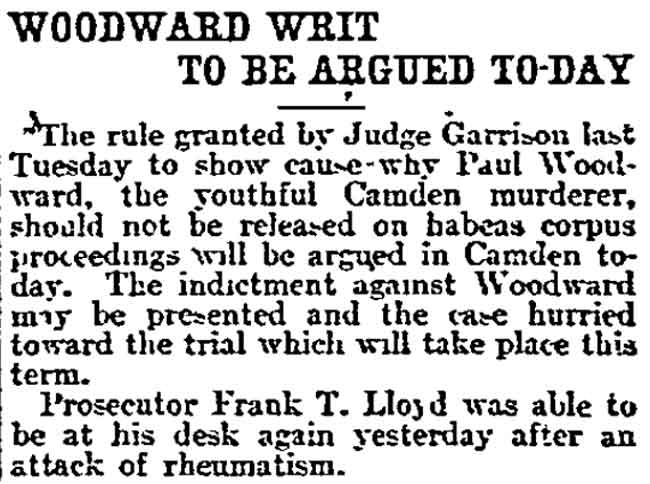
Philadelphia Inquirer, October 24, 1902: the habeas corpus rule granted by Judge Garrison for Paul Woodward is to be argued in Camden, and Prosecutor Frank T. Lloyd returns to his desk after an attack of rheumatism.
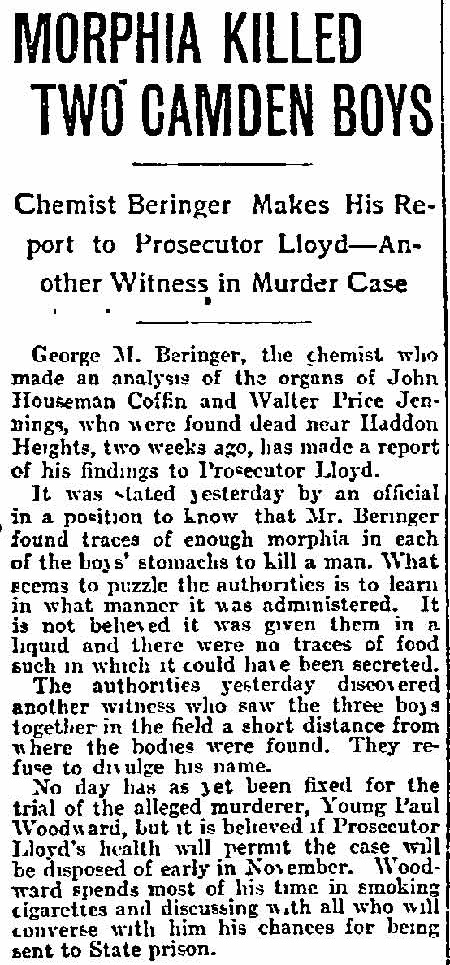
Philadelphia Inquirer, October 19, 1902: Chemist George M. Beringer reports to Prosecutor Lloyd that he found enough morphia in the stomachs of John Houseman Coffin and Walter Price Jennings to kill a man; the trial of Paul Woodward is expected in early November.
Philadelphia Inquirer, October 15, 1902: Paul Woodward, accused of murdering Camden boys John Coffin and W. Price Jennings, may be indicted within a day or two as Prosecutor Lloyd goes before the grand jury.
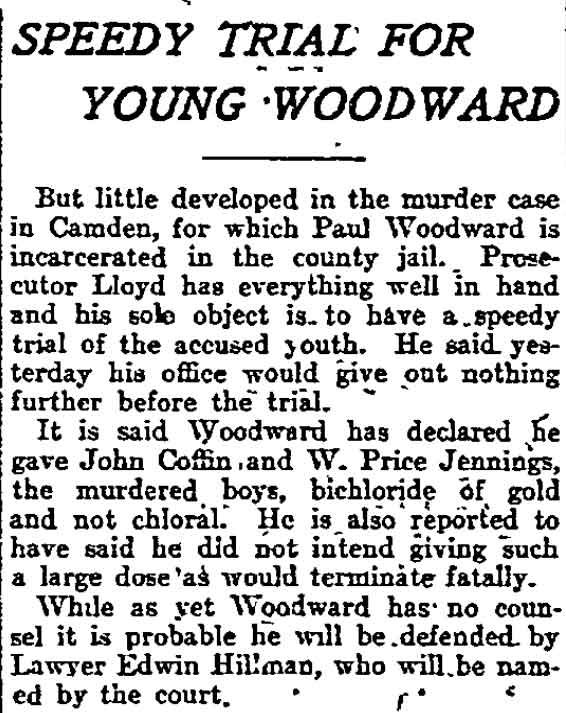
Philadelphia Inquirer, October 14, 1902: Prosecutor Lloyd wants a speedy trial of Paul Woodward, jailed in Camden for the deaths of John Coffin and W. Price Jennings; Woodward has no counsel yet and may be defended by Edwin Hillman.
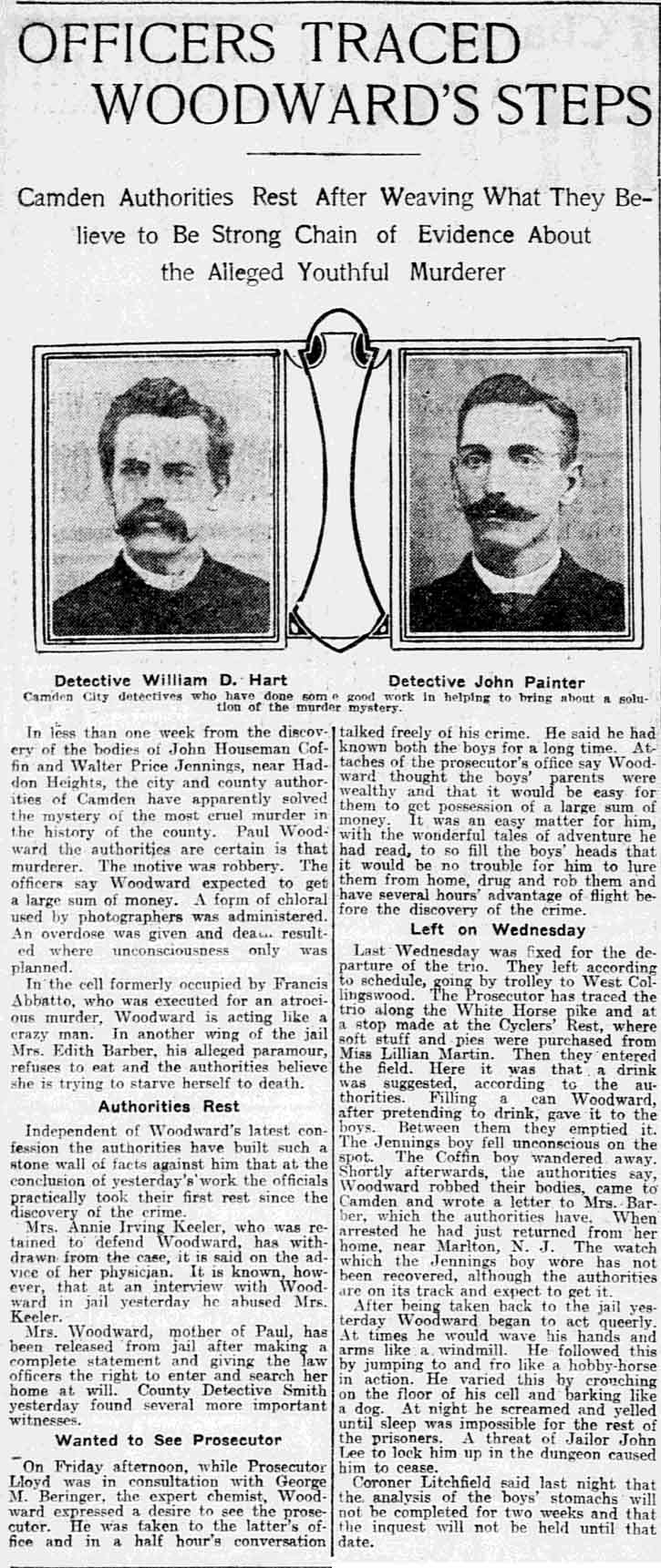
Philadelphia Inquirer, October 12, 1902: Camden authorities rest after building what they believe is a strong chain of evidence against Paul Woodward in the Coffin and Jennings murders near Haddon Heights.

Philadelphia Inquirer, October 11, 1902: Paul Woodward's mother and two boarders are arrested as witnesses in the Coffin and Jennings murders, and lawyer Annie Irving Keeler is retained to defend him.

"Beyond all question the murderer of these little boys is now in jail and the public's anxiety can now be allayed," said Prosecutor Frank T. Lloyd last night in making the first important statement concerning the tragedy of last week, when John Coffin and W. Price Jennings, two Camden lads, were murdered in an uncultivated field near Haddon Heights.
It is now generally believed that the Camden county authorities have succeeded in establishing a clear case against young Paul Woodward, who is in the county jail, charged with the crime of taking away the lives of little John Coffin and Price Jennings.

Philadelphia Inquirer report of October 8, 1902 on the Camden investigation into the deaths of John Coffin and Walter Price Jennings, with suspect Paul Woodward taken to the scene and questioned at Prosecutor Lloyd's home.
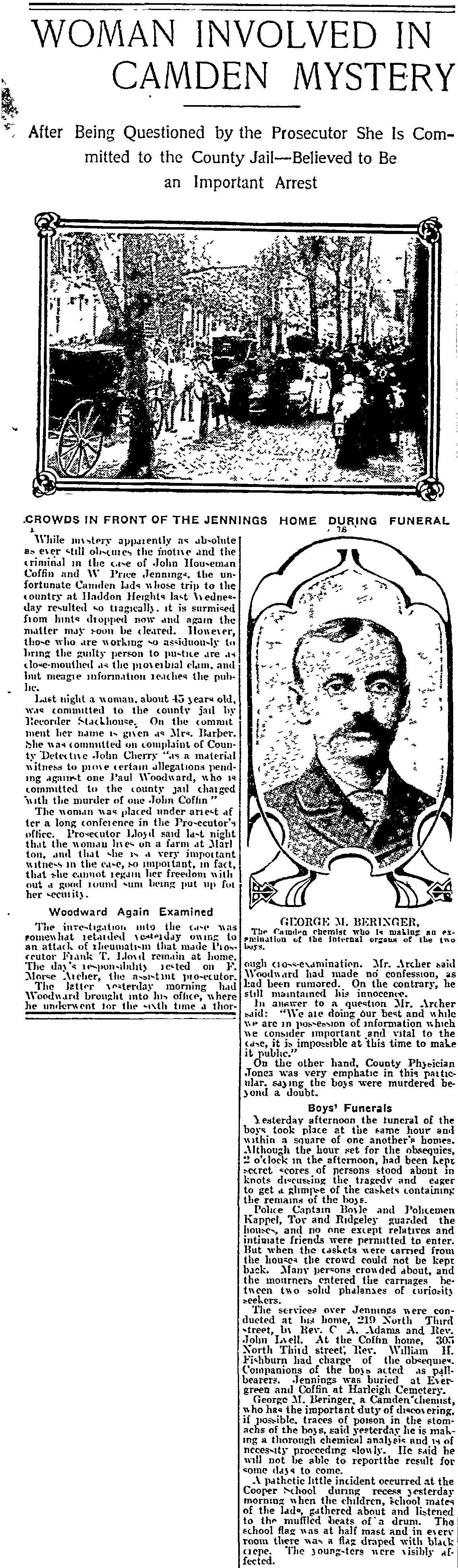
While mystery apparently as absolute as ever still obscures the motive and the criminal in the case of John Houseman Coffin and W. Price Jennings, the unfortunate Camden lads whose trip to the country at Haddon Heights last Wednesday resulted so tragically, it is surmised from hints dropped now and again the matter may soon be cleared.

Philadelphia Inquirer, October 6, 1902: Prosecutor Lloyd and others believe Price Jennings and John Houseman Coffin were murdered, while Paul Woodward is questioned and the boys' organs are analyzed.

The Philadelphia Inquirer reports the discovery of the bodies of Camden boys John H. Coffin, 11, and Price Jennings, 13, in a field near Haddon Heights, and the arrest of Paul Woodward, 18, on a charge of murder.