Camden Courier-Post, October 10, 1936View transcription
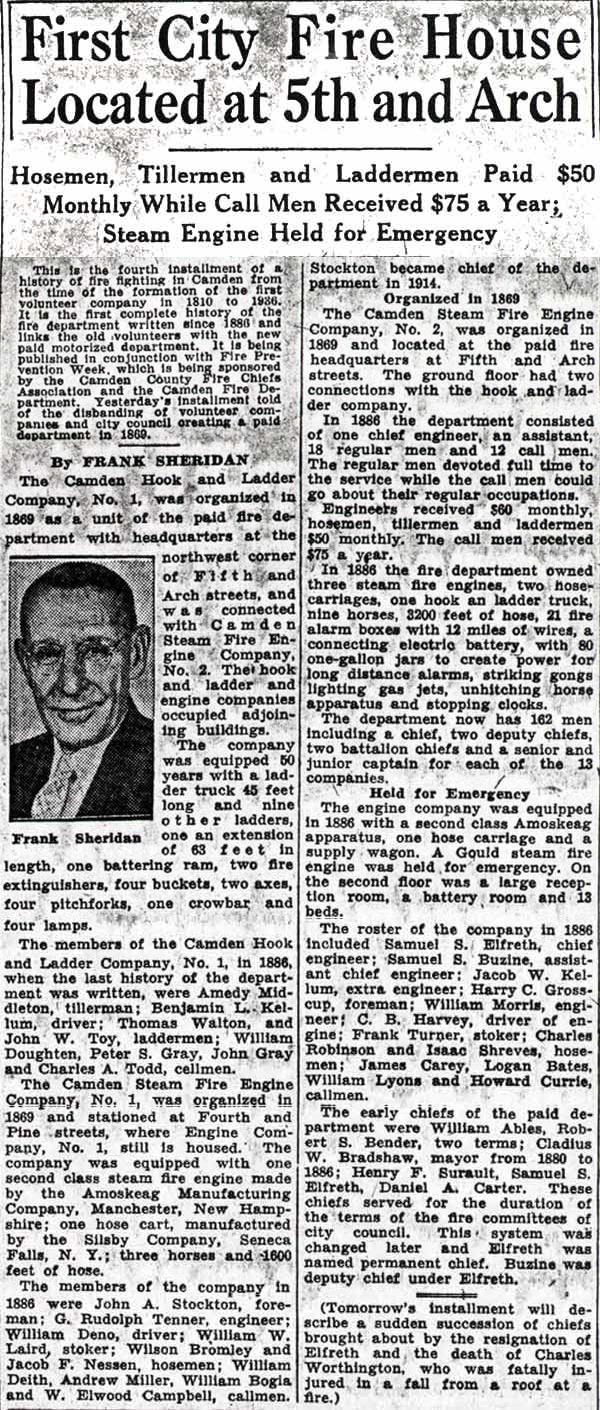
First City Fire House Located at 5th and Arch
Hosemen, Tillermen and Laddermen Paid $50 Monthly While Call Men Received $75 a Year; Steam Engine Held for Emergency
This is the fourth installment of a history of fire fighting in Camden from the time of the formation of the first volunteer company in 1810 to 1936. It is the first complete history of the fire department written since 1886 and links the old volunteers with the new paid motorized department. It is being published in conjunction with Fire Prevention Week, which is being sponsored by the Camden County Fire Chiefs Association and the Camden Fire Department. Yesterday's installment told of the disbanding of volunteer companies and city council creating a paid department in 1869.
By FRANK SHERIDAN
The Camden Hook and Ladder Company, No. 1, was organized in 1869 as a unit of the paid fire department with headquarters at the northwest corner of Fifth and Arch streets, and was connected with Camden Steam Fire Engine Company, No. 2. The hook and ladder and engine companies occupied adjoining buildings.
The company was equipped 50 years with a ladder truck 45 feet long and nine other ladders, one an extension of 63 feet in
Frank Sheridan
length, one battering ram, two fire extinguishers, four buckets, two axes, four pitchforks, one crowbar and four lamps.
The members of the Camden Hook and Ladder Company, No. 1, in 1886, when the last history of the department was written, were Amedy Middleton, tillerman; Benjamin L. Kellum, driver; Thomas Walton, and John W. Toy, laddermen; William Doughten, Peter S. Gray, John Gray and Charles A. Todd, cellmen.
The Camden Steam Fire Engine Company, No. 1, was organized in 1869 and stationed at Fourth and Pine streets, where Engine Company, No. 1, still is housed. The company was equipped with one second class steam fire engine made by the Amoskeag Manufacturing Company, Manchester, New Hampshire; one hose cart, manufactured by the Silsby Company, Seneca Falls, N. Y.; three horses and 1600 feet of hose.
The members of the company in 1886 were John A. Stockton, foreman; G. Rudolph Tenner, engineer; William Deno, driver; William W. Laird, stoker; Wilson Bromley and Jacob F. Nessen, hosemen; William Deith, Andrew Miller, William Bogia and W. Elwood Campbell, callmen.
Stockton became chief of the department in 1914.
Organized in 1869
The Camden Steam Fire Engine Company, No. 2, was organized in 1869 and located at the paid fire headquarters at Fifth and Arch streets. The ground floor had two connections with the hook and ladder company.
In 1886 the department consisted of one chief engineer, an assistant, 18 regular men and 12 call men. The regular men devoted full time to the service while the call men could go about their regular occupations.
Engineers received $60 monthly, hosemen, tillermen and laddermen $50 monthly. The call men received $75 a year.
In 1886 the fire department owned three steam fire engines, two hose-carriages, one hook an ladder truck, nine horses, 3200 feet of hose, 21 fire alarm boxes with 12 miles of wires, a connecting electric battery, with 80 one-gallon jars to create power for long distance alarms, striking gongs lighting gas jets, unhitching horse apparatus and stopping clocks.
The department now has 162 men including a chief, two deputy chiefs, two battalion chiefs and a senior and junior captain for each of the 13 companies.
Held for Emergency
The engine company was equipped in 1886 with a second class Amoskeag apparatus, one hose carriage and a supply wagon. A Gould steam fire engine was held for emergency. On the second floor was a large reception room, a battery room and 13 beds.
The roster of the company in 1886 included Samuel S. Elfreth, chief engineer; Samuel S. Buzine, assistant chief engineer; Jacob W. Kellum, extra engineer; Harry C. Grosscup, foreman; William Morris, engineer; C. B. Harvey, driver of engine; Frank Turner, stoker; Charles Robinson and Isaac Shreves, hosemen; James Carey, Logan Bates, William Lyons and Howard Currie, callmen.
The early chiefs of the paid department were William Ables, Robert S. Bender, two terms; Cladius W. Bradshaw, mayor from 1880 to 1886; Henry F. Surault, Samuel S. Elfreth, Daniel A. Carter. These chiefs served for the duration of the terms of the fire committees of city council. This system was changed later and Elfreth was named permanent chief. Buzine was deputy chief under Elfreth.
(Tomorrow's installment will describe a sudden succession of chiefs brought about by the resignation of Elfreth and the death of Charles Worthington, who was fatally injured in a fall from a roof at a fire.)
Hosemen, Tillermen and Laddermen Paid $50 Monthly While Call Men Received $75 a Year; Steam Engine Held for Emergency
This is the fourth installment of a history of fire fighting in Camden from the time of the formation of the first volunteer company in 1810 to 1936. It is the first complete history of the fire department written since 1886 and links the old volunteers with the new paid motorized department. It is being published in conjunction with Fire Prevention Week, which is being sponsored by the Camden County Fire Chiefs Association and the Camden Fire Department. Yesterday's installment told of the disbanding of volunteer companies and city council creating a paid department in 1869.
The Camden Hook and Ladder Company, No. 1, was organized in 1869 as a unit of the paid fire department with headquarters at the northwest corner of Fifth and Arch streets, and was connected with Camden Steam Fire Engine Company, No. 2. The hook and ladder and engine companies occupied adjoining buildings.
The company was equipped 50 years with a ladder truck 45 feet long and nine other ladders, one an extension of 63 feet in length, one battering ram, two fire extinguishers, four buckets, two axes, four pitchforks, one crowbar and four lamps.
The members of the Camden Hook and Ladder Company, No. 1, in 1886, when the last history of the department was written, were Amedy Middleton, tillerman; Benjamin L. Kellum, driver; Thomas Walton, and John W. Toy, laddermen; William Doughten, Peter S. Gray, John Gray and Charles A. Todd, cellmen [sic].
The Camden Steam Fire Engine Company, No. 1, was organized in 1869 and stationed at Fourth and Pine streets, where Engine Company, No. 1, still is housed. The company was equipped with one second class steam fire engine made by the Amoskeag Manufacturing Company, Manchester, New Hampshire; one hose cart, manufactured by the Silsby Company, Seneca Falls, N. Y.; three horses and 1600 feet of hose.
The members of the company in 1886 were John A. Stockton, foreman; G. Rudolph Tenner, engineer; William Deno, driver; William W. Laird, stoker; Wilson Bromley and Jacob F. Nessen, hosemen; William Deith, Andrew Miller, William Bogia and W. Elwood Campbell, callmen.
Stockton became chief of the department in 1914.
Organized in 1869
The Camden Steam Fire Engine Company, No. 2, was organized in 1869 and located at the paid fire headquarters at Fifth and Arch streets. The ground floor had two connections with the hook and ladder company.
In 1886 the department consisted of one chief engineer, an assistant, 18 regular men and 12 call men. The regular men devoted full time to the service while the call men could go about their regular occupations.
Engineers received $60 monthly, hosemen, tillermen and laddermen $50 monthly. The call men received $75 a year.
In 1886 the fire department owned three steam fire engines, two hose-carriages, one hook an [sic] ladder truck, nine horses, 3200 feet of hose, 21 fire alarm boxes with 12 miles of wires, a connecting electric battery, with 80 one-gallon jars to create power for long distance alarms, striking gongs lighting gas jets, unhitching horse apparatus and stopping clocks.
The department now has 162 men including a chief, two deputy chiefs, two battalion chiefs and a senior and junior captain for each of the 13 companies.
Held for Emergency
The engine company was equipped in 1886 with a second class Amoskeag apparatus, one hose carriage and a supply wagon. A Gould steam fire engine was held for emergency. On the second floor was a large reception room, a battery room and 13 beds.
The roster of the company in 1886 included Samuel S. Elfreth, chief engineer; Samuel S. Buzine, assistant chief engineer; Jacob W. Kellum, extra engineer; Harry C. Grosscup, foreman; William Morris, engineer; C. B. Harvey, driver of engine; Frank Turner, stoker; Charles Robinson and Isaac Shreves, hosemen; James Carey, Logan Bates, William Lyons and Howard Currie, callmen.
The early chiefs of the paid department were William Ables, Robert S. Bender, two terms; Cladius [sic] W. Bradshaw, mayor from 1880 to 1886; Henry F. Surault, Samuel S. Elfreth, Daniel A. Carter. These chiefs served for the duration of the terms of the fire committees of city council. This system was changed later and Elfreth was named permanent chief. Buzine was deputy chief under Elfreth.
(Tomorrow's installment will describe a sudden succession of chiefs brought about by the resignation of Elfreth and the death of Charles Worthington, who was fatally injured in a fall from a roof at a fire.)