Camden Courier-Post, February 20, 1946View transcription
INJURED AS FIRE DESTROYS KRESGE BUILDING
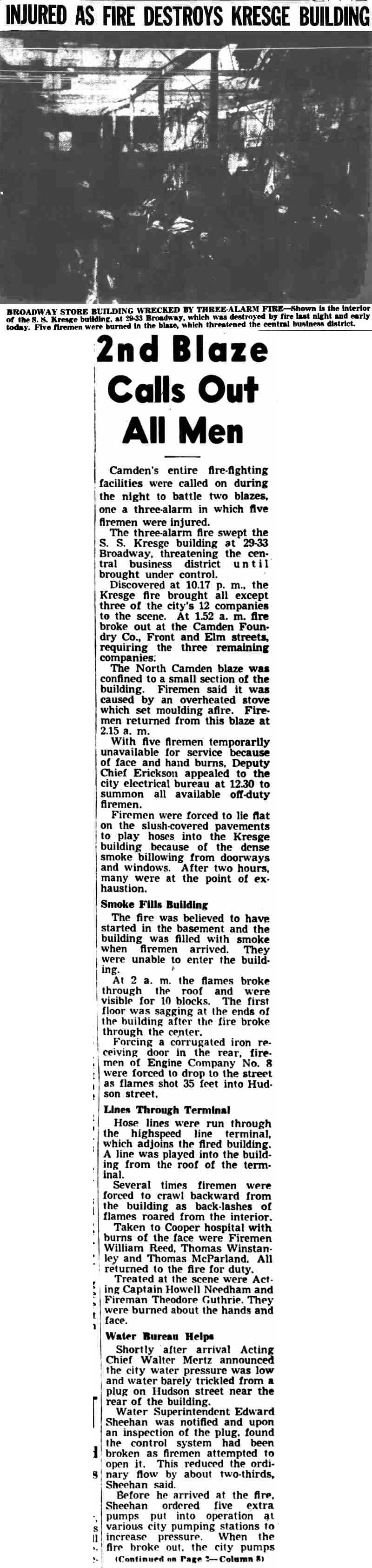
BROADWAY STORE BUILDING WRECKED BY THREE-ALARM FIRE—Shown is the interior of the S. S. Kresge building, at 29-33 Broadway, which was destroyed by fire last night and early today. Five firemen were burned in the blaze, which threatened the central business district.
2nd Blaze Calls Out All Men
Camden's entire fire-fighting facilities were called on during the night to battle two blazes, one a three-alarm in which five firemen were injured.
The three-alarm fire swept the S. S. Kresge building at 29-33 Broadway, threatening the central business district until brought under control.
Discovered at 10.17 p. m., the Kresge fire brought all except three of the city's 12 companies to the scene. At 1.52 a. m. fire broke out at the Camden Foundry Co., Front and Elm streets, requiring the three remaining companies:
The North Camden blaze was confined to a small section of the building. Firemen said it was caused by an overheated stove which set moulding afire. Firemen returned from this blaze at 2.15 a. m.
With five firemen temporarily unavailable for service because of face and hand burns, Deputy Chief Erickson appealed to the city electrical bureau at 12.30 to summon all available off-duty firemen.
Firemen were forced to lie flat on the slush-covered pavements to play hoses into the Kresge building because of the dense smoke billowing from doorways and windows. After two hours, many were at the point of exhaustion.
Smoke Fills Building
The fire was believed to have started in the basement and the building was filled with smoke when firemen arrived. They were unable to enter the building.
At 2 a. m. the flames broke through the roof and were visible for 10 blocks. The first floor was sagging at the ends of the building after the fire broke through the center.
Forcing a corrugated iron receiving door in the rear, firemen of Engine Company No. 8 were forced to drop to the street as flames shot 35 feet into Hudson street.
Lines Through Terminal
Hose lines were run through the highspeed line terminal, which adjoins the fired building. A line was played into the building from the roof of the terminal.
Several times firemen were forced to crawl backward from the building as back-lashes of flames roared from the interior.
Taken to Cooper hospital with burns of the face were Firemen William Reed, Thomas Winstanley and Thomas McParland. All returned to the fire for duty.
Treated at the scene were Acting Captain Howell Needham and Fireman Theodore Guthrie. They were burned about the hands and face.
Water Bureau Helps
Shortly after arrival Acting Chief Walter Mertz announced the city water pressure was low and water barely trickled from a plug on Hudson street near the rear of the building.
Water Superintendent Edward Sheehan was notified and upon an inspection of the plug, found the control system had been broken as firemen attempted to open it. This reduced the ordinary flow by about two-thirds, Sheehan said.
Before he arrived at the fire, Sheehan ordered five extra pumps put into operation at various city pumping stations to increase pressure. When the fire broke out, the city pumps
(Continued on Page 2—Column 8)
BROADWAY STORE BUILDING WRECKED BY THREE-ALARM FIRE—Shown is the interior of the S. S. Kresge building, at 29-33 Broadway, which was destroyed by fire last night and early today. Five firemen were burned in the blaze, which threatened the central business district.
2nd Blaze Calls Out All Men
Camden's entire fire-fighting facilities were called on during the night to battle two blazes, one a three-alarm in which five firemen were injured.
The three-alarm fire swept the S. S. Kresge building at 29-33 Broadway, threatening the central business district until brought under control.
Discovered at 10.17 p. m., the Kresge fire brought all except three of the city's 12 companies to the scene. At 1.52 a. m. fire broke out at the Camden Foundry Co., Front and Elm streets, requiring the three remaining companies.
The North Camden blaze was confined to a small section of the building. Firemen said it was caused by an overheated stove which set moulding afire. Firemen returned from this blaze at 2.15 a. m.
With five firemen temporarily unavailable for service because of face and hand burns, Deputy Chief Erickson appealed to the city electrical bureau at 12.30 to summon all available off-duty firemen.
Firemen were forced to lie flat on the slush-covered pavements to play hoses into the Kresge building because of the dense smoke billowing from doorways and windows. After two hours, many were at the point of exhaustion.
Smoke Fills Building
The fire was believed to have started in the basement and the building was filled with smoke when firemen arrived. They were unable to enter the building.
At 2 a. m. the flames broke through the roof and were visible for 10 blocks. The first floor was sagging at the ends of the building after the fire broke through the center.
Forcing a corrugated iron receiving door in the rear, firemen of Engine Company No. 8 were forced to drop to the street as flames shot 35 feet into Hudson street.
Lines Through Terminal
Hose lines were run through the highspeed line terminal, which adjoins the fired building. A line was played into the building from the roof of the terminal.
Several times firemen were forced to crawl backward from the building as back-lashes of flames roared from the interior.
Treated at the scene were Acting Captain Howell Needham and Fireman Theodore Guthrie. They were burned about the hands and face.
Water Bureau Helps
Shortly after arrival Acting Chief Walter Mertz announced the city water pressure was low and water barely trickled from a plug on Hudson street near the rear of the building.
Water Superintendent Edward Sheehan was notified and upon an inspection of the plug, found the control system had been broken as firemen attempted to open it. This reduced the ordinary flow by about two-thirds, Sheehan said.
Before he arrived at the fire, Sheehan ordered five extra pumps put into operation at various city pumping stations to increase pressure. When the fire broke out, the city pumps