Suttill Skeptical of Explanation for Ablett House Flaw
Suttill Skeptical of Explanation for Ablett House Flaw, Camden Courier-Post, November 1942
Camden Courier-Post, November 1942
View transcription
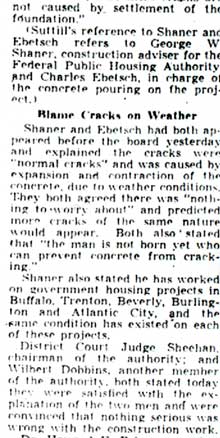
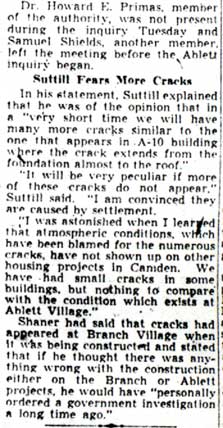
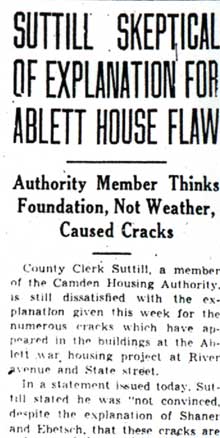
SUTTILL SKEPTICAL OF EXPLANATION FOR ABLETT HOUSE FLAW Authority Member Thinks Foundation, Not Weather, Caused Cracks County Clerk Suttill, a member of the Camden Housing Authority, is still dissatisfied with the explanation given this week for the numerous cracks which have appeared in the buildings at the Ablett war housing project at River avenue and State street. In a statement issued today, Suttill stated he was "not convinced," despite the explanation of Shaner and Ebetsch, that these cracks are not caused by settlement of the foundation. (Suttill's reference to Shaner and Ebetsch refers to George W. Shaner, construction adviser for the Federal Public Housing Authority, and Charles Ebetsch, in charge of the concrete pouring on the project.) Blame Cracks on Weather Shaner and Ebetsch had both appeared before the board yesterday and explained that the cracks were "normal cracks" and were caused by expansion and contraction of the concrete, due to weather conditions. They both agreed there was "nothing to worry about" and predicted more cracks of the same nature would appear. Both also stated that "the man is not born yet who can prevent concrete from cracking." Shaner also stated he has worked on government housing projects in Buffalo, Trenton, Beverly, Burlington and Atlantic City, and the same condition has existed on each of these projects. District Court Judge Sheehan, chairman of the authority; and Wilbert Dobbins, another member of the authority, both stated today they were satisfied with the explanation of the two men and were convinced that nothing serious was wrong with the construction work. Dr. Howard E. Primas, member of the authority, was not present during the inquiry Tuesday, and Samuel Shields, another member, left the meeting before the Ablett inquiry began. Suttill Fears More Cracks In his statement, Suttill explained that he was of the opinion that in a "very short time we will have many more cracks similar to the one that appears in A-10 building" where the crack extends from the foundation almost to the roof. "It will be very peculiar if more of these cracks do not appear," Suttill said. "I am convinced they are caused by settlement. "I was astonished when I learned that atmospheric conditions, which have been blamed for the numerous cracks, have not shown up on other housing projects in Camden. We have had small cracks in some buildings, but nothing to compare with the condition which exists at Ablett Village." Shaner had said that cracks had appeared at Branch Village when it was being constructed and stated that if he thought there was anything wrong with the construction either on the Branch or Ablett projects, he would have "personally ordered a government investigation a long time ago."
Suttill Skeptical of Explanation for Ablett House Flaw, continued (page 2 of 3)
Camden Courier-Post, November 1942
Suttill Skeptical of Explanation for Ablett House Flaw, continued (page 3 of 3)
Camden Courier-Post, November 1942

Authority Member Thinks Foundation, Not Weather, Caused Cracks

County Clerk Suttill, a member of the Camden Housing Authority, is still dissatisfied with the explanation given this week for the numerous cracks which have appeared in the buildings at the Ablett war housing project at River avenue and State street.

In a statement issued today, Suttill stated he was “not convinced,” despite the explanation of Shaner and Ebetsch, that these cracks are not caused by settlement of the foundation.

(Suttill’s reference to Shaner and Ebetsch refers to George W. Shaner, construction adviser for the Federal Public Housing Authority, and Charles Ebetsch, in charge of the concrete pouring on the project.)

Blame Cracks on Weather

Shaner and Ebetsch had both appeared before the board yesterday and explained that the cracks were “normal cracks” and were caused by expansion and contraction of the concrete, due to weather conditions. They both agreed there was “nothing to worry about” and predicted more cracks of the same nature would appear. Both also stated that “the man is not born yet who can prevent concrete from cracking.”

Shaner also stated he has worked on government housing projects in Buffalo, Trenton, Beverly, Burlington and Atlantic City, and the same condition has existed on each of these projects.

District Court Judge Sheehan, chairman of the authority; and Wilbert Dobbins, another member of the authority, both stated today they were satisfied with the explanation of the two men and were convinced that nothing serious was wrong with the construction work.

Dr. Howard E. Primas, member of the authority, was not present during the inquiry Tuesday, and Samuel Shields, another member, left the meeting before the Ablett inquiry began.

Suttill Fears More Cracks

In his statement, Suttill explained that he was of the opinion that in a “very short time we will have many more cracks similar to the one that appears in A-10 building” where the crack extends from the foundation almost to the roof.

“It will be very peculiar if more of these cracks do not appear,” Suttill said. “I am convinced they are caused by settlement.

“I was astonished when I learned that atmospheric conditions, which have been blamed for the numerous cracks, have not shown up on other housing projects in Camden. We have had small cracks in some buildings, but nothing to compare with the condition which exists at Ablett Village.”

Shaner had said that cracks had appeared at Branch Village when it was being constructed and stated that if he thought there was anything wrong with the construction either on the Branch or Ablett projects, he would have “personally ordered a government investigation a long time ago.”

No date line is visible on any of the three scanned crops of this clipping. It is dated November 1942 on the strength of the filename's own month/year encoding (hacc-1142 = 11/42); the April 25, 1942 date used elsewhere for this clipping cannot be correct, since construction on Ablett Village did not begin until June 1942.

Advertisement

Comments