People
Harry Mailahn
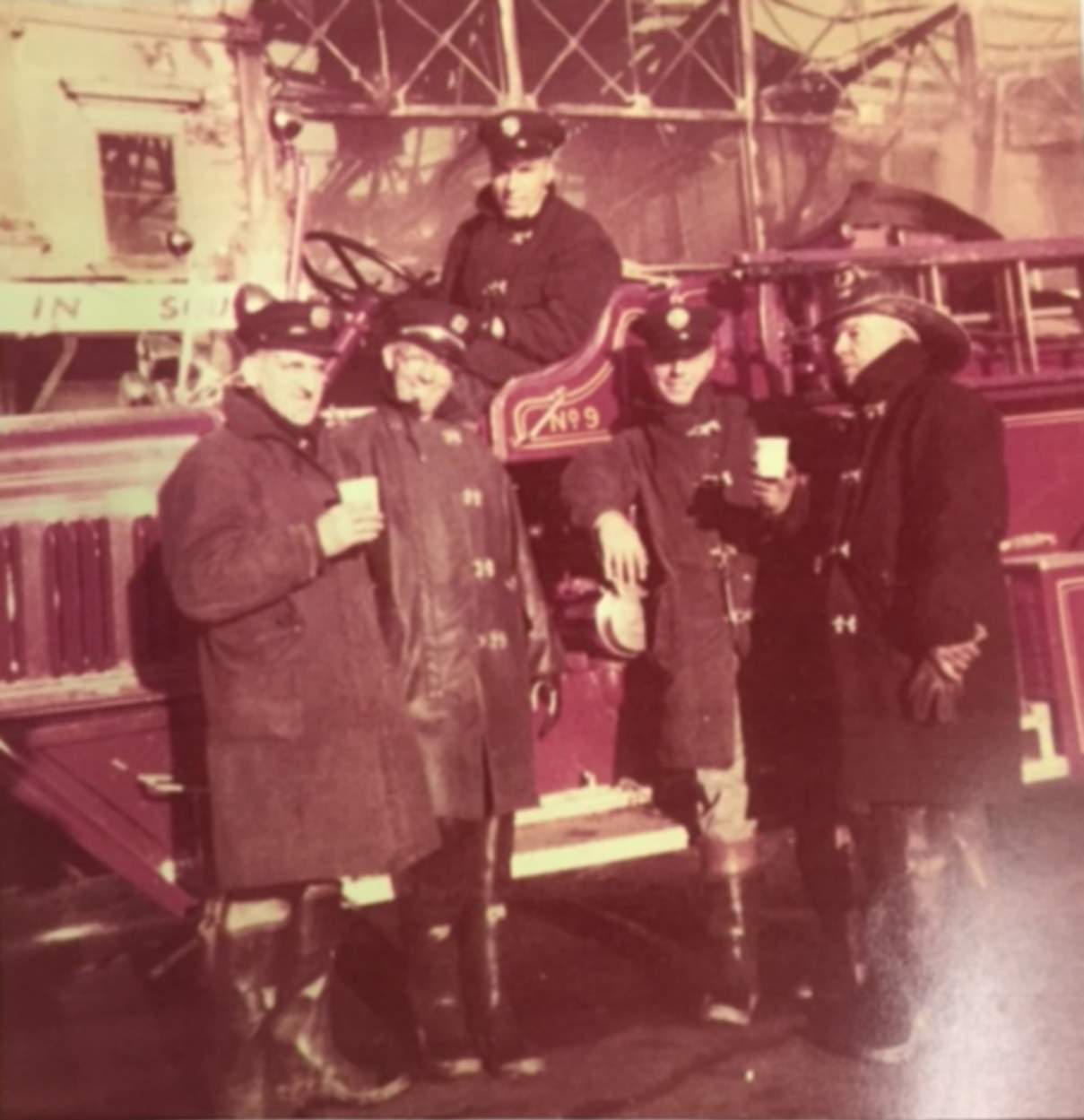
Harry Mailahn (1926–1971) was a Camden firefighter assigned to Engine Company 9 from his appointment in January 1951 until his death in 1971. A Navy veteran of World War II, he lived at 2924 Royden Street in East Camden.
Tag
Harry Mailahn (1926–1971) was a Camden firefighter assigned to Engine Company 9 from his appointment in January 1951 until his death in 1971. A Navy veteran of World War II, he lived at 2924 Royden Street in East Camden.
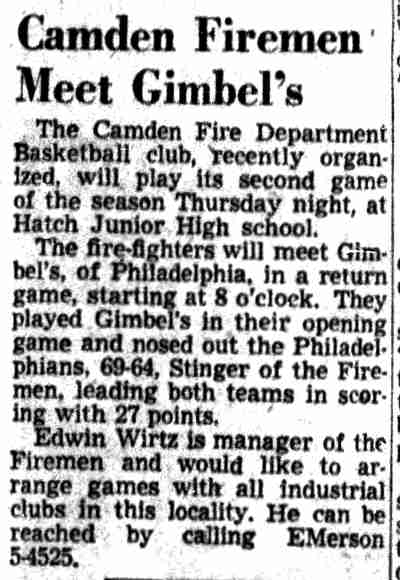
Edwin Stanley Wirtz (1914–1975), son of Camden policeman Stanley R. Wirtz and grandson of Camden fireman James McDade, was appointed to the Camden Fire Department in October 1943 and served 22 years, retiring in October 1965 as an inspector in the Fire Marshal's office.
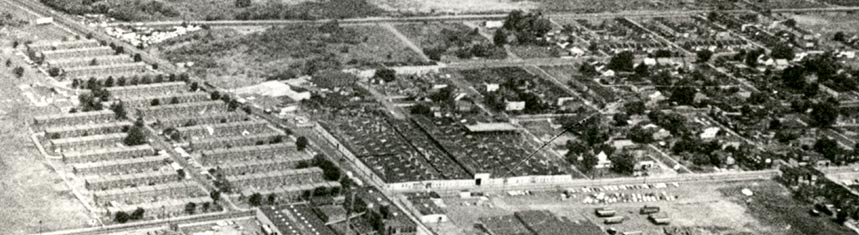
William Stanley Ablett Village is a 306-unit public housing project at River Road and State Street in the Cramer Hill section of Camden, built by the Housing Authority of the City of Camden during World War II and named for a Camden soldier killed in action in France during World War I.
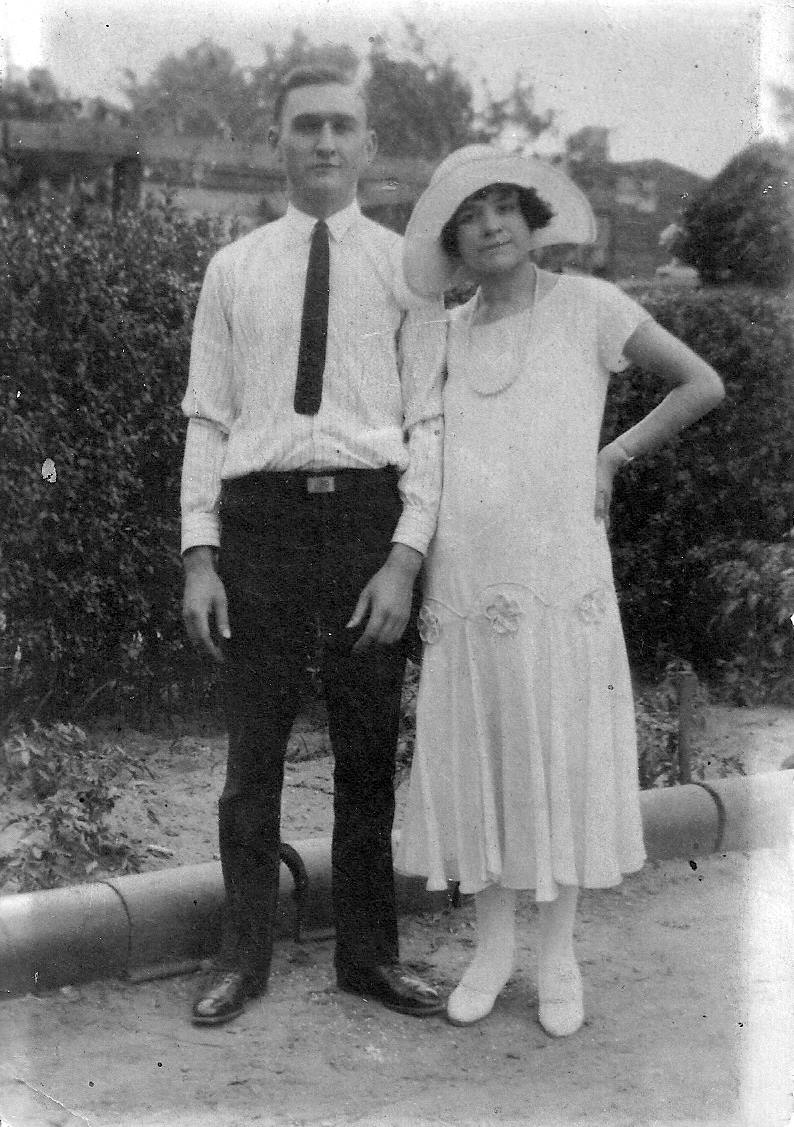
History of the Engel family of Camden — Julius and Mary Engel, immigrants from Slovakia and Hungary who settled in South Camden, and their son Frank Engel, who shot and wounded Howard Unruh during the 1949 Cramer Hill "Walk of Death."

August W. "Augie" Oswald Jr. was the licensee for the bar at 1000 North 27th Street in 1939. He was born in Pennsylvania and moved with his family to Cramer Hill when he was young.
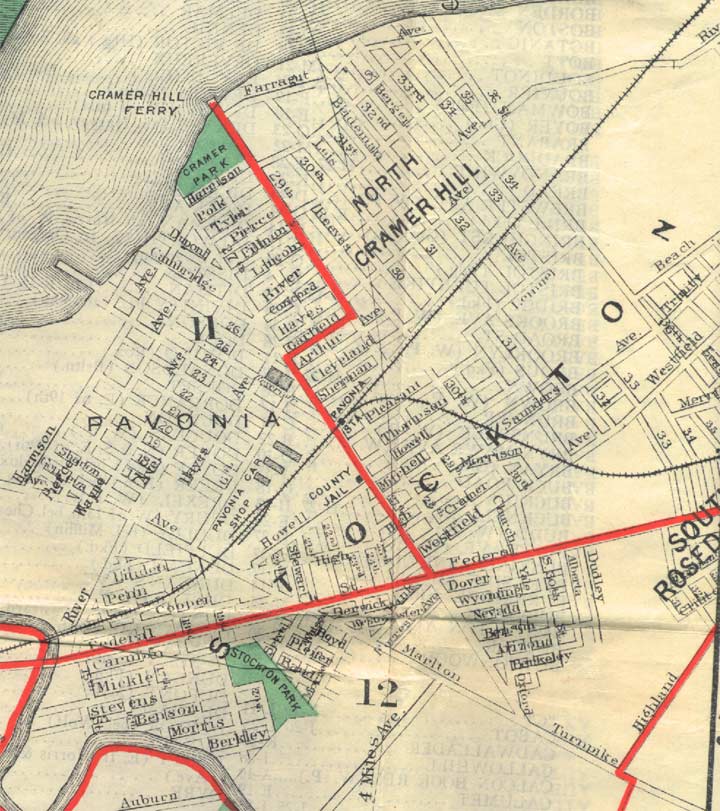
Cambridge Avenue, also known as Cambridge Street, runs easterly from the Delaware River through the Cramer Hill neighborhood, crossing Harrison, Pierce, Wayne, and River avenues to North 27th Street.
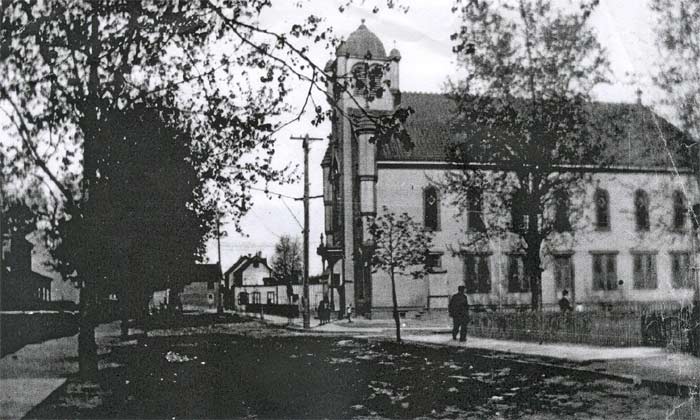
Howell Street runs through East Camden from 20th Street to 30th Street, parallel to the Pavonia railroad tracks. Homes were built by the 1880s, and several businesses operated here during Camden's industrial years, including Nick's Auto Parts and the Pavonia Ice & Coal Company. The first Catholic parish in East Camden, St. Joseph Church, stood at 25th and Howell Street.
Erie Street in North Camden runs from Beach Avenue to 9th Street, crossing Delaware Avenue, Point, Front, Segal, and the numbered streets 2nd through 9th.
Orris W. Smith was born in Camden on September 8, 1920, to Edward and Catherine Smith. The 1924 City Directory lists the family at 1113 Carpenter Street .

aka Claudius W. Bradshaw School; aka Challenge Square Academy; aka Met East High School 1151 Kaighn Avenue Camden had become an industrial city by the 1880s, and although the country went into an economic slump in the early 1890s, generally referred to as "the panic of 1893," the city continued to grow and with it the need for new schools.

Bergen Avenue runs through the Cramer Hill section of Camden from Cleveland Avenue north to Farragut Avenue near the Delaware River, likely named for Martin V. Bergen or Christopher A. Bergen, prominent Camden legal figures in the late 1800s.
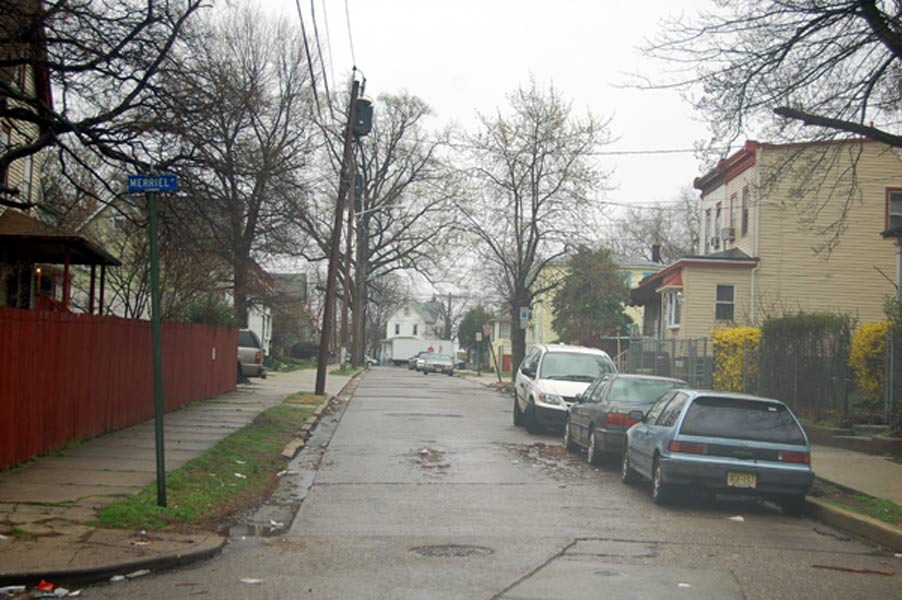
35th Street runs from the Delaware River south to River Avenue, then resumes east of the Pavonia railroad switching yard and again beyond Westfield Avenue, reaching Federal Street and continuing three blocks to Highland Avenue at the Pennsauken border. It is North 35th Street above Federal and South 35th below.

34th Street runs from the Delaware River south to Highland Avenue at the Pennsauken border. It is North 34th Street above Federal and South 34th below.
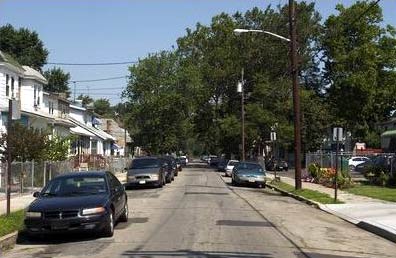
31st Street spans from the Delaware River through Cramer Hill and East Camden, with no addresses outside Cramer Hill since the early 1920s. It is North 31st Street above Federal and South 31st below.

29th Street extends from the Delaware River through Cramer Hill and East Camden, running from River Road to Clinton Street. It is North 29th Street above Federal and South 29th below.
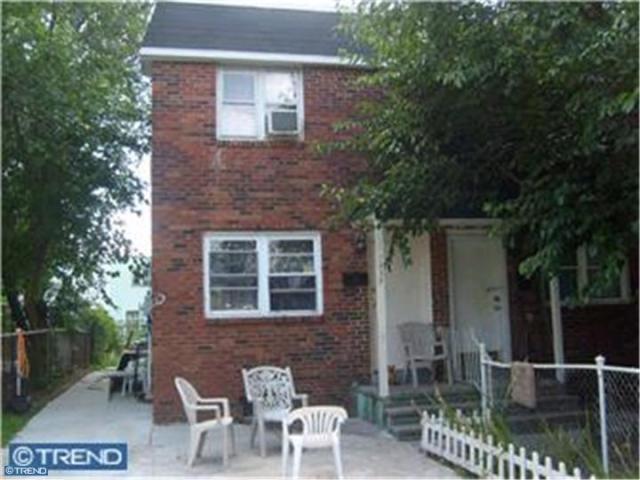
22nd Street spans the former Pavonia section — now Cramer Hill — and extends south to Federal Street in East Camden, already laid out by the time the 1887–1888 Camden City Directory was published.

Twenty-First Street runs through Cramer Hill and into East Camden, extending from Harrison Avenue to Federal Street, established by the 1887–1888 Camden City Directory.
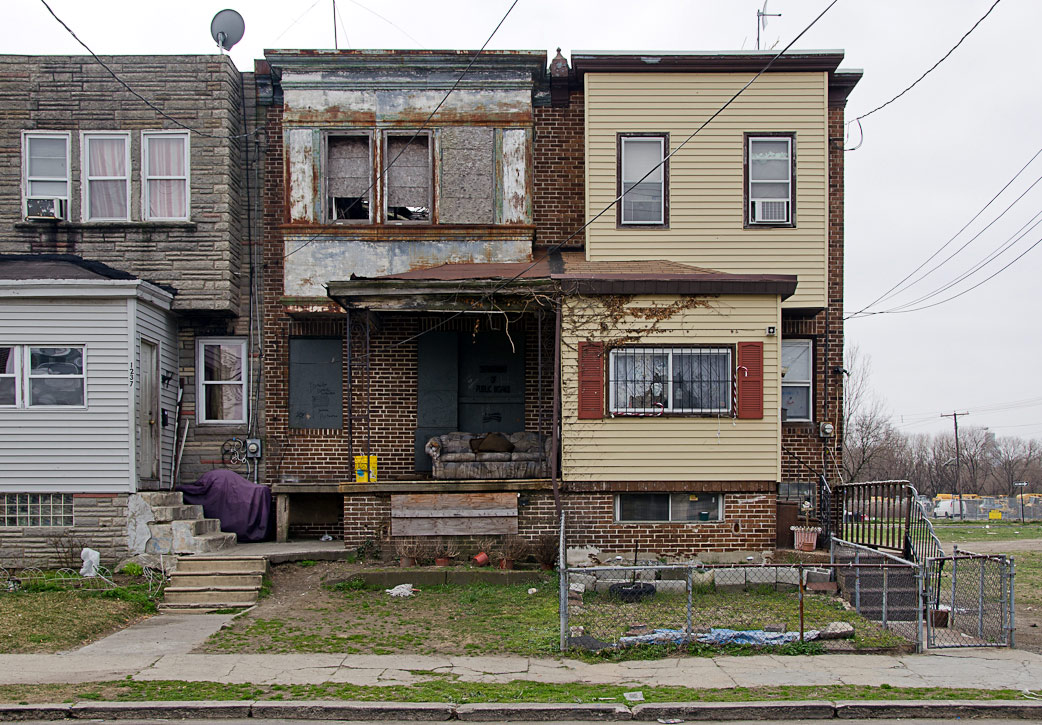
Twentieth Street runs through Cramer Hill and East Camden, from Harrison Avenue to Bank Street, established by the 1887–1888 Camden City Directory. In 1954, fourteen homes with South 20th Street addresses were added when McGuire Gardens public housing was built; they were demolished and redeveloped in the 1990s.
Nineteenth Street runs from the Pavonia railroad switching yards across River Avenue north to Harrison Avenue in the Cramer Hill section of Camden, New Jersey.
Eighteenth Street runs from River Avenue north to just beyond Harrison Avenue in the Cramer Hill section of Camden, New Jersey. Originally called Dayton Avenue, it was renamed shortly after the 1900 Census.
Seventeenth Street runs through two separate sections of Camden: North 17th Street extends from Harrison Avenue to River Avenue through the Cramer Hill neighborhood, while South 17th Street runs from Federal Street southward across Carman Street to Admiral Wilson Boulevard in East Camden.

Cramer Hill derives its name from Alfred Cramer , who in the late 19th century purchased large tracts of farmland, for the most part between Federal Street and the Delaware River in what was then Stockton Township , subdivided the land into building lots, and sold them on an installment basis to people of average means.
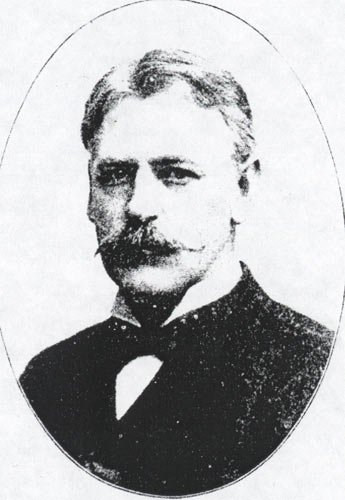
Frank T. Lloyd (1859–1951) was a Camden printer turned lawyer who served in the New Jersey Assembly, as Camden County Prosecutor, as a Circuit Court judge from 1906 and as a New Jersey Supreme Court Justice from 1924 until his retirement in 1938.
I just reviewed the Bergen Avenue site again. Ok, so my parents bought 1021 Bergen from the Kennedy family in 1953. My parents lived in the white house, one house from Engles Lot.

By ANGELA RUCKER, Courier-Post Staff CAMDEN — Six-year-old Danny Dombkowski paused briefly — very briefly — after scooting out of the McGuire Gardens Community Center with his arms wrapped around a box filled with toy cars and other contraptions.
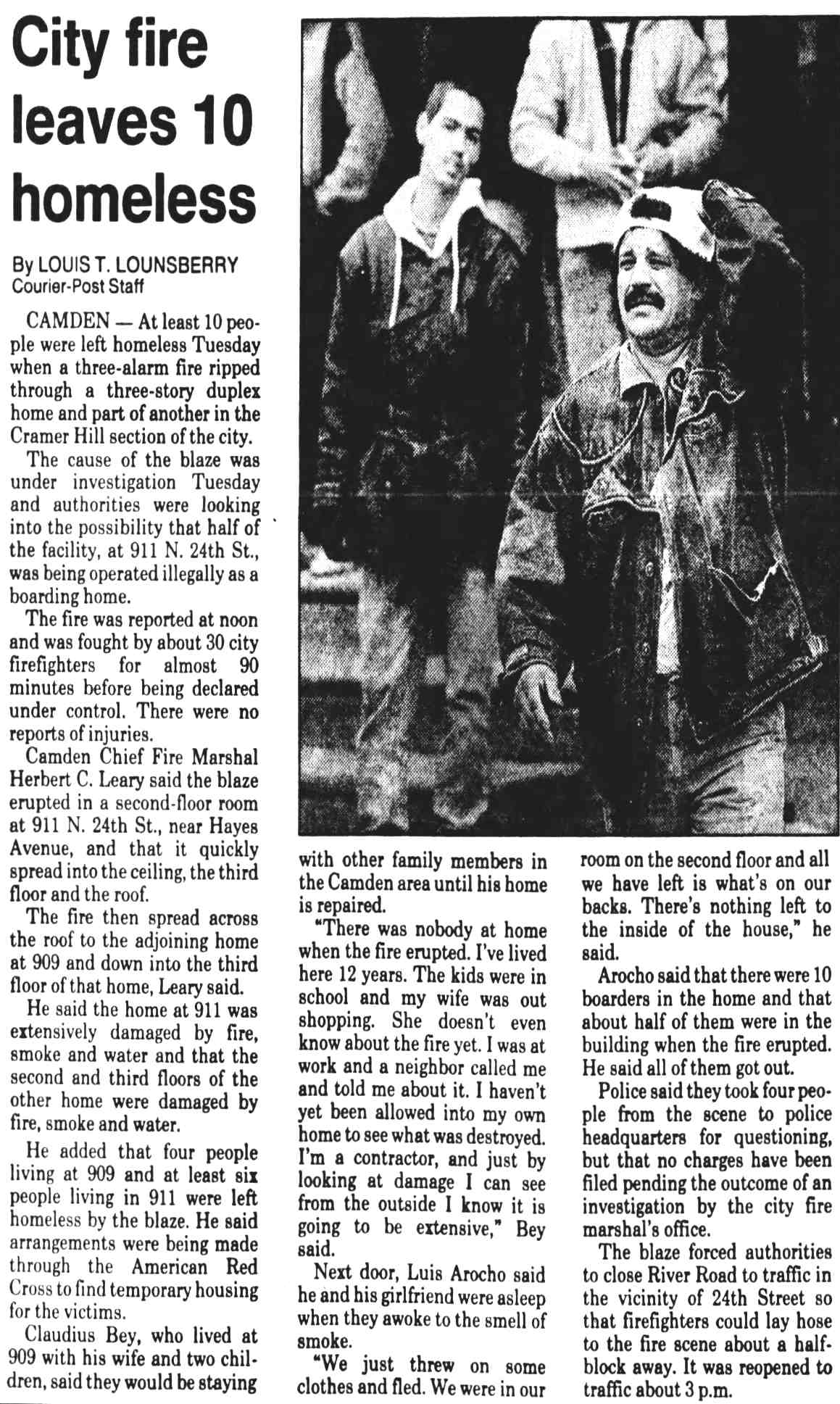
A three-alarm fire destroyed the duplex at 909-911 North 24th Street in the Cramer Hill section of Camden on December 17, 1991, leaving ten people homeless. (Camden Courier-Post, December 18, 1991)
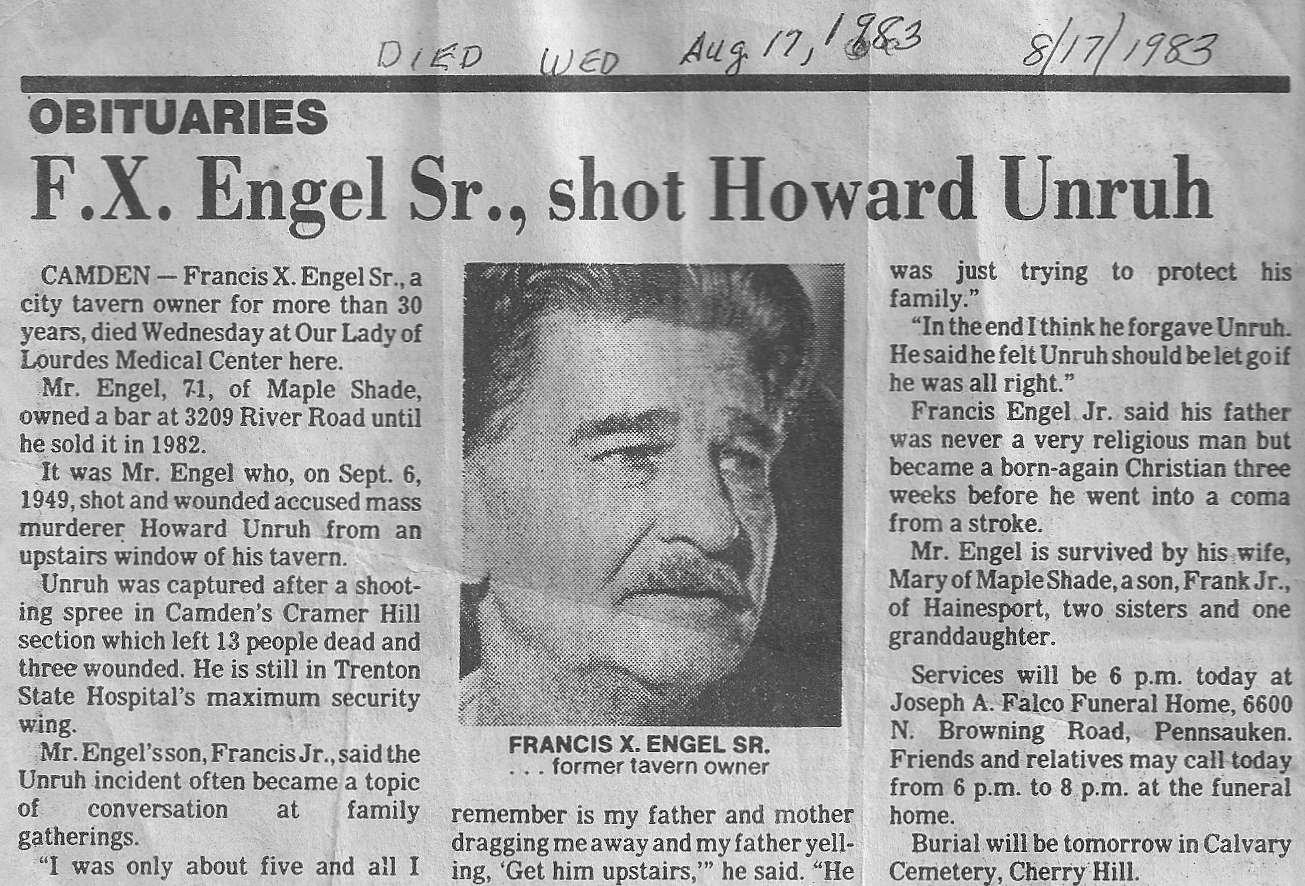
Obituary of Francis X. Engel Sr., the Camden tavern owner who shot and wounded mass murderer Howard Unruh from an upstairs window during the 1949 Cramer Hill rampage. Camden Courier-Post, August 17, 1983.
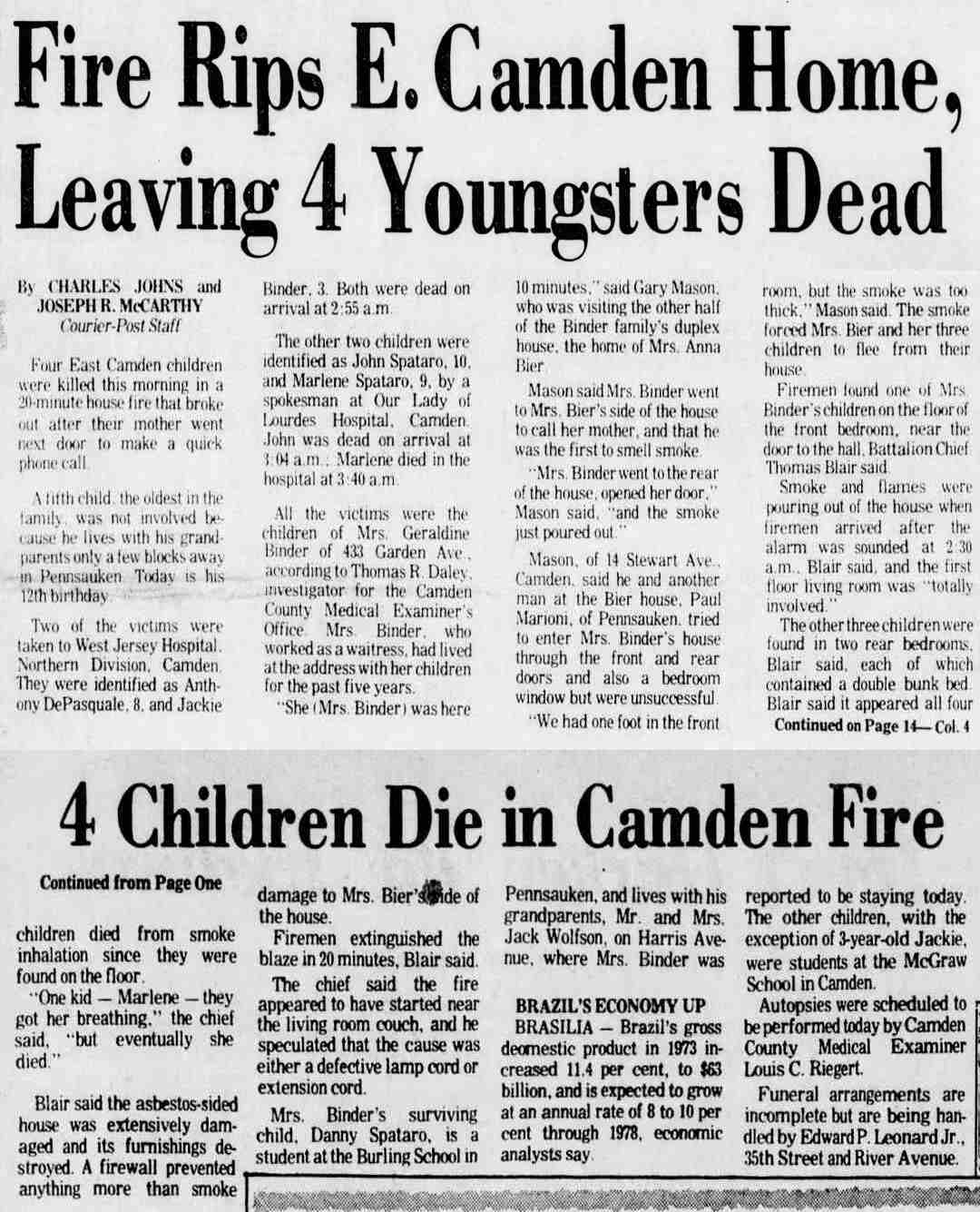
Four children of Mrs. Geraldine Binder died in a 20-minute fire at 433 Garden Avenue in East Camden; Battalion Chief Thomas Blair said all four appeared to have died of smoke inhalation and that the blaze likely started near the living room couch.
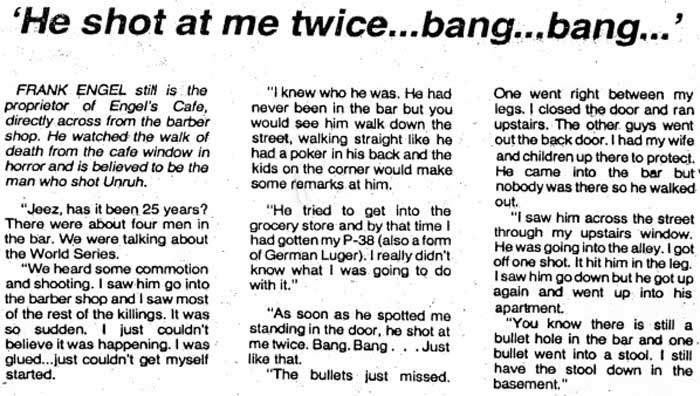
Twenty-five years after Howard Unruh's 1949 "Walk of Death," Frank Engel — proprietor of Engel's Cafe on River Avenue in Cramer Hill — recounts to the Camden Courier-Post how he fired the shot that wounded the killer.
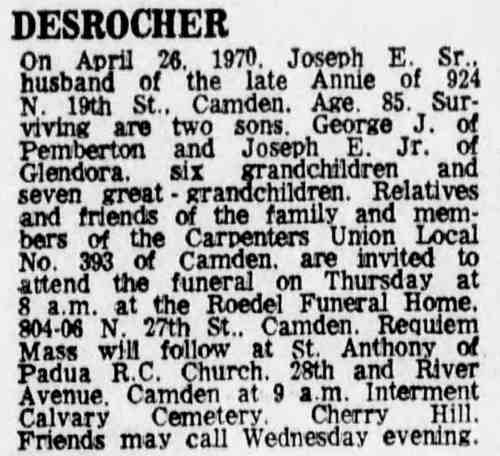
Death notice of Joseph E. Desrocher Sr., 85, of 924 North 19th Street, Camden, who died April 26, 1970.
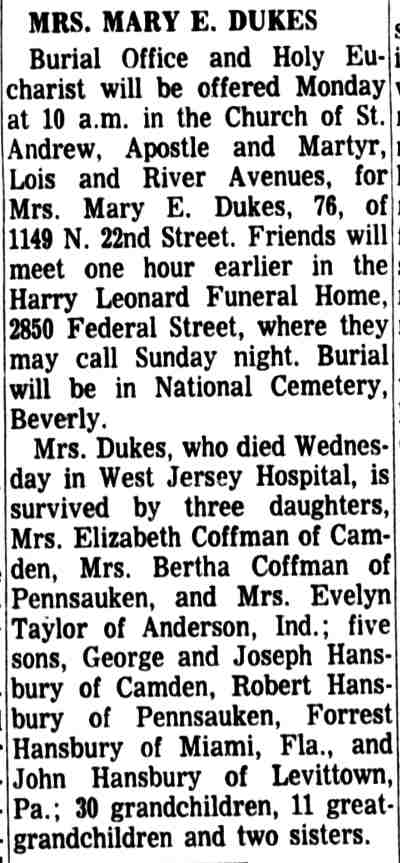
Obituary of Mrs. Mary E. Dukes, 76, of 1149 North 22nd Street, who died at West Jersey Hospital; burial at National Cemetery, Beverly.
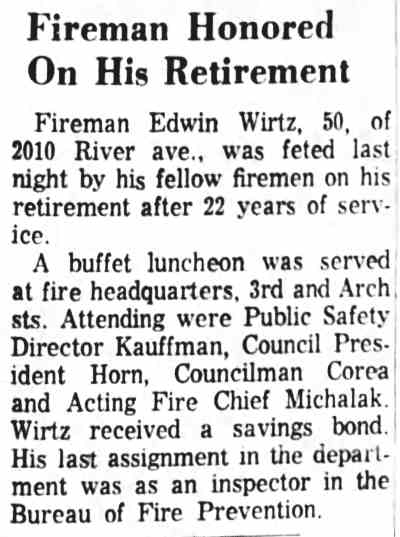
Fireman Edwin Wirtz of 2010 River Avenue was feted at a buffet luncheon at Camden fire headquarters on his retirement after 22 years of service; his last assignment was as an inspector in the Bureau of Fire Prevention.
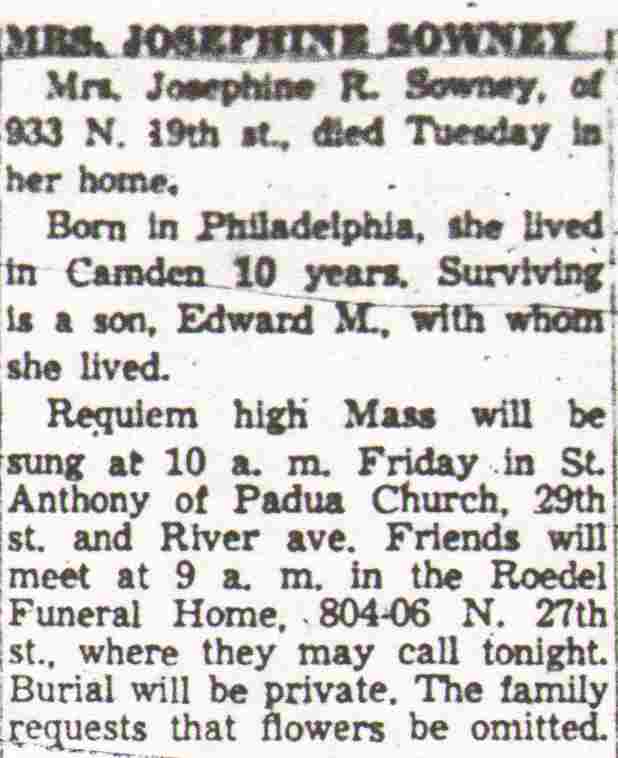
Obituary of Mrs. Josephine R. Sowney of 933 North 19th Street, Camden, who died at her home in December 1957.
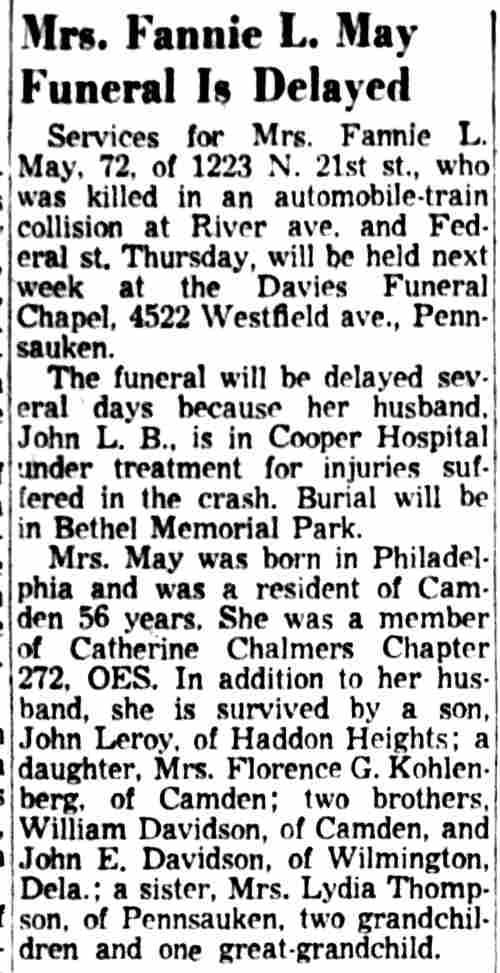
Funeral for Mrs. Fannie L. May of 1223 North 21st Street was delayed because her husband John was hospitalized from injuries in the automobile-train collision that killed her.
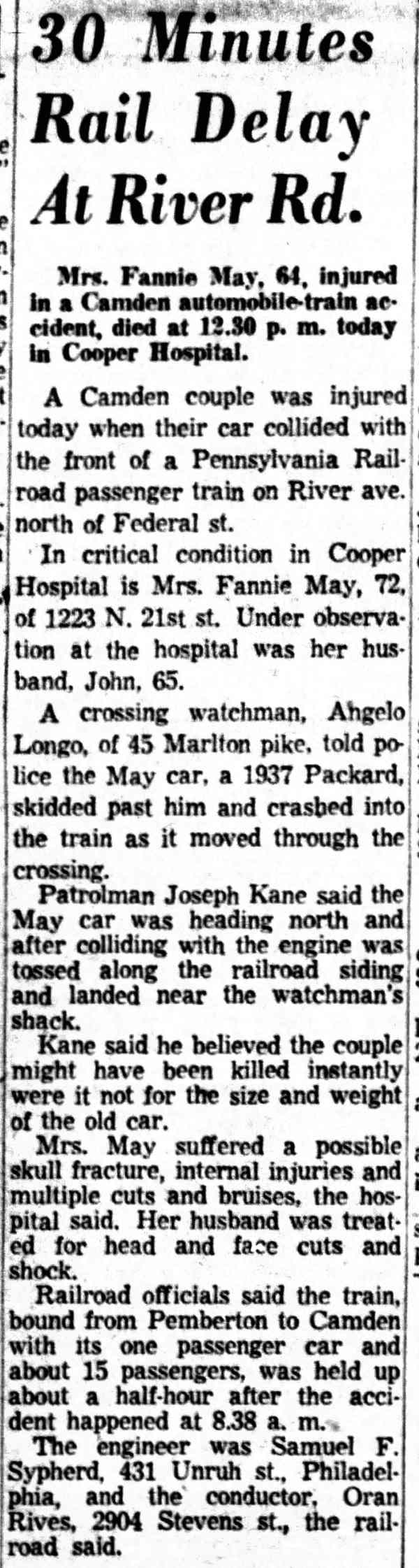
Mrs. Fannie May, 72, of 1223 North 21st Street was critically injured when her car skidded into a Pennsylvania Railroad passenger train at River Avenue and Federal Street; she died that afternoon.
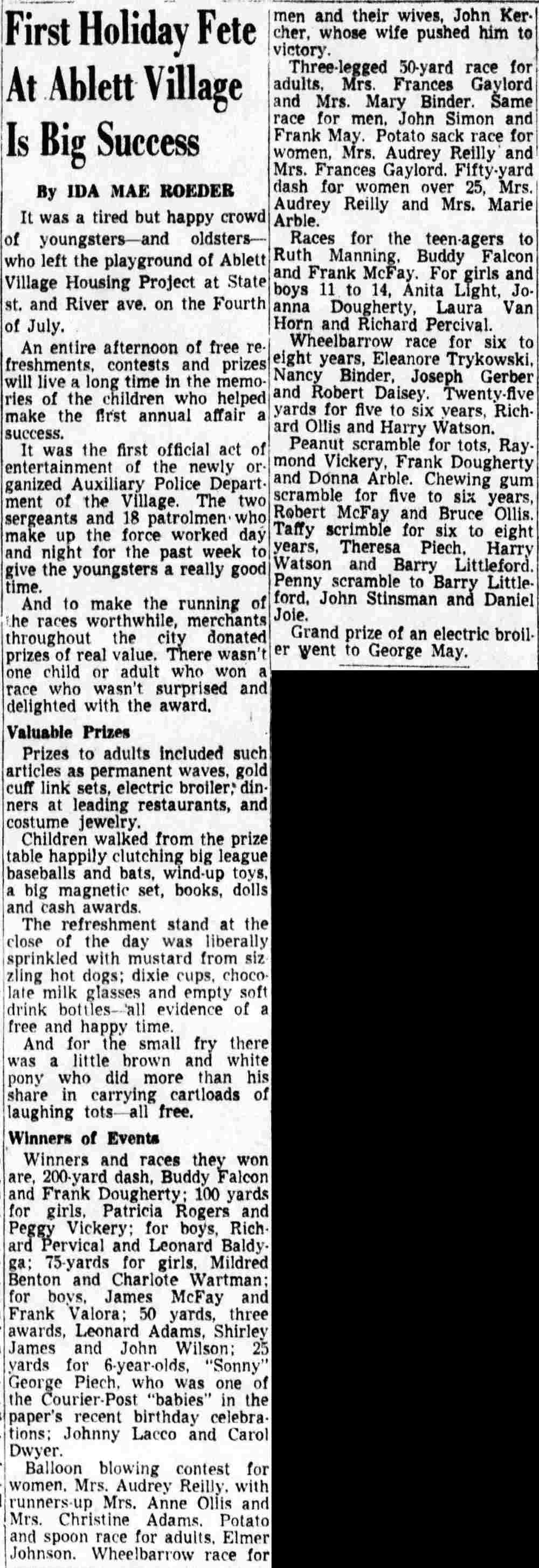
The newly organized Auxiliary Police Department of Ablett Village staged the project's first Fourth of July celebration, with races, donated prizes and a pony for the children. Camden Courier-Post, July 6, 1953.
Fifty years ago, the old town of Stockton was annexed to the City of Camden over the protests of Democratic members of the town council.
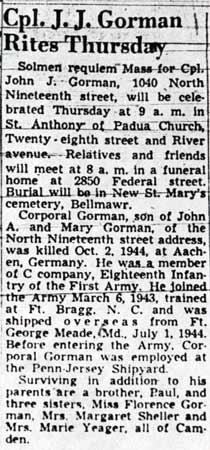
Camden Courier-Post notice of the solemn requiem Mass for Corporal John J. Gorman of 1040 North Nineteenth Street, killed at Aachen, Germany, held at St. Anthony of Padua Church in November 1947.
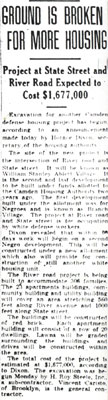
Excavation began at River Road and State Street for a $1,677,000, 306-family defense housing project to be known as William Stanley Ablett Village. Camden Courier-Post, June 11, 1942.
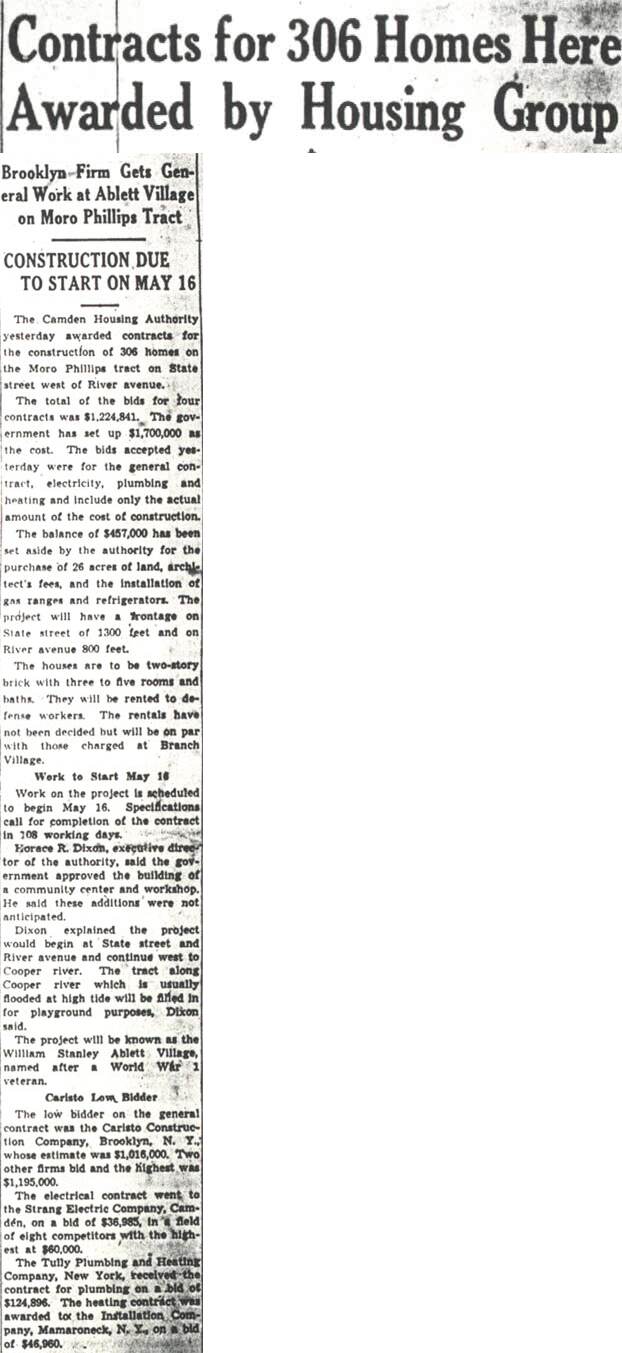
The Camden Housing Authority awarded four contracts totaling $1,224,841 for 306 homes on the Moro Phillips tract, to be known as the William Stanley Ablett Village. Camden Courier-Post, April 25, 1942.

The Camden Housing Authority announced U.S. Housing Authority approval of a $1,566,000 defense housing project of 306 units on the south side of East State Street between Cooper Creek and River Avenue. Camden Courier-Post, January 17, 1942.
Possibility of amending existing statutes providing state aid for elimination or grade crossings to permit financing, an underpass in Cramer Hill was suggested by City Commissioner Hartmann to State Senator Burling and Assemblymen Lawrence H. Ellis and Millard E. Allen at the weekly legislative forum.
An open-air meeting of the Cramer Hill Businessmen's Association at Veterans Park praised local business, with Mayor Frederick von Nieda among the speakers; prizes were awarded including a vacuum cleaner to George Blanck of 1026 North Twenty-first Street.
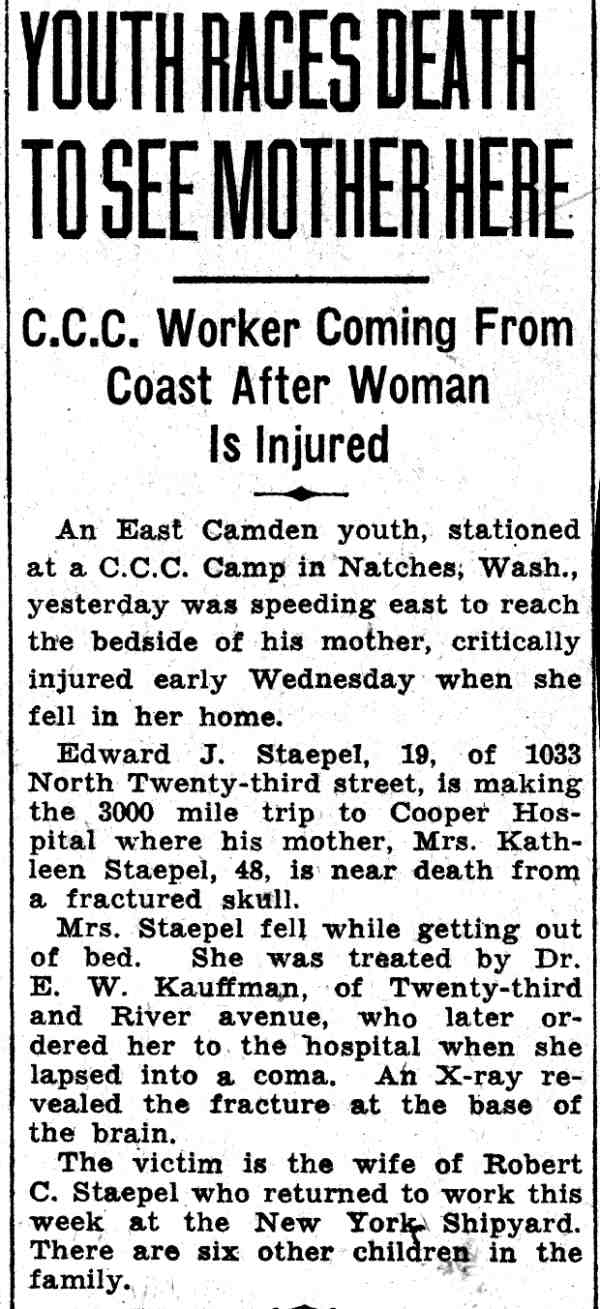
Edward J. Staepel, 19, of 1033 North Twenty-third Street made a 3,000-mile trip from a C.C.C. Camp in Washington State to reach Cooper Hospital, where his mother lay near death from a fractured skull.
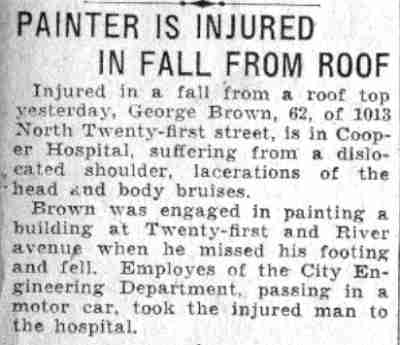
George Brown, 62, of 1013 North Twenty-first Street was hospitalized at Cooper Hospital with a dislocated shoulder and head lacerations after falling from a roof at Twenty-first and River Avenue.

Sergeant Horner Recalls Days When Horse-Drawn Patrol Toted Woozy Celebrants From Moist Recreation Centers to City Hall East Camden used to have three parks "in the old days" — and to hear a veteran like Police Sergeant William C. Horner tell it — they certainly kept the police force "on its toes." Sergeant Horner, who has seen more than a quarter century of service on the police force in East Camden and is now head of the city missing persons bureau, often tells of those days.

With orders to "shoot on sight" issued to suburban police hunting South Jersey's "phantom sniper," a man giving a fake name reported a 16th shooting that investigators could not verify, while a 15th victim came forward separately in Collingswood.
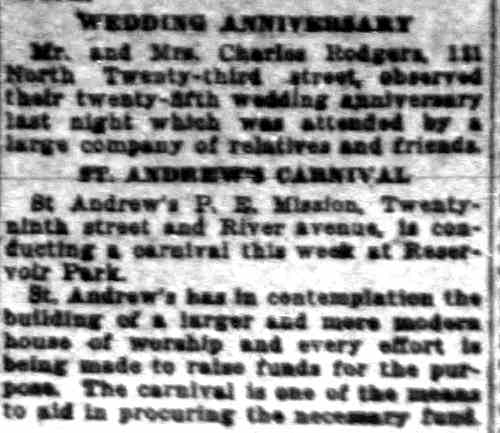
Mr. and Mrs. Charles Rodgers of 131 North Twenty-third Street celebrated their twenty-fifth wedding anniversary with a large gathering of relatives and friends. The same column reports that St. Andrew's P. E. Mission was conducting a carnival at Reservoir Park to raise funds for a new house of worship.
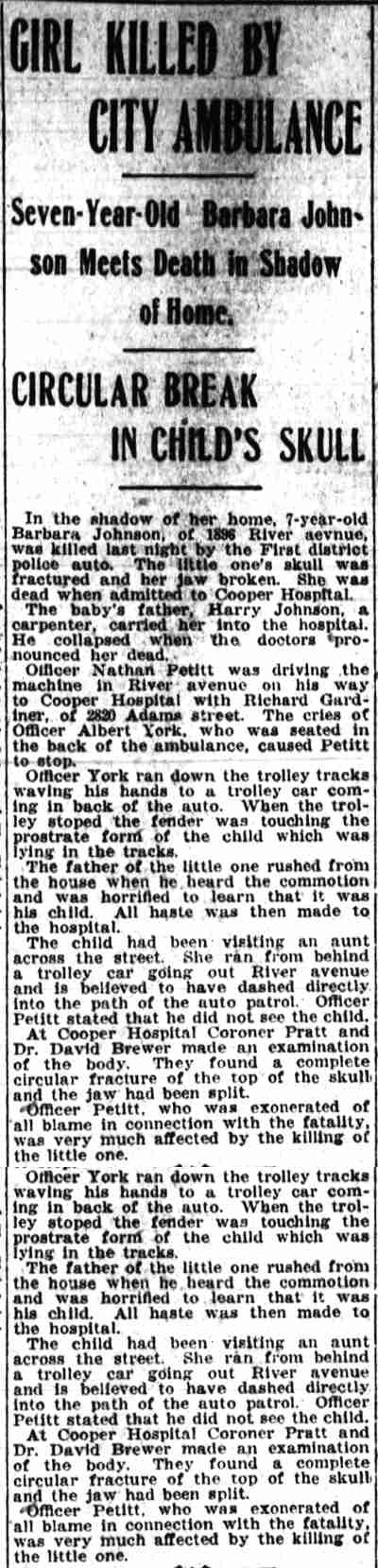
Seven-year-old Barbara Johnson of 1896 River Avenue was killed when a Camden police ambulance transporting Richard Gardiner of 2820 Adams Street struck her in the street, as reported in the Camden Post-Telegram of February 22, 1919.