Streets
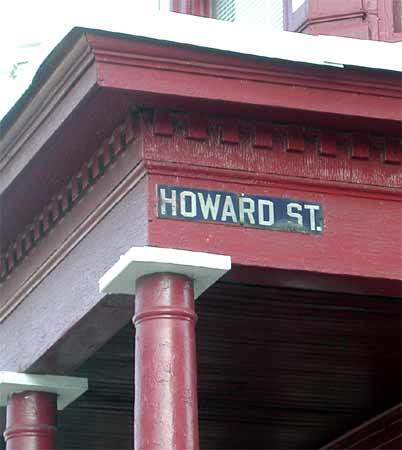
Howard Street
Howard Street ran for two blocks in North Camden, from State Street north to Erie Street, parallel to North Front and North 2nd Streets. It was already laid out and built up by 1887.
Tag
Howard Street ran for two blocks in North Camden, from State Street north to Erie Street, parallel to North Front and North 2nd Streets. It was already laid out and built up by 1887.
Technician Fourth Class Isaac Z. Gosling (1911–1942) was born in Camden to Boston and Elizabeth Gosling; the family had moved to 118 North 23rd Street by September 1918. Called to service in March 1941, he died of pneumonia in England on September 3, 1942 while serving with the 85th Quartermaster Depot Supply Company, and was buried at Beverly National Cemetery in 1949.
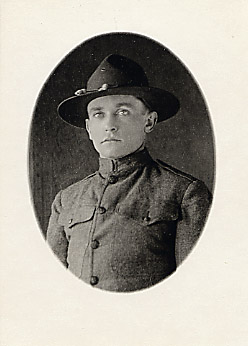
Charles Behrend of Camden, NJ served as a Private First Class in Company C, 309th Infantry Regiment, 78th Infantry Division. He was killed in action on September 25, 1918 during the Battle of St. Mihiel and is buried at St. Mihiel American Cemetery in Thiaucourt, France.
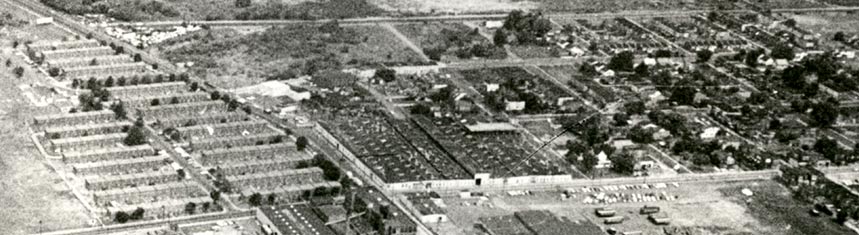
William Stanley Ablett Village is a 306-unit public housing project at River Road and State Street in the Cramer Hill section of Camden, built by the Housing Authority of the City of Camden during World War II and named for a Camden soldier killed in action in France during World War I.
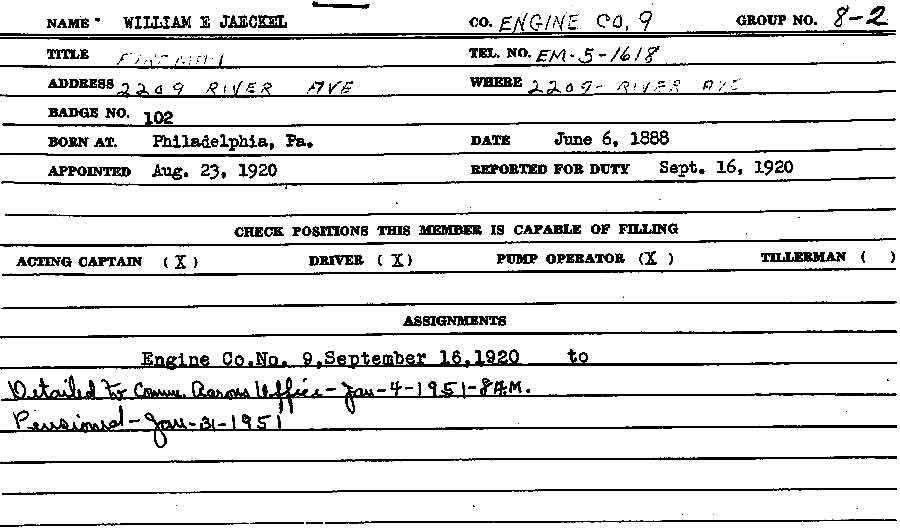
William E. "Pud" Jaeckel (1888–1961) joined the Camden Fire Department in 1920 and served over thirty years with Engine Company 9 at North 27th and Federal Streets in East Camden, retiring on pension in January 1951.
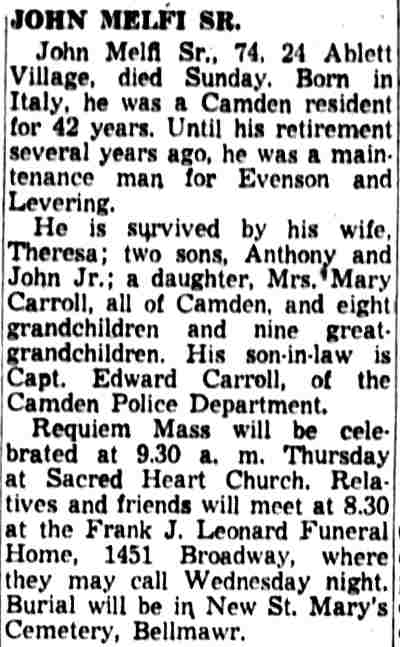
Ablett Village is a public housing project at State Street and River Road in Camden, constructed during World War II and operated by the Housing Authority of the City of Camden. Named after William Stanley Ablett.
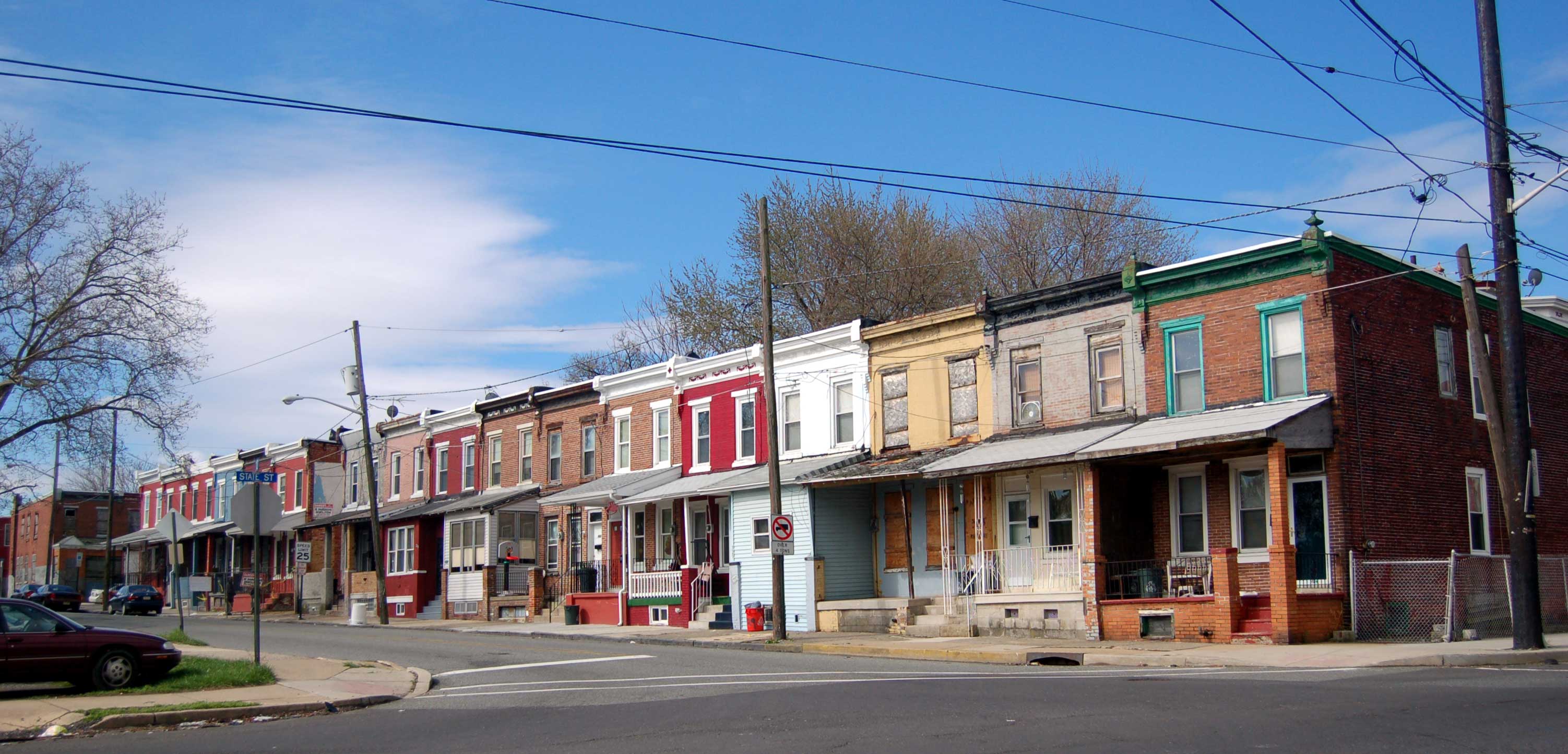
City directory records and newspaper accounts for 10th Street, one of Camden’s longest thoroughfares, running from State Street in North Camden through Cramer Hill and Whitman Park to Morgan Village, 1870s–1970s.
Dr. Paul Cohen was born in Moorestown, NJ, in 1903. He graduated from Moorestown High School in 1922, the University of Pennsylvania in 1926, and the University of Switzerland Medical School in 1934.
Linden Street runs east from the Delaware River to North 12th Street in Camden; large portions were demolished for the Benjamin Franklin Bridge, Rutgers University and the toll plaza.

Point Street in North Camden was laid out in 1804 as Cooper's Point Road, giving access along the riverbank to sawmills, planing mills and shipyards; its current name comes from that road.
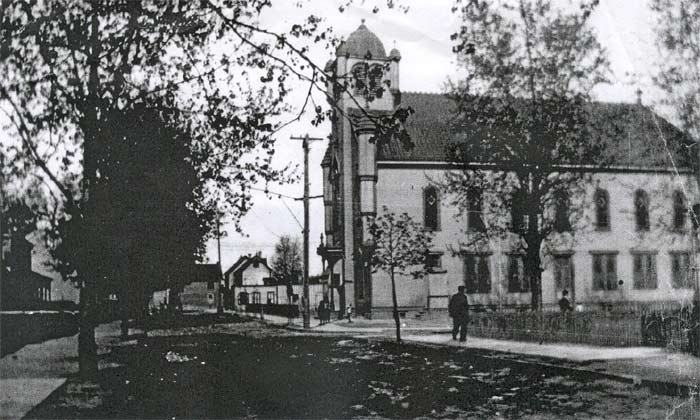
Howell Street runs through East Camden from 20th Street to 30th Street, parallel to the Pavonia railroad tracks. Homes were built by the 1880s, and several businesses operated here during Camden's industrial years, including Nick's Auto Parts and the Pavonia Ice & Coal Company. The first Catholic parish in East Camden, St. Joseph Church, stood at 25th and Howell Street.
Erie Street in North Camden runs from Beach Avenue to 9th Street, crossing Delaware Avenue, Point, Front, Segal, and the numbered streets 2nd through 9th.

Marlton Avenue in East Camden begins at Federal Street as an extension of State Street and runs east to the city limits; nearby houses were razed around 2006 for the new Thomas Dudley Elementary School.
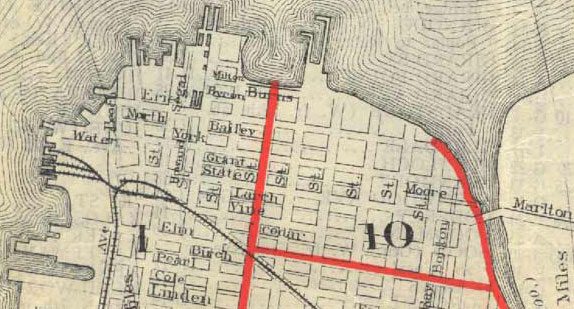
A small street running from 708 North 2nd Street east to North 8th Street, between State and Vine Streets, in Camden, New Jersey.

Sycamore Street is one of Camden's "tree" streets, originally running east from Front Street to Haddon Avenue; its intersections at 7th, 8th and Louis Streets were hubs for different ethnic and cultural communities.
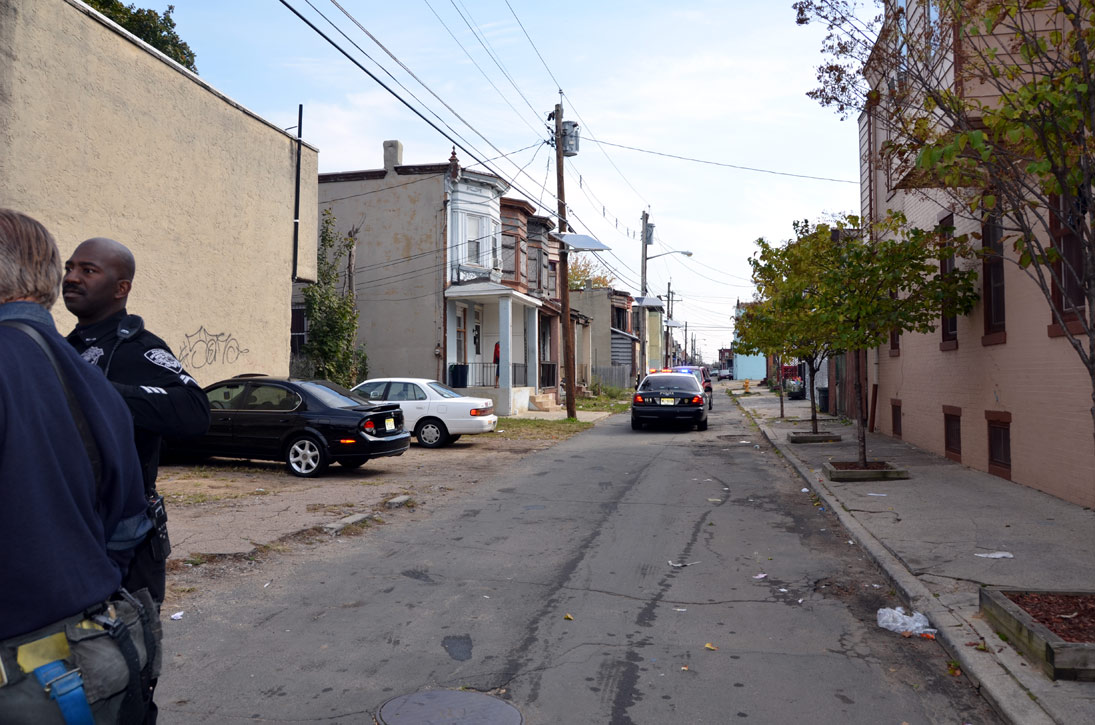
Bailey Street appears to be named for real estate developer William T. Bailey, who was responsible for building rows of homes between North 5th and North 6th Streets on State, Grant, Bailey and York Streets.
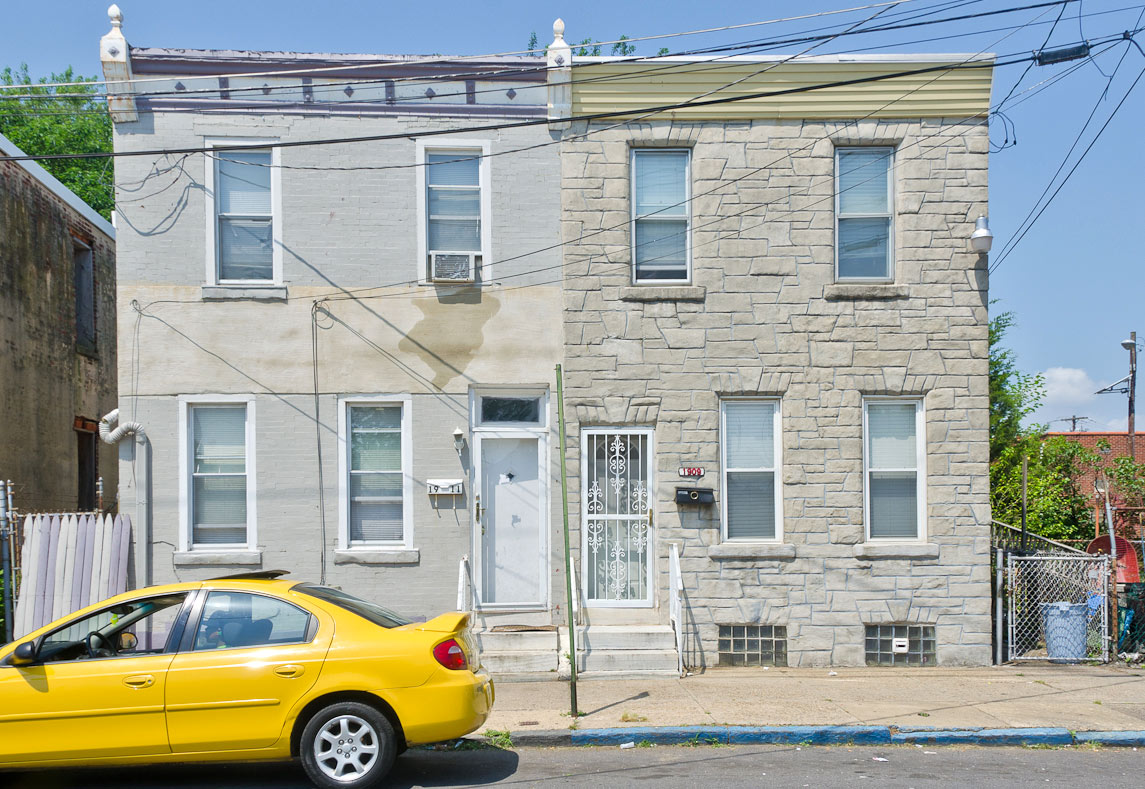
Kossuth Street ran south through South Camden from Van Hook Street to the railroad tracks; named for the Hungarian revolutionary Louis Kossuth, much of it was razed in the 1950s for the Franklin D. Roosevelt Manor and Chelton Terrace public housing projects.

Arthur Avenue, named after President Chester A. Arthur, is located in the Cramer Hill neighborhood of Camden. It runs from 24th Street eastward to 29th Street and Von Nieda Park, passing along the south side of Veterans Memorial Park.

State Street, established in 1856, runs from the Delaware River to the Cooper River in North Camden. Citizens petitioned for it to shorten the trip to markets and the ferry.

York Street in North Camden stretches from Delaware Avenue to 10th Street, crossing Beach, Point, Front and Howard Streets. The page includes 2004 photographs looking east and west along the street.
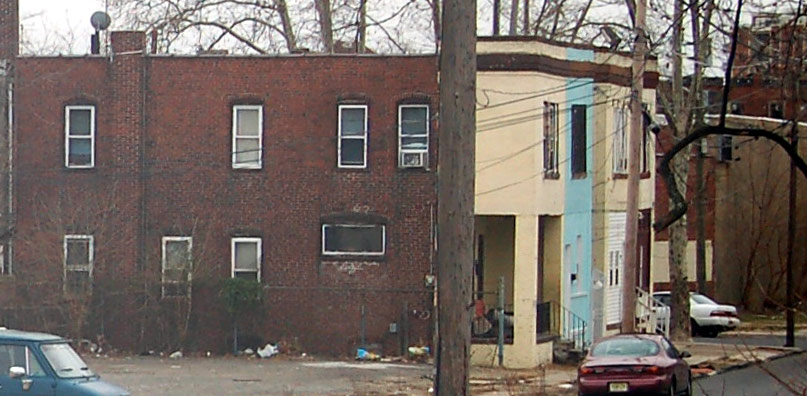
Cramer Street runs east through the Cramer Hill and East Camden neighborhoods of Camden, NJ. Named for real estate developer Alfred Cramer, who sold more than 5,000 building lots in the area by 1897, it stretches from the 2600 to 3400 blocks.

Reprinted from the series of stories of Camden's earlier days, under the title Sixty Years in Camden County - Gosh! by Will Paul, appearing in The Community news, of Merchantville, NJ.
Main Street is a diagonal street in North Camden running southeast from State and Point Streets. The 1878 city directory listed it as starting at the Vine Street Ferry.

One of Camden's oldest and most storied streets, named after the Cooper family. Covers the full length from the waterfront to the 2000 block, including the Victor Talking Machine Company, Esterbrook Pen Company, Johnson Park, the Hotel Plaza, the Walt Whitman Hotel, the Elks Lodge, and East Camden's other Cooper Street.

Joseph A. Alcorn (1919-1958) was a Camden, New Jersey native and US Marine Corps veteran who founded Alcorn Motor Sales on Federal Street in East Camden.

WILLIAM E. ALBERT was born in New Jersey around 1870. He was the son of Ernest and Hannah Albert. Ernest Albert had emigrated to America from Wurttemburg in what is now Germany.

Vincent Ariel Tydeman was born in New Jersey on August 24, 1883, to Edmund and Sarah Tydeman, who emigrated from England to the U.S. in 1878 with their nine children. The Tydemans welcomed another child, Florence, just before the 1880 census.

On the eve of his March 1980 retirement dinner, Camden fire captain John P. Gryckiewicz looked back on 40 years with the department — the rescues, the Garden State Race Track fire, 84-hour weeks and $60 paychecks, and a city he still loved.
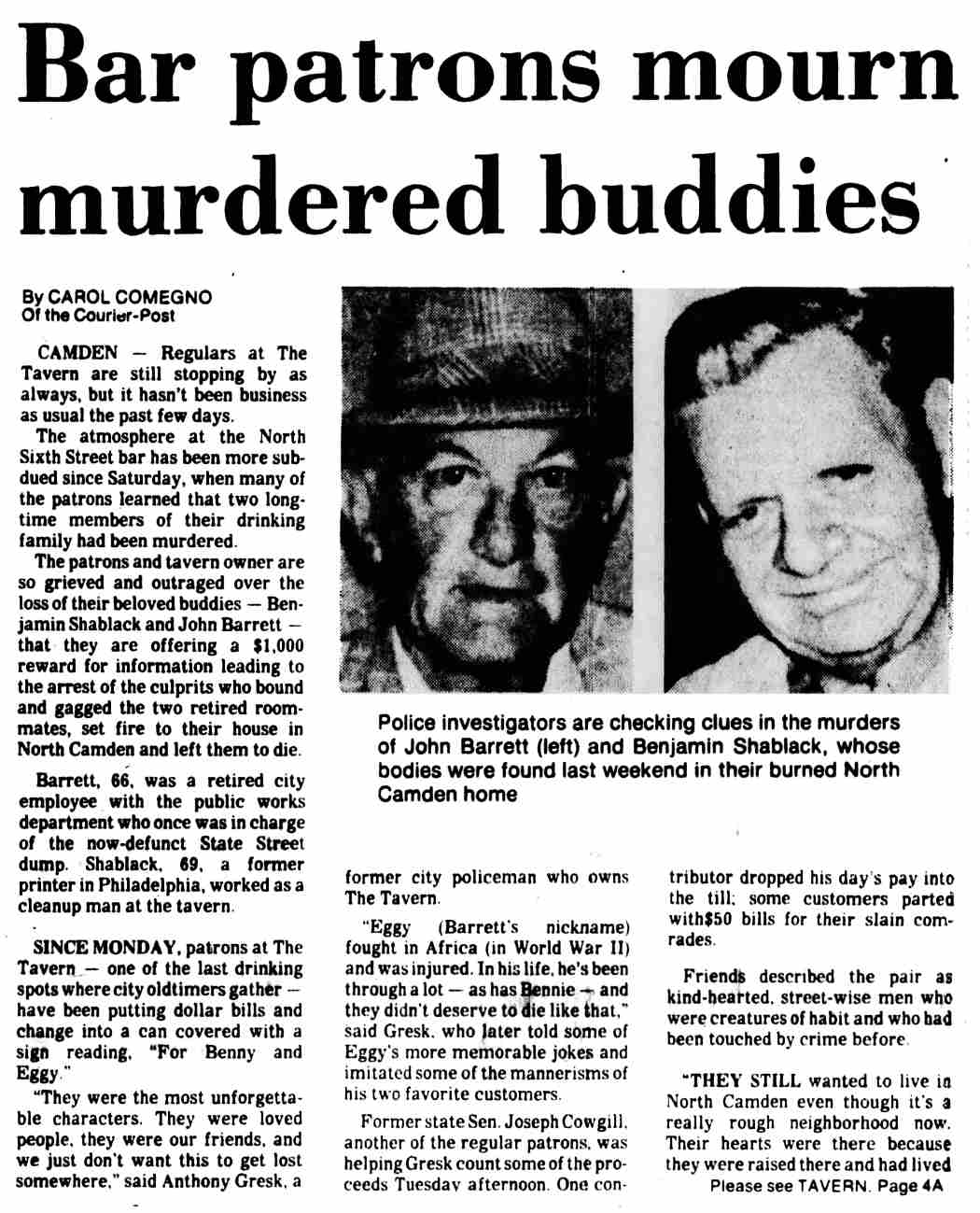
Regulars at The Tavern, a North Sixth Street bar, mourned Benjamin Shablack and John Barrett, two retired roommates bound, gagged, and left to die in a fire set in their North Camden rowhouse on Bailey Street. Fire Marshal Harold Pike found the fire was deliberately set in four locations.
Two elderly men, Benjamin Shablock and John Barrett, were found bound and gagged and died of smoke inhalation in a deliberately set fire at their Bailey Street home, prompting renewed calls for better police protection in North Camden.
A Camden Courier-Post retrospective on the origins of organized labor in Camden, centering on Peter J. McGuire and on the father-and-son cigarmakers Frank and Robert Hartmann, whose Third and Arch Streets factory housed the movement's earliest meetings. Robert Hartmann was elected first president of the Camden County Central Labor Union in 1908.

A Camden fire pumper from Engine 1, answering a mattress fire, collided with an automobile and crashed through the front of an insurance office at Broadway and Pine Streets, injuring firemen, a passerby and the car's occupants and leaving the building condemned.
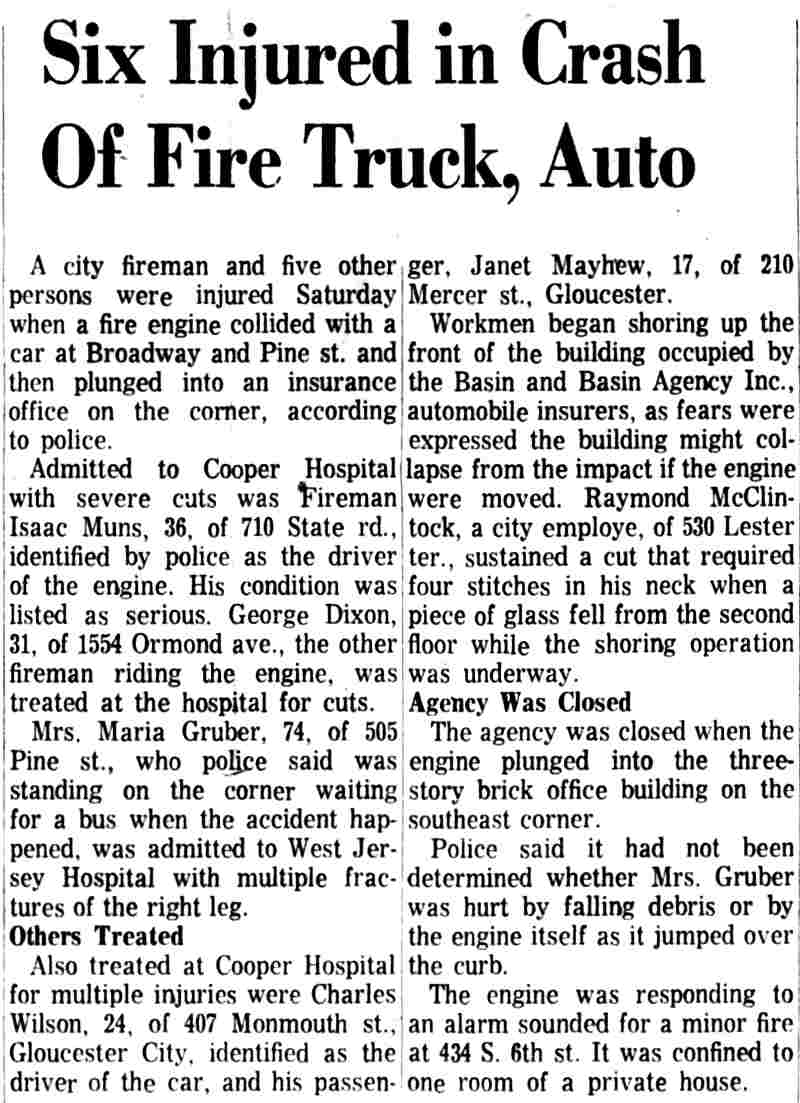
A Camden fire engine driven by Fireman Isaac Muns collided with a car at Broadway and Pine Street and plunged into an insurance office on the corner, injuring two firemen, a woman waiting for a bus, the car's two occupants and a city worker shoring up the building.
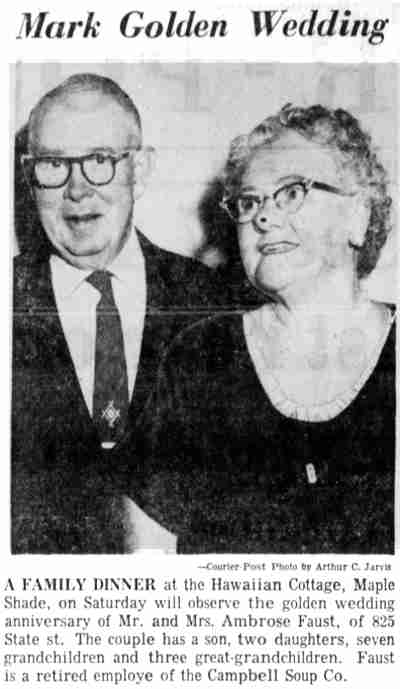
A family dinner at the Hawaiian Cottage in Maple Shade was to observe the golden wedding anniversary of Mr. and Mrs. Ambrose Faust of 825 State Street.
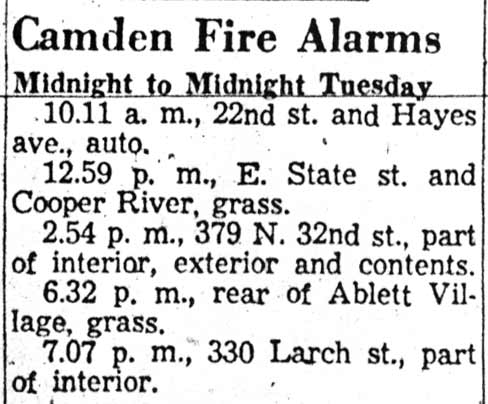
A December 4, 1957 Camden Courier-Post list of fire alarms, including a fire at 330 Larch Street.
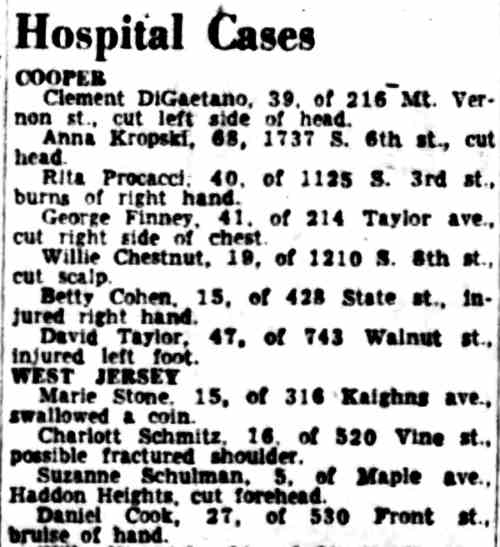
Cooper and West Jersey hospital cases reported in the Camden Courier-Post of February 3, 1956, including Rita Procacci of 1125 South 3rd Street, treated for burns of the right hand.
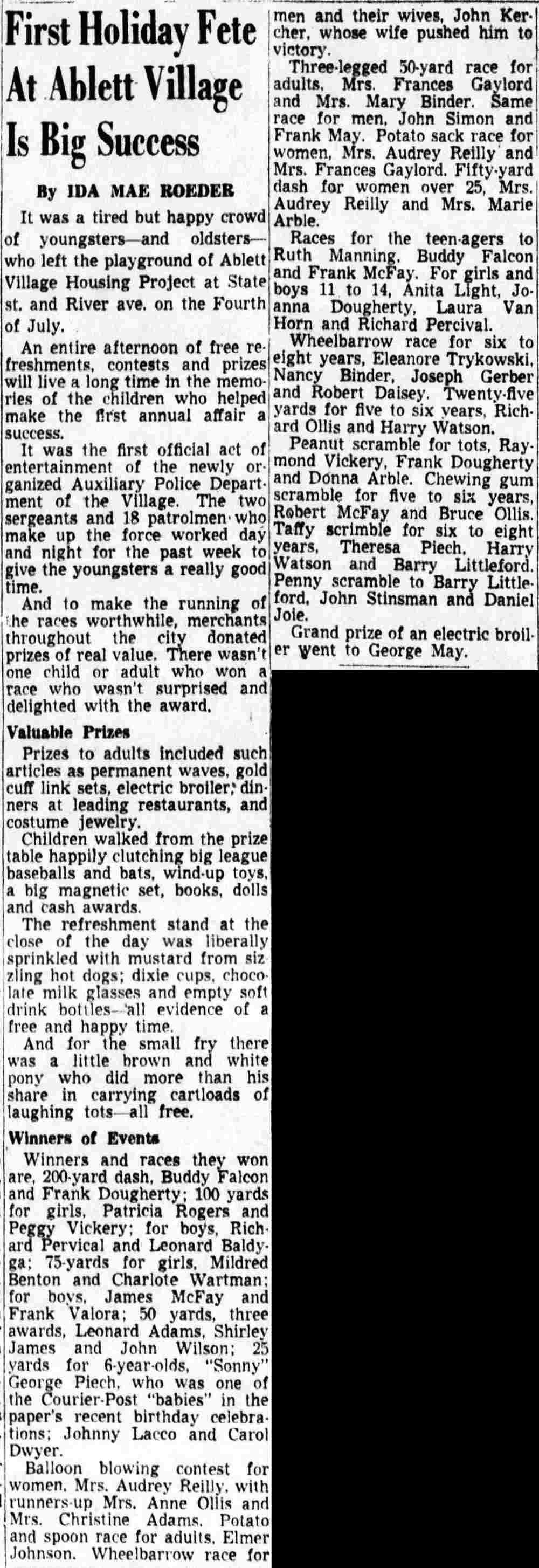
The newly organized Auxiliary Police Department of Ablett Village staged the project's first Fourth of July celebration, with races, donated prizes and a pony for the children. Camden Courier-Post, July 6, 1953.
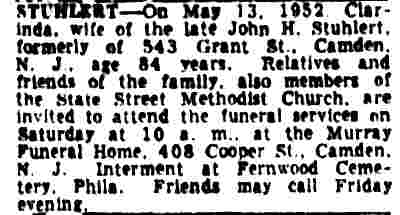
Death notice for Clarinda Stuhlert, 84, widow of John H. Stuhlert and formerly of 543 Grant Street, Camden.
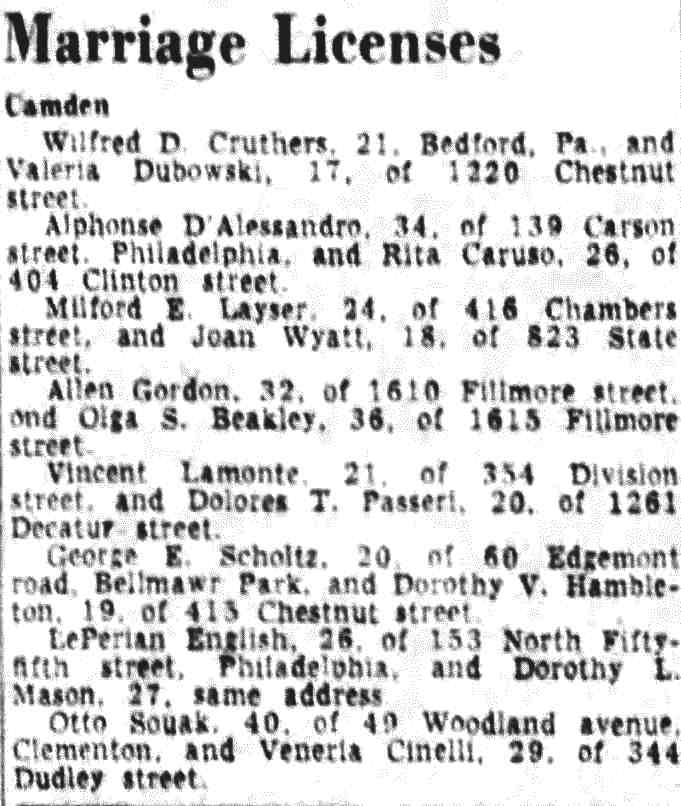
Eight Camden marriage licenses published April 2, 1952, including Otto Souak of Clementon and Veneria Cinelli of 344 Dudley Street.

A Camden Courier-Post account of a father who carried his three children from their smoke-filled apartment at 216 State Street, and of a Haddon Avenue gift-shop fire in which two firemen were injured.

Camden Courier-Post - July 8, 1950 By Wilbur Morse Jr. Petitions for highway safety measures or improvements usually come from adult individuals or organizations.

Camden Courier-Post, February 6, 1950: Housing authority chairman Joseph J. McComb announces 400 low-rent dwellings will be built near the four existing projects.
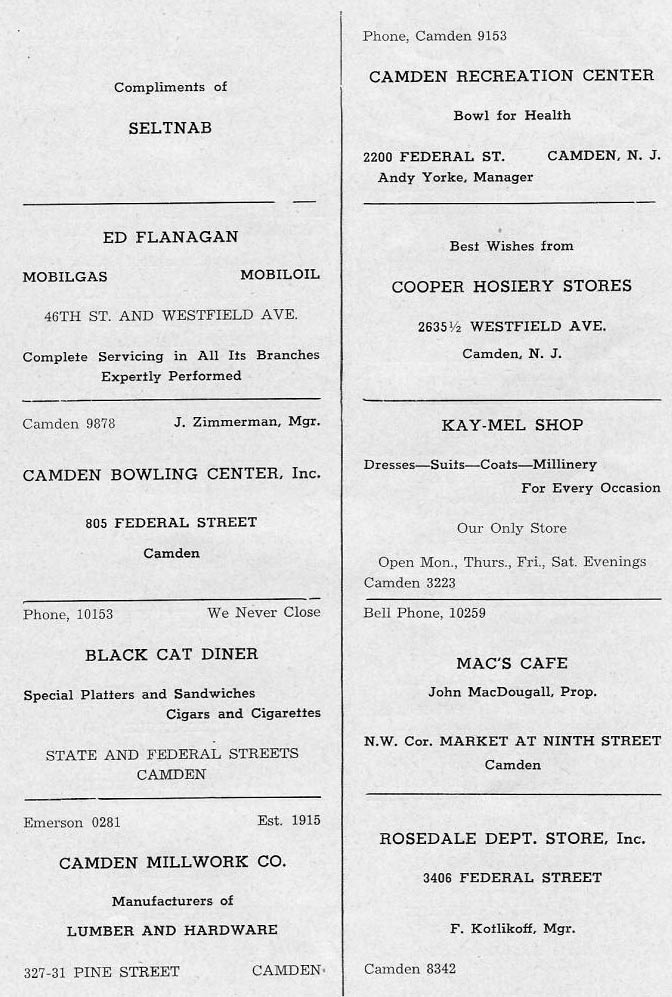
Page 67 of the 1943 St. Joseph's Roman Catholic Church Golden Jubilee Year Book: compliments of Seltnab, with advertisements for Ed Flanagan's Mobilgas station at 46th St. and Westfield Ave., the Camden Bowling Center at 805 Federal Street, the Black Cat Diner at State and Federal Streets, the Camden Millwork Co. at 327-31 Pine Street, the Camden Recreation Center at 2200 Federal St., Cooper Hosiery Stores at 2635½ Westfield Ave., the Kay-Mel Shop, Mac's Cafe at Market and Ninth Streets, and the Rosedale Dept. Store at 3406 Federal Street.
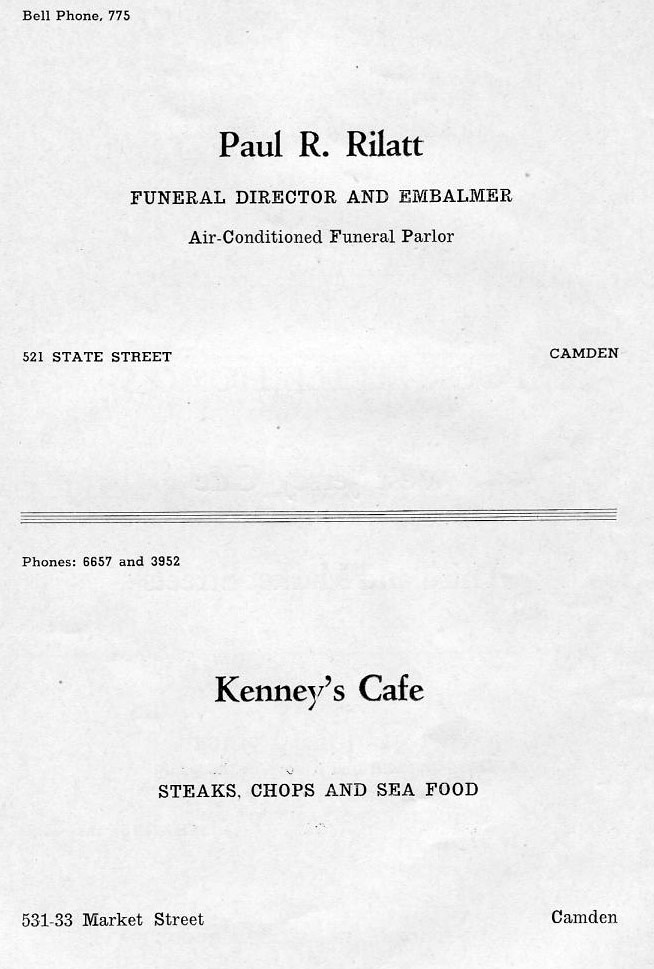
Page 17 of the 1943 St. Joseph's Roman Catholic Church Golden Jubilee Year Book: advertisements for funeral director and embalmer Paul R. Rilatt at 521 State Street and Kenney's Cafe at 531-33 Market Street.
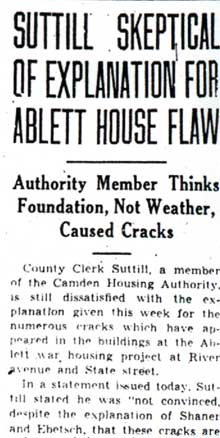
Camden Housing Authority member Frank J. Suttill publicly doubted officials' explanation that weather, not foundation settlement, caused numerous cracks in the newly built Ablett Village buildings. Camden Courier-Post, November 1942.
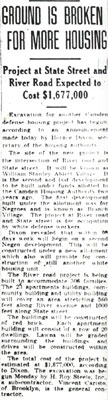
Excavation began at River Road and State Street for a $1,677,000, 306-family defense housing project to be known as William Stanley Ablett Village. Camden Courier-Post, June 11, 1942.
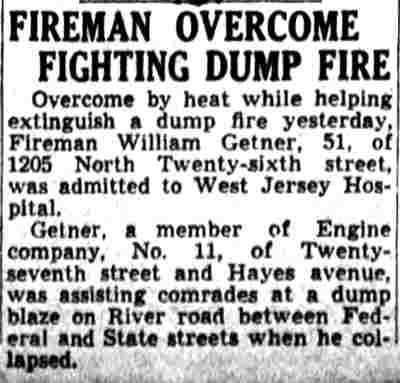
Fireman William Getner, 51, of 1205 North Twenty-sixth Street, a member of Engine Company No. 11, was overcome by heat on June 7, 1942, while fighting a dump fire on River Road between Federal and State Streets, and was admitted to West Jersey Hospital.
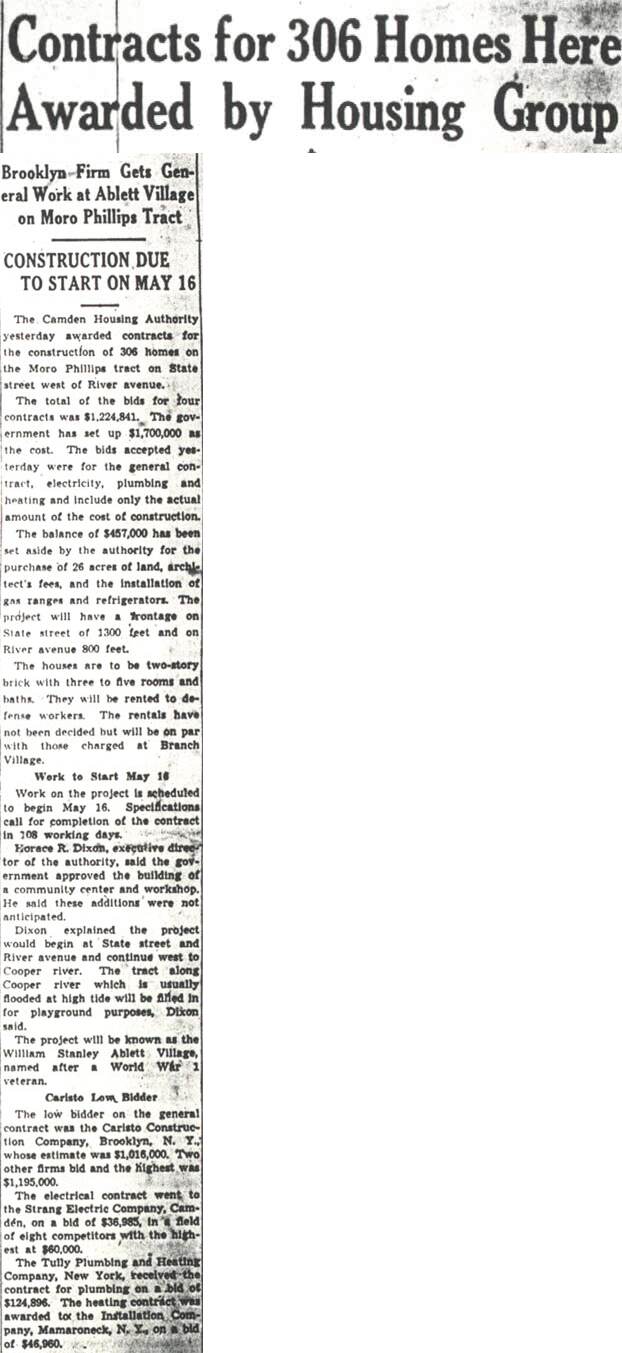
The Camden Housing Authority awarded four contracts totaling $1,224,841 for 306 homes on the Moro Phillips tract, to be known as the William Stanley Ablett Village. Camden Courier-Post, April 25, 1942.
A March 1942 account from "Housing in Camden" of how the Camden Housing Authority's third public housing project — a $1,409,000 development designated N.J. 10-2 — was funded, and how the rule was set that it be named for a Camden native killed in action.

The Camden Housing Authority announced U.S. Housing Authority approval of a $1,566,000 defense housing project of 306 units on the south side of East State Street between Cooper Creek and River Avenue. Camden Courier-Post, January 17, 1942.