Woodward on Trial for Coffin Murder
Philadelphia Inquirer, November 13, 1902
View transcription
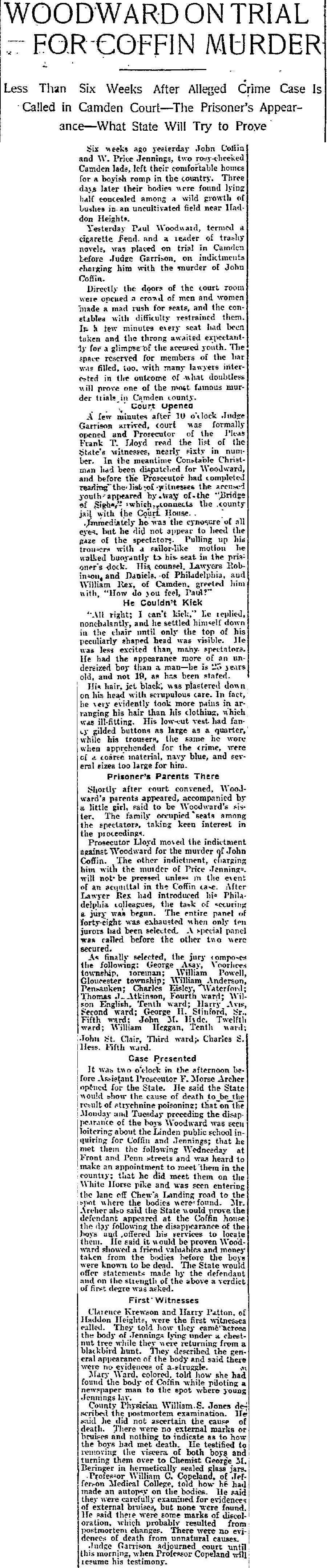
WOODWARD ON TRIAL FOR COFFIN MURDER
Less Than Six Weeks After Alleged Crime Case Is Called in Camden Court — The Prisoner's Appearance — What State Will Try to Prove
Six weeks ago yesterday John Coffin and W. Price Jennings, two rosy-cheeked Camden lads, left their comfortable homes for a boyish romp in the country. Three days later their bodies were found lying half concealed among a wild growth of bushes in an uncultivated field near Haddon Heights.
Yesterday Paul Woodward, termed a cigarette fiend and a reader of trashy novels, was placed on trial in Camden before Judge Garrison, on indictments charging him with the murder of John Coffin.
Directly the doors of the court room were opened a crowd of men and women made a mad rush for seats, and the constables with difficulty restrained them. In a few minutes every seat had been taken and the throng awaited expectantly for a glimpse of the accused youth. The space reserved for members of the bar was filled, too, with many lawyers interested in the outcome of what doubtless will prove one of the most famous murder trials in Camden county.
Court Opened
A few minutes after 10 o'clock Judge Garrison arrived, court was formally opened and Prosecutor of the Pleas Frank T. Lloyd read the list of the State's witnesses, nearly sixty in number. In the meantime Constable Christman had been dispatched for Woodward, and before the Prosecutor had completed reading the list of witnesses the accused youth appeared by way of the "Bridge of Sighs," which connects the county jail with the Court House.
Immediately he was the cynosure of all eyes, but he did not appear to heed the gaze of the spectators. Pulling up his trousers with a sailor-like motion he walked buoyantly to his seat in the prisoner's dock. His counsel, Lawyers Robinson and Daniels, of Philadelphia, and William Rex, of Camden, greeted him with, "How do you feel, Paul?"
He Couldn't Kick
"All right; I can't kick," he replied, nonchalantly, and he settled himself down in the chair until only the top of his peculiarly shaped head was visible. He was less excited than many spectators. He had the appearance more of an undersized boy than a man—he is 2[?] years old, and not 1[?], as has been stated.
His hair, jet black, was plastered down on his head with scrupulous care. In fact, he very evidently took more pains in arranging his hair than his clothing, which was ill-fitting. His low-cut vest had fancy gilded buttons as large as a quarter, while his trousers, the same he wore when apprehended for the crime, were of a coarse material, navy blue, and several sizes too large for him.
Prisoner's Parents There
Shortly after court convened, Woodward's parents appeared, accompanied by a little girl, said to be Woodward's sister. The family occupied seats among the spectators, taking keen interest in the proceedings.
Prosecutor Lloyd moved the indictment against Woodward for the murder of John Coffin. The other indictment, charging him with the murder of Price Jennings, will not be pressed unless in the event of an acquittal in the Coffin case. After Lawyer Rex had introduced his Philadelphia colleagues, the task of securing a jury was begun. The entire panel of forty-eight was exhausted when only ten jurors had been selected. A special panel was called before the other two were secured.
As finally selected, the jury composes the following: George Asay, Voorhees township, foreman; William Powell, Gloucester township; William Anderson, Pensauken; Charles Eisley, Waterford; Thomas J. Atkinson, Fourth ward; Wilson English, Tenth ward; Harry Avis, Second ward; George H. Stinford, Sr., Fifth ward; John M. Hyde, Twelfth ward; William Heggan, Tenth ward; John St. Clair, Third ward; Charles S. Hess, Fifth ward.
Case Presented
It was two o'clock in the afternoon before Assistant Prosecutor F. Morse Archer opened for the State. He said the State would show the cause of death to be the result of strychnine poisoning; that on the Monday and Tuesday preceding the disappearance of the boys Woodward was seen loitering about the Linden public school inquiring for Coffin and Jennings; that he met them the following Wednesday at Front and Penn streets and was heard to make an appointment to meet them in the country; that he did meet them on the White Horse pike and was seen entering the lane off Chew's Landing road to the spot where the bodies were found. Mr. Archer also said the State would prove the defendant appeared at the Coffin house the day following the disappearance of the boys and offered his services to locate them. He said it would be proven Woodward showed a friend valuables and money taken from the bodies before the boys were known to be dead. The State would offer statements made by the defendant and on the strength of the above a verdict of first degree was asked.
First Witnesses
Clarence Krewson and Harry Patton, of Haddon Heights, were the first witnesses called. They told how they came across the body of Jennings lying under a chestnut tree while they were returning from a blackbird hunt. They described the general appearance of the body and said there were no evidences of a struggle.
Mary Ward, colored, told how she had found the body of Coffin while piloting a newspaper man to the spot where young Jennings lay.
County Physician William S. Jones described the postmortem examination. He said he did not ascertain the cause of death. There were no external marks or bruises and nothing to indicate as to how the boys had met death. He testified to removing the viscera of both boys and turning them over to Chemist George M. Beringer in hermetically sealed glass jars.
Professor William C. Copeland, of Jefferson Medical College, told how he had made an autopsy on the bodies. He said they were carefully examined for evidences of external bruises, but none were found. He said there were some marks of discoloration, which probably resulted from postmortem changes. There were no evidences of death from unnatural causes.
Judge Garrison adjourned court until this morning, when Professor Copeland will resume his testimony.
Advertisement