
Streets
Sycamore Street
Sycamore Street is one of Camden's "tree" streets, originally running east from Front Street to Haddon Avenue; its intersections at 7th, 8th and Louis Streets were hubs for different ethnic and cultural communities.
Tag
Sycamore Street is one of Camden's "tree" streets, originally running east from Front Street to Haddon Avenue; its intersections at 7th, 8th and Louis Streets were hubs for different ethnic and cultural communities.
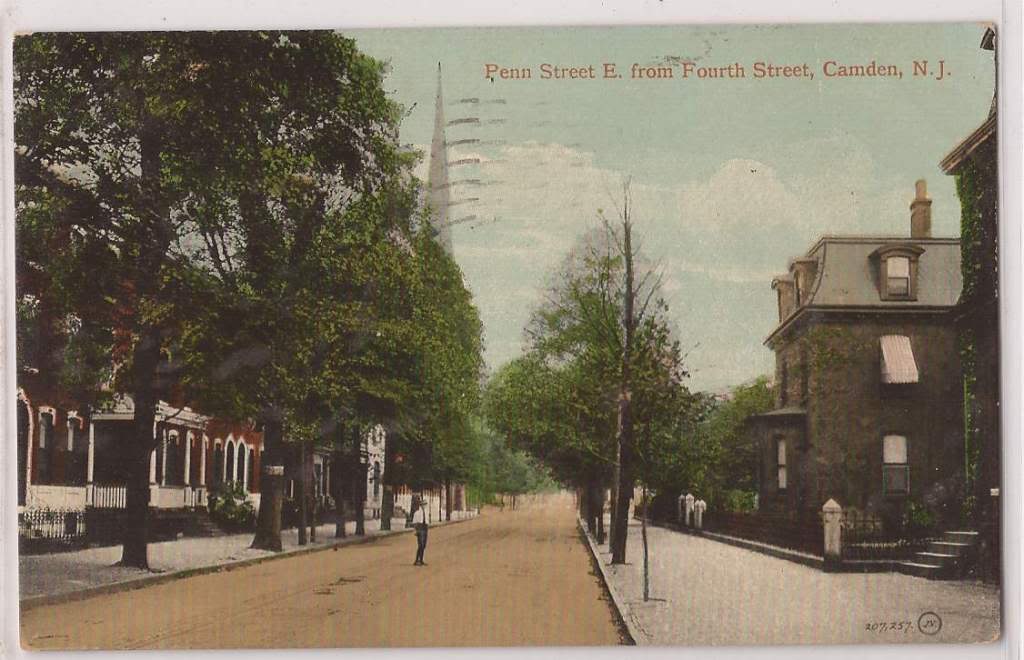
Penn Street runs east from the Delaware River to North 12th Street in Camden. First listed in the 1867 city directory, it lost blocks to the expansion of Rutgers University and the building of Route 676.

Charles Grant Garrison was born in Swedesboro, New Jersey, on August 3, 1849. He was the son of Rev. Joseph Fithian Garrison and had three younger brothers: Lindley, William, and Joseph.

LINDLEY MILLER GARRISON was born on November 28, 1864, in Camden, New Jersey, the son of the Rev. Jospeh Fithian Garrison. He had three older brothers, Charles G., William, and Joseph.
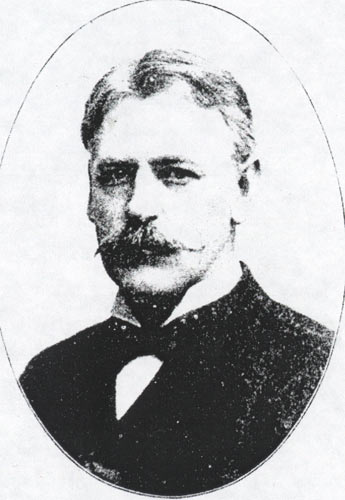
Frank T. Lloyd (1859–1951) was a Camden printer turned lawyer who served in the New Jersey Assembly, as Camden County Prosecutor, as a Circuit Court judge from 1906 and as a New Jersey Supreme Court Justice from 1924 until his retirement in 1938.
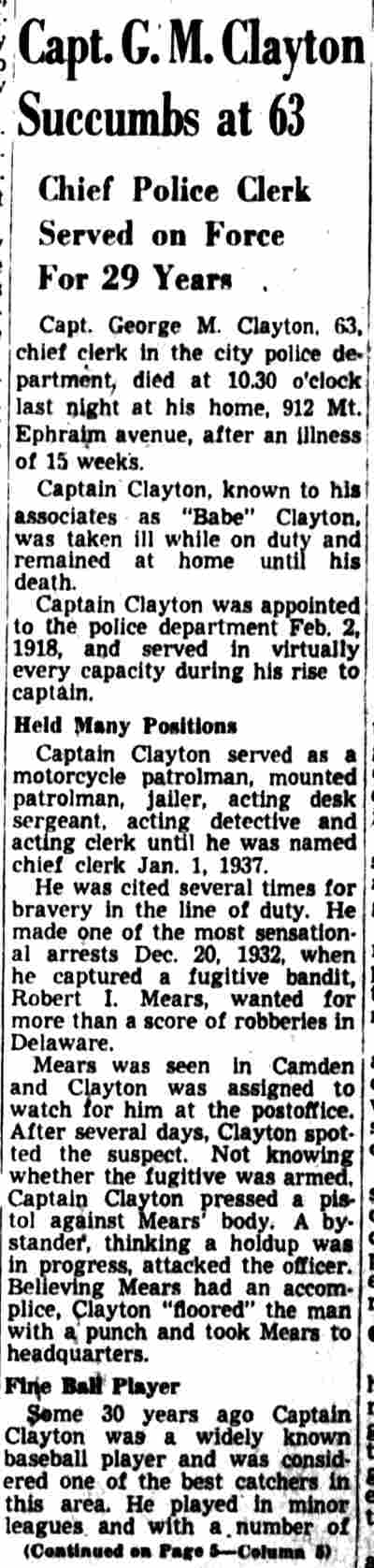
Courier-Post obituary of Capt. George M. "Babe" Clayton, 63, chief clerk of the Camden police department, who served on the force 29 years; funeral at Joseph H. Murray and Son, 408 Cooper Street.
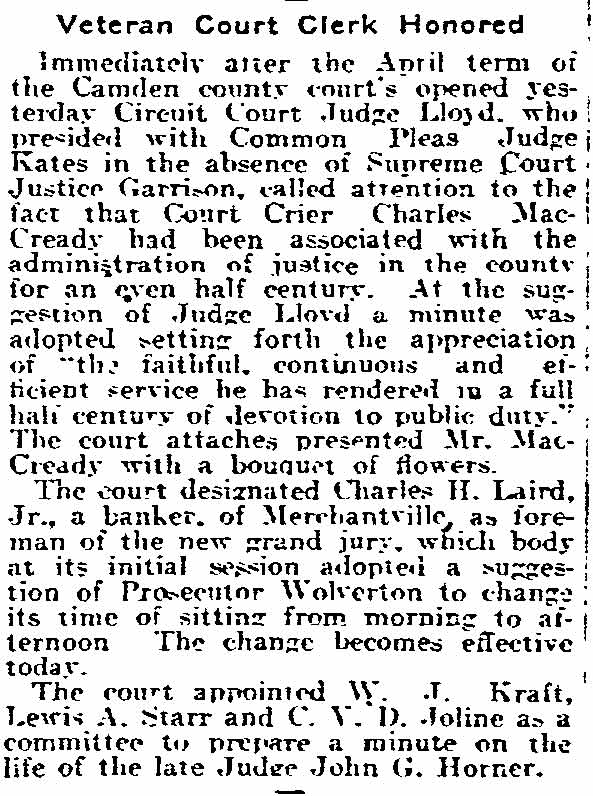
Immediately after the April term of the Camden county courts opened yesterday, Circuit Court Judge Lloyd, who presided with Common Pleas Judge Kates in the absence of Supreme Court Justice Garrison, called attention to the fact that Court Crier Charles MacCready had been associated with the administration of justice in the county for an even half century.
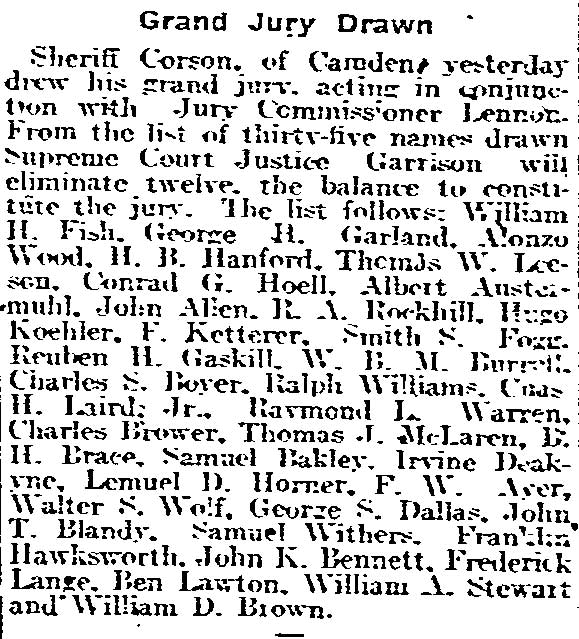
Sheriff Corson, of Camden, yesterday drew his grand jury, acting in conjunction with Jury Commissioner Lennox. From the list of thirty-five names drawn Supreme Court Justice Garrison will eliminate twelve, the balance to constitute the jury.
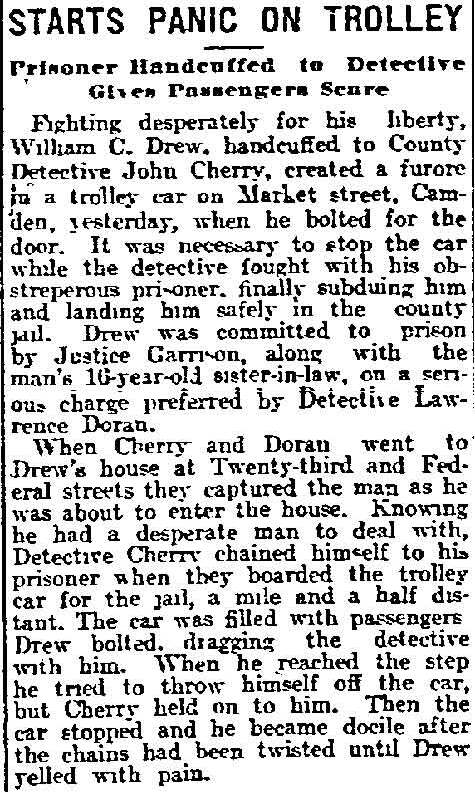
William C. Drew, handcuffed to County Detective John Cherry, bolted for the door of a crowded Market street trolley car in Camden after his capture at Twenty-third and Federal streets; the car was stopped while the detective subdued him and took him to the county jail.

A Camden County grand jury returned fifty-five true bills for alleged election irregularities in January 1911; John H. Carroll was among those accused of violations.
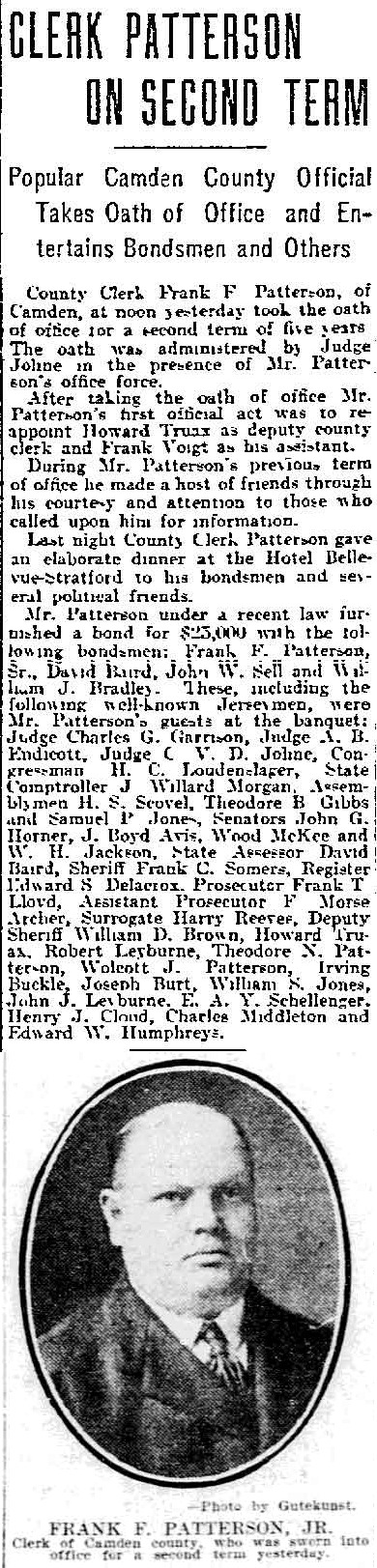
Camden County Clerk Frank F. Patterson took the oath of office for a second five-year term and that night gave a dinner at the Hotel Bellevue-Stratford for his bondsmen and political friends, among them Prosecutor Frank T. Lloyd.
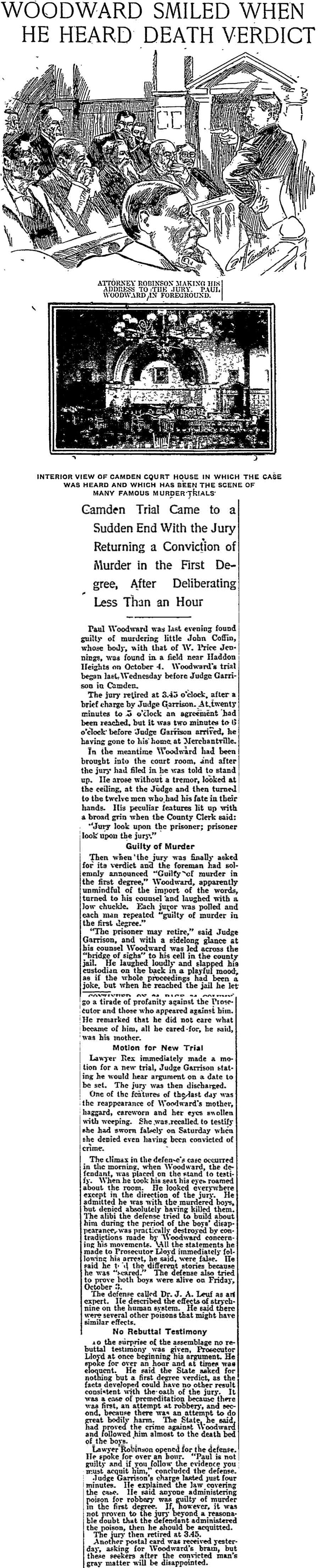
Paul Woodward smiled when a Camden jury, after deliberating less than an hour, found him guilty of first-degree murder in the poisoning of little John Coffin, following Prosecutor Lloyd's argument and Judge Garrison's four-minute charge.
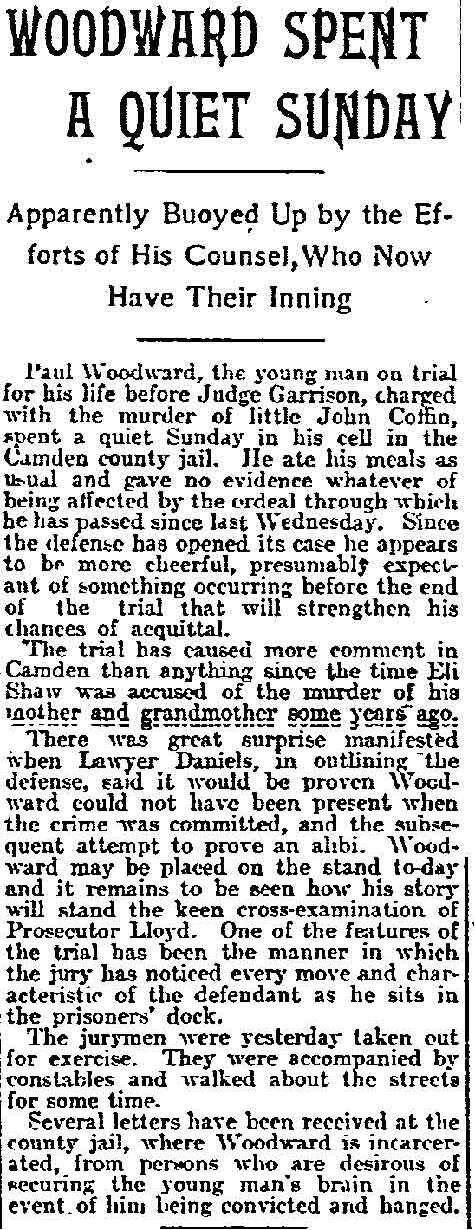
Philadelphia Inquirer, November 17, 1902: Paul Woodward, on trial in Camden for the murder of John Coffin, spent a quiet Sunday in the county jail while the defense opened its case.

At the Camden murder trial of Paul Woodward, a drug clerk testifies to selling him strychnine and jail inmate David J. Horgan tells of a confession, while relatives of John Coffin and W. Price Jennings give damaging testimony.
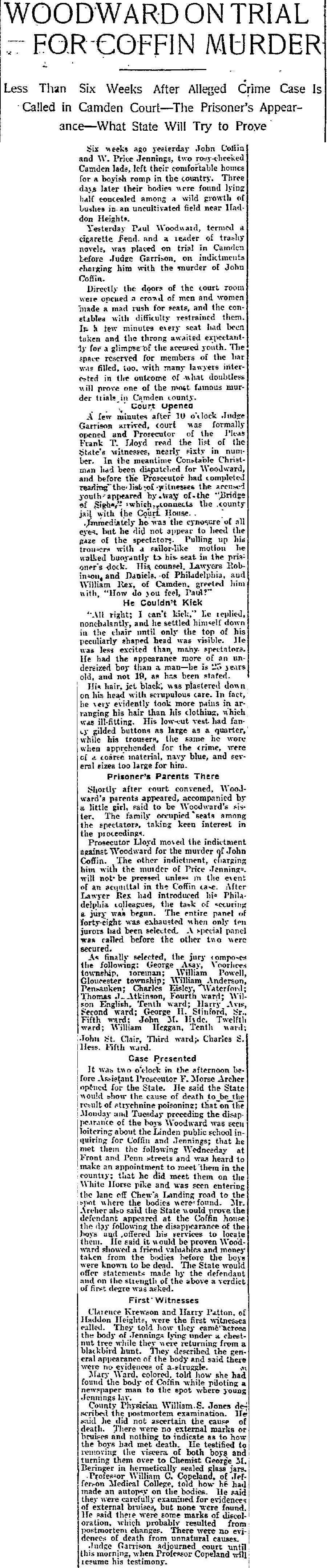
Philadelphia Inquirer, November 13, 1902: Paul Woodward is placed on trial in Camden for the murder of John Coffin, with Prosecutor Frank T. Lloyd and Assistant Prosecutor F. Morse Archer opening for the State.
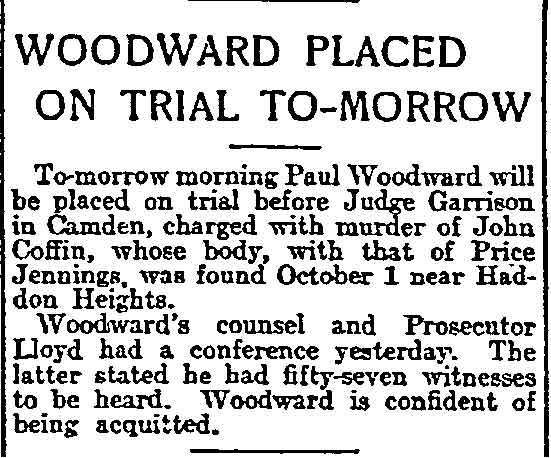
Philadelphia Inquirer, November 11, 1902: Paul Woodward is to be placed on trial in Camden for the murder of John Coffin, and Prosecutor Lloyd has fifty-seven witnesses.
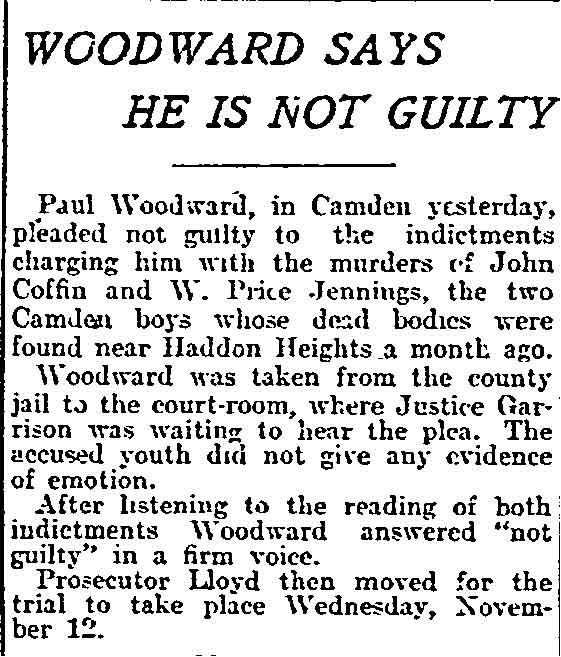
Philadelphia Inquirer, November 1, 1902: Paul Woodward pleads not guilty in Camden to the indictments for the murders of John Coffin and W. Price Jennings.
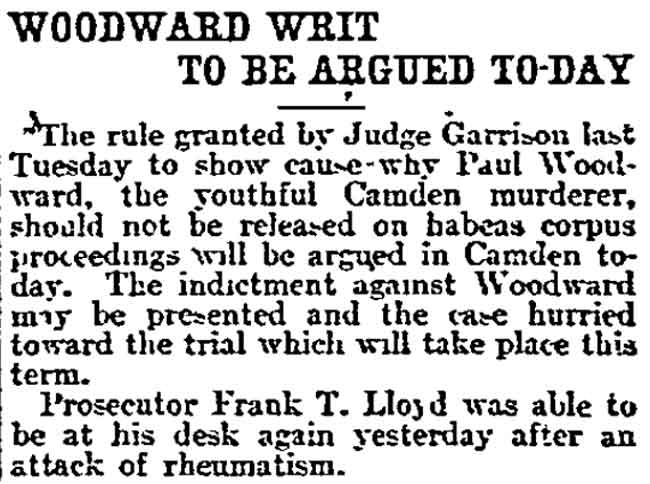
Philadelphia Inquirer, October 24, 1902: the habeas corpus rule granted by Judge Garrison for Paul Woodward is to be argued in Camden, and Prosecutor Frank T. Lloyd returns to his desk after an attack of rheumatism.
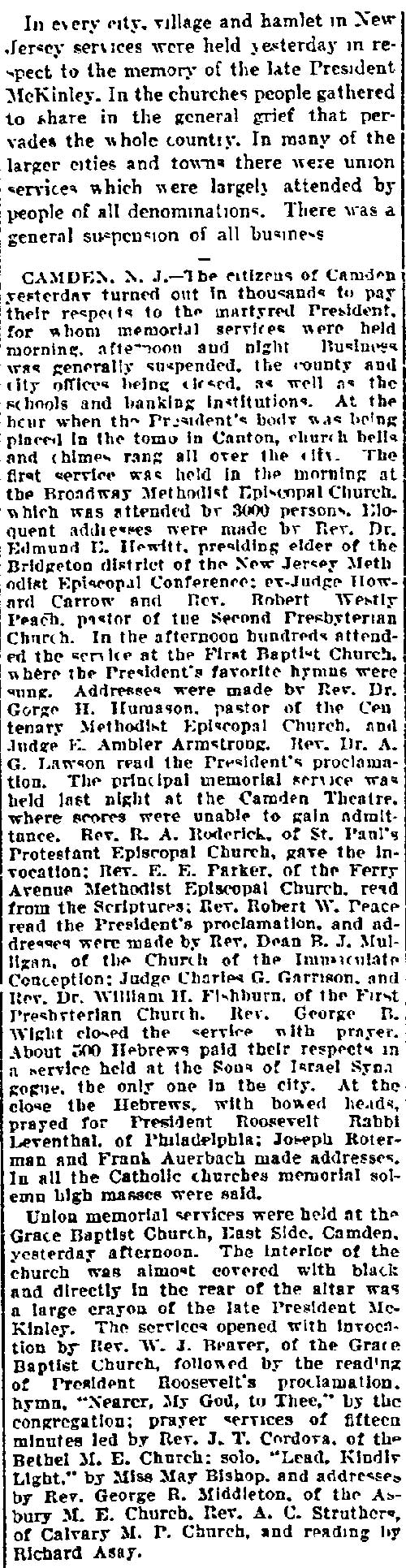
Camden held memorial services for President McKinley morning, afternoon and night, and about 500 Hebrews paid their respects at the Sons of Israel Synagogue, with addresses by Rabbi Leventhal, Joseph Roterman and Frank Auerbach.

Francisco Abbatto, convicted of the murder of Genaro DeFeo near Blue Anchor, was hanged at the Camden County Jail on May 10, 1900, the first hanging conducted by Sheriff John Wesley Sell; the gallows stood in the loft at the Broadway and Federal streets corner of the building.
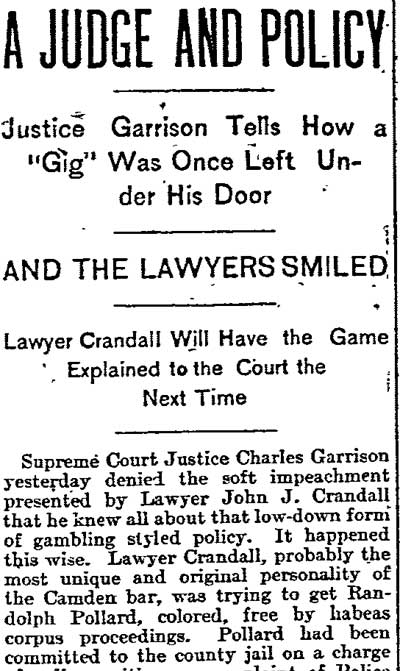
Supreme Court Justice Charles Garrison denied Lawyer John J. Crandall's suggestion that he understood the game of policy, during habeas corpus proceedings for Randolph Pollard, committed on Captain Stanley's complaint.

Nicholas Theodore Lambert was hanged in the Camden County Jail on December 19, 1895, for the murder of cracker baker William G. Kairer, protesting to the end that Josiah Stevens fired the fatal shot.
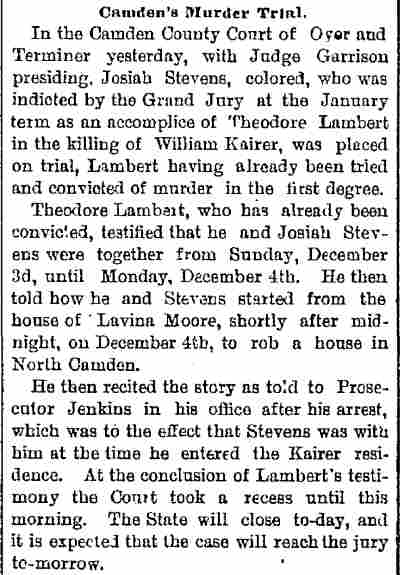
Trenton Evening Times, September 26, 1894: Josiah Stevens is tried in the Camden County Court of Oyer and Terminer as an accomplice of Theodore Lambert in the killing of William Kairer.