Josiah Matlack
Josiah Matlack served as Chief of Police of Camden from 1880 to 1886. Born in Lancaster, Pennsylvania in 1830, he came to Camden as a young man, served on City Council, and was appointed police chief by Mayor Claudius W. Bradshaw.

Tag

Josiah Matlack served as Chief of Police of Camden from 1880 to 1886. Born in Lancaster, Pennsylvania in 1830, he came to Camden as a young man, served on City Council, and was appointed police chief by Mayor Claudius W. Bradshaw.
Clement T. Branch (1869-1933), Camden physician and civil rights leader, was the first Black member of the city's Board of Education.

Camden Chief of Police Arthur Colsey, a 27-year veteran of the department, died of a heart attack in his sleep at his home at 2937 Stevens Street. The Courier-Post traced his career from merchant at Ninth and Market streets and Second Ward councilman to patrolman in 1912 and permanent chief in 1934.

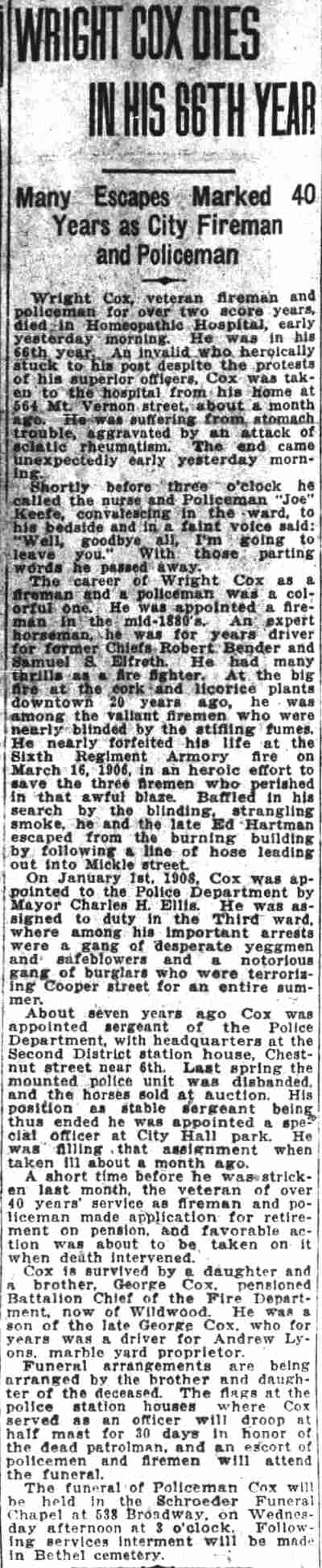
Wright Cox, a Camden fireman and policeman for more than 40 years, died in Homeopathic Hospital in his 66th year. His funeral was set for the Schroeder Funeral Chapel at 538 Broadway, with interment in Bethel Cemetery.

Hundreds lined the streets and firehouse bells tolled as the cortege of Captain Martin B. Carrigan passed through Camden to Arlington Cemetery, escorted by ninety-two firemen under Chief Peter B. Carter.
Camden's municipal buildings, police stations and firehouses were draped in mourning for Captain Martin Carrigan, who died of injuries received fighting the Kaighn Avenue fire; city council voted to pay the expense of his funeral.
Captain Martin B. Carrigan of Engine Company No. 2 died at Cooper Hospital of a fractured skull and severe burns received while leading his men at the Economy Store fire on Kaighn Avenue.

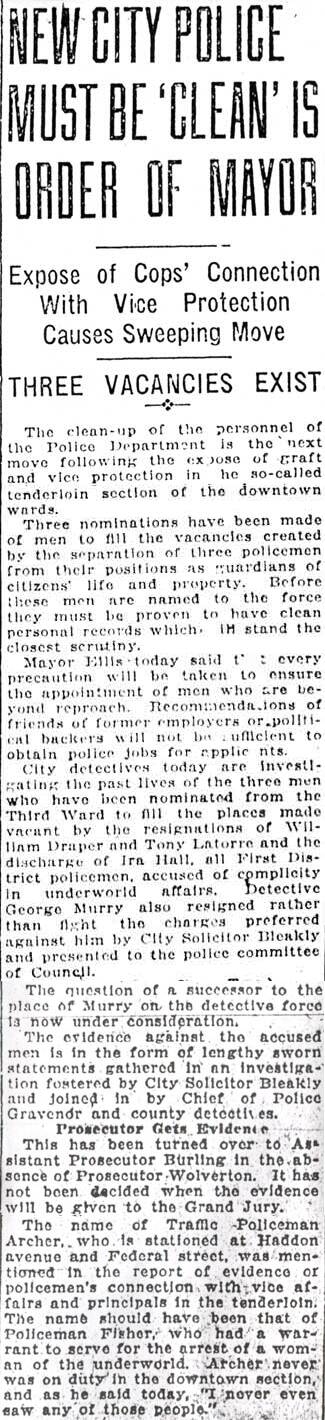
The Camden Courier of January 13, 1922 reports Mayor Ellis's order that new policemen must have clean records after the expose of graft and vice protection in the downtown tenderloin, which cost Policemen William Draper, Tony Latorre and Ira Hall their places and led Detective George Murry to resign.

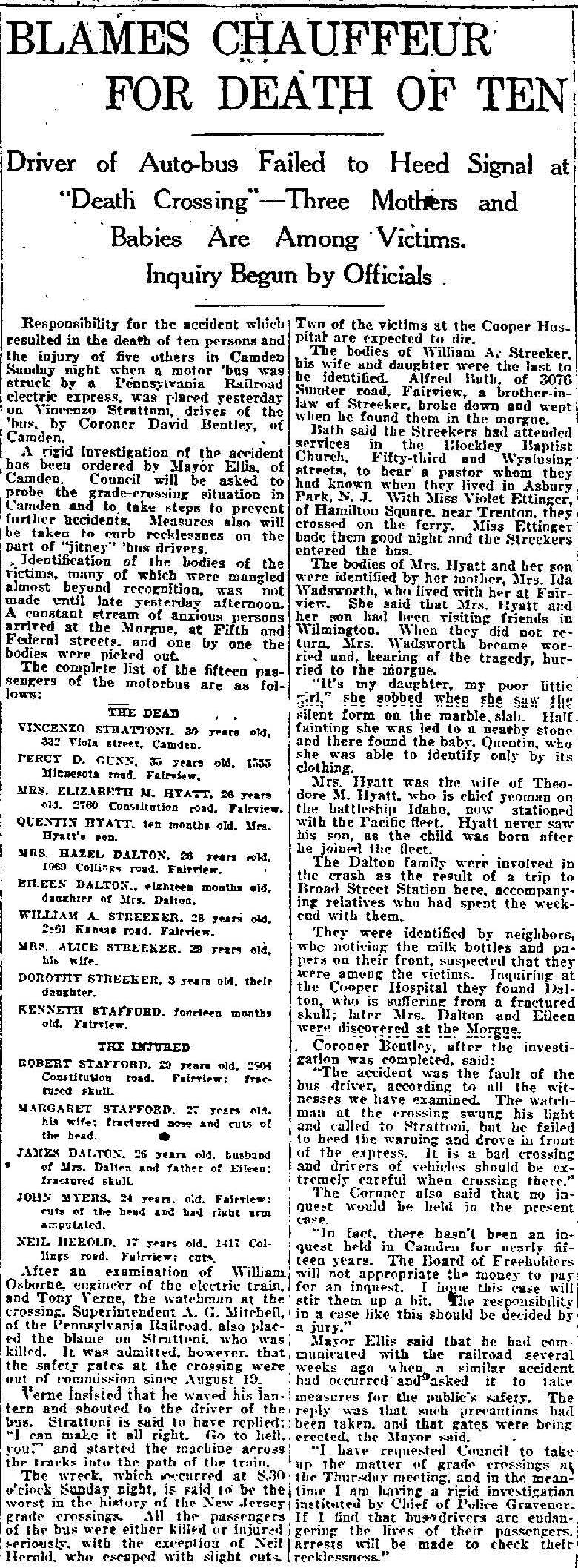
Coroner David Bentley blamed jitney driver Vincenzo Strattoni of 332 Viola Street for the Camden grade-crossing wreck in which a Pennsylvania Railroad express struck his motor bus, killing ten and injuring five; Mayor Ellis ordered an investigation.

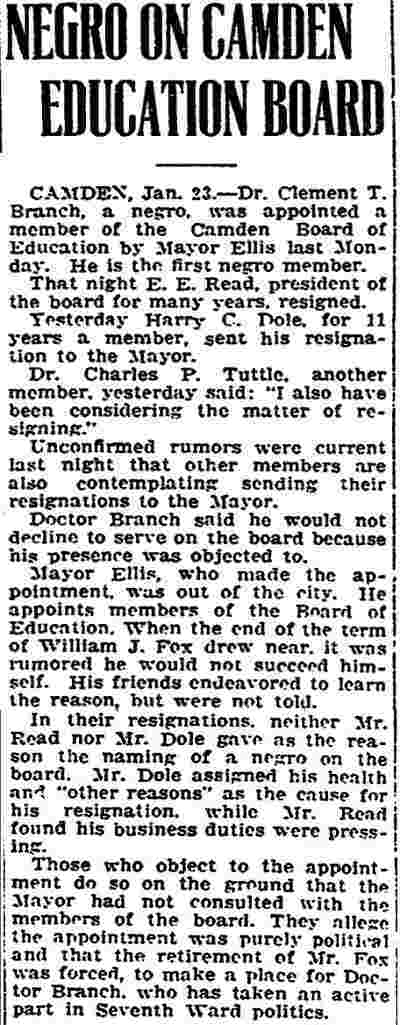
Dr. Clement T. Branch was appointed to the Camden Board of Education by Mayor Ellis in January 1920, its first negro member; board president E. E. Read and member Harry C. Dole resigned within days.

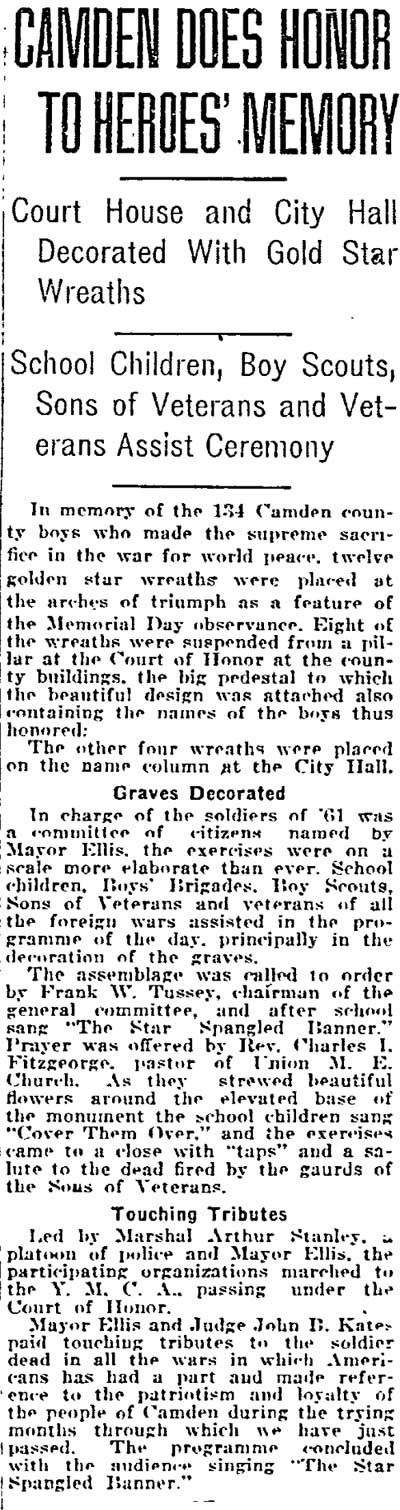
Camden's 1919 Memorial Day observance placed twelve gold star wreaths for the 134 county men who died in the war. Marshal Arthur Stanley led a platoon of police and Mayor Ellis in the march to the Y.M.C.A. under the Court of Honor.

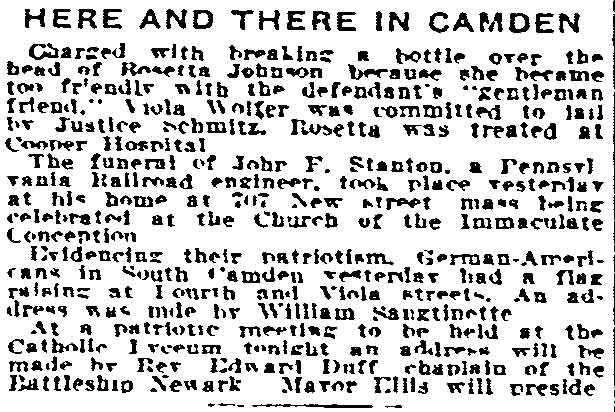
Philadelphia Inquirer Camden briefs of May 29, 1917: a woman jailed for breaking a bottle over another's head, a railroad engineer's funeral, a German-American flag raising at Fourth and Viola Streets with an address by William Sangtinette, and a patriotic meeting.

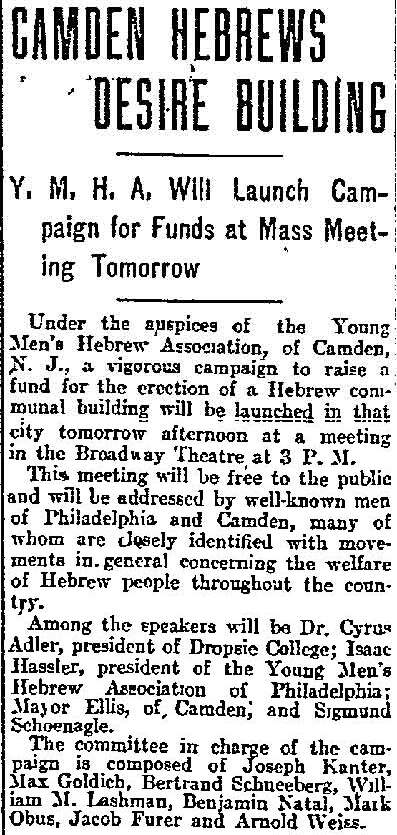
The Young Men's Hebrew Association of Camden planned to launch a campaign to fund a Hebrew communal building at a free public meeting in the Broadway Theatre, with speakers including Dr. Cyrus Adler, Isaac Hassler, Mayor Ellis and Sigmund Schoenagle.

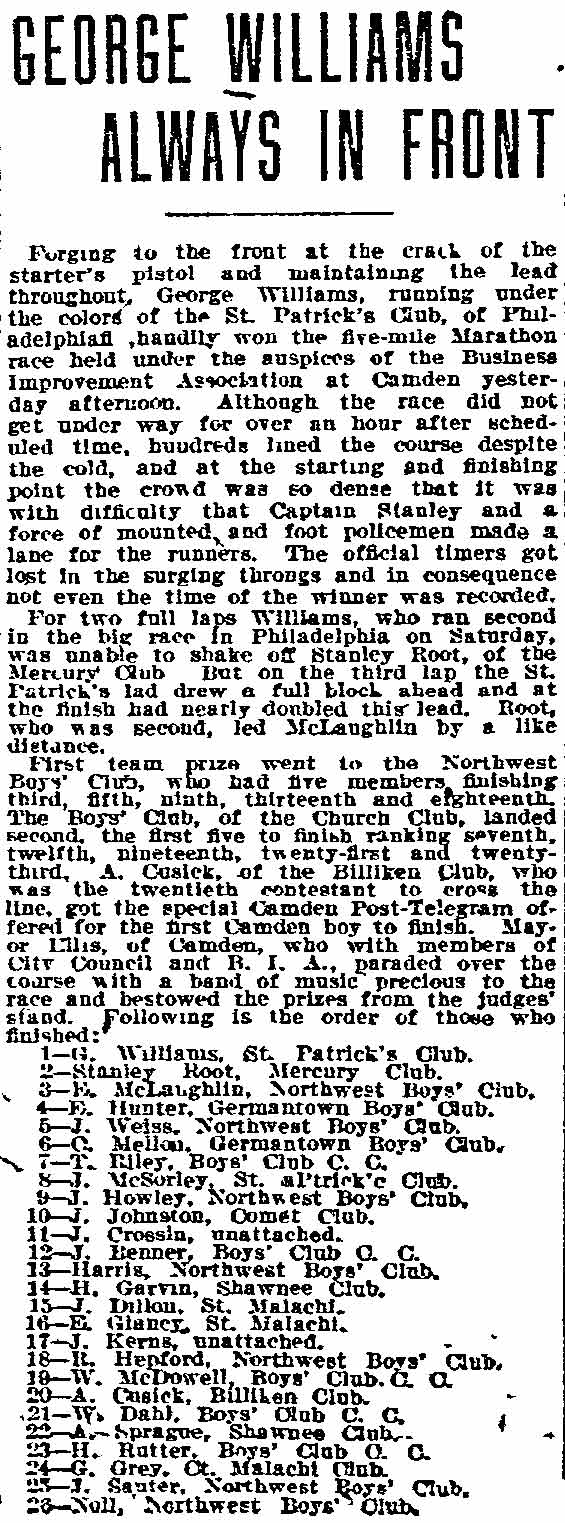
George Williams of Philadelphia's St. Patrick's Club won the five-mile Marathon race staged in Camden by the Business Improvement Association. Captain Stanley and a force of mounted and foot policemen struggled to open a lane through the dense crowd for the runners.

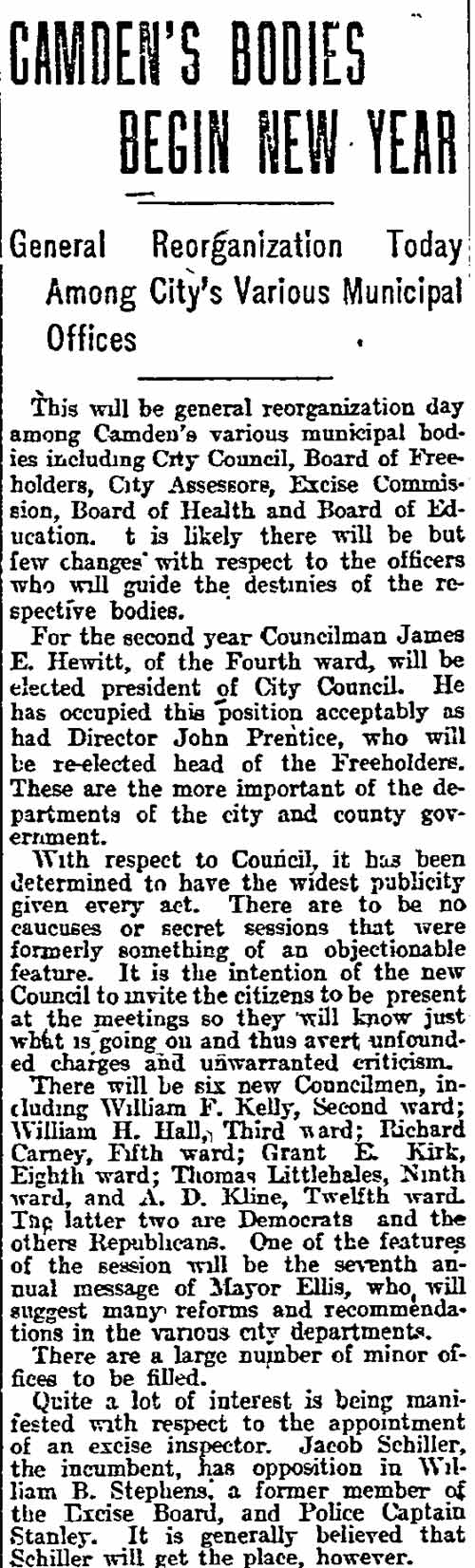
Camden's municipal bodies reorganized for 1912 with James E. Hewitt returning as Council president. Police Captain Stanley was among those in contention for the post of excise inspector.

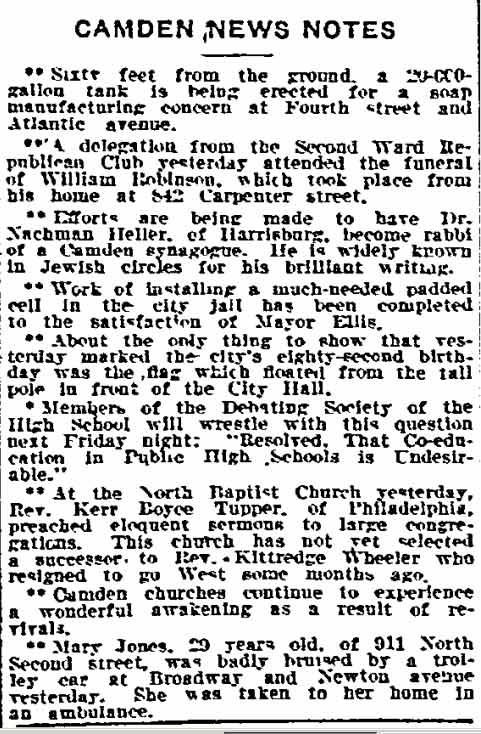
Camden briefs for February 14, 1910, including efforts to bring Dr. Nachman Heller of Harrisburg to a Camden synagogue as rabbi, a new padded cell in the city jail, and Mary Jones of 911 North Second Street bruised by a trolley car at Broadway and Newton Avenue.

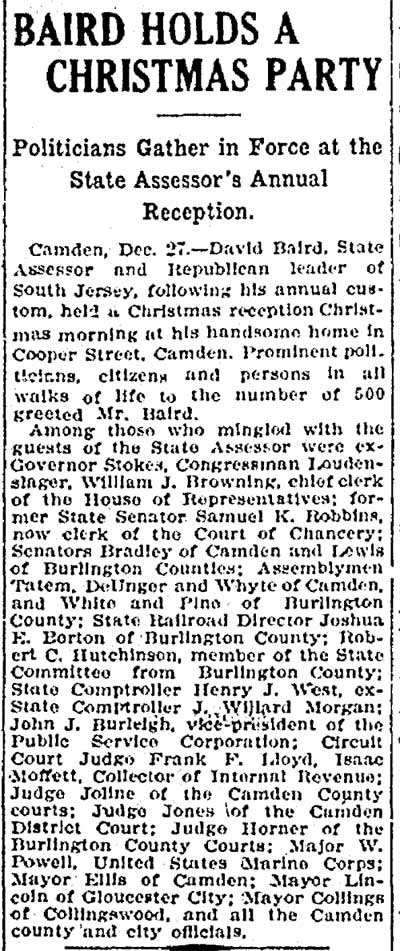
David Baird, State Assessor and Republican leader of South Jersey, following his annual custom, held a Christmas reception Christmas morning at his handsome home in Cooper Street, Camden. Prominent politicians, citizens and persons in all walks of life to the number of 500 greeted Mr. Baird.

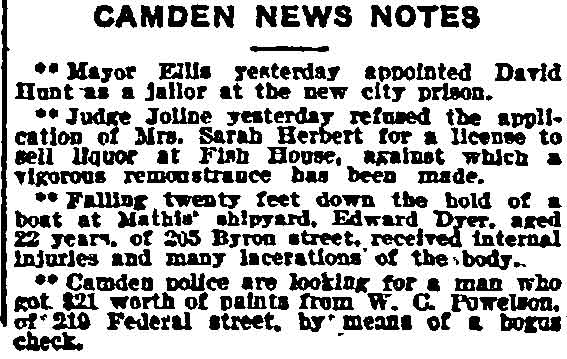
Edward Dyer, 22, of 205 Byron Street, was seriously injured after falling twenty feet into the hold of a boat at Mathis' shipyard.

A mixing-tank explosion touched off a disastrous fire that swept the N.Z. Graves Paint and Varnish Company plant on Twelfth Street, Camden, between Linden and Federal streets — destroying more than half a million dollars in property, injuring three, and driving families from their homes. (Philadelphia Inquirer, February 18, 1908.)

City on Saint Valentine's Day, Will Observe the Anniversary of Its Incorporation—Some Facts and Figures Concerning "Slow Town" Across the River Eighty years will have passed on Friday, February 14, since Camden became an incorporated city, and just now the citizens are looking back over those years and recalling with a pardonable pride the epochs that have made it a community of homes, of splendid industries and of clean, progressive government.

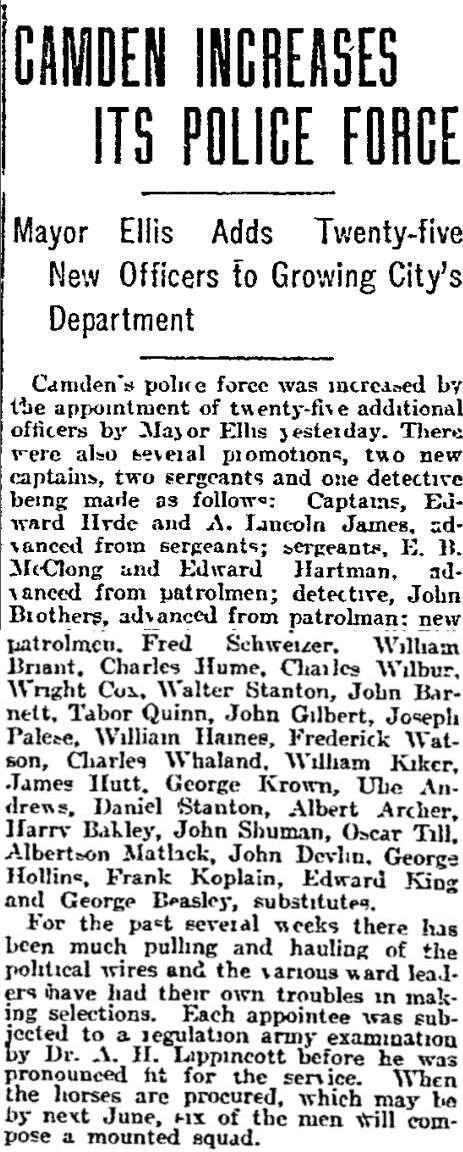
Mayor Ellis adds twenty-five officers to the Camden police force and orders several promotions, elevating Edward Hyde and A. Lincoln James from sergeants to captains.

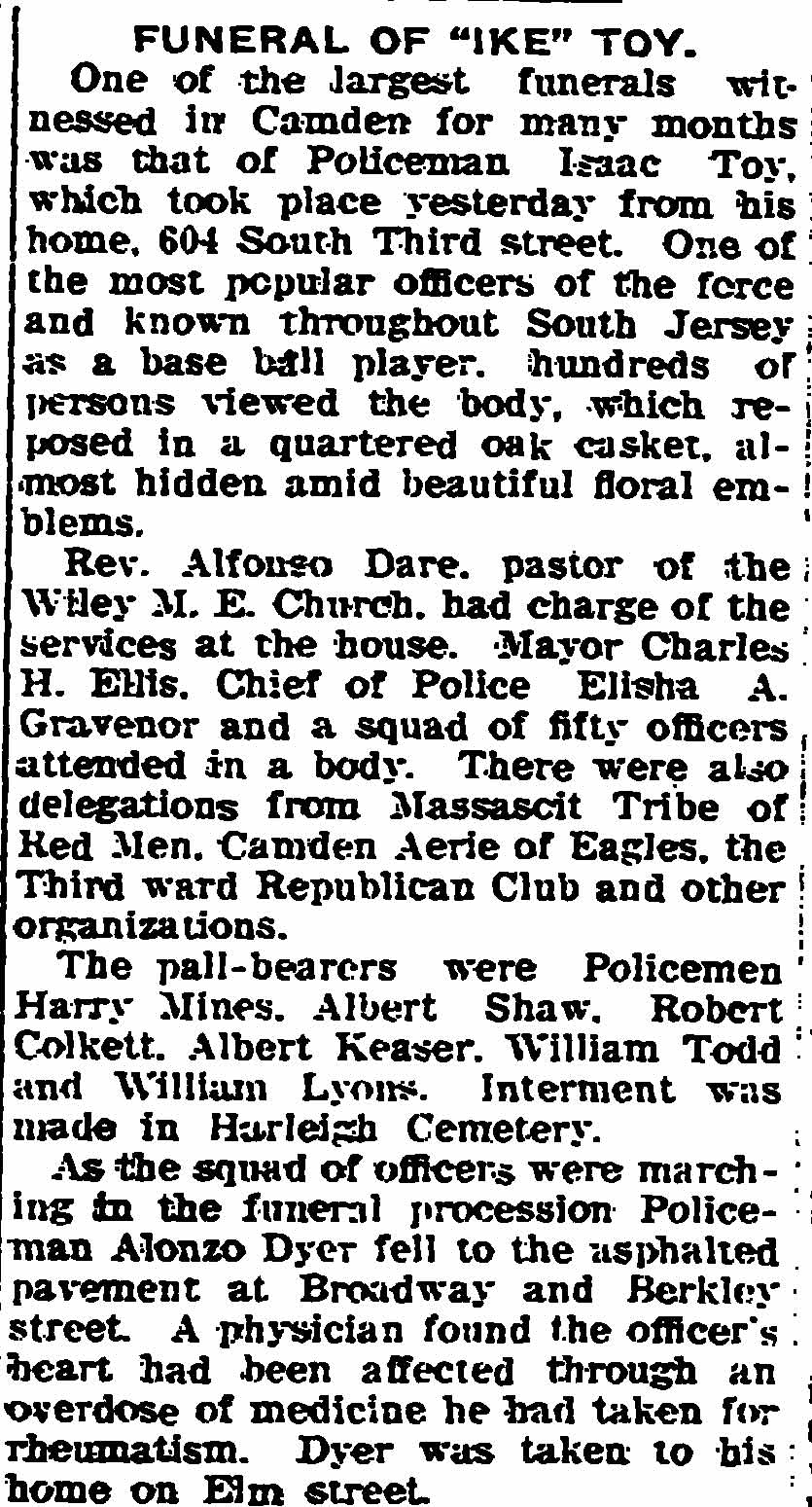
The Bridgeton Evening News describes the funeral of Camden Policeman Isaac "Ike" Toy, held from his home at 604 South Third Street and attended by Mayor Charles H. Ellis, Chief of Police Elisha A. Gravenor and fifty officers, with interment in Harleigh Cemetery. During the procession Policeman Alonzo Dyer collapsed at Broadway and Berkley Street.

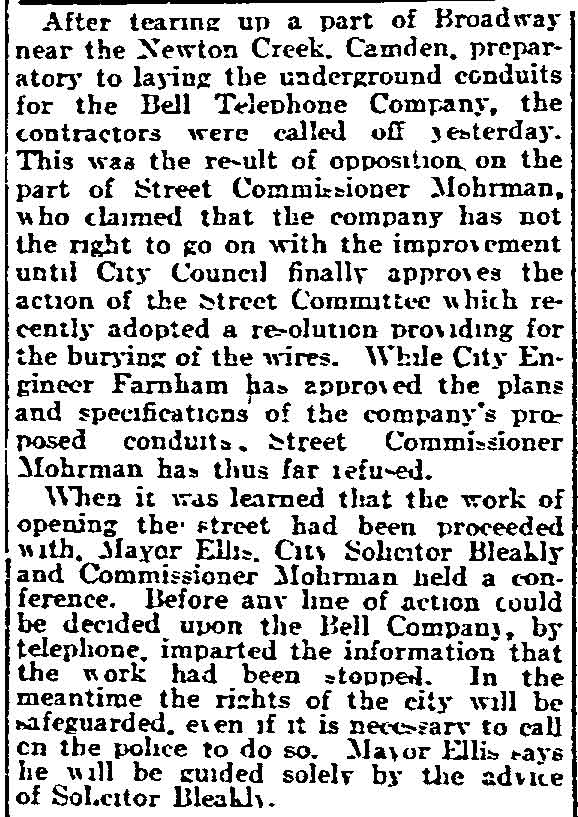
Contractors tearing up Broadway near the Newton Creek to lay underground conduits for the Bell Telephone Company were called off after Street Commissioner Mohrman objected that City Council had not yet approved the burying of the wires.

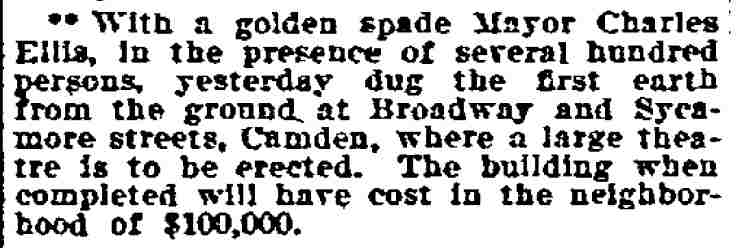
With a golden spade, Mayor Charles Ellis dug the first earth at Broadway and Sycamore streets, Camden, where a large theatre costing about $100,000 was to be erected.

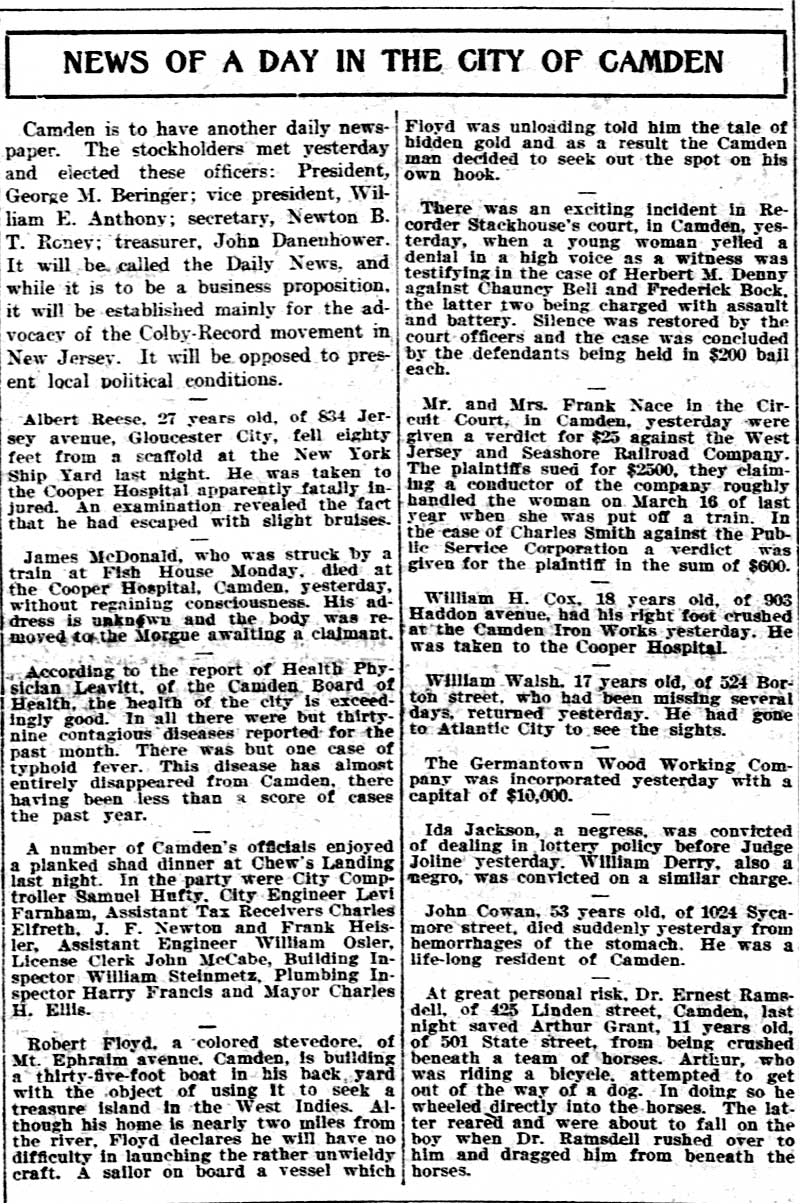
A Philadelphia Inquirer column of Camden news for May 16, 1906, including a planked shad dinner at Chew's Landing attended by Mayor Charles H. Ellis and city officials, plans for a new daily newspaper, and Dr. Ernest Ramsdell's rescue of a boy from beneath a team of horses.

Three firemen — George Shields, William Hillman, and William Jobes — are killed and nine people injured when fire destroys the old Sixth Regiment Armory in Camden.

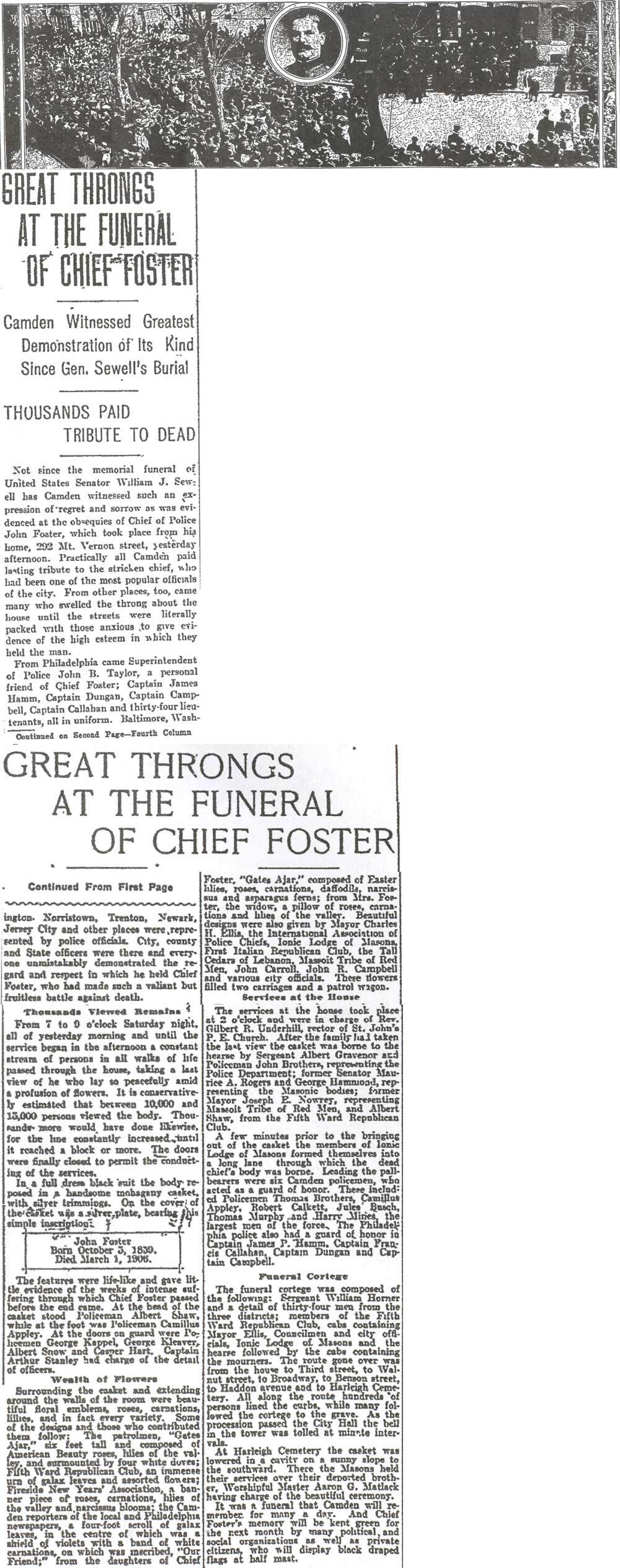
Thousands attended the funeral of Camden Chief of Police John Foster in March 1906; among the donors of floral tributes was John Carroll.

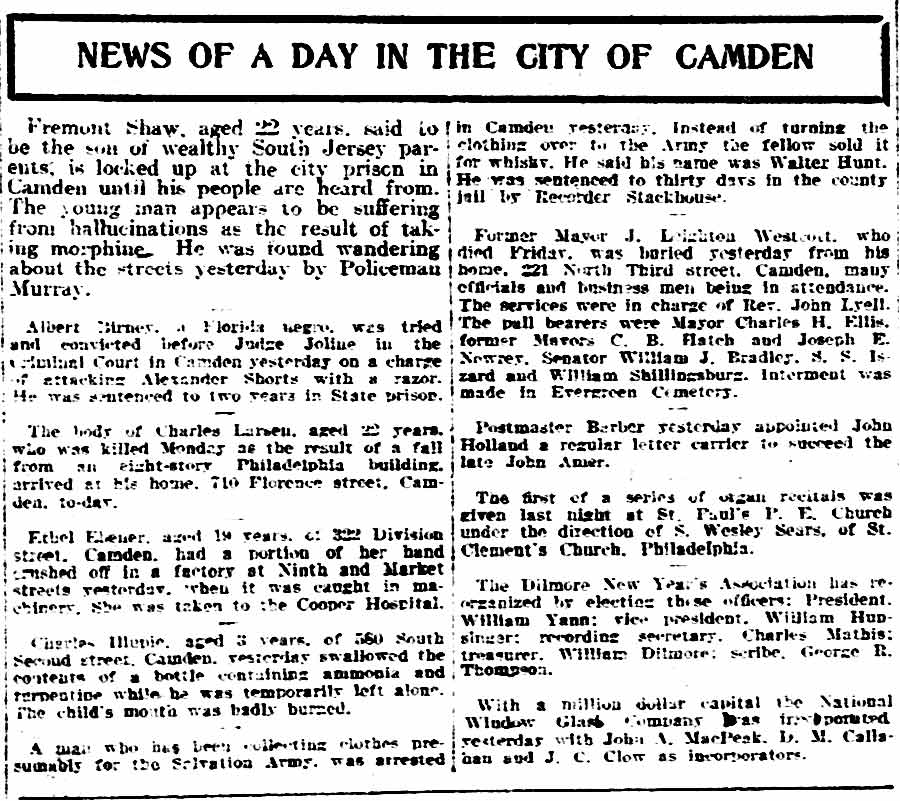
A Philadelphia Inquirer column of Camden news for January 17, 1906, including the burial of former Mayor J. Leighton Westcott from his home at 221 North Third Street, and a girl's hand crushed in factory machinery at Ninth and Market Streets.

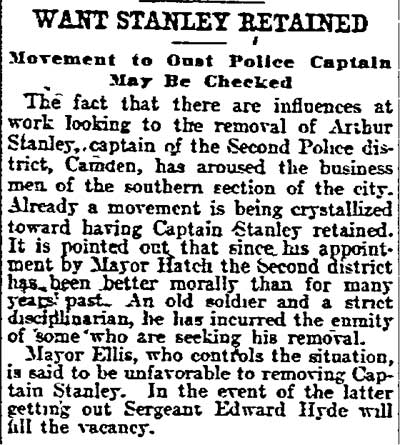
Business men of southern Camden move to block the removal of Police Captain Arthur Stanley; were he ousted, Sergeant Edward Hyde would fill the vacancy.

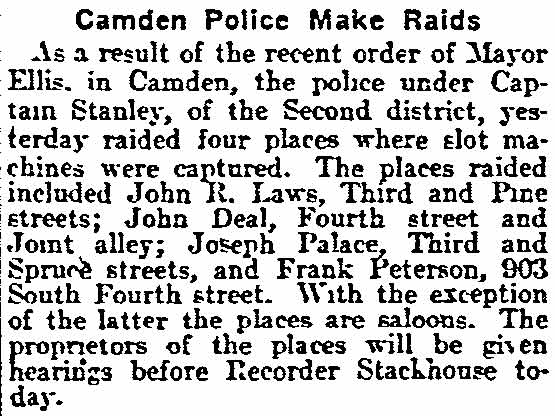
Acting on Mayor Ellis's recent order, police under Captain Stanley raided four Camden places and seized slot machines; the proprietors were to be heard before Recorder Stackhouse.

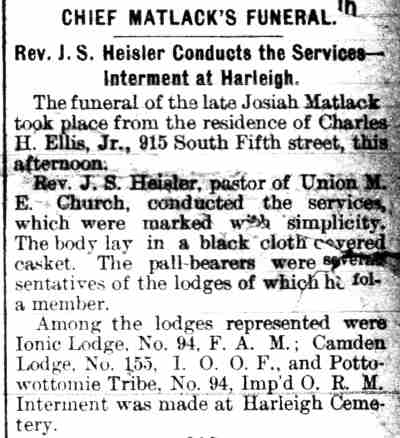
The August 26, 1896 Camden Daily Courier account of Josiah Matlack's funeral at the residence of Charles H. Ellis, Jr., conducted by Rev. J. S. Heisler with lodge representatives as pall-bearers and interment at Harleigh Cemetery.

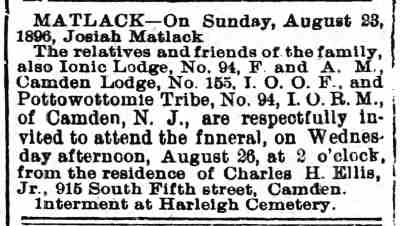
The August 25, 1896 funeral notice for Josiah Matlack, inviting relatives and members of Ionic Lodge No. 94, Camden Lodge No. 155, and Pottowottomie Tribe to services at the residence of Charles H. Ellis, Jr., 915 South Fifth Street, with interment at Harleigh Cemetery.

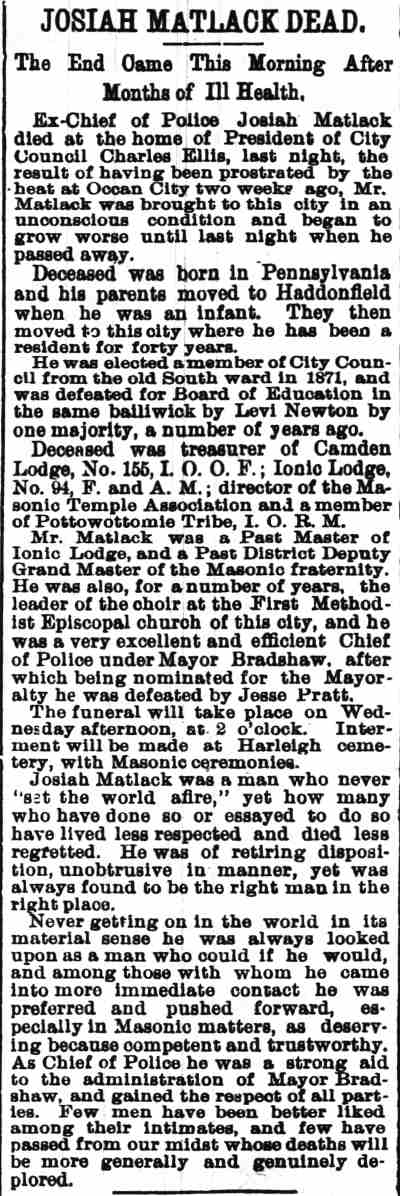
The August 24, 1896 Camden Post obituary of ex-Chief of Police Josiah Matlack, who died at the home of City Council President Charles Ellis after being prostrated by heat at Ocean City. It recounts his Council service, Masonic and fraternal memberships, and his tenure as chief under Mayor Bradshaw.
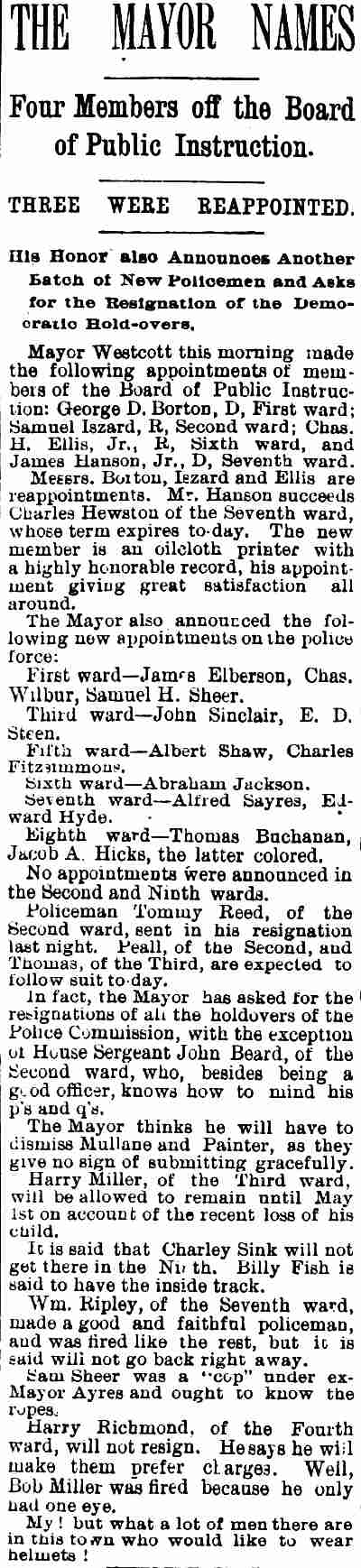
Mayor Westcott announces four members of the Board of Public Instruction and a fresh batch of new policemen, including Edward Hyde of the Seventh Ward, while asking Democratic holdovers to resign.

The Camden Daily Telegram's account of Mayor Westcott's appointments to the Board of Commissioners of Instruction and the police force, including Edward Hyde of the Seventh Ward, followed by a column of political notes.