Motorization of Camden Fire Department Completed Under Chief P. B. Carter in 1915
Camden Courier-Post, October 12, 1936
View transcription
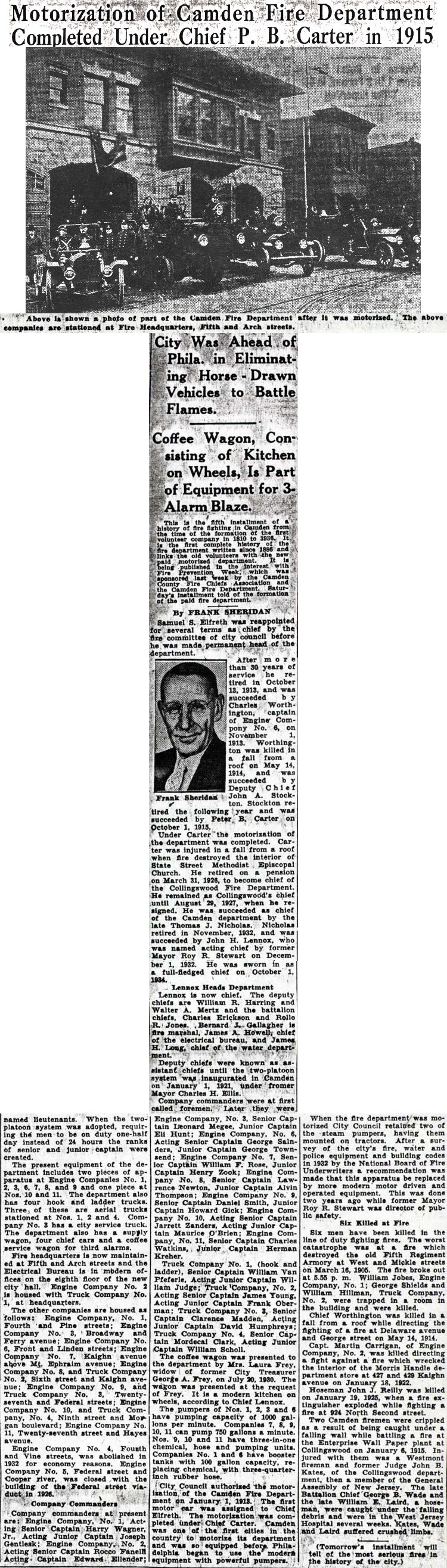
Motorization of Camden Fire Department Completed Under Chief P. B. Carter in 1915
Above is shown a photo of part of the Camden Fire Department after it was motorized. The above companies are stationed at Fire Headquarters, Fifth and Arch streets.
City Was Ahead of Phila. in Eliminating Horse-Drawn Vehicles to Battle Flames.
Coffee Wagon, Consisting of Kitchen on Wheels, Is Part of Equipment for 3-Alarm Blaze.
This is the fifth installment of a history of fire fighting in Camden from the time of the formation of the first volunteer company in 1810 to 1936. It is the first complete history of the fire department written since 1886 and links the old volunteers with the new paid motorized department. It is being published in the interest with Fire Prevention Week, which was sponsored last week by the Camden County Fire Chiefs Association and the Camden Fire Department. Saturday's installment told of the formation of the paid fire department.
By FRANK SHERIDAN
Samuel S. Elfreth was reappointed for several terms as chief by the fire committee of city council before he was made permanent head of the department.
Frank Sheridan
After more than 30 years of service he retired in October 13, 1913, and was succeeded by Charles Worthington, captain of Engine Compony No. 6, on November 1, 1913. Worthington was killed in a fall from a roof on May 14, 1914, and was succeeded by Deputy Chief John A. Stockton. Stockton retired the following year and was succeeded by Peter B. Carter on October 1, 1915.
Under Carter the motorization of the department was completed. Carter was injured in a fall from a roof when fire destroyed the interior of State Street Methodist Episcopal Church. He retired on a pension on March 31, 1926, to become chief of the Collingswood Fire Department. He remained as Collingswood's chief until August 29, 1927, when he resigned. He was succeeded as chief of the Camden department by the late Thomas J. Nicholas. Nicholas retired in November, 1932, and was succeeded by John H. Lennox, who was named acting chief by former Mayor Roy R. Stewart on December 1, 1932. He was sworn in as a full-fledged chief on October 1, 1934.
Lennox Heads Department
Lennox is now chief. The deputy chiefs are William R. Harring and Walter A. Mertz and the battalion chiefs, Charles Erickson and Rollo R. Jones. Bernard J. Gallagher is fire marshal, James A. Howell, chief of the electrical bureau, and James H. Long, chief of the water department.
Deputy chiefs were known as assistant chiefs until the two-platoon system was inaugurated in Camden on January 1, 1921, under fromer Mayor Charles H. Ellis.
Company commanders were at first called foremen. Later they were named lieutenants. When the two-platoon system was adopted, requiring the men to be on duty one-half day instead of 24 hours the ranks of senior and junior captain were created.
The present equipment of the department includes two pieces of apparatus at Engine Companies No. 1, 2, 3, 6, 7, 8, and 9 and one piece at Nos. 10 and 11. The department also has four hook and ladder trucks. Three of these are aerial trucks stationed at Nos. 1, 2 and 4. Company No. 3 has a city service truck. The department also has a supply wagon, four chief cars and a coffee service wagon for third alarms.
Fire headquarters is now maintained at Fifth and Arch streets and the Electrical Bureau is in modern offices on the eighth floor of the new city hall. Engine Company No. 2 is housed with Truck Company No. 1, at headquarters.
The other companies are housed as follows: Engine Company, No. 1, Fourth and Pine streets; Engine Company No. 3, Broadway and Ferry avenue; Engine Company No. 6, Front and Linden streets; Engine Company No. 7, Kaighn avenue above Mt. Ephraim avenue; Engine Company No. 8, and Truck Company No. 2, Sixth street and Kaighn avenue; Engine Company No. 9, and Truck Company No. 3, Twenty-seventh and Federal streets; Engine Company No. 10, and Truck Company, No. 4, Ninth street and Morgan boulevard; Engine Company No. 11, Twenty-seventh street and Hayes avenue.
Engine Company No. 4, Fourth and Vine streets, was abolished in 1932 for economy reasons. Engine Company No. 5, Federal street and Cooper river, was closed with the building of the Federal street viaduct in 1926.
Company Commanders
Company commanders at present are: Engine Company, No. 1, Acting Senior Captain Harry Wagner, Jr., Acting Junior Captain Joseph Gentlesk; Engine Company, No. 2, Acting Senior Captain Rocco Fanelli Acting Captain Edward Ellender; Engine Company, No. 3, Senior Captain Leonard Megee, Junior Captain Eli Hunt; Engine Company, No. 6, Acting Senior Captain George Salnders, Junior Captain George Townsend; Engine Company No. 7, Senior Captain William F. Rose, Junior Captain Henry Zook; Engine Company No. 8, Senior Captain Lawrence Newton, Junior Captain Alvin Thompson; Engine Company No. 9, Senior Captain Daniel Smith, Junior Captain Howard Gick; Engine Company No. 10, Acting Senior Captain Jarrett Zanders, Acting Junior Captain Maurice O'Brien; Engine Company, No. 11, Senior Captain Charles Watkins, Junior Captain Herman Kreher.
Truck Company No. 1, (hook and ladder), Senior Captain William Van Pfeferle, Acting Junior Captain William Judge; Truck Company, No. 2, Acting Senior Captain James Young, Acting Junior Captain Frank Oberman; Truck Company No. 3, Senior Captain Clarence Madden, Acting Junior Captain David Humphreys; Truck Company No. 4, Senior Captain Mordecai Clark, Acting Junior Captain William Scholl.
The coffee wagon was presented to the department by Mrs. Laura Frey, widow of former City Treasurer George A. Frey, on July 20, 1930. The wagon was presented at the request of Frey. It is a modern kitchen on wheels, according to Chief Lennox.
The pumpers of Nos. 1, 2, 3 and 6 have pumping capacity of 1000 gallons per minute. Companies 7, 8, 9, 10, 11 can pump 750 gallons a minute. Nos. 9, 10 and 11 have three-in-one chemical, hose and pumping units. Companies No. 1 and 6 have booster tanks with 100 gallon capacity, replacing chemical, with three-quarter-inch rubber hose.
City Council authorized the motorization of the Camden Fire Department on January 1, 1913. The first motor car was assigned to Chief Elfreth. The motorization was completed under Chief Carter. Camden was one of the first cities in the country to motorize its department and was so equipped before Philadelphia began to use the modern equipment with powerful pumpers.
When the fire department was motorized City Council retained two of the steam pumpers, having them mounted on tractors. After a survey of the city's fire, water and police equipment and building codes in 1932 by the National Board of Fire Underwriters a recommendation was made that this apparatus be replaced by more modern motor driven and operated equipment. This was done two years ago while former Mayor Roy R. Stewart was director of public safety.
Six Killed at Fire
Six men have been killed in the line of duty fighting fires. The worst catastrophe was at a fire which destroyed the old Fifth Regiment Armory at West and Mickle streets on March 16, 1905. The fire broke out at 5.55 p. m. William Jobes, Engine Company, No. 1; George Shields and William Hillman, Truck Company, No. 2, were trapped in a room in the building and were killed.
Chief Worthington was killed in a fall from a roof while directing the fighting of a fire at Delaware avenue and George street on May 14, 1914.
Capt. Martin Carrigan, of Engine Company, No. 2, was killed directing a fight against a fire which wrecked the interior of the Morris Handle department store at 427 and 429 Kaighn avenue on January 18, 1922.
Hoseman John J. Reilly was killed on January 19, 1925, when a fire extinguisher exploded while fighting a fire at 924 North Second street.
Two Camden firemen were crippled as a result of being caught under a falling wall while battling a fire at the Enterprise Wall Paper plant at Collingswood on January 6, 1915. Injured with them was a Westmont fireman and former Judge John B. Kates, of the Collingswood department, then a member of the General Assembly of New Jersey. The late Battalion Chief George B. Wade and the late William E. Laird, a hoseman, were caught under the falling debris and were in the West Jersey Hospital several weeks. Kates, Wade and Laird suffered crushed limbs.
(Tomorrow's installment will tell of the most serious fires in the history of the city.)
Advertisement