Chief Accuses Four Officers in Vice Probe
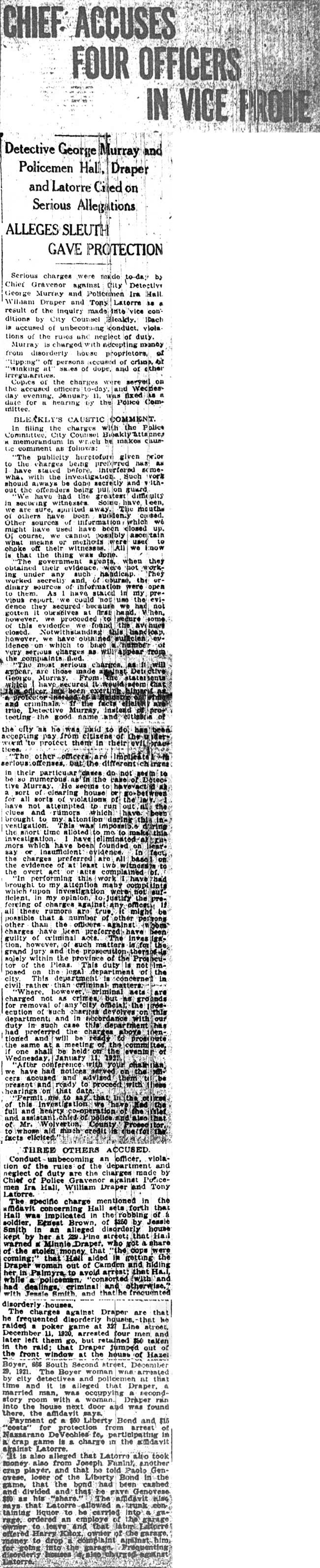
Newspaper clipping, "Chief Accuses Four Officers in Vice Probe," Camden Post-Telegram, January 4, 1922.
Camden Post-Telegram, January 4, 1922
View transcription
CHIEF ACCUSES FOUR OFFICERS IN VICE PROBE Detective George Murray and Policemen Hall, Draper and Latorre Cited on Serious Allegations ALLEGES SLEUTH GAVE PROTECTION Serious charges were made to-day by Chief Gravenor against City Detective George Murray and Policemen Ira Hall, William Draper and Tony Latorre as a result of the inquiry made into vice conditions by City Counsel Bleakly. Each is accused of unbecoming conduct, violations of the rules and neglect of duty. Murray is charged with accepting money from disorderly house proprietors, of "tipping" off persons accused of crime, of "winking at" sales of dope, and of other irregularities. Copies of the charges were served on the accused officers to-day, and Wednesday evening, January 11, was fixed as a date for a hearing by the Police Committee. BLEAKLY'S CAUSTIC COMMENT In filing the charges with the Police Committee, City Counsel Bleakly attaches a memorandum in which he makes caustic comment as follows: "The publicity heretofore given prior to the charges being preferred has, as I have stated before, interfered somewhat with the investigation. Such work should always be done secretly and without the offenders being put on guard. "We have had the greatest difficulty in securing witnesses. Some have been, we are sure, spirited away. The mouths of others have been suddenly closed. Other sources of information which we might have used have been closed up. Of course, we cannot possibly ascertain what means or methods were used to choke off their witnesses. All we know is that the thing was done. "The government agents, when they obtained their evidence, were not working under any such handicap. They worked secretly and, of course, the ordinary sources of information were open to them. As I have stated in my previous report, we could not use the evidence they secured because we had not gotten it ourselves at first hand. When, however, we proceeded to secure some of this evidence we found the avenues closed. Notwithstanding this handicap, however, we have obtained sufficient evidence on which to base a number of very serious charges as will appear from the complaints filed. "The most serious charges, as it will appear, are those made against Detective George Murray. From the statements which I have secured it would seem that this officer has been exerting himself as a protector instead of a [illegible] and criminals. If the facts elicited are true, Detective Murray, instead of protecting the good name and citizens of the city as he was paid to do, has been accepting pay from citizens of the underworld to protect them in their evil practices. "The other officers are implicated in serious offenses, but the different charges in their particular cases do not seem to be so numerous as in the case of Detective Murray. He seems to have acted as a sort of clearing house or go-between for all sorts of violations of the law. I have not attempted to run out all the clues and rumors which have been brought to my attention during this investigation. This was impossible during the short time alloted to me to make this investigation. I have eliminated all rumors which have been founded on hearsay or insufficient evidence. In fact, the charges preferred are all based on the evidence of at least two witnesses to the overt act or acts complained of. "In performing this work I have had brought to my attention many complaints which upon investigation were not sufficient, in my opinion, to justify the preferring of charges against any officer. If all these rumors are true, it might be possible that a number of other persons other than the officers against whom charges have been preferred have been guilty of criminal acts. The investigation, however, of such matters is for the grand jury and the prosecution thereof is solely within the province of the Prosecutor of the Pleas. This duty is not imposed on the legal department of the city. This department is concerned in civil rather than criminal matters. "Where, however, criminal acts are charged not as crimes, but as grounds for removal of any city official, the prosecution of such charges devolves on this department, and in accordance with our duty in such case this department has had preferred the charges above mentioned and will be ready to prosecute the same at a meeting of the committee, if one shall be held on the evening of Wednesday, January 11, 1922. "After conference with your chairman, we have had notices served on the officers accused and advised them to be present and ready to proceed with these hearings on that date. "Permit me to say that in the course of this investigation we have had the full and hearty co-operation of the chief and assistant chief of police and also that of Mr. Wolverton, County Prosecutor, to whose aid much credit is due for the facts elicited." THREE OTHERS ACCUSED. Conduct unbecoming an officer, violation of the rules of the department and neglect of duty are the charges made by Chief of Police Gravenor against Policemen Ira Hall, William Draper and Tony Latorre. The specific charge mentioned in the affidavit concerning Hall sets forth that Hall was implicated in the robbing of a soldier, Ernest Brown, of $250 by Jessie Smith in an alleged disorderly house kept by her at 229 Pine street; that Hall warned a Minnie Draper, who got a share of the stolen money, that "the cops were coming;" that Hall aided in getting the Draper woman out of Camden and hiding her in Palmyra to avoid arrest; that Hall, while a policeman, "consorted with and had dealings, criminal and otherwise," with Jessie Smith, and that he frequented disorderly houses. The charges against Draper are that he frequented disorderly houses, that he raided a poker game at 327 Line street, December 11, 1920, arrested four men and later left them go, but retained $50 taken in the raid; that Draper jumped out of the front window at the house of Hazel Boyer, 66[?] South Second street, December 29, 1921. The Boyer woman was arrested by city detectives and policemen at that time and it is alleged that Draper, a married man, was occupying a second-story room with a woman. Draper ran into the house next door and was found there, the affidavit says. Payment of a $50 Liberty Bond and $15 "costs" for protection from arrest of Nazzarano DeVechies fo[?], participating in a crap game is a charge in the affidavit against Latorre. It is also alleged that Latorre also took money also from Joseph Fanin[?], another crap player, and that he told Paolo Genovese, loser of the Liberty Bond in the game, that the bond had been cashed and divided and that he gave Genovese $[?]0 as his "share." The affidavit also says that Latorre allowed a trunk containing liquor to be carried into a garage, ordered an employe of the garage owner to leave and that later Latorre offered Harry K[?]ox, owner of the garage, money to drop a complaint against him for going into the garage. Frequenting disorderly houses is also charged against Latorre.

Detective George Murray and Policemen Hall, Draper and Latorre Cited on Serious Allegations

Alleges Sleuth Gave Protection

Serious charges were made to-day by Chief Gravenor against City Detective George Murray and Policemen Ira Hall, William Draper and Tony Latorre as a result of the inquiry made into vice conditions by City Counsel Bleakly. Each is accused of unbecoming conduct, violations of the rules and neglect of duty.

Murray is charged with accepting money from disorderly house proprietors, of "tipping" off persons accused of crime, of "winking at" sales of dope, and of other irregularities.

Copies of the charges were served on the accused officers to-day, and Wednesday evening, January 11, was fixed as a date for a hearing by the Police Committee.

Bleakly's Caustic Comment

In filing the charges with the Police Committee, City Counsel Bleakly attaches a memorandum in which he makes caustic comment as follows:

"The publicity heretofore given prior to the charges being preferred has, as I have stated before, interfered somewhat with the investigation. Such work should always be done secretly and without the offenders being put on guard.

"We have had the greatest difficulty in securing witnesses. Some have been, we are sure, spirited away. The mouths of others have been suddenly closed. Other sources of information which we might have used have been closed up. Of course, we cannot possibly ascertain what means or methods were used to choke off their witnesses. All we know is that the thing was done.

"The government agents, when they obtained their evidence, were not working under any such handicap. They worked secretly and, of course, the ordinary sources of information were open to them. As I have stated in my previous report, we could not use the evidence they secured because we had not gotten it ourselves at first hand. When, however, we proceeded to secure some of this evidence we found the avenues closed. Notwithstanding this handicap, however, we have obtained sufficient evidence on which to base a number of very serious charges as will appear from the complaints filed.

"The most serious charges, as it will appear, are those made against Detective George Murray. From the statements which I have secured it would seem that this officer has been exerting himself as a protector instead of a [illegible] and criminals. If the facts elicited are true, Detective Murray, instead of protecting the good name and citizens of the city as he was paid to do, has been accepting pay from citizens of the underworld to protect them in their evil practices.

"The other officers are implicated in serious offenses, but the different charges in their particular cases do not seem to be so numerous as in the case of Detective Murray. He seems to have acted as a sort of clearing house or go-between for all sorts of violations of the law. I have not attempted to run out all the clues and rumors which have been brought to my attention during this investigation. This was impossible during the short time alloted to me to make this investigation. I have eliminated all rumors which have been founded on hearsay or insufficient evidence. In fact, the charges preferred are all based on the evidence of at least two witnesses to the overt act or acts complained of.

"In performing this work I have had brought to my attention many complaints which upon investigation were not sufficient, in my opinion, to justify the preferring of charges against any officer. If all these rumors are true, it might be possible that a number of other persons other than the officers against whom charges have been preferred have been guilty of criminal acts. The investigation, however, of such matters is for the grand jury and the prosecution thereof is solely within the province of the Prosecutor of the Pleas. This duty is not imposed on the legal department of the city. This department is concerned in civil rather than criminal matters.

"Where, however, criminal acts are charged not as crimes, but as grounds for removal of any city official, the prosecution of such charges devolves on this department, and in accordance with our duty in such case this department has had preferred the charges above mentioned and will be ready to prosecute the same at a meeting of the committee, if one shall be held on the evening of Wednesday, January 11, 1922.

"After conference with your chairman, we have had notices served on the officers accused and advised them to be present and ready to proceed with these hearings on that date.

"Permit me to say that in the course of this investigation we have had the full and hearty co-operation of the chief and assistant chief of police and also that of Mr. Wolverton, County Prosecutor, to whose aid much credit is due for the facts elicited."

Three Others Accused.

Conduct unbecoming an officer, violation of the rules of the department and neglect of duty are the charges made by Chief of Police Gravenor against Policemen Ira Hall, William Draper and Tony Latorre.

The specific charge mentioned in the affidavit concerning Hall sets forth that Hall was implicated in the robbing of a soldier, Ernest Brown, of $250 by Jessie Smith in an alleged disorderly house kept by her at 229 Pine street; that Hall warned a Minnie Draper, who got a share of the stolen money, that "the cops were coming;" that Hall aided in getting the Draper woman out of Camden and hiding her in Palmyra to avoid arrest; that Hall, while a policeman, "consorted with and had dealings, criminal and otherwise," with Jessie Smith, and that he frequented disorderly houses.

The charges against Draper are that he frequented disorderly houses, that he raided a poker game at 327 Line street, December 11, 1920, arrested four men and later left them go, but retained $50 taken in the raid; that Draper jumped out of the front window at the house of Hazel Boyer, 66[?] South Second street, December 29, 1921. The Boyer woman was arrested by city detectives and policemen at that time and it is alleged that Draper, a married man, was occupying a second-story room with a woman. Draper ran into the house next door and was found there, the affidavit says.

Payment of a $50 Liberty Bond and $15 "costs" for protection from arrest of Nazzarano DeVechies fo[?], participating in a crap game is a charge in the affidavit against Latorre.

It is also alleged that Latorre also took money also from Joseph Fanin[?], another crap player, and that he told Paolo Genovese, loser of the Liberty Bond in the game, that the bond had been cashed and divided and that he gave Genovese $[?]0 as his "share." The affidavit also says that Latorre allowed a trunk containing liquor to be carried into a garage, ordered an employe of the garage owner to leave and that later Latorre offered Harry K[?]ox, owner of the garage, money to drop a complaint against him for going into the garage. Frequenting disorderly houses is also charged against Latorre.

Advertisement

Comments