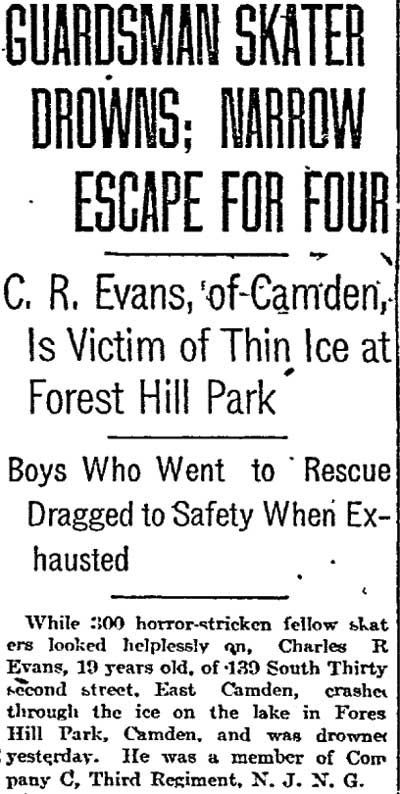
Guardsman Skater Drowns; Narrow Escape For Four
View transcription
C. R. Evans, of Camden, Is Victim of Thin Ice at Forest Hill Park — Boys Who Went to Rescue Dragged to Safety When Exhausted
While 300 horror-stricken fellow skaters looked helplessly on, Charles R. Evans, 19 years old, of 139 South Thirty-second street, East Camden, crashed through the ice on the lake in Forest Hill Park, Camden, and was drowned yesterday. He was a member of Company C, Third Regiment, N. J. N. G.
In attempting to rescue their companion, Harry Haas, 14 years old, of 512 Walnut street, and Graham Wishart, 18 years old, of 30 South Thirty-fifth street, almost met a similar fate. In their frantic efforts to rescue these two, Wilbur Crane, of 1468 Haddon avenue, and Matthew Yingling, of Eighth and Florence streets, also were overcome by the frigidity of the water and had to be dragged to shore.
Evans, Haas and Wishart were racing over the ice of the lake, which empties into the Cooper River, to the east, through a sluice. Evans was slightly in the lead.
As the three shot swiftly across the smooth surface, with merry quips to their companions and hearty laughs, there was a sudden sharp and echoing crack. Evans had gone through the ice and had disappeared, being carried under the frozen surface.
The film of snow that had gradually been covering the ice hid from the three the thinness of the ice as they approached the sluice gates.
Exhausted In Freezing Water
Unaware that the water at this point reaches a depth of twelve feet, Haas and Wishart went to their companion’s aid but in a few minutes they were exhausted from the freezing water.
Crane and Yingling heard their cries for aid and tried to reach the two would-be rescuers from the ragged edge of the ice. The ice upon which they were leaning gave way and they, too, fell floundering in the icy water. They attempted even then to help Haas and Wishart to the edge of the ice, but their strength was soon exhausted and they had to look to their own safety. They grasped the edge of the ice and tried to get themselves clear of the water, but their efforts resulted only in the further breaking of the ice and they repeatedly slipped back into the water.
By this time the other skaters, terrorized by the sight, had fled to shore and had gathered about the sluice watching the struggle of those in the water.
Samuel Cox, a park guard, and Policeman Edward Smith, were attracted to the scene and they bent their efforts to rescue the boys struggling for life.
Cox and Smith obtained ropes and poles and with the aid of these finally succeeded in pulling Crane, Yingling, Haas and Wishart from the water, but the body of Evans had not been seen after the ill-fated crash. Long poles, fitted with grappling hooks, were obtained, and Evans finally was drawn from the lake.
Evans Dead When Found
Noting a flicker of life remaining, Dr. Charles Jackson, summoned by automobile, worked over the stricken youth, but without avail. The youth was sent to the Homeopathic Hospital, where a lungmotor was called into service, but all efforts to revive him proved in vain.
The lake, which was the scene of yesterday’s fatal episode, was constructed when Forest Hill Park was laid out several years ago. In winter it has been a pleasure ground for skaters while the weather permitted. It was looked upon as ordinarily safe except just about the sluice gates. The thinness of the ice is easily seen under ordinary conditions, but the snow of yesterday afternoon gave the whole surface the appearance of equal thickness.
Full page scan: Philadelphia Inquirer, January 22, 1917 (PDF)