…He Left A Trail Of Death

View transcription
View transcription
September 6, 1949 was a pleasant, sunny Tuesday but 27-year-old Howard B. Unruh awoke in a black mood. He had been at the movies in Philadelphia the night before but paid little attention to the double feature. He had planned his revenge in that theater. He had planned to kill them all—those neighbors that had caused him so much grief and humiliation. The druggist and his wife, the barber, the tailor, the shoemaker.
He was in such a dark mood that he even theatened [sic] his mother. He had a wrench in his hands, Mrs. Freda Unruh would tearfully recall four days later, and he raised the wrench and threatened her. He was upset about the late, Mrs. Unruh knew. But Howard wouldn't talk. He wouldn't tell his mother what was bothering him. And Mrs. Unruh was so alarmed by his unusual behavior that she left her apartment and went to a neighbor's home. She said she felt like calling the police, but she didn't and the one opportunity to avoid a massacre slipped by.
THE TALL, square-shouldered, veteran of World War II waited until 9:30. He told investigators he waited until all the stores were open so he could get all his "persecutors" at once. He took his German Luger and several clips.
He lived with his mother in a small second-floor apartment, just one door from the corner of River Avenue and 32nd Street in the East Camden neighborhood known as Cramer Hill. Eyewitness accounts conflict as to where Unruh started his trail of death. The 10-minute killing spree was confined to a few yards of pavement at that intersection and he must have retraced his steps several times. The Courier-Post that day said his first stop was the drugstore of Maurice M. Cohen. Unruh felt a special grudge toward Cohen and his wife, Rose.
IT STEMMED from the unusual setup of the Uhruh [sic] apartment. The only entrance was through a rear door. The most convenient way to get to the door was through the Cohens' backyard. Over the years there had been friction. Sometimes the druggist allowed Unruh to use the backyard, sometimes he didn't. Just a few days before there had been conflict over a gate Unruh had constructed between the two yards. And then someone tore the gate off its hinges.
The silent Unruh saw this as a source of humiliation. He smoldered inside. The pharmacist apparently saw Unruh coming. He tried to warn his wife, mother and 12-year-old son, who were upstairs. Unruh apparently chased him and killed him outside the store. Then he went up the steps and killed Mrs. Cohen and the elderly mother of the druggist as they tried to hide in the clothes closets. The boy somehow escaped.
As he left the pharmacy, James H. Hutton, 45, an insurance agent well known in the neighborhood and also known to Unruh, was entering the store. Unruh executed the insurance man on the sidewalk.
MOST NEWSPAPER accounts talk about Unruh's "deadly accuracy," and his "marksmanship." But all of his victims were shot at almost point-blank range. It doesn't take a marksman to kill from three or four feet away.
Probably the next victim was Alvin M. Day, 24, an RCA television repairman from Mantua. He was making his first stop of the day on River Avenue and was probably halted at the intersection for the traffic light. Unruh went up to his car and put a bullet through his head.
Then Unruh walked a few paces down River Avenue to Clark Hoover's Barber Shop. Unruh told investigaters [sic] that the barber was always directing insulting remarks in his direction. THE BARBER had a carousel-type hobbyhorse in his shop used by tots instead of the barber chair. That morning six-year-old Orris Smith was perched on the horse getting a haircut for school. Before the horrified mother, Unruh put bullets into the heads of the barber and her son.
His next stop was an adjoining shoe repair shop, where he killed the cobbler, John J. Pilarchik, 27. The next building on River Avenue is a private home. Mrs. Mary Hamilton, nine months pregnant, was playing with her three sons in the living room. She saw Unruh peer through the window and aim his gun. She got two of the boys out of the room in time but two-year-old Thomas Hamilton died.
UNRUH NEXT went into the tailor shop. He was after owner Thomas Zegrino but he was not there. So Unruh killed Zegrino's bride of only a few weeks, Helga. Unruh walked back up River Avenue, passing the shops where he had left a trail of death. A car was stopped for a red light at the intersection. Unruh walked up to the car, put his hand through the window and shot the driver, Mrs. Helen Wilson of Pennsauken, her elderly mother and her 10-year-old son. The two women died instantly. The boy died the next morning in the hospital. By now the intersection was littered with bodies in stalled cars and on the sidewalks. People were rushing from the scene screaming while Unruh calmly walked around looking for more victims.
Unruh took a shot at Charles Peterson, 18, who had stopped his car and had came [sic] out to see the bodies. Peterson was hit in the leg and survived.
ACROSS THE STREET, customers in the American Store had bolted the door and taken cover behind the counter. Unruh tried the door but could not open it. He shot twice into the store but no one was hit. He took two shots at a group of men looking out from Frank Engle's Cafe. Both shots missed. Engel got his pistol and shot at Unruh from his second story window, hitting the gunman in the buttocks.
Unruh walked a short distance up 32nd Street and into the first house where he shot Mrs. Madeline Harrie. Her son, Armand, 16, took a flying leap at Unruh. The killer hit him with the butt of his Luger and shot him as he lay on the floor. Both survived their wounds.
UNRUH HAD reloaded his pistol several times but by now had used most of his ammunition. He went back up into his second-story apartment, locking the doors behind him. Soon the air was filled with the shrill wail of police sirens and the intersection swarmed with heavily armed officers, perhaps 50 of them. The policemen kept discovering bodies and rushing them off to Cooper Hospital.
It might have been 15 or 30 minutes before police realized it was one man they were after and he was probably sitting right above their heads looking down on the whole scene. Police, armed with sub-machine guns, took up positions in the rear of the building and shouted for Unruh to give himself up. Then they opened up fire on the windows and finally lobbed in tear gas cylinders which never went off. Then came a voice, "Don't shoot. Don't shoot. I'm coming down."
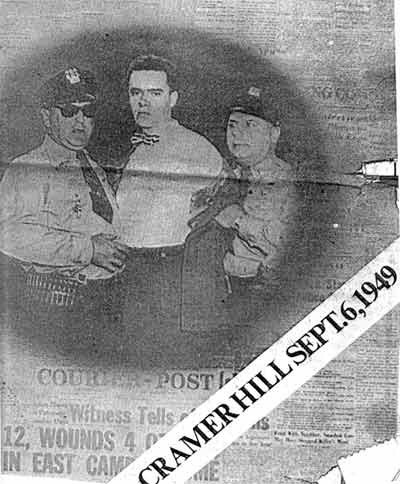
DOWN THE backstairs and out into the sunshine stepped Howard Unruh. He was calm. He was dressed neatly in a pinstriped suit, white shirt, bow tie. A photographer captured the scene. One cop said, "What's the matter with you? You a psycho?"
"I'm no psycho. I have a good mind," answered Howard Unruh. He was quickly hustled away from a menacing crowd. He gave a confession to Camden County Prosecutor Mitchell Cohen, now a federal judge. He said to Cohen, "I'm glad I did it. They were making derogatory remarks about my character." When asked about the children, he said, "What children?" He was booked on 12 counts of murder (raised to 13 the next day). It was discovered that he and he was was [sic] taken to Cooper Hospital. At two the next morning he was whisked away to Trenton State Hospital's Vroom Building for the criminally insane. He has been there ever since.