Police Shakeups of Today Mild Compared to Years Ago
Camden Courier-Post, July 6, 1930
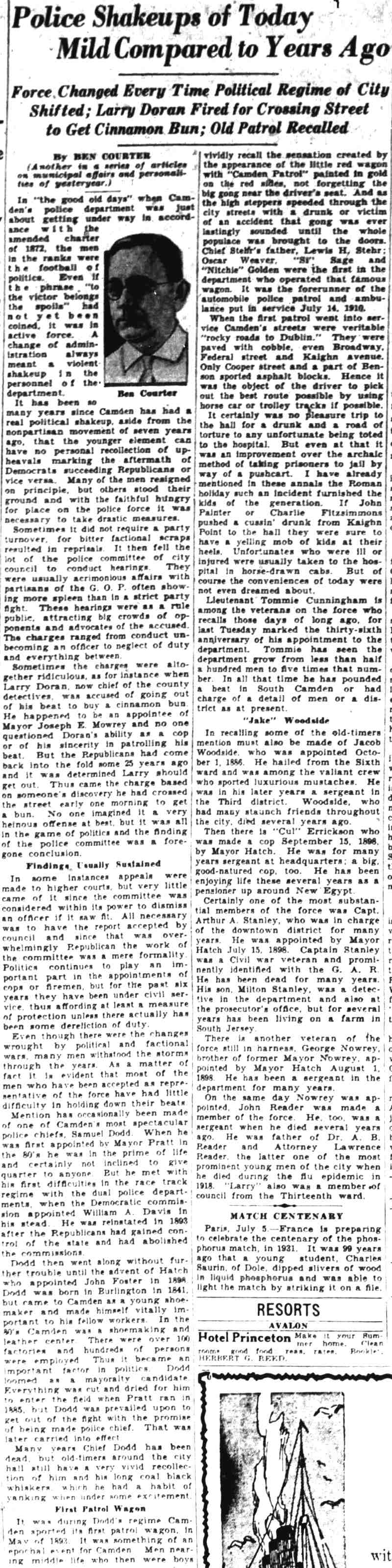
View transcription
Police Shakeups of Today Mild Compared to Years Ago
Force Changed Every Time Political Regime of City Shifted; Larry Doran Fired for Crossing Street to Get Cinnamon Bun; Old Patrol Recalled
By BEN COURTER
(Another in a series of articles on municipal affairs and personalities of yesteryear.)
Ben Courter
In "the good old days" when Camden's police department was just about getting under way in accordance with the amended charter of 1872, the men in the ranks were the football of politics. Even if the phrase "to the victor belongs the spoils" had not yet been coined, it was in active force. A change of administration always meant a violent shakeup in the personnel of the department.
It has been so many years since Camden has had a real political shakeup, aside from the nonpartisan movement of seven years ago, that the younger element can have no personal recollection of upheavals marking the aftermath of Democrats succeeding Republicans or vice versa. Many of the men resigned on principle, but others stood their ground and with the faithful hungry for place on the police force it was necessary to take drastic measures.
Sometimes it did not require a party turnover, for bitter factional scraps resulted in reprisals. It then fell the lot of the police committee of city council to conduct hearings. They were usually acrimonious affairs with partisans of the G. O. P. often showing more spleen than in a strict party fight. These hearings were as a rule public, attracting big crowds of opponents and advocates of the accused. The charges ranged from conduct unbecoming an officer to neglect of duty and everything between.
Sometimes the charges were altogether ridiculous, as for instance when Larry Doran, now chief of the county detectives, was accused of going out of his beat to buy a cinnamon bun. He happened to be an appointee of Mayor Joseph E. Mowrey and no one questioned Doran's ability as a cop or of his sincerity in patrolling his beat. But the Republicans had come back into the fold some 25 years ago and it was determined Larry should get out. Thus came the charge based on someone's discovery he had crossed the street early one morning to get a bun. No one imagined it a very heinous offense at best, but it was all in the game of politics and the finding of the police committee was a foregone conclusion.
Findings, Usually Sustained
In some instances appeals were made to higher courts, but very little came of it since the committee was considered within its power to dismiss an officer if it saw fit. All necessary was to have the report accepted by council and since that was overwhelmingly Republican the work of the committee was a mere formality. Politics continues to play an important part in the appointments of cops or firemen, but for the past six years they have been under civil service, thus affording at least a measure of protection unless there actually has been some dereliction of duty.
Even though there were the changes wrought by political and factional wars, many men withstood the storms through the years. As a matter of fact it is evident that most of the men who have been accepted as representative of the force have had little difficulty in holding down their beats.
Mention has occasionally been made of one of Camden's most spectacular police chiefs, Samuel Dodd. When he was first appointed by Mayor Pratt in the 80's he was in the prime of life and certainly not inclined to give quarter to anyone. But he met with his first difficulties in the race track regime with the dual police departments, when the Democratic commission appointed William A. Davis in his stead. He was reinstated in 1893 after the Republicans had gained control of the state and had abolished the commissions.
Dodd then went along without further trouble until the advent of Hatch who appointed John Foster in 1898. Dodd was born in Burlington in 1841, but came to Camden as a young shoemaker and made himself vitally important to his fellow workers. In the 80's Camden was a shoemaking and leather center. There were over 100 factories and hundreds of persons were employed. Thus it became an important factor in politics. Dodd loomed as a mayoralty candidate. Everything was cut and dried for him to enter the field when Pratt ran in 1885, but Dodd was prevailed upon to get out of the fight with the promise of being made police chief. That was later carried into effect.
Many years Chief Dodd has been dead, but old-timers around the city hall still have a very vivid recollection of him and his long coal black whiskers, which he had a habit of yanking when under some excitement.
First Patrol Wagon
It was during Dodd's regime Camden sported its first patrol wagon, in May of 1893. It was something of an epochal event for Camden. Men nearing middle life who then were boys vividly recall the sensation created by the appearance of the little red wagon with "Camden Patrol" painted in gold on the red sides, not forgetting the big gong near the driver's seat. And as the high steppers speeded through the city streets with a drunk or victim of an accident that gong was everlastingly sounded until the whole populace was brought to the doors. Chief Stehr's father, Lewis H. Stehr; Oscar Weaver, "Si" Sage and "Nitchie" Golden were the first in the department who operated that famous wagon. It was the forerunner of the automobile police patrol and ambulance put in service July 14, 1910.
When the first patrol went into service Camden's streets were veritable "rocky roads to Dublin." They were paved with cobble, even Broadway, Federal street and Kaighn avenue. Only Cooper street and a part of Benson sported asphalt blocks. Hence it was the object of the driver to pick out the best route possible by using horse car or trolley tracks if possible.
It certainly was no pleasure trip to the hall for a drunk and a road of torture to any unfortunate being toted to the hospital. But even at that it was an improvement over the archaic method of taking prisoners to jail by way of a pushcart. I have already mentioned in these annals the Roman holiday such an incident furnished the kids of the generation. If John Painter or Charlie Fitzsimmons pushed a cussin' drunk from Kaighn Point to the hall they were sure to have a yelling mob of kids at their heels. Unfortunates who were ill or injured were usually taken to the hospital in horse-drawn cabs. But of course the conveniences of today were not even dreamed about.
Lieutenant Tommie Cunningham is among the veterans on the force who recalls those days of long ago, for last Tuesday marked the thirty-sixth anniversary of his appointment to the department. Tommie has seen the department grow from less than half a hundred men to five times that number. In all that time he has pounded a beat in South Camden or had charge of a detail of men or a district as at present.
"Jake" Woodside
In recalling some of the old-timers mention must also be made of Jacob Woodside, who was appointed October 1, 1886. He hailed from the Sixth ward and was among the valiant crew who sported luxurious mustaches. He was in his later years a sergeant in the Third district. Woodside, who had many staunch friends throughout the city, died several years ago.
Then there is "Cul" Errickson who was made a cop September 15, 1898, by Mayor Hatch. He was for many years sergeant at headquarters; a big, good-natured cop, too. He has been enjoying life these several years as a pensioner up around New Egypt.
Certainly one of the most substantial members of the force was Capt. Arthur A. Stanley, who was in charge of the downtown district for many years. He was appointed by Mayor Hatch July 15, 1898. Captain Stanley was a Civil war veteran and prominently identified with the G. A. R. He has been dead for many years. His son, Milton Stanley, was a detective in the department and also at the prosecutor's office, but for several years has been living on a farm in South Jersey.
There is another veteran of the force still in harness, George Nowrey, brother of former Mayor Nowrey, appointed by Mayor Hatch August 1, 1898. He has been a sergeant in the department for many years.
On the same day Nowrey was appointed, John Reader was made a member of the force. He, too, was a sergeant when he died several years ago. He was father of Dr. A. B. Reader and Attorney Lawrence Reader, the latter one of the most prominent young men of the city when he died during the flu epidemic in 1918. "Larry" also was a member of council from the Thirteenth ward.
MATCH CENTENARY
Paris, July 5.—France is preparing to celebrate the centenary of the phosphorus match, in 1931. It was 99 years ago that a young student, Charles Saurin, of Dole, dipped slivers of wood in liquid phosphorus and was able to light the match by striking it on a file.
RESORTS
AVALON
Hotel Princeton Make it your Summer home. Clean rooms good food reas. rates. Booklet. HERBERT G. REED.
Advertisement