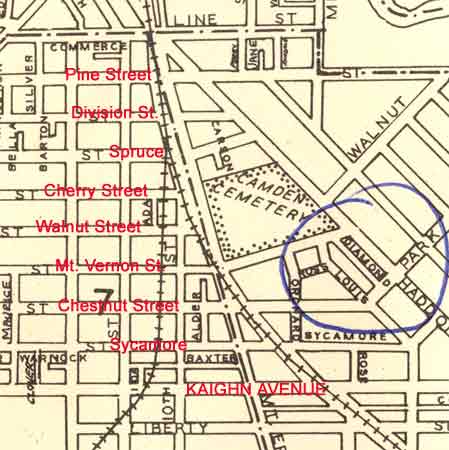
Alder Street, also known as Ann Street, was a small street that ran from a half block north of Chestnut Street south to Sycamore Street, between South 10th and South 9th Streets, west of the railroad tracks. It was home to two prominent families, the Tunsil family and the Waples family, both involved for many years in Camden as funeral directors.
The 1000 block of Alder Street was obliterated by the construction of Interstate Route I-676. No trace exists of the 1100 block — it too appears to have been taken for highway construction.
(1891) Sanborn Fire Insurance Map from Camden, Camden County, New Jersey. Sanborn Map Company. Retrieved from the Library of Congress.1946 map of Camden. Alder Street can be found in the middle of the map, running south to north from Sycamore Street.
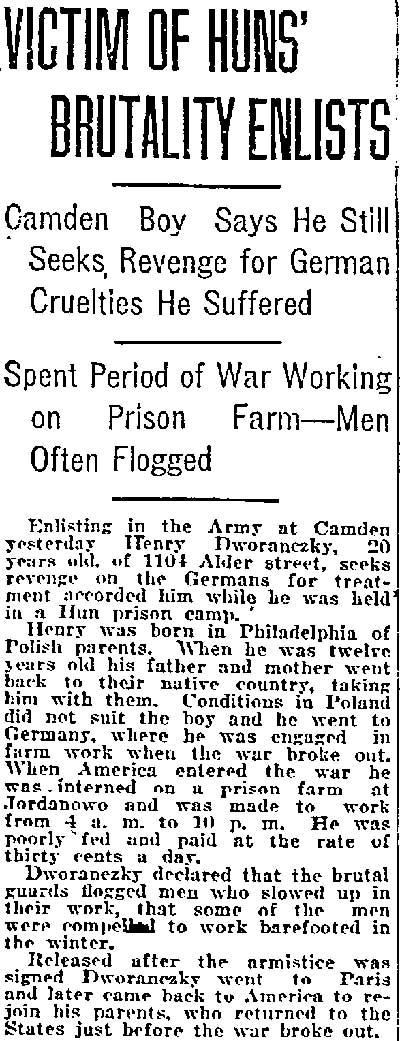
Philadelphia Inquirer, June 22, 1919View transcription
Victim of Huns' Brutality Enlists
Camden Boy Says He Still Seeks Revenge for German Cruelties He Suffered
Spent Period of War Working on Prison Farm—Men Often Flogged
Enlisting in the Army at Camden yesterday Henry Dworanczky, 20 years old, of 1104 Alder street, seeks revenge on the Germans for treatment accorded him while he was held in a Hun prison camp.
Henry was born in Philadelphia of Polish parents. When he was twelve years old his father and mother went back to their native country, taking him with them. Conditions in Poland did not suit the boy and he went to Germany, where he was engaged in farm work when the war broke out. When America entered the war he was interned on a prison farm at Jordanowo and was made to work from 4 a. m. to 10 p. m. He was poorly fed and paid at the rate of thirty cents a day.
Dworanczky declared that the brutal guards flogged men who slowed up in their work, that some of the men were compelled to work barefooted in the winter.
Released after the armistice was signed Dworanczky went to Paris and later came back to America to rejoin his parents, who returned to the States just before the war broke out.
Camden Boy Says He Still Seeks Revenge for German Cruelties He Suffered
Spent Period of War Working on Prison Farm—Men Often Flogged
Enlisting in the Army at Camden yesterday Henry Dworanczky, 20 years old, of 1104 Alder street, seeks revenge on the Germans for treatment accorded him while he was held in a Hun prison camp.
Henry was born in Philadelphia of Polish parents. When he was twelve years old his father and mother went back to their native country, taking him with them. Conditions in Poland did not suit the boy and he went to Germany, where he was engaged in farm work when the war broke out. When America entered the war he was interned on a prison farm at Jordanowo and was made to work from 4 a. m. to 10 p. m. He was poorly fed and paid at the rate of thirty cents a day.
Dworanczky declared that the brutal guards flogged men who slowed up in their work, that some of the men were compelled to work barefooted in the winter.
Released after the armistice was signed Dworanczky went to Paris and later came back to America to rejoin his parents, who returned to the States just before the war broke out.