William Stanley Ablett Village
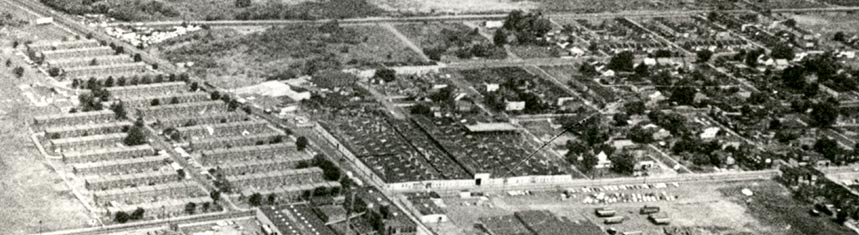
William Stanley Ablett Village is a public housing project in the Cramer Hill section of Camden, at River Road and State Street. It was built in 1942 by the Housing Authority of the City of Camden and contains 306 dwelling units.
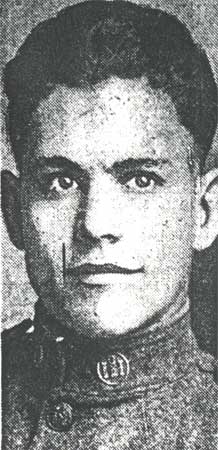
Ablett Village was named after William Stanley Ablett, a soldier from Camden who was killed in action in France during World War I.
At the time Ablett Village was built, public housing was segregated in Camden. Some of the documents reproduced on this page were written using the standard vocabulary and grammar in use in the 1940s.
History
The story of Ablett Village goes back to the 1930s. When sites were being considered for Camden's first public housing project, an area in North Camden east of Second Street, near Pyne Point Park, was considered. Reluctance on the part of homeowners here and in other parts of Camden contributed to the decision to build the first site, Westfield Acres, on a mostly vacant site on Westfield Avenue in East Camden.
With the successful completion of Westfield Acres and the subsequent organization of the Housing Authority of the City of Camden in 1938, the decision was made to construct further housing projects. The next project constructed was the Clement T. Branch Village project in South Camden, specifically for African-American residents of the city, many of whom lived in the Centerville neighborhood in which it was built. In December of 1939, the Housing Authority received word that it would be allocated funds to build a third project, to be located at River Road and State Street in the Cramer Hill section of Camden.
This area was known as the Moro Phillips tract. Moro Phillips was a Polish immigrant who amassed a huge fortune as a chemical manufacturer and real estate investor in the 19th century. He also operated a chromite mine in Chester County PA. When he passed in April of 1886, his estate was valued at over $10,000,000.00, a huge amount in that time. In the early 1920s, the tract became the site of Camden's first airport, which was known as Moro Phillips Field. This site turned out to be less than satisfactory due to the numerous factory smokestacks in the area, and the field was abandoned as flight operations were shifted to Central Airport in Pennsauken in 1929.
Before There Was an Ablett Village — 1941 Aerial Photos
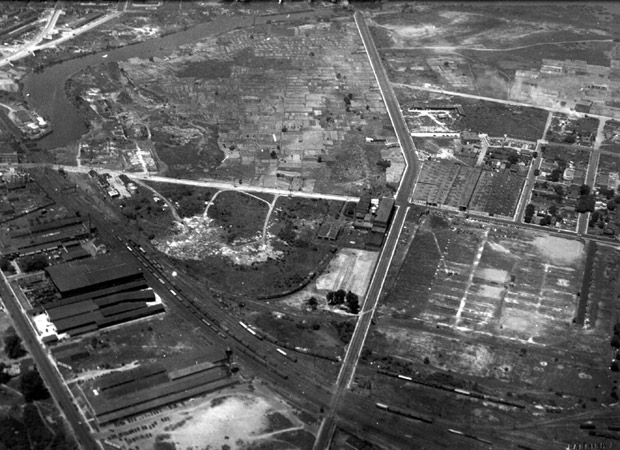
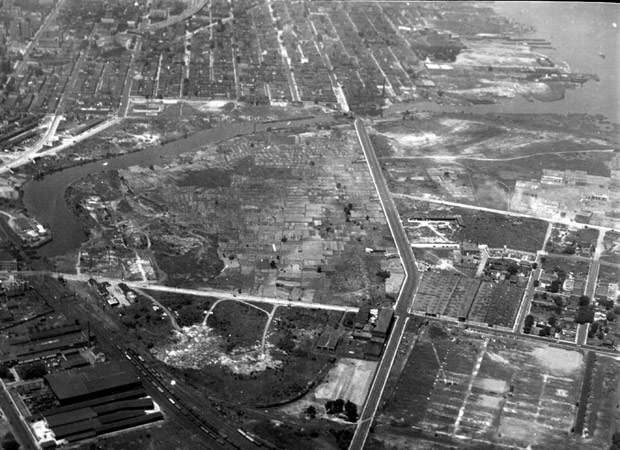
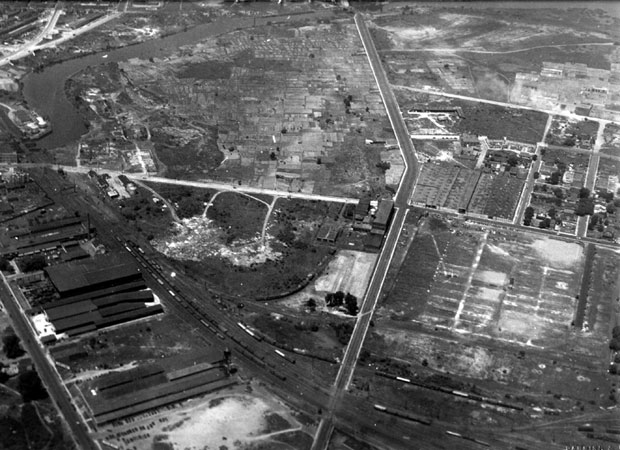
Three aerial views of the Moro Phillips Tract, the land bounded by the Cooper River, East State Street, and River Road. River Road bisects the pictures horizontally, East State Street vertically. Federal Street is visible in lower left hand corners. The Warren Webster Company plant, DuBell Lumber (Dimedio Lime) and other buildings are evident on Federal Street. The Harrison Avenue Dump, slated for conversion into a golf course, is visible north of East State Street at the mouth of the Cooper, and parts of North Camden including Pyne Point Park can be seen in the lower left aerial photo.
Dedication of William Stanley Ablett Village
View transcription
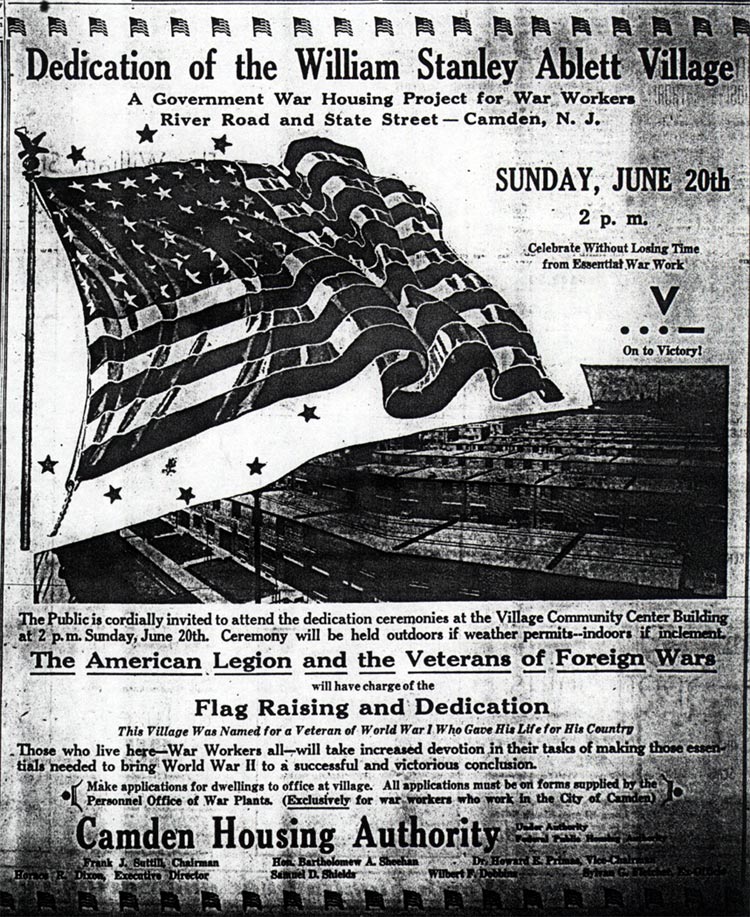
The Village was dedicated on Sunday, June 20, 1943. The printed dedication broadside reads:
Dedication of the William Stanley Ablett Village — A Government War Housing Project for War Workers — River Road and State Street, Camden, N. J.
Sunday, June 20th, 2 p.m. (Celebrate Without Losing Time from Essential War Work.) On to Victory!
The Public is cordially invited to attend the dedication ceremonies at the Village Community Center Building at 2 p.m. Sunday, June 20th. Ceremony will be held outdoors if weather permits — indoors if inclement.
The American Legion and the Veterans of Foreign Wars will have charge of the Flag Raising and Dedication.
This Village Was Named for a Veteran of World War I Who Gave His Life for His Country.
Those who live here — War Workers all — will take increased devotion in their tasks of making those essentials needed to bring World War II to a successful and victorious conclusion.
Make applications for dwellings to office at village. All applications must be on forms supplied by the Personnel Office of War Plants. (Exclusively for war workers who work in the City of Camden.)
Camden Housing Authority — Frank J. Suttill, Chairman; Hon. Bartholomew A. Sheehan; Dr. Howard E. Primas, Vice-Chairman; Horace R. Dixon, Executive Director; Samuel D. Shields; Wilbert F. Dobbins; Sylvan G. Fletcher, Ex-Officio.
Management
As construction was finishing up, James H. O'Brien, who was serving as the Chief Air Raid Warden in Camden, was named to be the first manager. He filled this post until his sudden passing in March of 1944. Although residents and local veterans groups campaigned so that Allan T. Kline would be named manager, James J. Scarduzio, who operated a real estate business at 1809 Broadway in South Camden, was given the job.
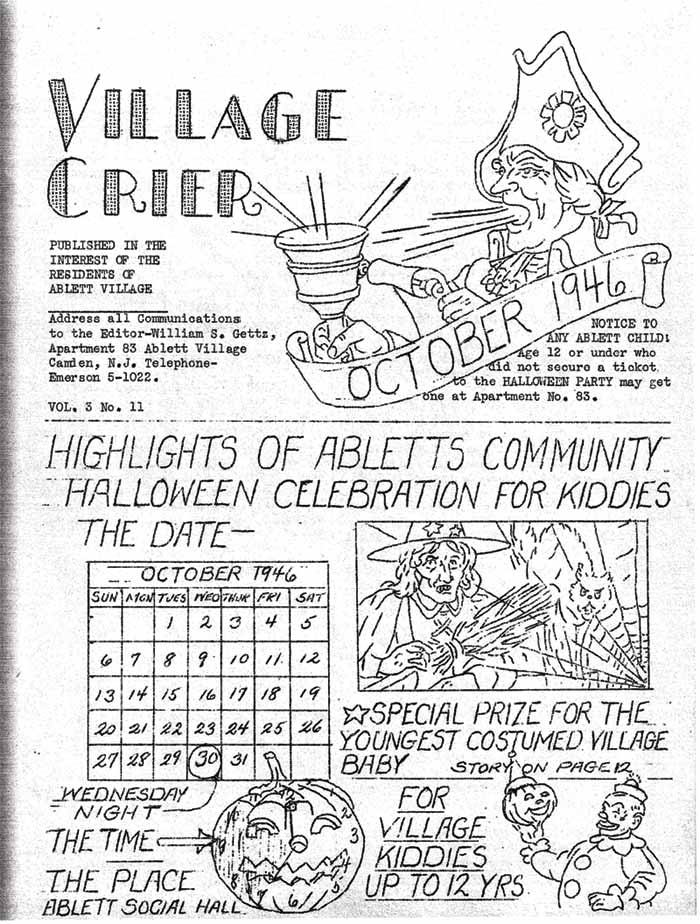
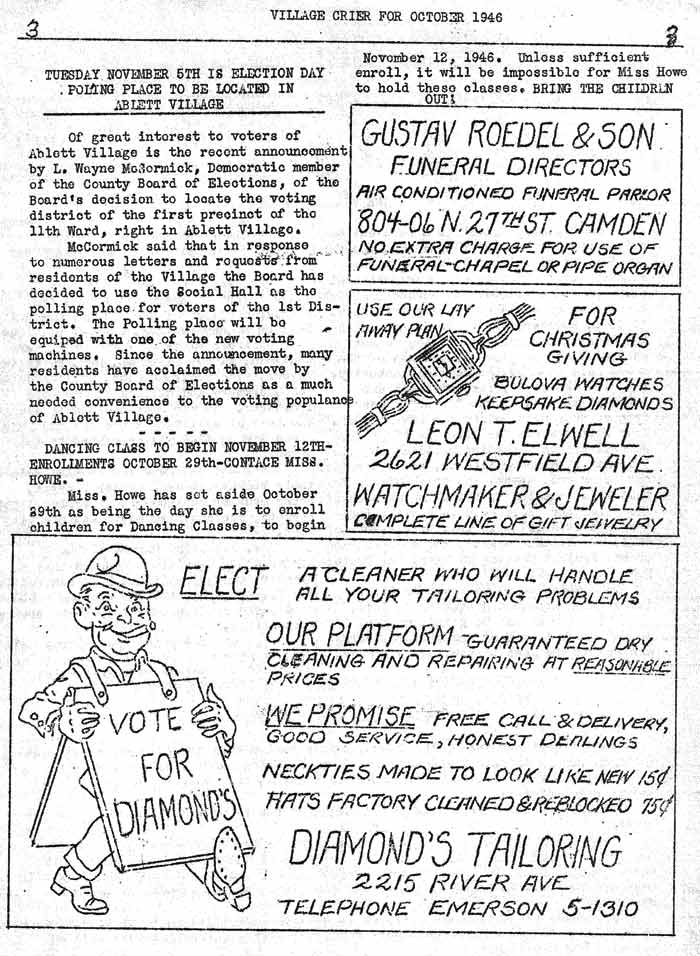
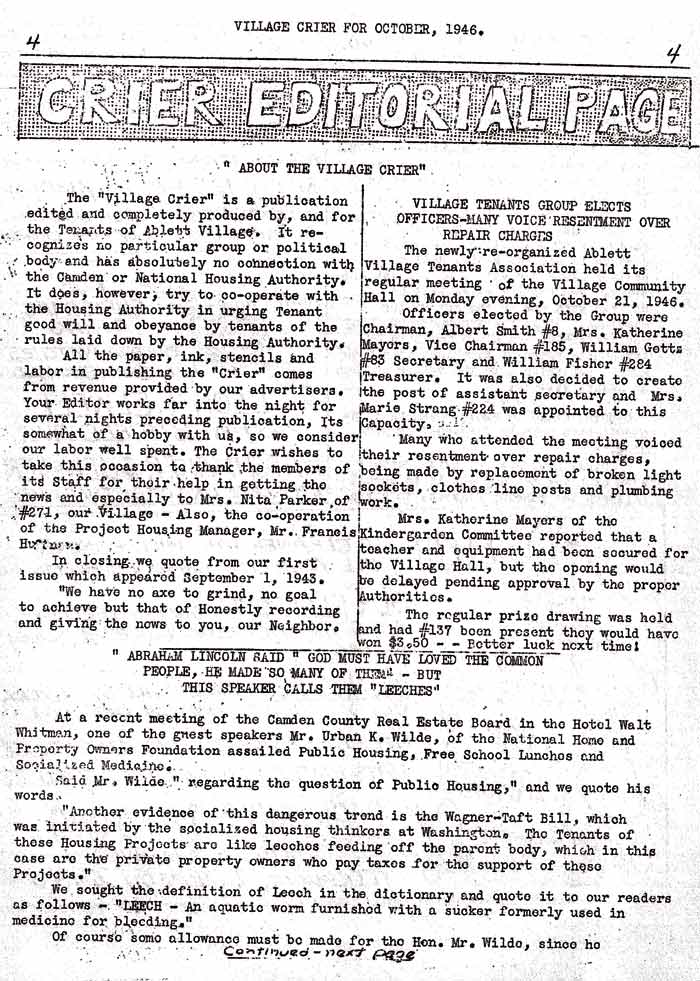
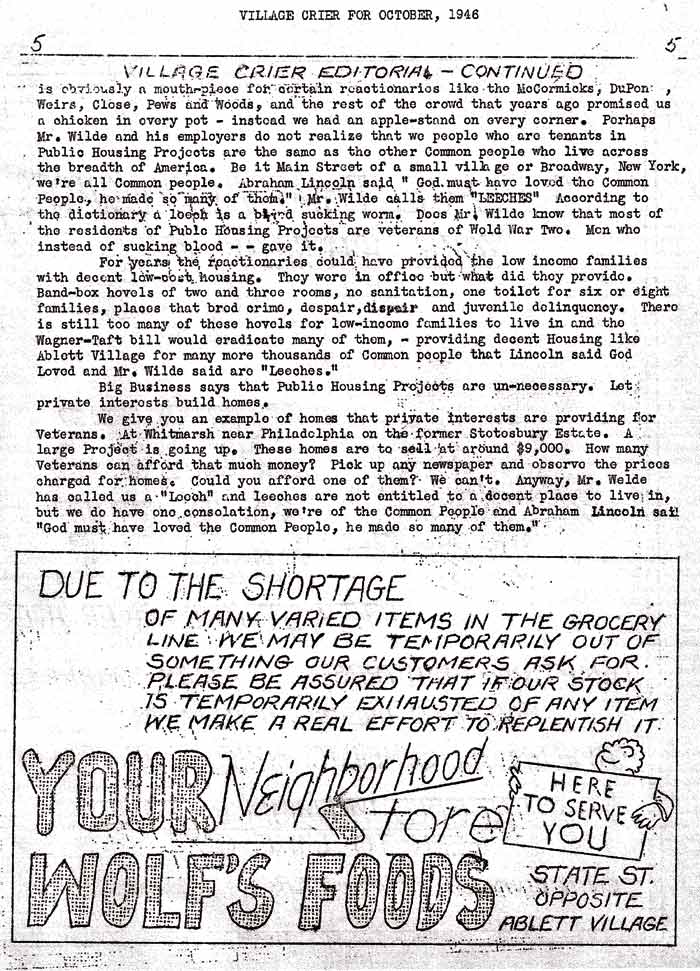
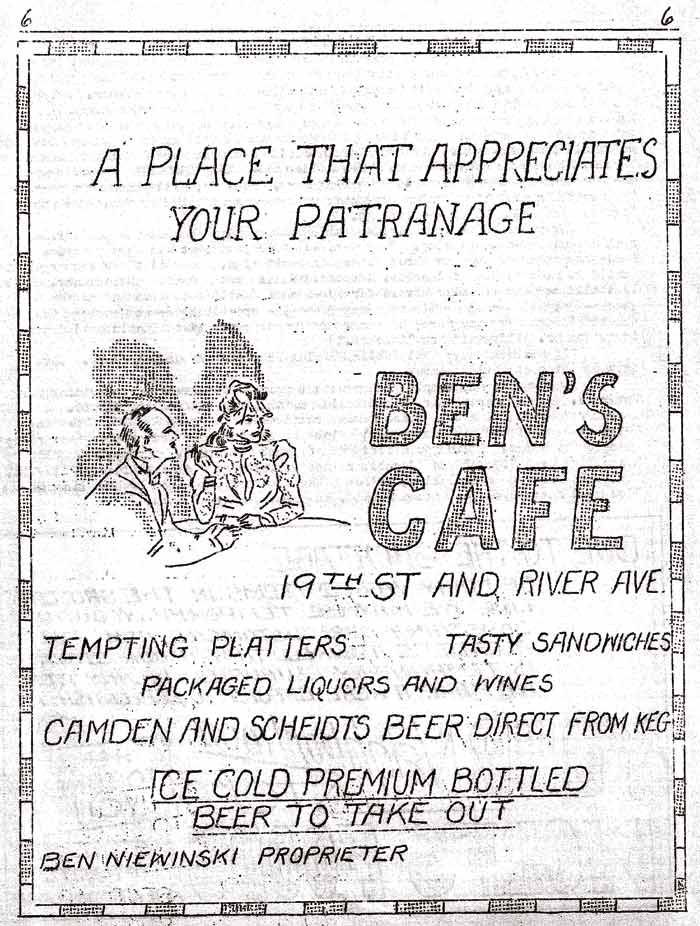
Village Crier — October 1946
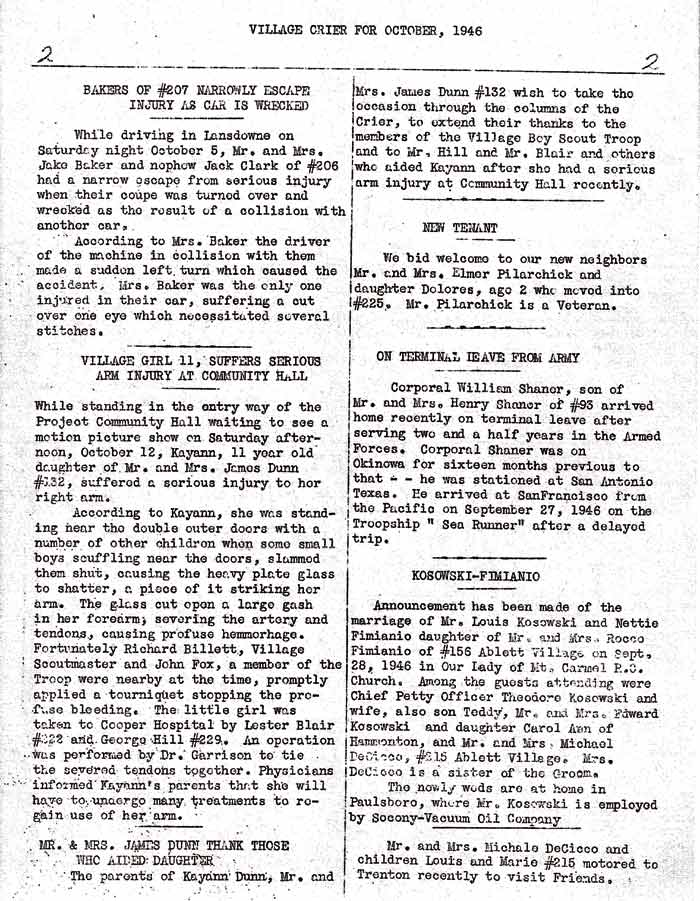
This came courtesy of Kayann Dunn Pfeiffer, who was the little girl mentioned as being injured on page 2. Click for the complete 12-page newspaper in PDF format.
View transcription
View transcription
View transcription
View transcription
View transcription
View transcription
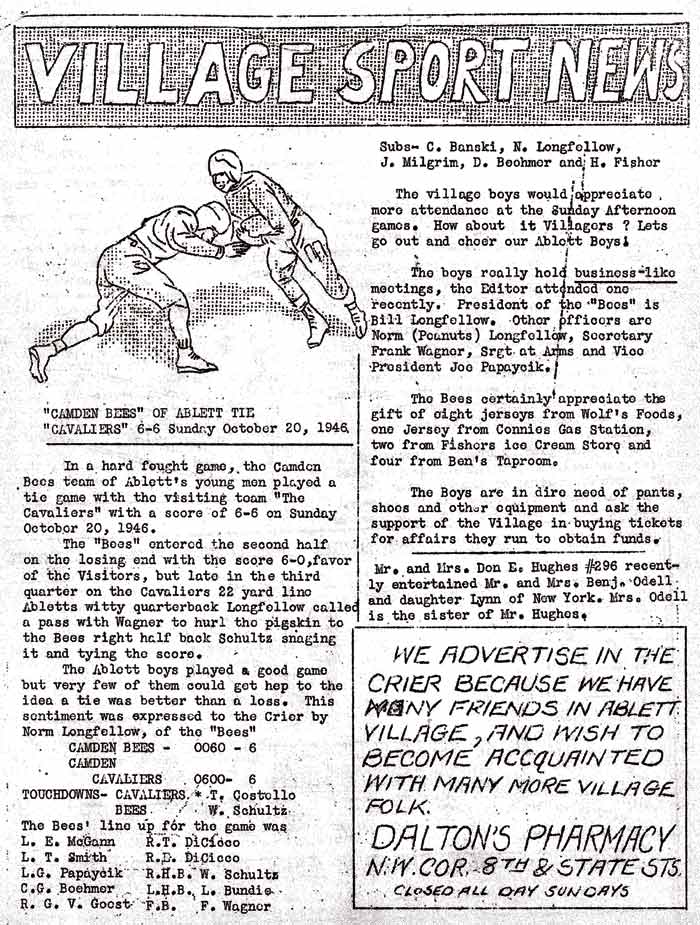
View transcription
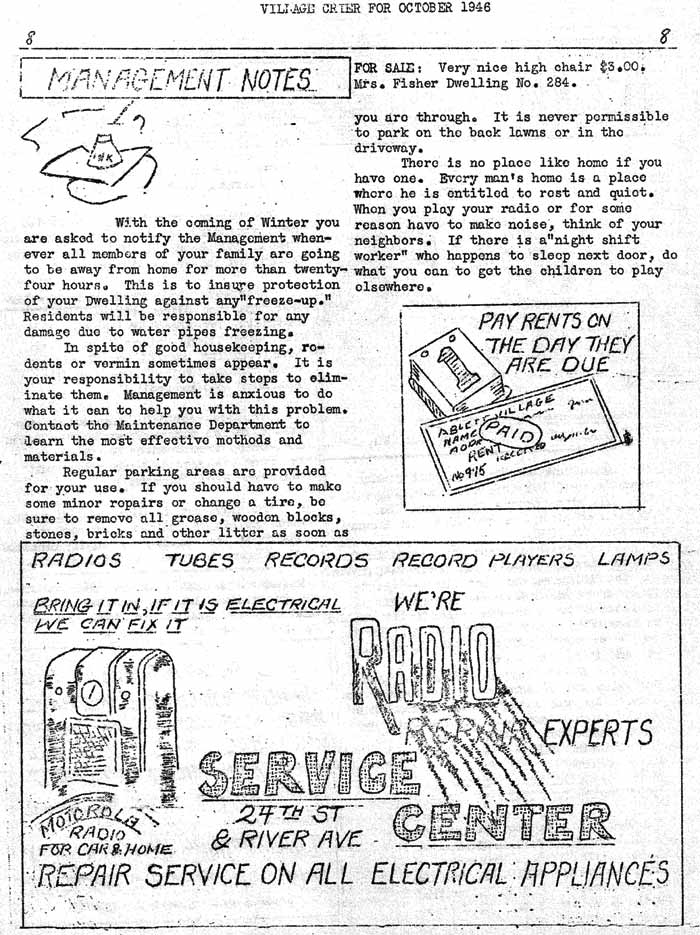
View transcription
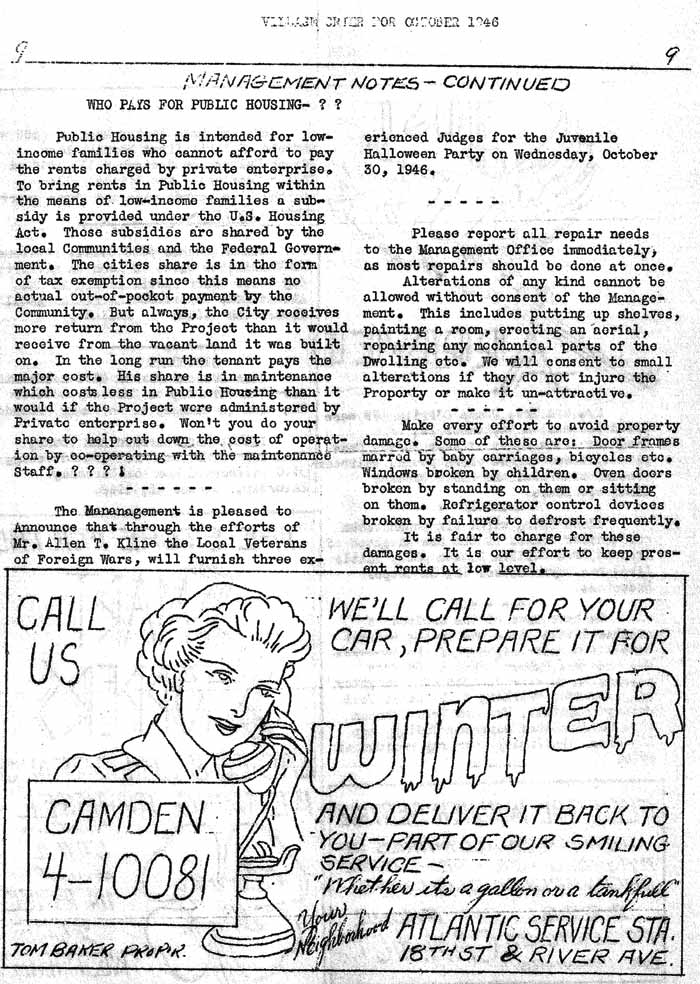
View transcription
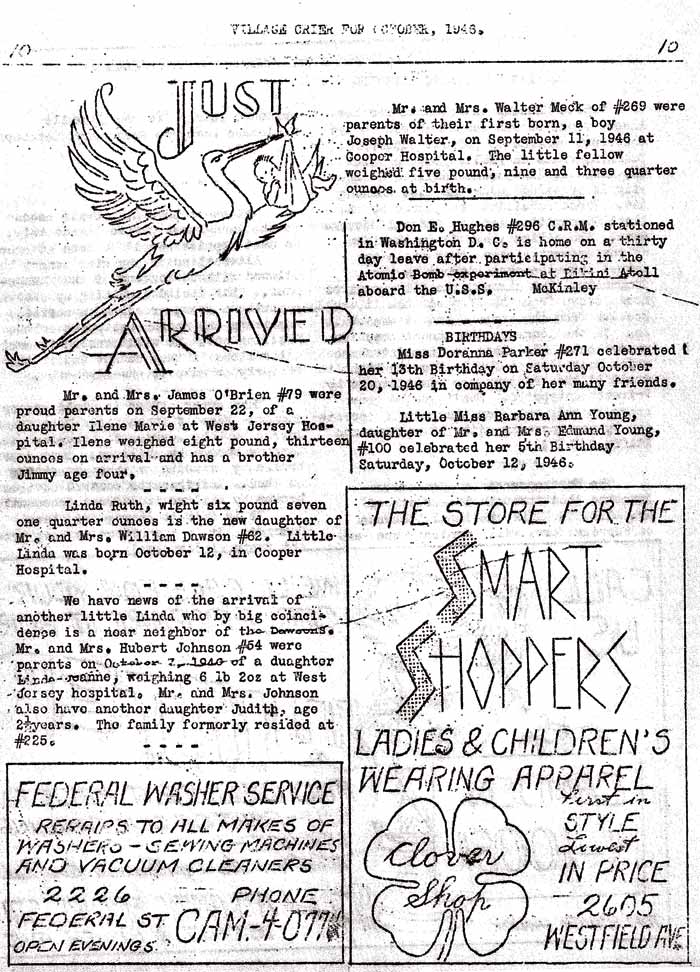
View transcription
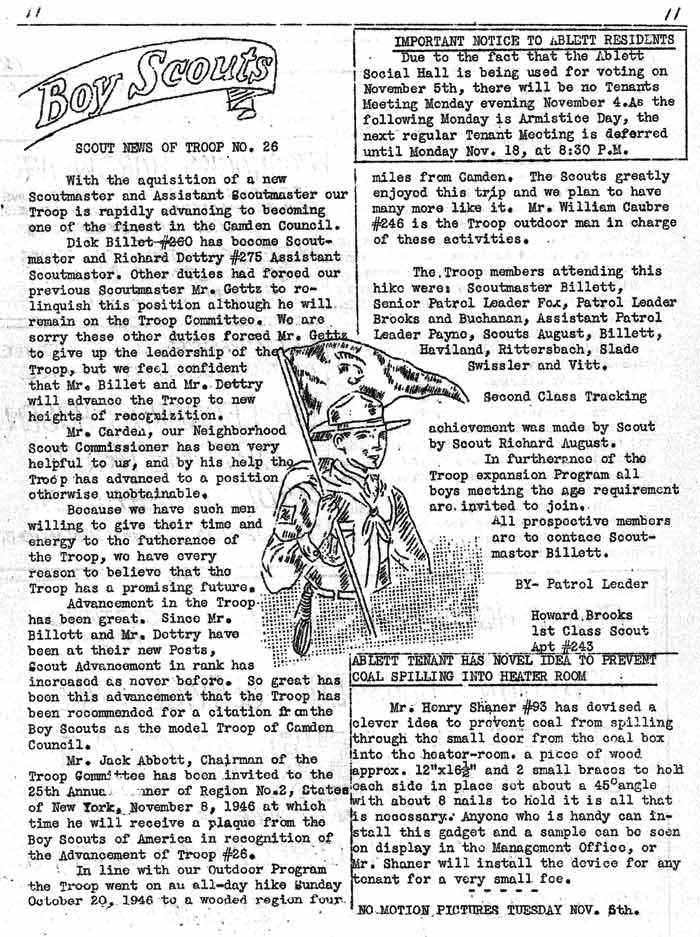
View transcription
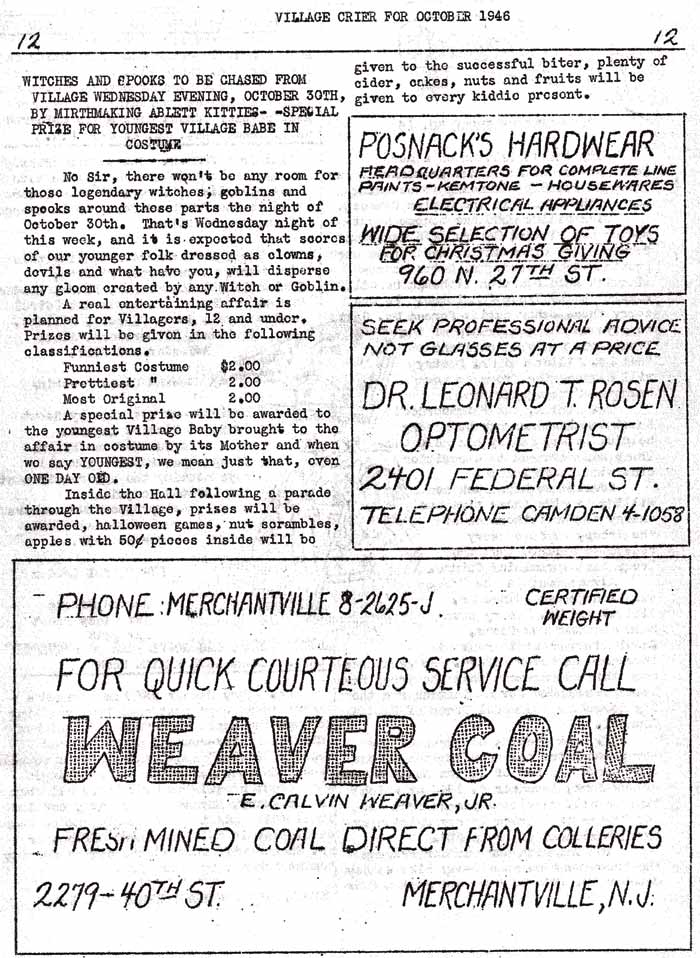
View transcription
Every page of the Crier has now been fully transcribed -- click “View transcription” beneath any page image above to read it.
Named: Page 1: William S. Gettz, Page 2: Mr. & Mrs. John Baker, Jack Clark, Kayann Dunn, Mr. & Mrs. James Dunn, Lester Blair, George Hill, Dr. Garrison, Elmer Pilarchik, Mr. & Mrs. Henry Shanor, William Shanor, Louis Koslowski, Mattie Fimiano, Mr. & Mrs. Rocco Fimiano, Theodore Kosowski, Mr. & Mrs. Edward Kosowski, Carol Ann Kosowski, Mr. & Mrs. Michael DiCicco, Louis DiCicco, Marie DiCicco, Page 3: L. Wayne McCormick, Leon T. Elwell, Dorothy Howe, Gustav Roedel, Diamond's Tailoring, Nathan Diamond, Irving Diamond, Joseph Diamond, Page 4: Albert Smith, Katherine Mayors, William Gettz, William Fisher, Marie Strang, Page 5: Wolf's Foods, Page 6: Ben's Cafe, Ben Niewinski, Page 7: Bill Longfellow, Norm "Peanuts" Longfellow, Frank Wagner, Joe Papaycik, Mr. & Mrs. Don Hughes, Dalton's Pharmacy, Page 9: Allen T. Kline, Tom Baker, Page 10: Mr. & Mrs. James O'Brien, Ilene Marie O'Brien, Jimmy O'Brien, Don E. Hughes, Mr. & Mrs. William Dawson, Linda Ruth Dawson, Doranna Parker, Mr. & Mrs. Hubert Johnson, Linda Jeanne Johnson, Judith Johnson, Mr. & Mrs. Walter Meck, Joseph Walter Meck, Mr. & Mrs. Edmund Young, Barbara Ann Young, Page 11: Dick Billett, Richard Dettry, Jack Abbott, Howard Brooks, Richard August, Henry Shaner, William Caubre, Page 12: Posnack's Hardware, Dr. Leonard T. Rosen, E. Calvin Weaver, and Weaver Coal.
Ablett Village — 1947
The 1947 Camden City Directory lists the occupants of Ablett Village. Those listings are recorded in the unit directory on the Ablett Village street page.
Memories of Ablett Village
My Uncle Roy and Aunt Hazel Walliser and my cousin Carol lived in Ablett Village. Carol is 3 years younger than me. Here are a couple of shots of Carol and Ablett Village.
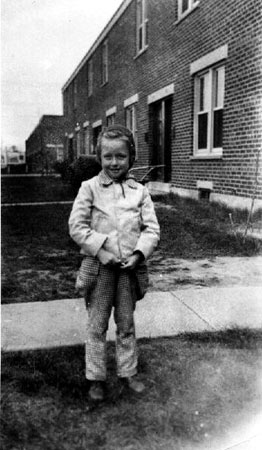
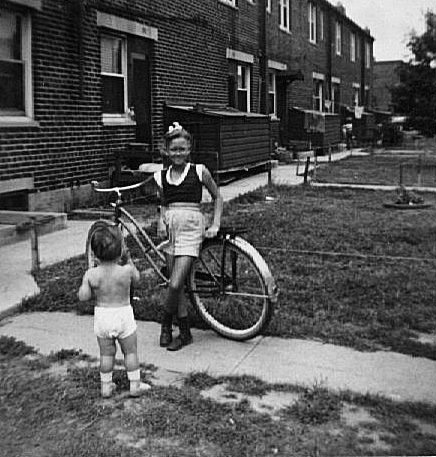
Carol Walliser at Ablett Village. To see more of Bernie's photos visit Railroad Days in Camden and Childhood Memories of East Camden.
Fats Domino at Ablett Village
My friend Bobby Dorton who lived in Ablett Village with his grandmother came over to my house one night around 10 p.m. and knocked on the door and my mother answered and Bobby was begging her to let me out. He told her that there was music coming out of the recording studio which was across the street from the village. Well, she finally let me out and we went over there.
We climbed up and over fence to the windows to watch and hear Fats Domino play and sing Red Sails In The Sunset and on the piano was a bottle of Piel's Beer. A bus was parked there with the name Fats and Dominos were painted on it.
Take notice to the two windows in front of the street sign these are the windows that we watched through.
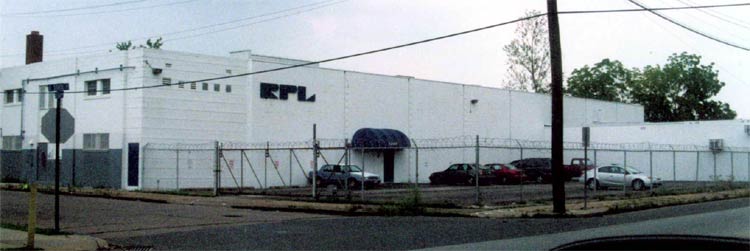
Recorded Publications Laboratories, across State Street from Ablett Village. Read more about Fats Domino in Camden.
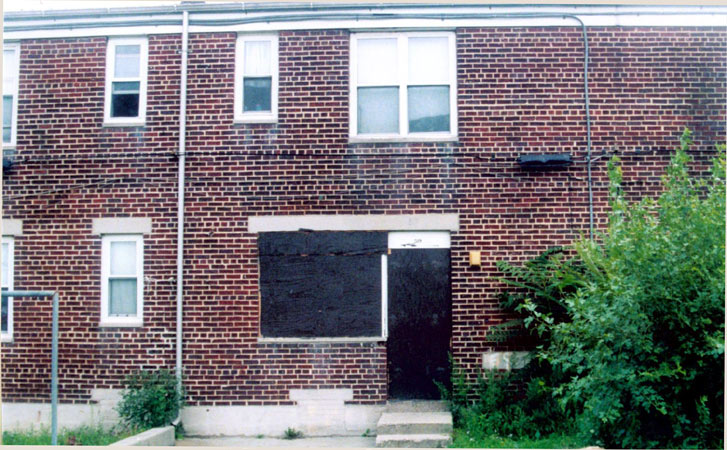
59 Ablett Village
59 Ablett Village. I lived there when they had coal bins. The bin was located to the left of the steps in the rear of the dwelling. Take notice to the area that has been blocked and cemented over. This was an access hole to the outside coal bin.
— Earl Crim, August 2004
The Fritschie Family
The Fritschie family lived at 264 Ablett Village in the 1960s and 1970s.
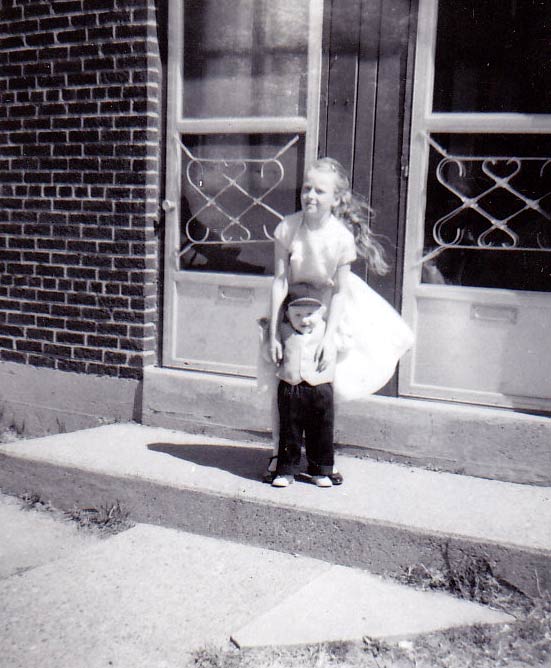
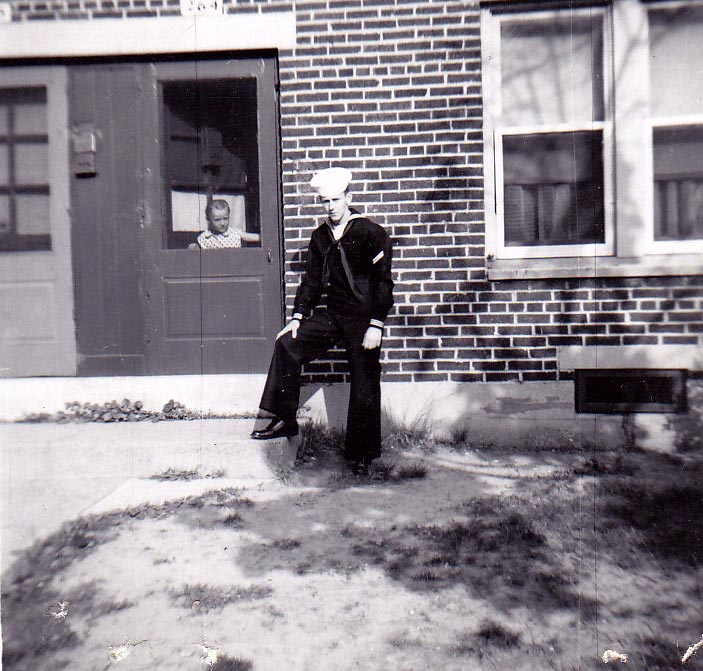
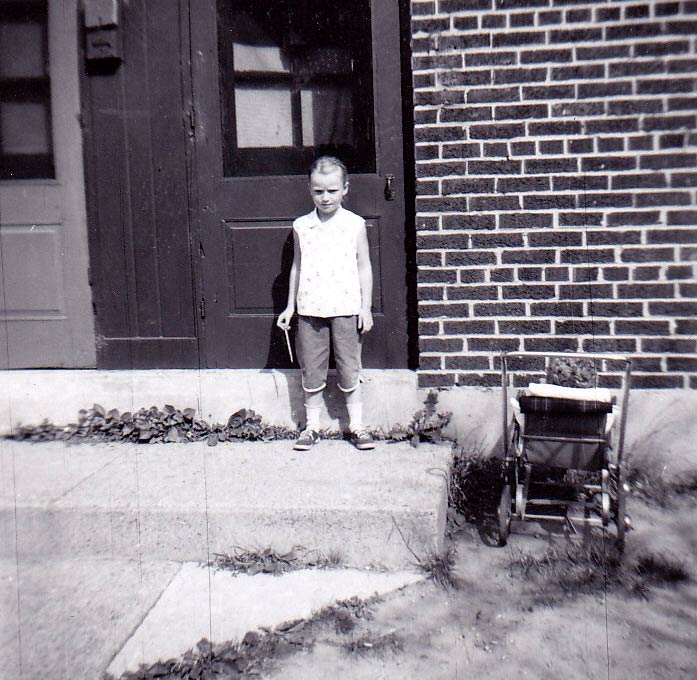
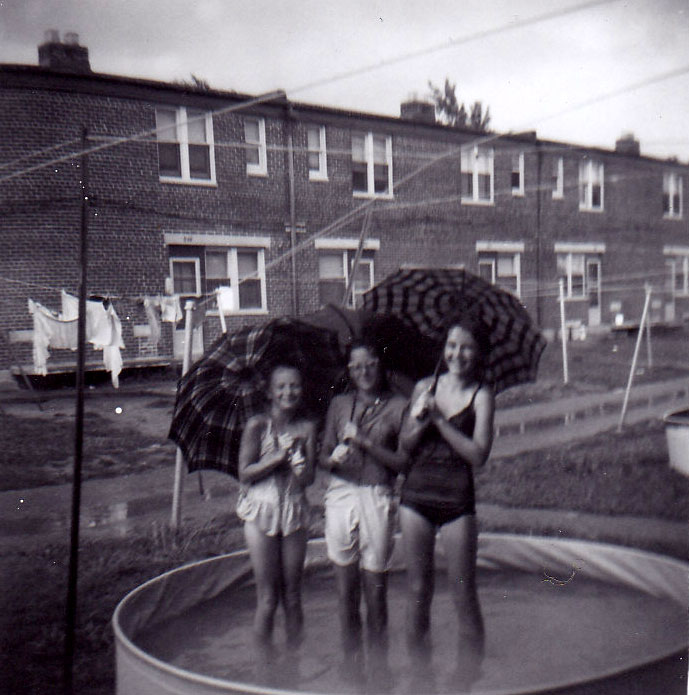
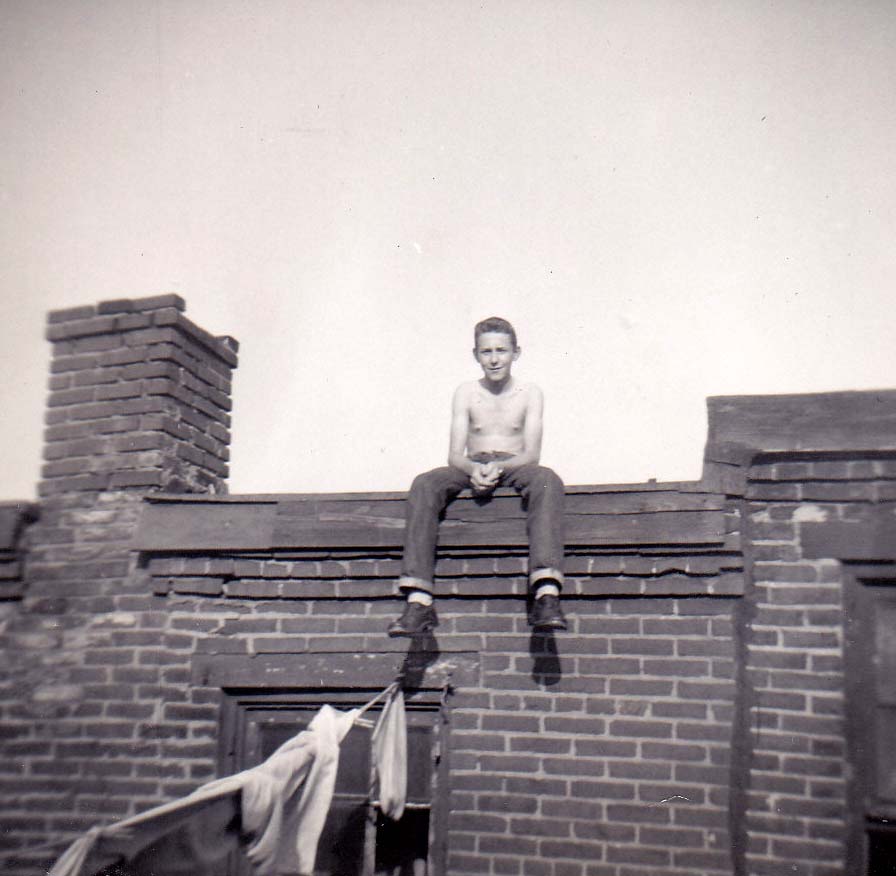
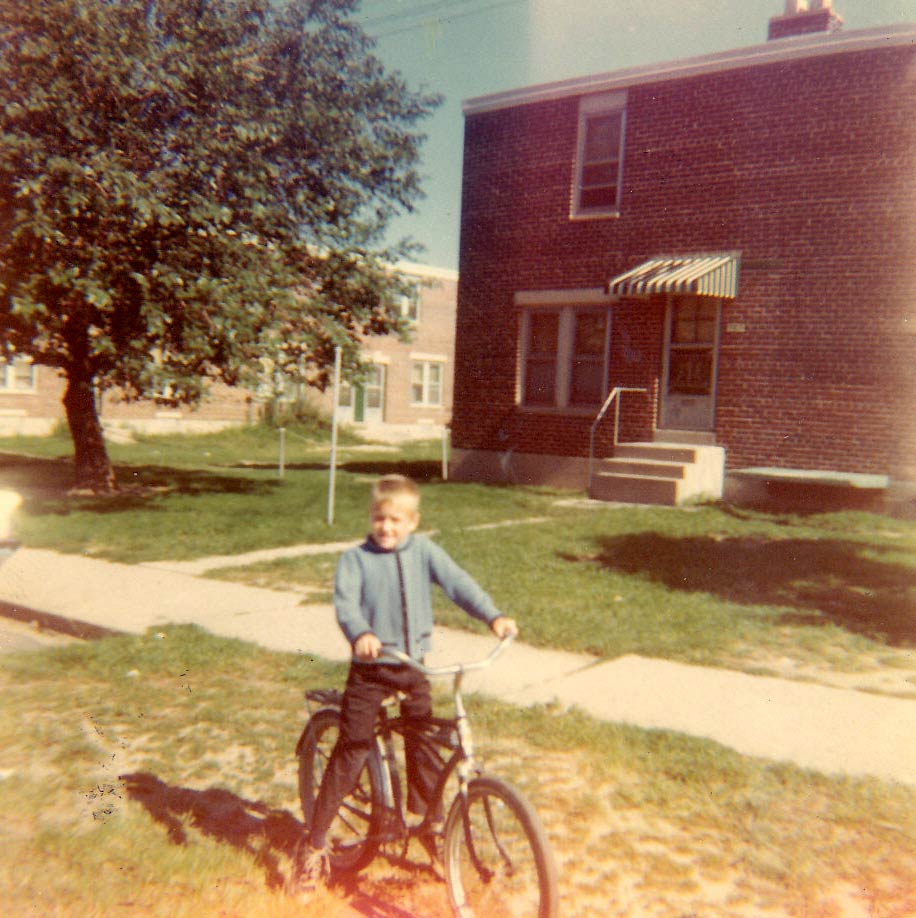
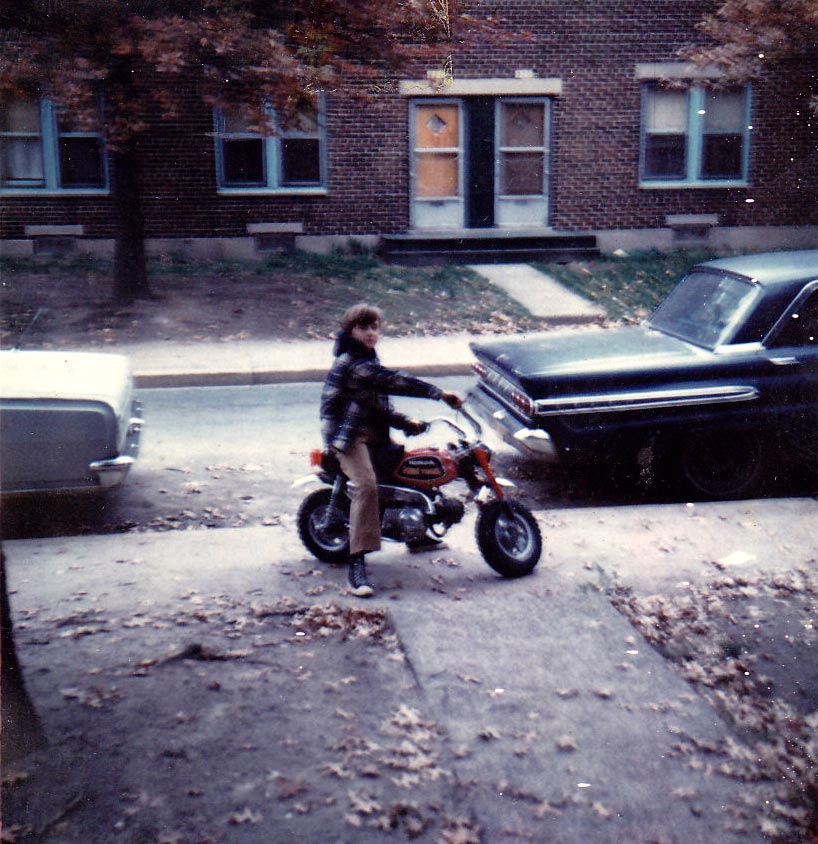
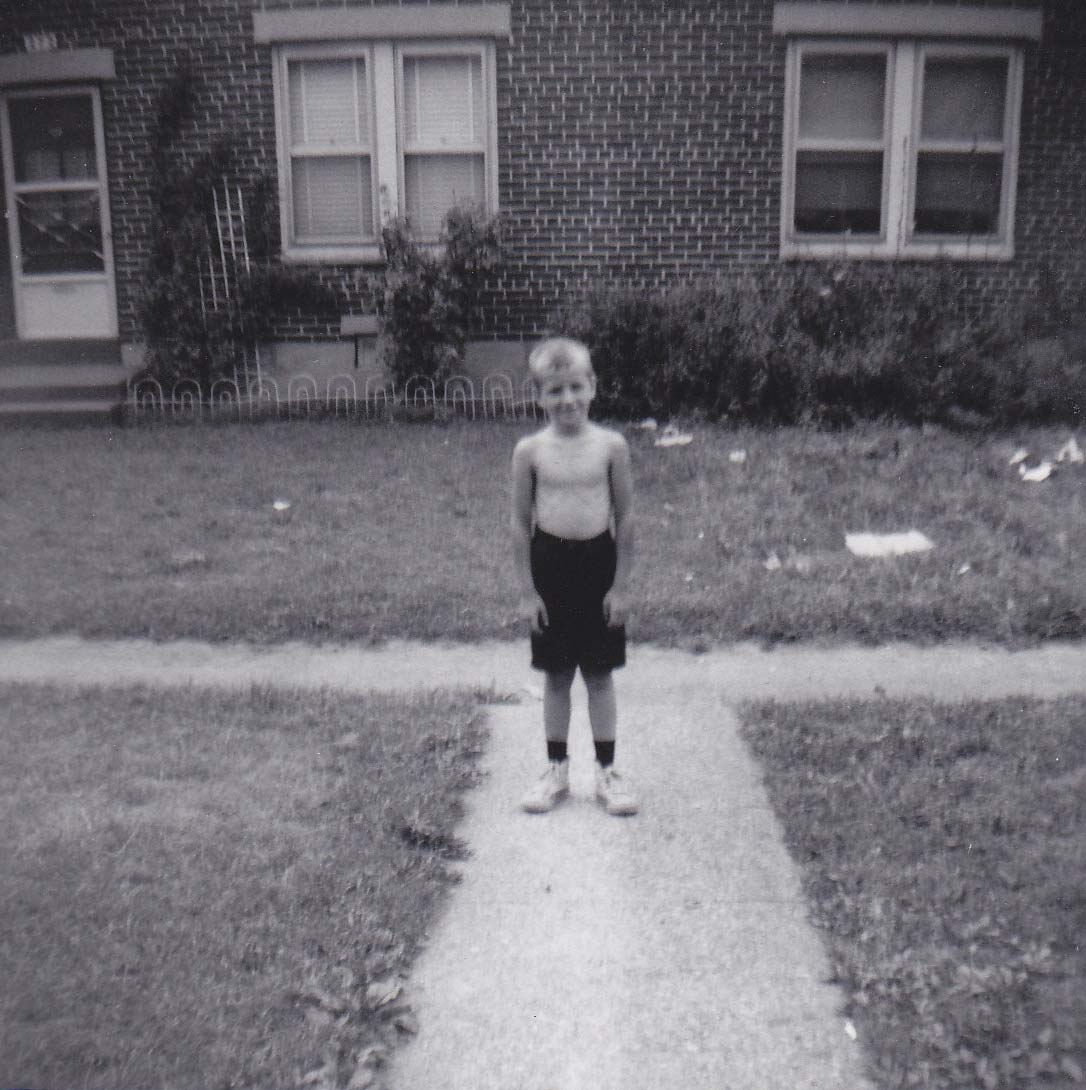
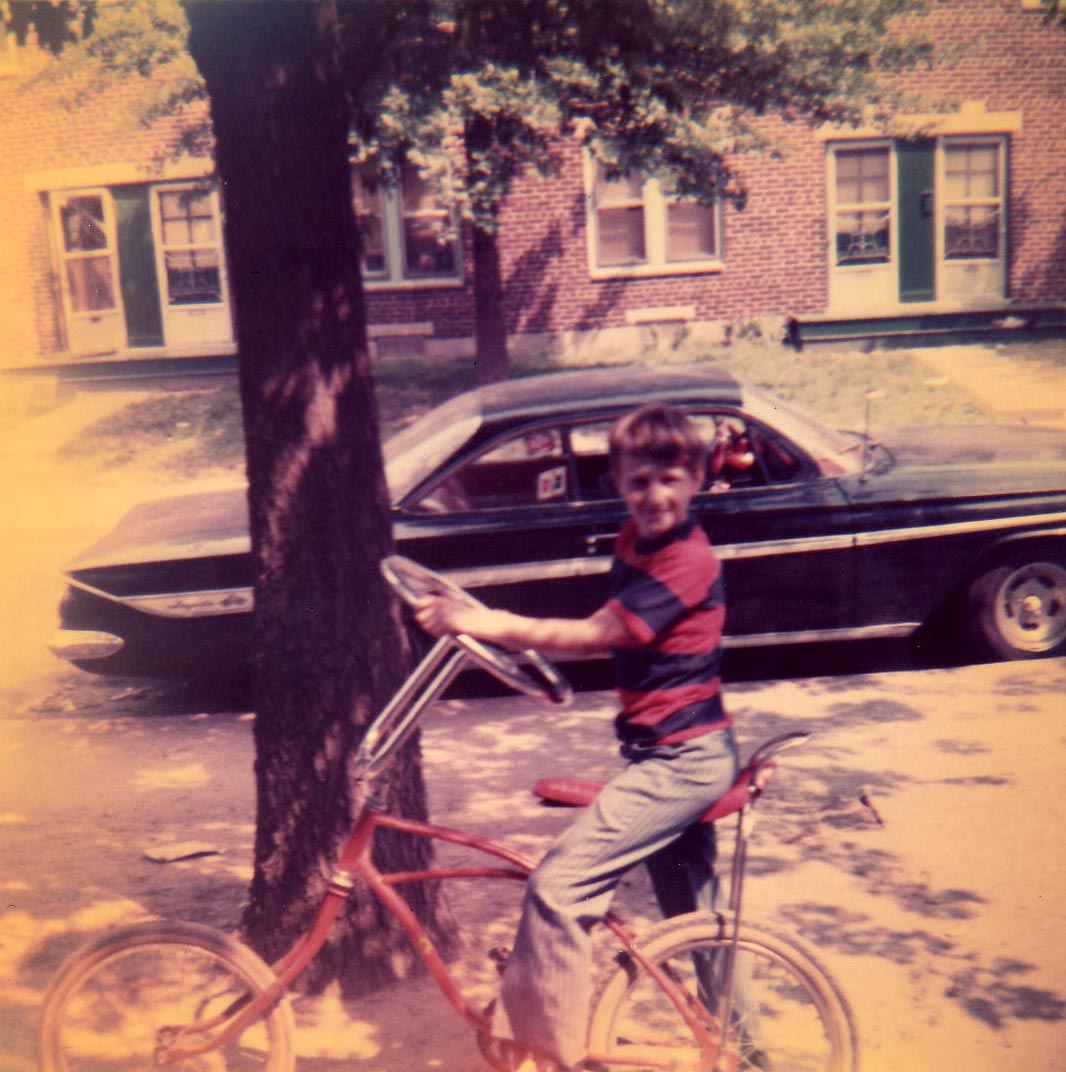
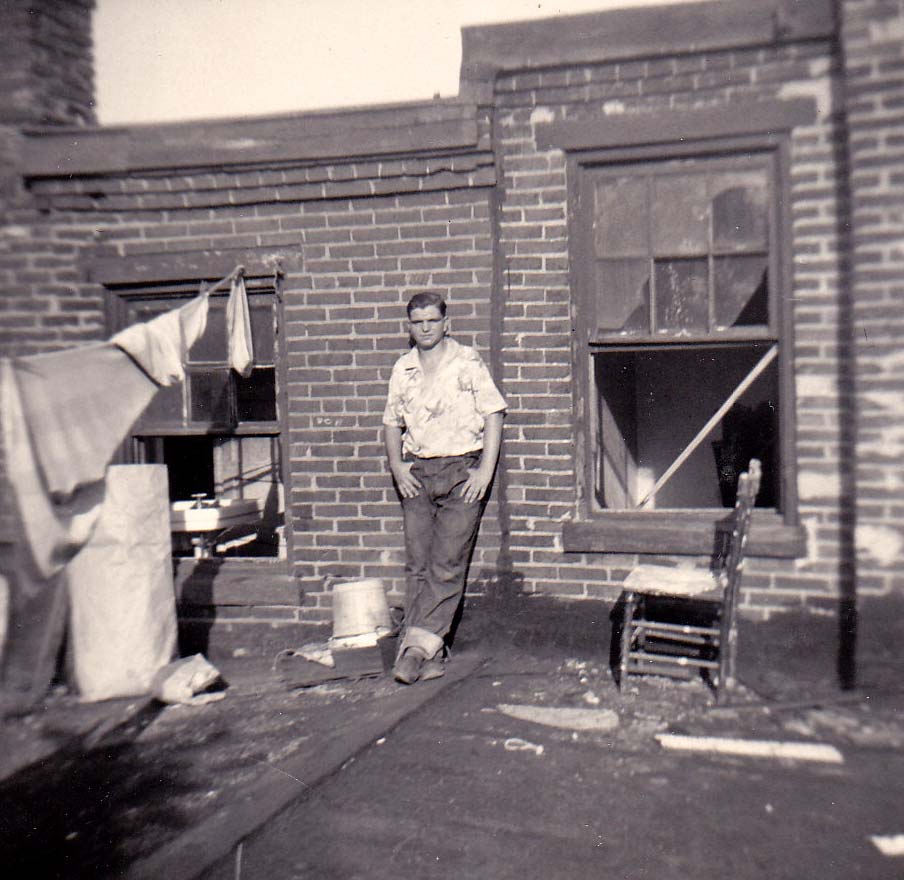
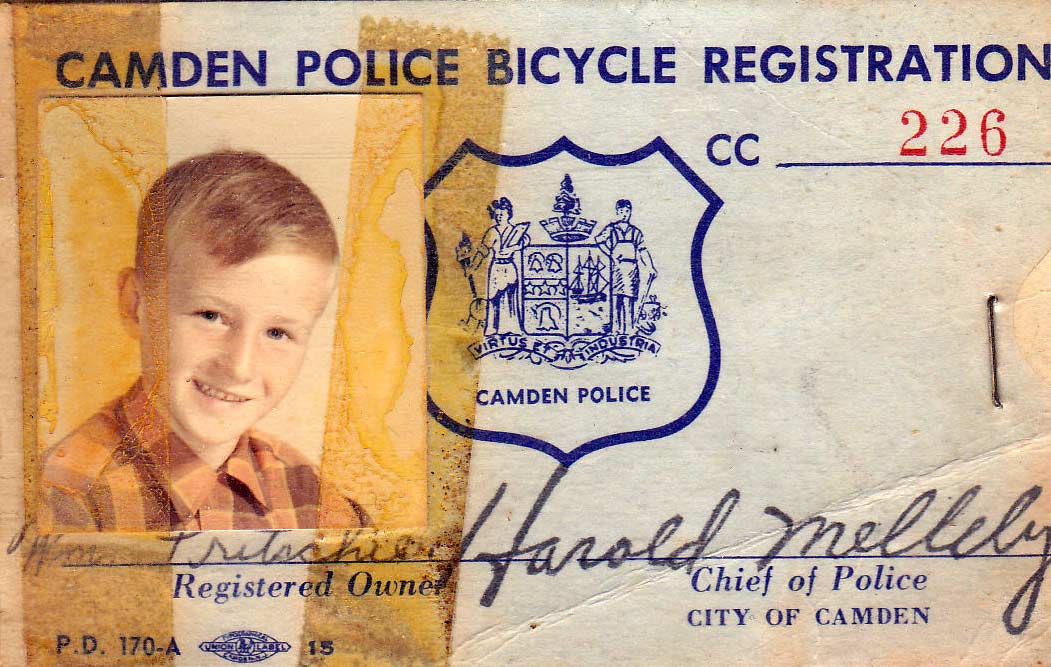
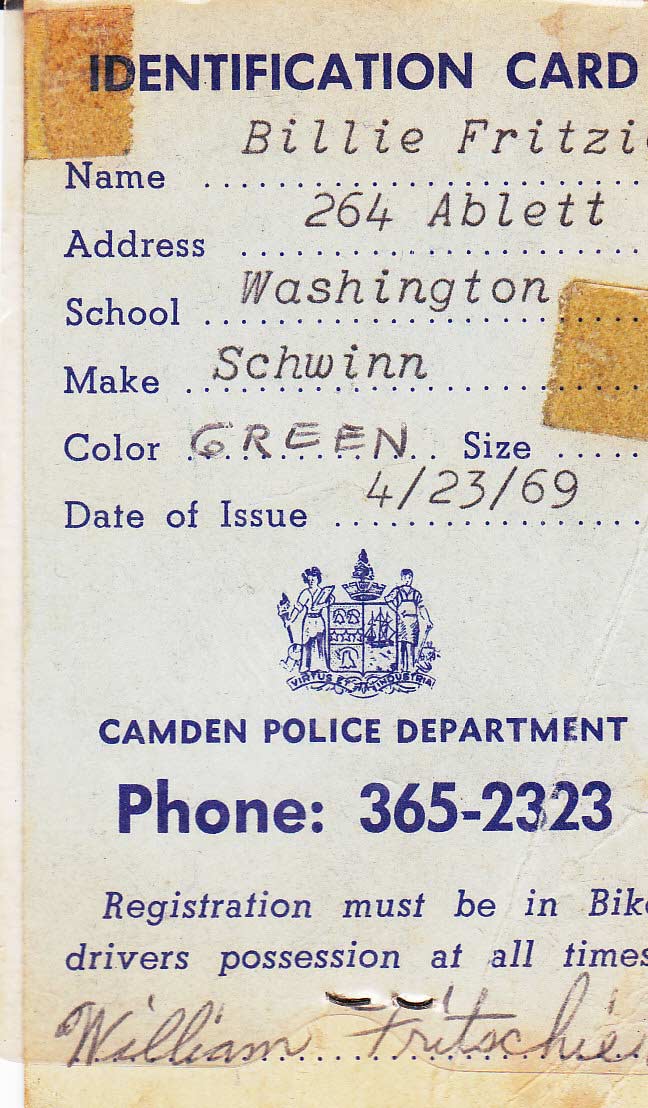
The Fritschie family at 264 Ablett Village, 1960s–1970s. Includes Mary Fritschie, William "Bill" Fritschie, and Robert "Bob" Fritschie. William's bicycle registration, April 23, 1969.
Ablett Village Memories — As told by those who have lived and worked there
My name is Kevin Hackett. My father was Charles and mother Bertha. I lived there when I was 4 years old to 6 years old, that was about 1960. I remember they did away with the coal bins that where on each apartment at that time. I lived in #274. I also remember that we had electric meters in the kitchens that operated on quarters. There was also a rec center. The bigger kids would throw me up on the roof to retrieve balls.
— Kevin Hackett, December 2005
I played baseball as a 16 yr old for the Ablett Village AA. [circa 1950] I still have my uniform.
— Richard A. Sullivan, March 2004
My name is Henry S. Pease III (Ted). We lived there at 195 in late 50's to 60's when our house burned down in North Camden. Living there was good until my parents got on their feet and bought a house in Cramer Hill.
— Ted Pease, March 2005
I can still remember my parents saying at night when we lived in Ablett Village "It's time to bank the heater" which meant adding enough coal to hold the fire over until the next morning. I remember the coal trucks and the coal bins and if a family was running out of coal they used to borrow some from the neighbors until they received their delivery. Jim Bessing has mentioned about sifting the ashes for un-burnt coal. I used to do that as a chore as my father made a square box with wire mesh on the top and we used to dump the ashes on the form and moved them around. It was amazing how much good coal was found. Talking about finding coal, we used to walk the railroad tracks and pickup coal that fell off the rail cars. We also saved the ashes or cinders for the ice and snow for traction. Coal heat wasn't the best heat and there were many nights my mother, my dad, myself and my sister would be in the vicinity of the grate, grill, or as we called it the register.
— Earl Crim, August 2004 (see also Heating Your House with Coal)
I grew up in Cramer Hill in Ablett Village and Arthur Avenue. I hung out with Gary Wilson, Bob Willis, Charlie Hans, Frannie Cline, Joe Becker, Bill Smith (Smitty) just to mention a few. When I was underage, the bums on 26th and River Road would go to the bar and get us beer. We would drink it on the corner of 26th & River Road across from the Pavonia House bar, there was an old hose there, sometimes the cops would come, break all of our bottles and tell us to get lost. We would go swimming in the Delaware River near the old dump on State Street. Also we would play chicken on the trains between 27th Street and the State Street Bridge. Man was that dangerous. There was a store on the other side of the State Street Bridge right before Federal Street that sold penny candy, won't see that again. I wonder sometimes whatever happened to all the good people that I used to know, I am 52 now and moved out of The Hill when I was 20, 1972. Well maybe some of the old-timers will find this site.
— Jim, September 2005
I remember the Mister Softee trucks coming thru Ablett Village and the Good Humor truck too. We would have one or two of us go up in a tree, then we would wait for the truck, right under the tree. The people in the tree would get on the roof and ride around for awhile. Sometimes the driver would get pissed and chase us with a baseball bat. We would go to the dump on State Street and find all kind of stuff. Mostly we would scrap the copper wire that RCA would dump and make some good money. The Delaware River was one of our playgrounds too, we would build rafts and swim a lot. I am 53 now, I left the Hill when I was 25. I went to Vets, does anyone remember Mr. Goldberg? He was the Vice Principal there, and man were we a bunch of class clowns. Frannie Cline, me, and Joe Becker were always shootin' spit balls in class, one day I hit Mrs. Bilson right in the eye, got suspended for two weeks. Also we would go to Mikes Sub Shop to eat lunch or Berries. There was a Deli on the corner of 21st & River Road across from Frank the barber, can't remember the name though. Frank the Barber was out to cut all of our hair, but we would have nothing of it. Long hair, bell bottom jeans and square tip boots were the style. My friends were Bobby Budd, Frannie Cline, Tommy Hawk, and a lot more. Anyway I live in Seattle, far from there now and hope to get back that way someday.
— Jim, October 2005
My first recollection of a neighborhood was Ablett Village near RCA. I have some pictures from that time. Next, the family moved to Hayes Avenue and I lived there until I went into the service around '68. I remember the "yum yum" man and the clothes prop guy. I also remember the waffle guy that used to come to Ablett Village with his horse drawn "waffle cart". My brothers our friends had a great time growing up in Cramer Hill. We were in the Boy's Club and did all the sports activities that were offered.
— Tom Sviben, February 2002
My name is Charles Moy, and I am now 62 years old, but way back in the mid 50's and again in 60 and 61, I lived in the Cramer Hill section of Camden. Perhaps we have met long, long ago. I have sort of have an unusual nickname… Skeeter. Now in Cramer Hill there was another fellow, a tall thin red haired guy called Skeeter, that's not me. I am short— 5'2" tall and used to be thin LOL, and looked a lot younger than I was. In Cramer Hill, I lived at 28th and Polk (50's) and Ablett Village (60 and 61). I joined The Army in 61. In East Camden, I lived on Rosedale Avenue (next to Dudley Grange Park), 29th and Westfield, and East State Street.
Also in the 50's I attended the following schools in those areas: Washington, Dudley, Sharp, h.h. davis, Cramer Junior High School. I would have went to Woodrow Wilson, but had to quit school in '59 to go to work.
People who I knew or hung out with in those days… Cramer Hill— Al Marioni, Peanut Colsey, Dorothy Seidleman, Richard, Tommy, Helen Harris, Bobbi Rodgers. Went to the dances at Davis School and the Youth Center, upstairs where Federal and Westfield meet, between 26th and 27th Streets. In East Camden… Fred and Leonard Kalt, Nancy and Rita Shisler, Bill McKnight, Charlie and Jean Holliday, Bruce Marks, Jesse Wilbourne, John Porter, Joe McCool, Phil Batchelor. Played little league baseball with the East Camden Marauders, behind the Acres. Coach was a fireman named Phil Stinger. Also in the '50s, I lived in North Camden at 5th and Penn, and between 2nd & 3rd on Main Street. Remember in the summer, all those trucks filled with tomatoes lined up on Main Street overnight waiting to deliver to Campbell Soup the next morning? I used to go to the following luncheonettes— Spot, Grapevine, Sugar Bowl, M&H, Mars, and others. Just thought I would post to see if any of this jogs your memory. Feel free to reply if any of this sounds familiar. Take care,
— Charlie Moy…Skeeter, December 2003
My dad, Charlie McIntyre—Woodrow Wilson class of '54—is from Cramer Hill. He grew up in Ablett Village.
— Victoria Kline, March 2004
I also have fond memories of the neighborhood around and leading up to Pyne Poynt. What about those Donuts or Cinnamon Buns from the State Street Bakery. How about Wolfe's Market on State Street across from Ablett Village. Riding to school on either the 12-80 or the #9 or #15 bus— this was a rare treat and only came about when you had the pocket change to do so if not you walked.
If there is anyone out there that can add a few lines to this please do so. Friends like Joyce Dill, Bev Hartz, Annie Martin, Susan French, Millie Kurth, Joann Kavalich, just to name a few of the opposite sex.
— Earl Crim, September 2004
I spent my first 5 years (1945–1950) in Ablett Village. I remember playing with Johnny Hopkins as well as my cousins Raymond, Jimmy and Carole Leporati who also lived there as did my sister Andrea.
— Bob Leporati, August 2006
My name was Kayann Dunn when we lived in Ablett Village. My dad worked at Warren Webster's when he started work there. We moved up from Ocean City— that was 1942, I was seven years old. I went to Washington school then Northeast school, the all girl school and across the street was the all boy school then I went to Vets and Wilson High. They were the good old days. I remember Wolf's store when he started out in a trailer. I remember the clothes-prop man and the Fuller Brush horse and buggy. The waffle guy all those things back then, plus a lot more when I was eleven we had a five cent movie in the village and my arm went through the window. A boy scout saved my life— my arm was hanging off, so they wired my arm back up and said I would never use it but I do, thanks to Doctor Cooper. When I think back in time it really makes me sad, things are so different today. My dad name is on the address you have on here James J. Dunn address 132.
— Kayann, August 2007
WOW! What a walk down memory lane! My sister Judy, and I lived in 276 Ablett Village from 1943 until 1949. My god-parents, Joe and Esta Winokur, and their children Anise and Gary lived next door in 277 (Anise and I are close to this day). My parents, Max and Rose Friedman, along with the Winokurs, migrated from the Bronx to Camden when WWII broke out and worked at the New York Shipyard. My best friends were Ray Leparati, Joey DiAngeles, George "Buddy" Seward, Charlie "Scotty" McIntyre, Leroy "Sonny" Knight, Jack Devenny, and Jackie Billett. The Assistant Scout Master of Troop 26 mentioned in the 1947 Village Voice, Dick Dettrey, (unit 275) was in the Navy during the War…an Ensign, I think. He brought me several souvenirs from the Pacific, took me swimming at the public pool near Camden High, and even taught me to drive. I think he went on to become a church pastor. Nick Malessa also helped with the Scouts. I remember one week-long camping trip when all our food spoiled. A bunch of our parents showed up unexpectedly, discovered our food shortage, promptly went shopping, and we had one scruptious hot dog dinner that night. I also remember the horse-drawn milk wagon from Supplee-Sealtest, an old man who came through pulling a little red wagon and selling big, fat, soft pretzels with mustard which he dipped out of a big jar with a (probably not too clean) stick, and Phil Plasky, a huckster, who sold produce from the back of his truck. During the war we had an Ablett village volunteer police force; many of our Dads were on it. I remember one summer day when a bunch of us were cooling off under the hose when our Dads came home from the shipyard. We turned the hose on them and they didn't say a word, but, a few minutes later, all of them came out in their bathing suits and we had a real father and son water fight. What a blast!
Even though Ablett Village was built as a low-rent housing project, you couldn't ask to live among nicer people. I have very fond memories of living there. It seemed like all the people around us were always pitching in on one community project or another. Or just making a neighborhood waffle lunch for all us kids. It saddened me to read about the drug gang problems there now, but even that stark revelation can't take away my memories.
— Allan Friedman, October 2009
My name is Howard Conover. My family and I lived in Ablett Village in the mid to late 1960's. Our address was 245 Ablett Village and I remember going to Sunday School just up the street at the Center that was there.
We moved from there to 21 South 42nd Street which was on the other side of Rte 130 on the border of Pennsauken.
My wife and I presently now live in Delaware but when I go to visit my sister in Fairview. I sometimes go past the houses I use to live in Collingswood and on 42nd Street in Camden.
I have wanted to sometime drive past the address I use to live at in Ablett Village but some people have told me that it is not even safe to drive there and take a look at where I use to live.
I can remember us burning leaves under the blue-green slates on the back of our place at night.
— Howard J. Conover, November 2009
From 1955–1967 I lived at 305 Ablett Village with my mother (Evelyn Pomponio) and my older brother (Harold Funk). Our house was on the last row facing the Camden City Dump. As a result, we had rats living under our outside steps and large roaches that were impossible to eradicate no matter how clean you kept your home. Vietnam was the only place where I saw roaches as large. Putting the rats and roaches aside, I had a very happy childhood in the "Village". I played endless hours of baseball and basketball behind the AV Community Center. My friends include Bruce Leary, Cliff Leary, Mike Cox, Betty Agigian, Cathy Hearn, John O'Toole, Buddy Woods, Bobby Pierce, Ben Trykowski, George Clarke and Nancy Clarke. I left the Village in 1967 and enlisted in the Army, but the lessons I learned growing up on "the wrong side of the tracks" has benefited me my entire life.
— John Pomponio, October 2019 (see also A Memory of 305 Ablett Village)
Tag: ablett-village
Ablett Village
Ablett Village is a public housing project at State Street and River Road in Camden, constructed during World War II and operated by the Housing Authority of the City of Camden. Named after William Stanley Ablett.

Bartholomew A. Sheehan
Bartholomew A. Sheehan was born on December 18, 1907, to Jeremiah and Mary (McCarthy) Sheehan.
A Child's Life on Grant Street: Memories of Camden
It all begins in a little row house (they call them townhouses now) on Grant Street in Camden NJ. I remember my mother telling me once that she and my father paid $3,000 for that house somewhere around 1952, when they married.
James H. O'Brien
James Henry O'Brien was born around 1894. He served as a Yeoman 3rd Class in the United States Navy during World War I and became active in veterans and civic affairs in Camden, NJ, after the war.

New Camden Cemetery
New Camden Cemetery, at Mount Ephraim and Ferry Avenues in Camden, NJ, opened in 1887 and holds veterans' plots and historic Jewish sections.
Frank J. Suttill
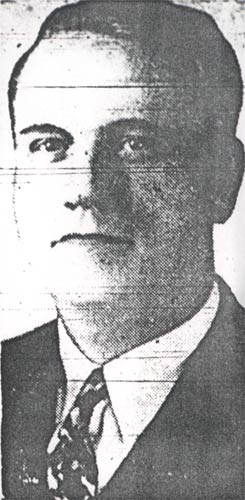
Frank J. Suttill, born on September 8, 1893, in Pennsylvania, made significant contributions to Camden County's political and civic life. His family relocated to Camden County in 1902, marking the beginning of his long association with the area.
A Memory of 305 Ablett Village
John Pomponio recalls living at 305 Ablett Village from 1955 to 1967, with memories of friends, baseball behind the community center, and eventually enlisting in the Army in 1967.
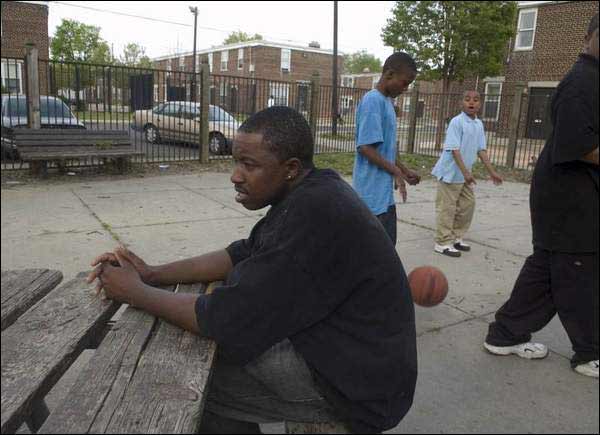
Ablett Village on the Edge
A 2008 Courier-Post report on drug dealing, three unsolved homicides and a proposed trespassing ordinance at Ablett Village, with residents largely unwilling to speak on the record. Camden Courier-Post, May 5, 2008.

Heating Your House with Coal
That center grate was also a good place to sneak a peek after you went to bed to see who was gathering in the dining room.
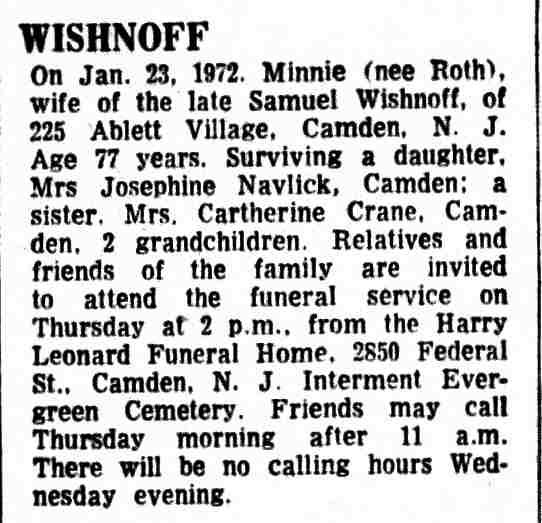
Wishnoff
Death notice for Minnie Roth Wishnoff, 77, of 225 Ablett Village, Camden — wife of the late Samuel Wishnoff. Camden Courier-Post, January 25, 1972.
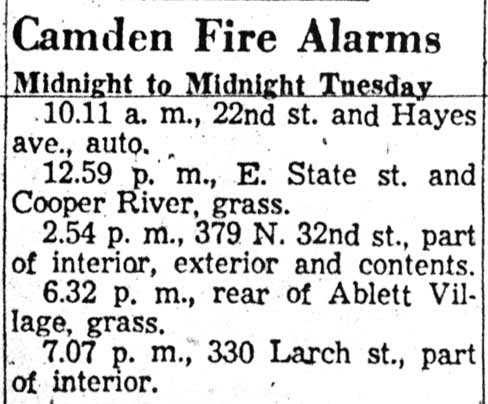
Camden Fire Alarms
A December 4, 1957 Camden Courier-Post list of fire alarms, including a fire at 330 Larch Street.
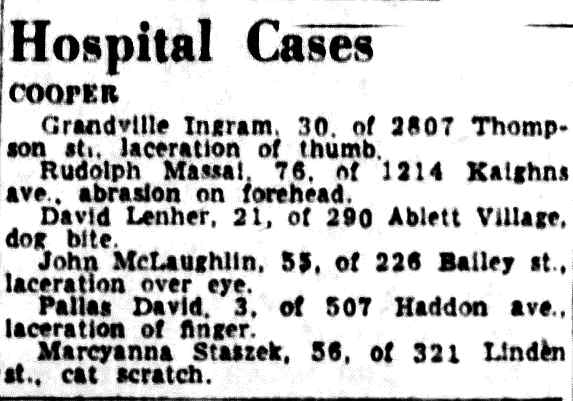
Hospital Cases
Cooper Hospital cases from December 1956, including David Lenher, 21, of 290 Ablett Village, treated for a dog bite. Camden Courier-Post, December 11, 1956.
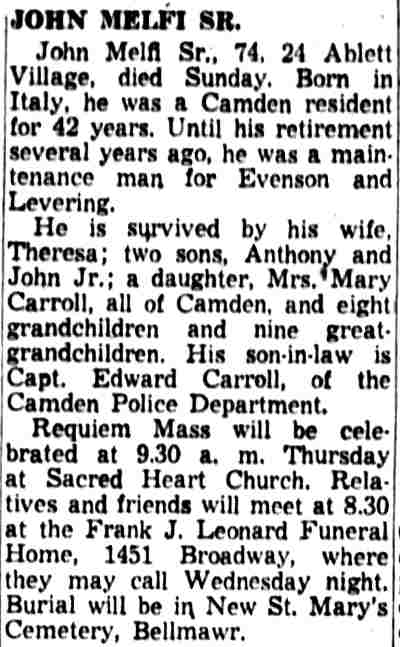
John Melfi Sr.
Obituary of John Melfi Sr., 74, of 24 Ablett Village, Camden — born in Italy, Camden resident for 42 years, maintenance man for Eavenson and Levering. Camden Courier-Post, December 11, 1956.
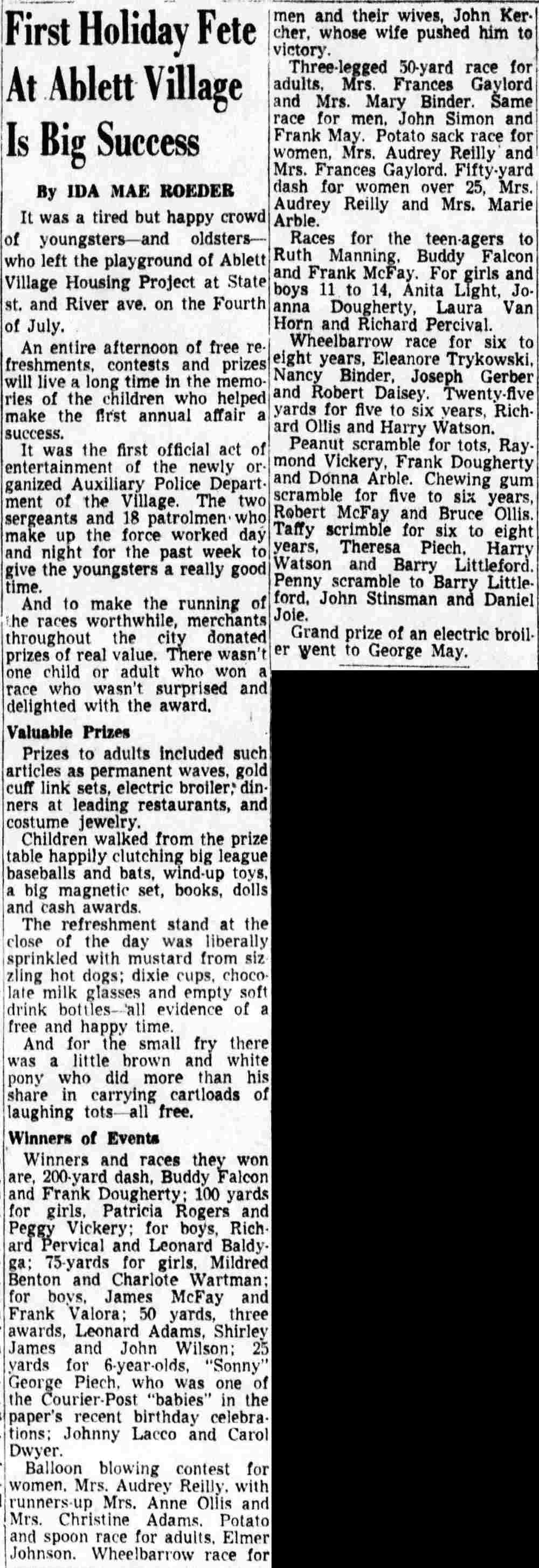
First Holiday Fete At Ablett Village Is Big Success
The newly organized Auxiliary Police Department of Ablett Village staged the project's first Fourth of July celebration, with races, donated prizes and a pony for the children. Camden Courier-Post, July 6, 1953.
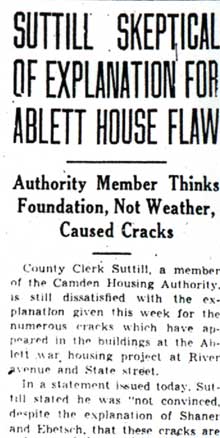
Suttill Skeptical of Explanation for Ablett House Flaw
Camden Housing Authority member Frank J. Suttill publicly doubted officials' explanation that weather, not foundation settlement, caused numerous cracks in the newly built Ablett Village buildings. Camden Courier-Post, November 1942.
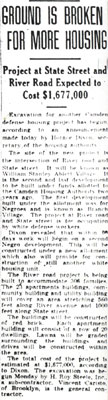
Ground Is Broken for More Housing
Excavation began at River Road and State Street for a $1,677,000, 306-family defense housing project to be known as William Stanley Ablett Village. Camden Courier-Post, June 11, 1942.
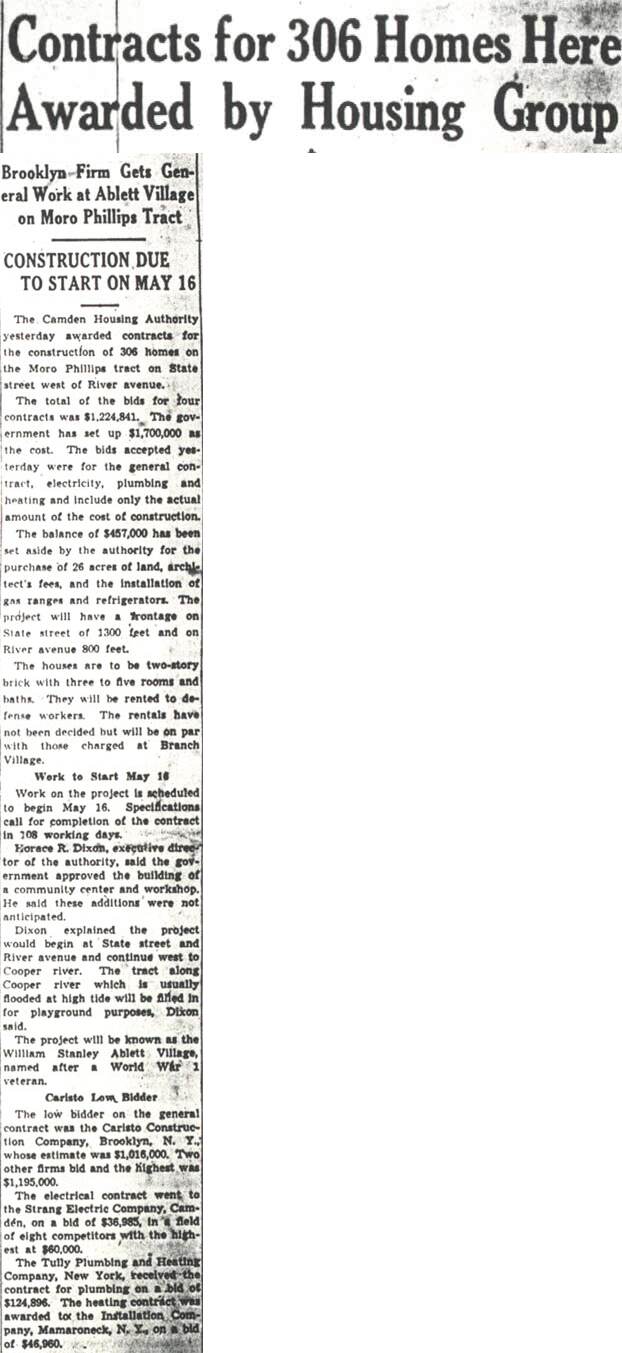
Contracts for 306 Homes Here Awarded by Housing Group
The Camden Housing Authority awarded four contracts totaling $1,224,841 for 306 homes on the Moro Phillips tract, to be known as the William Stanley Ablett Village. Camden Courier-Post, April 25, 1942.
The Third Project
A March 1942 account from "Housing in Camden" of how the Camden Housing Authority's third public housing project — a $1,409,000 development designated N.J. 10-2 — was funded, and how the rule was set that it be named for a Camden native killed in action.

Housing Plans in East Camden Okayed by U.S.
The Camden Housing Authority announced U.S. Housing Authority approval of a $1,566,000 defense housing project of 306 units on the south side of East State Street between Cooper Creek and River Avenue. Camden Courier-Post, January 17, 1942.