Klostermans Identified as Numbers Kings by 5 Witnesses
Camden Courier-Post, March 20, 1935
View transcription
Storekeeper Says His Place Was Used as ‘Drop’ for Gaming Slips
5 CONVICTS RECALLED FROM STATE PRISON
Five witnesses in Criminal Court yesterday placed their fingers on the Klosterman brothers, Joseph and Fred, as Camden numbers "barons," as they went on trial on 12 counts charging them with operating a lottery.
Each of the witnesses admitted under direct examination by Prosecutor Samuel P. Orlando they had been in the employ of the Klostermans at two of the three establishments they are alleged to have maintained.
John Frenia, 57, proprietor of a delicatessen store at 1413 Mt. Ephraim avenue, testified he worked for the Klostermans at the Young Republicans Seventh Ward Club, 1411 Mt. Ephraim avenue. He said the Klostermans used the club as a headquarters for their numbers bank. He further admitted his store was used as a numbers "drop" for the Klostermans and that packages of numbers were left at his store daily by "pick up" men and called for by either Fred or Joseph Kloster-
(Continued on Page Fourteen)
Camden Courier-Post, March 20, 1935
View transcription
5 WITNESSES NAME TWO KLOSTERMANS AS NUMBERS BARONS
Prosecution Recalls Five Convicted Men to Testify at Trial
USED CLUB FOR 'BLIND'
(Continued from Page One)
man. His wife, Pauline, corroborated his testimony.
Chester Topolski, 25, of 1230 Dayton street, testified he was employed as a janitor at the club and received money from the bank operators to be turned over to "pick up" to pay off winners.
Tells of Numbers Party
Another witness, Albert Magee, 45, colored, of Davistown near Westmont, told of a party which Fred Klosterman "threw for his 'numbers' writers at a Black Horse pike roadhouse. It was strictly a formal affair, Magee testified, and he was introduced to Fred Klosterman as "one of his numbers writers."
John Szalanski, 30, of 1188 Chestnut street, another witness testified he was employed by the Klostermans as a "pickup" man in the number business for three years. He worked for them until a few days after they were acquitted January 17 last in Criminal Court here of 30 joint "numbers" indictments.
The court adjourned at 4.03 p. m. until 10 a. m. today after Mrs. Frenia finished her testimony.
Seated in the court room near the exit to the county jail were five numbers writers, who suddenly lost their memory at the first trial of the Klostermans in January and were resentenced to serve from two to three years in state prison. They were Crawford Smith, 53, of 702 Carman street; Thomas Kirk, of 935 Carpenter street; Walter Hart, 28, of 1245 Thurman street; Andrew Pointkowski, 1475 South Ninth street, and Arthur Woodridge, 40, of 7910 Park avenue, Pennsauken. They were returned from Trenton for the trial and probably will be called by the state this morning.
It was indicated last night by the prosecutor that these men are willing to talk.
Szalanski further testified he saw both Klosterman brothers in the Young Men's Seventh Ward Republican Club and at a taproom called the Chez La Joy, 1050 Mechanic street. The state charges the taproom and another establishment at 1051 Mechanic street were used by the Klostermans as headquarters for their illegal "numbers" racket.
Passed Bags of Slips
Frenia asserted that both Fred and Joseph Klosterman came into his store with bags containing "numbers" slips.
"I would pass them over to Leon Dabrowski, who worked in the Republican Club or to a man called "Sparrow" or another known to me only as 'Peaches'," Frenia testified.
Frenia told Prosecutor Orlando under direct examination that he could look from his second floor window directly into the second floor room of the Republican Club which is spearated [sic] by a five-foot alley:
"I could see men working over adding machines computing the daily play of the 'numbers' game," Frenia testified.
"One one [sic] occasion the adding machines were passed from the Republican Club across the alley into my second story room."
The witness said he was formerly employed by the Klostermans in their saloon business.
He further declared he received "numbers" slips from the Klostermans before and after their first trial in Criminal Court which resulted in acquittal because of lack of evidence produced by the state.
Szalanski further declared that he saw both Klosterman brothers in the Young Men's Seventh Ward Republican Club at 1411 Mt. Ephraim avenue and at a taproom called the Chez LaJoy at 1050 Mechanic street, which the state alleges were two of the three headquarters of the "numbers" bank operated by the Klostermans.
Tells of 'Counting Room'
"I saw both Fred and Joe Klosterman at the Republican Club last Summer in rooms on the second floor in which there were five adding machines for computing the daily 'numbers' play," testified Szalanski.
"On one occasion when one of the 'numbers' slips which I picked up, hit the daily number, Fred Klosterman paid me $500 to distribute to the writers who then gave it to the winners."
The Klostermans, represented by Carl Kisselman, are on trial on 12 joint indictments charging the operation of a "numbers" lottery. The true bills allege the brothers "unlawfully did keep a place with the intent that persons might resort thereto for the purpose of gambling at so-called game of numbers."
The indictments further charged the political club was used for unlawful lottery purposes between September 22, 1934, and January 31, 1935; that the taproom, Chez LaJoy and a dwelling at 1051 Mechanic street was so used between March 1, 1933, and July 31, 1934.
Szalanski, the first witness to definitely hook up the Klostermans with the "numbers" racket in Camden, said that he was employed by the brothers after a conference in a saloon at Mechanic and Liberty streets.
"I told the Klostermans I had no car and they advanced me $100 to buy an automobile," said the witness.
When the witness said he continued to work for the Klostermans as a "pickup man" during and after the first trial, which resulted in the court directing a verdict of acquittal because of lack of evidence, Judge Neutze questioned him:
"Do you mean to say that you turned money over to the Klostermans at the Republican Club after their last trial?"
"Yes," the witness replied.
Denies Intimidation
Szalanski admitted he was arrested two weeks ago in Philadelphia on "numbers" charges and is at liberty under bail.
Cross-examination of the witness by Kisselman failed to move Szalanski.
"Didn't the prosecutor's office try to intimidate you into testifying here?" asked Kisselman. "Didn't they tell you what happened to other 'numbers' witnesses when the prosecutor's office deemed their testimony was not satisfactory?"
The witness denied he had been intimidated or threatened into testifying.
"I know what is going on—I read the newspapers," he asserted.
Szalanski corroborated statements of Topolski, as to the identity of persons seen about the club.
Szalanski was recalled to the stand when court reconvened after the noon recess. He testified he worked
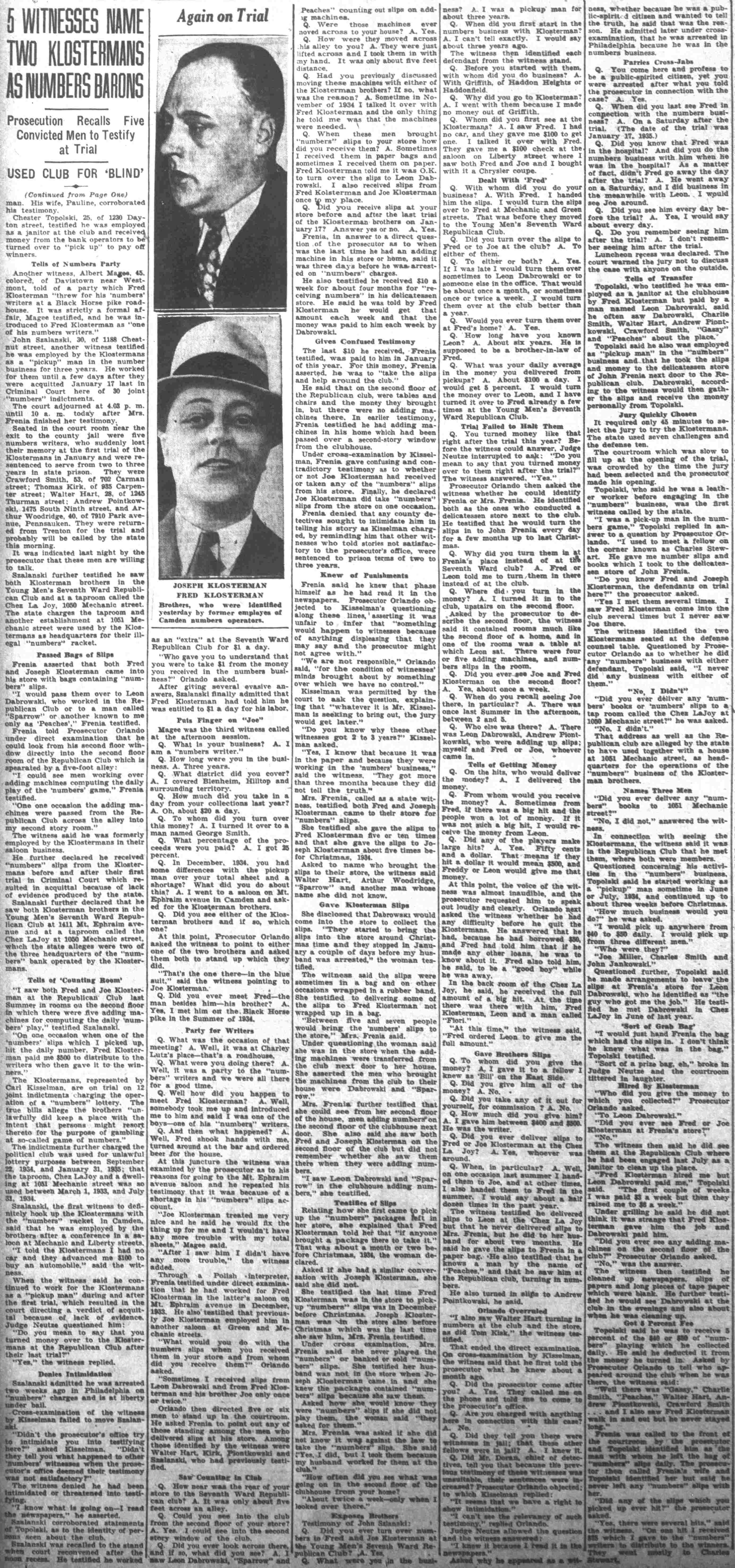
Again on Trial
JOSEPH KLOSTERMAN
FRED KLOSTERMAN
Brothers, who were identified yesterday by former employes of Camden numbers operators.
as an "extra" at the Seventh Ward Republican Club for $1 a day.
"Who gave you to understand that you were to take $1 from the money you received in the numbers business?" Orlando asked.
After giving several evasive answers, Szalanski finally admitted that Fred Klosterman had told him he was entitled to $1 a day for his labor.
Puts Finger on "Joe"
Magee was the third witness called at the afternoon session.
Q. What is your business? A. I am a "numbers writer."
Q. How long were you in the business. A. Three years.
Q. What district did you cover? A. I covered Blenheim, Hilltop and surrounding territory.
Q. How much did you take in a day from your collections last year? A. Oh, about $20 a day.
Q. To whom did you turn over this money? A. I turned it over to a man named George Smith.
Q. What percentage of the proceeds were you paid? A. I got 25 percent.
Q. In December, 1934, you had some differences with the pickup man over your total sheet and a shortage? What did you do about this? A. I went to a saloon on Mt. Ephraim avenue in Camden and asked for the Klosterman brothers.
Q. Did you see either of the Klosterman brothers and if so, which one?
At this point, Prosecutor Orlando asked the witness to point to either one of the two brothers and asked them both to stand up which they did.
"That's the one there—in the blue suit," said the witness pointing to Joe Klosterman.
Q. Did you ever meet Fred—the man besides him—his brother? A. Yes, I met him on the Black Horse pike in the Summer of 1934.
Party for Writers
Q. What was the occasion of that meeting? A. Well, it was at Charley Lutz's place—that's a roadhouse.
Q. What were you doing there? A. Well, it was a party to the "numbers" writers and we were all there for a good time.
Q. Well how did you happen to meet Fred Klosterman? A. Well, somebody took me up and introduced me to him and said I was one of the boys—one of his "numbers" writers.
Q. And then what happened? A. Well, Fred shook hands with me, turned around at the bar and ordered beer for the house.
At this juncture the witness was examined by the prosecutor as to his reasons for going to the Mt. Ephraim avenue saloon and he repeated his testimony that it was because of a shortage in his "numbers" slips account.
"Joe Klosterman treated me very nice and he said he would fix the thing up for me and I wouldn't have any more trouble with my total sheets," Magee said.
"After I saw him I didn't have any more trouble," the witness added.
Through a Polish interpreter, Frenia testified under direct examination that he had worked for Fred Klosterman in the latter's saloon on Mt. Ephraim avenue in December, 1933. He also testified that previously Joe Klosterman employed him in another saloon at Green and Mechanic streets.
"What would you do with the numbers slips when you received them in your store and from whom did you receive them?" Orlando asked.
"Sometimes I received slips from Leon Dabrowski and from Fred Klosterman and his brother Joe only once or twice."
Orlando then directed five or six men to stand up in the courtroom. He asked Frenia to point out any of those standing among the men who delivered slips at his store. Among those identified by the witness were Walter Hart, Kirk, Piontkowski and Szalanski, who had previously testified.
Saw Counting in Club
Q. How near was the rear of your store to the Seventh Ward Republican club? A. It was only about five feet across an alley.
Q. Could you see into the club from the second floor of your store? A. Yes. I could see into the second story window of the club.
Q. Did you ever look across there, and if so, what did you see? A. I saw Leon Dabrowski, "Sparrow" and "Peaches" counting out slips on adding machines.
Q. Were those machines ever moved across to your house? A. Yes.
Q. How were they moved across this alley to you? A. They were just lifted across and I took them in with my hand. It was only about five feet distance.
Q. Had you previously discussed moving these machines with either of the Klosterman brothers? If so, what was the reason? A. Sometime in November of 1934 I talked it over with Fred Klosterman and the only thing he told me was that the machines were needed.
Q. When these men brought "numbers" slips to your store how did you receive them? A. Sometimes I received them in paper bags and sometimes I received them on paper. Fred Klosterman told me it was O.K. to turn over the slips to Leon Dabrowski. I also received slips from Fred Kolsterman [sic] and Joe Klosterman once to my place.
Q. Did you receive slips at your store before and after the last trial of the Klosterman brothers on January 17? Answer yes or no. A. Yes.
Frenia, in answer to a direct question of the prosecutor as to when was the last time he had an adding machine in his store or home, said it was three days before he was arrested on "numbers" charges.
He also testified he received $10 a week for about four months for "receiving numbers" in his delicatessen store. He said he was told by Fred Klosterman he would get that amount each week and that the money was paid to him each week by Dabrowski.
Gives Confused Testimony
The last $10 he received, Frenia testified, was paid to him in January of this year. For this money, Frenia asserted, he was to "take the slips and help around the club."
He said that on the second floor of the Republican club, were tables and chairs and the money they brought in, but there were no adding machines there. In earlier testimony, Frenia testified he had adding machines in his home which had been passed over a second-story window from the clubhouse.
Under cross-examination by Kisselman, Frenia gave confusing and contradictory testimony as to whether or not Joe Klosterman had received or taken any of the "numbers" slips from his store. Finally, he declared Joe Klosterman did take "numbers" slips from the store on one occasion.
Frenia denied that any county detectives sought to intimidate him in telling his story as Kisselman charged, by reminding him that other witnesses who told stories not satisfactory to the prosecutor's office, were sentenced to prison terms of two to three years.
Knew of Punishments
Frenia said he knew that phase himself as he had read it in the newspapers. Prosecutor Orlando objected to Kisselman's questioning along these lines, asserting it was unfair to infer that "something would happen to witnesses because of anything displeasing that they may say and the prosecutor might not agree with."
"We are not responsible," Orlando said, "for the condition of witnesses' minds brought about by something over which we have no control."
Kisselman was permitted by the court to ask the question, explaining that "whatever it is Mr. Kisselman is seeking to bring out, the jury would get later."
"Do you know why these other witnesses got 2 to 3 years?" Kisselman asked.
"Yes, I know that because it was in the paper and because they were working in the 'numbers' business," said the witness. "They got more than three months because they did not tell the truth."
Mrs. Frenia, called as a state witness, testified both Fred and Joseph Klosterman came to their store for "numbers" slips.
She testified she gave the slips to Fred Klosterman five or ten times and that she gave the slips to Joseph Klosterman about five times before Christmas, 1934.
Asked to name who brought the slips to their store, the witness said Walter Hart, Arthur Woodridge, "Sparrow" and another man whose name she did not know.
Gave Klosterman Slips
She disclosed that Dabrowski would come into the store to collect the slips. "They started to bring the slips into the store around Christmas time and they stopped in January a couple of days before my husband was arrested," the woman testified.
The witness said the slips were sometimes in a bag and on other occasions wrapped in a rubber band. She testified to delivering some of the slips to Fred Klosterman not wrapped up in a bag.
"Between five and seven people would bring the 'numbers' slips to the store," Mrs. Frenia said.
Under questioning the woman said she was in the store when the adding machines were transferred from the club next door to her house. She asserted the men who brought the machines from the club to their house were Dabrowski and "Sparrow."
Mrs. Frenia further testified that she could see from her second floor of the house, men adding numbers on the second floor of the clubhouse next door. She also said she saw both Fred and Joseph Klosterman on the second floor of the club but did not remember whether she saw them there when they were adding numbers.
"I saw Leon Dabrowski and "Sparrow" in the clubhouse adding numbers," she testified.
Testifies of Slips
Relating how she first came to pick up the "numbers" packages left in her store, she explained that Fred Klosterman told her that "if anyone brought a package there to take it." That was about a month or two before Christmas, 1934, the woman declared.
Asked if she had a similar conversation with Joseph Klosterman, she said she did not.
She testified the last time Fred Klosterman was in the store to pick-up "numbers" slips was in December before Christmas. Joseph Klosterman was in the store also before Christmas which was the last time she saw him, Mrs. Frenia testified.
Under cross examination, Mrs. Frenia said she never played the "numbers" or banked or sold "numbers" slips. She testified her husband was not in the store when Joseph Klosterman came in and she knew the packages contained "numbers" slips because she saw them.
Asked how she would know they were "numbers" slips if she did not play them, the woman said "they asked for them."
Mrs. Frenia was asked if she did not know it was against the law to take the "numbers" slips. She said "Yes, I did, but I took them because my husband worked for them at the club."
"How often did you see what was going on in the second floor of the clubhouse from your home?"
"About twice a week—only when I looked over there."
Exposes Brothers
Testimony of John Szalanski:
Q. Did you ever turn over numbers to Fred and Joe Klosterman at the Young Men's Seventh Ward Republican Club? A. Yes.
Q. What were you in the business? A. I was a pickup man for about three years.
Q. When did you first start in the numbers business with Klosterman? A. I can't tell exactly. I would say about three years ago.
The witness then identified each defendant from the witness stand.
Q. Before you started with them, with whom did you do business? A. With Griffith, of Haddon Heights or Haddonfield.
Q. Why did you go to Klosterman? A. I went with them because I made no money out of Griffith.
Q. Whom did you first see at the Klostermans? A. I saw Fred. I had no car, and they gave me $100 to get one. I talked it over with Fred. They gave me a $100 check at the saloon on Liberty street where I saw both Fred and Joe and I bought with it a Chrysler coupe.
Dealt With 'Fred'
Q. With whom did you do your business? A. With Fred. I handed him the slips. I would turn the slips over to Fred at Mechanic and Green streets. That was before they moved to the Young Men's Seventh Ward Republican Club.
Q. Did you turn the slips over to Fred or to Joe at the club? A. To either of them.
Q. To either or both? A. Yes. If I was late I would turn them over sometimes to Leon Dabrowski or to someone else in the office. That would be about once a month, or sometimes once or twice a week. I would turn them over at the club better than a year.
Q. Would you ever turn them over at Fred's home? A. Yes.
Q. How long have you known Leon? A. About six years. He is supposed to be a brother-in-law of Fred.
Q. What was your daily average in the money you delivered from pickups? A. About $100 a day. I would get 5 percent. I would turn the money over to Leon, and I have turned it over to Fred already a few times at the Young Men's Seventh Ward Republican Club.
Trial Failed to Halt Them
Q. You turned money like that right after the trial this year? Before the witness could answer, Judge Neutze interrupted to ask: "Do you mean to say that you turned money over to them right after the trial?" The witness answered, "Yes."
Prosecutor Orlando then asked the witness whether he could identify Frenia or Mrs. Frenia. He identified both as the ones who conducted a delicatessen store next to the club. He testified that he would turn the slips in to John Frenia every day for a few months up to last Christmas.
Q. Why did you turn them in at Frenia's place instead of at the Seventh Ward club? A. Fred or Leon told me to turn them in there instead of at the club.
Q. Where did you turn in the money? A. I turned it in to the club, upstairs on the second floor.
Asked by the prosecutor to describe the second floor, the witness said it contained rooms much like the second floor of a home, and in one of the rooms was a table at which Leon sat. There were four or five adding machines, and numbers slips in the room.
Q. Did you ever see Joe and Fred Klosterman on the second floor? A. Yes, about once a week.
Q. When do you recall seeing Joe there, in particular? A. There was once last Summer in the afternoon, between 2 and 5.
Q. Who else was there? A. There was Leon Dabrowski, Andrew Piontkowski, who were adding up slips; myself and Fred or Joe, whoever came in.
Tells of Getting Money
Q. On the hits, who would deliver the money? A. I delivered the money.
Q. From whom would you receive the money? A. Sometimes from Fred, if there was a big hit and the people won a lot of money. If it was not such a big hit, I would receive the money from Leon.
Q. Did any of the players make large hits? A. Yes. Fifty cents and a dollar. That means if they hit a dollar it would mean $500, and Freddy or Leon would give me that money.
At this point, the voice of the witness was almost inaudible, and the prosecutor requested him to speak out loudly and clearly. Orlando next asked the witness whether he had any difficulty before he quit the Klostermans. He answered that he had, because he had borrowed $50, and Fred had told him that if he made any other loans, he was to know about it. Fred also told him, he said, to be a "good boy" while he was away.
In the back room of the Chez La Joy, he said, he received the full amount of a big hit. At the time there was there with him, Fred Klosterman, Leon and a man called "Flori."
"At this time," the witness said, "Fred ordered Leon to give me the full amount."
Gave Brothers Slips
Q. To whom did you give the money? A. I gave it to a fellow I knew as 'Bill' on the East Side.
Q. Did you give him all of the money? A. No.
Q. Did you take any of it out for yourself, for commission? A. No.
Q. How much did you give him? A. I gave him between $400 and $500. He was the writer.
Q. Did you ever deliver slips to Fred or Joe Klosterman at the Chez La Joy? A. Yes, whoever was around.
Q. When, in particular? A. Well, on one occasion last summer I handed them to Joe, and at other times, I also handed them to Fred in the summer. I would say about a half dozen times in the past year.
The witness testified he delivered slips to Leon at the Chez La Joy but that he never delivered slips to Mrs. Frenia, but he did to her husband for about two months. He said he gave the slips to Frenia in a paper bag. He also testified that he knows a man by the name of "Peaches," and that he saw him at the Republican club, turning in numbers.
He also turned in slips to Andrew Pointkowski, he said.
Orlando Overruled
"I also saw Walter Hart turning in numbers at the club and the store, as did Tom Kirk," the witness testified.
That ended the direct examination. On cross-examination by Kisselman, the witness said that he first told the prosecutor what he knew about a month ago.
Q. Did the prosecutor come after you? A. Yes. They called me on the phone and told me to come to the prosecutor's office.
Q. Are you charged with anything here in connection with this case? A. No.
Q. Did they tell you there were witnesses in jail; that these other fellows were in jail? A. I knew it.
Q. Did Mr. Doran, chief of detectives, tell you that because the previous testimony of these witnesses was unsuitable, their sentences were increased? Prosecutor Orlando objected; to which Kisselman replied:
"It seems that we have a right to show intimidation."
"I can't see the relevancy of such testimony," replied Orlando.
Judge Neutze allowed the question and the witness answered:
"I knew it because I read it in the newspapers."
Asked why he appeared as a witness, whether because he was a public-spirited citizen and wanted to tell the truth, he said that was the reason. He admitted later under cross-examination, that he was arrested in Philadelphia because he was in the numbers business.
Parries Cross-Jabs
Q. You come here and profess to be a public-spirited citizen, yet you were arrested after what you told the prosecutor in connection with the case? A. Yes.
Q. When did you last see Fred in connection with the numbers business? A. On a Saturday after the trial. (The date of the trial was January 17, 1935.)
Q. Did you know that Fred was in the hospital? And did you do the numbers business with him when he was in the hospital? As a matter of fact, didn't Fred go away the day after the trial? A. He went away on a Saturday, and I did business in the meanwhile with Leon. I would see Joe around.
Q. Did you see him every day before the trial? A. Yes, I would say about every day.
Q. Do you remember seeing him after the trial? A. I don't remember seeing him after the trial.
Luncheon recess was declared. The court warned the jury not to discuss the case with anyone on the outside.
Tells of Transfer
Topolski, who testified he was employed as a janitor at the clubhouse by Fred Klosterman but paid by a man named Leon Dabrowski, said he often saw Dabrowski, Charlie Smith, Walter Hart, Andrew Piontkowski, Crawford Smith, "Gassy" and "Peaches" about the place.
Topolski said he also was employed as "pickup man" in the "numbers" business and that he took the slips and money to the delicatessen store of John Frenia next door to the Republican club. Dabrowski, according to the witness would then gather the slips and receive the money personally from Topolski.
Jury Quickly Chosen
It required only 45 minutes to select the jury to try the Klostermans. The state used seven challenges and the defense ten.
The courtroom which was slow to fill up at the opening of the trial, was crowded by the time the jury had been selected and the prosecutor made his opening.
Topolski, who said he was a leather worker before engaging in the "numbers" business, was the first witness called by the state.
"I was a pick-up man in the numbers game," Topolski replied in answer to a question by Prosecutor Orlando. "I used to meet a fellow on the corner known as Charles Stewart. He gave me number slips and books which I took to the delicatessen store of John Frenia.
"Do you know Fred and Joseph Klosterman, the defendants on trial here?" the prosecutor asked.
"Yes I met them several times. I saw Fred Klosterman come into the club several times but I never saw Joe there.
The witness identified the two Klostermans seated at the defense counsel table. Questioned by Prosecutor Orlando as to whether he did any "numbers" business with either defendant, Topolski said, "I never did any business with either of them."
"No, I Didn't"
"Did you ever deliver any 'numbers' books or 'numbers' slips to a tap room called the Chez LaJoy at 1050 Mechanic street?" he was asked.
"No. I didn't."
That address as well as the Republican club are alleged by the state to have used together with a house at 1051 Mechanic street, as headquarters for the operations of the "numbers" business of the Klosterman brothers.
Names Three Men
"Did you ever deliver any "numbers" books to 1051 Mechanic street?"
"No, I did not," answered the witness.
In connection with seeing the Klostermans, the witness said it was in the Republican Club that he met them, where both were members.
Questioned concerning his activities in the "numbers" business, Topolski said he started working as a "pickup" man sometime in June or July, 1934, and continued up to about three weeks before Christmas.
"How much business would you do?" he was asked.
"I would pick up anywhere from $40 to $50 daily. I would pick up from three different men."
"Who were they?"
"Joe Miller, Charles Smith and John Jankowski."
Questioned further, Topolski said he made arrangements to leave the slips at Frenia's store for Leon Dabrowski, who he identified as "the guy who got me the job." He testified he met Dabrowski in Chez LaJoy in June of last year.
'Sort of Grab Bag'
"I would just hand Frenia the bag which had the slips in. I don't think he knew what was in the bag," Topolski testified.
"Sort of a prize bag, eh," broke in Judge Neutze and the courtroom tittered in laughter.
Hired by Klosterman
"Who did you give the money to which you collected?" Prosecutor Orlando asked.
"To Leon Dabrowski."
"Did you ever see Fred or Joe Klosterman at Frenia's store?"
"No."
The witness then said he did see them at the Republican Club where he had been engaged last July as a janitor to clean up the place.
"Fred Klosterman hired me but Leon Dabrowski paid me," Topolski said. "The first couple of weeks I was paid $3 a week but then they raised me to $6 a week."
Under grilling he said he did not think it was strange that Fred Klosterman gave him the job and Dabrowski paid him.
"Did you ever see any adding machines on the second floor of the club?" Prosecutor Orlando asked.
"No," was the answer.
The witness then testified he cleaned up newspapers, slips of papers and long pieces of tape paper which were blank. He further testified he would see Dabrowski at the club in the evenings and also about when he was cleaning up.
Got 5 Percent Fee
Topolski said he was to receive 5 percent of the $40 or $50 of "numbers" playing which he collected daily. He said he deducted it from the money he turned in. Asked by Prosecutor Orlando to tell who appeared around the club when he was there, the witness said:
"Well there was "Gassy," Charlie Smith, "Peaches," Walter Hart, Andrew Piontkowski, Crawford Smith . . . and I also saw Fred Klosterman walk in and out but he never stayed long."
Frenia was called to the front of the courtroom by the prosecutor and Topolski identified him as the man with whom he left the bag of "numbers" slips daily. The prosecutor then called Frenia's wife and Topolski identified her but said he never left any "numbers" slips with her.
"Did any of the slips which you picked up ever hit?" the prosecutor asked.
"Yes, there were several hits," said the witness. "On one hit I received $15 which I gave to the "numbers" writers to distribute to the winners. They went mostly to Charles Stewart."