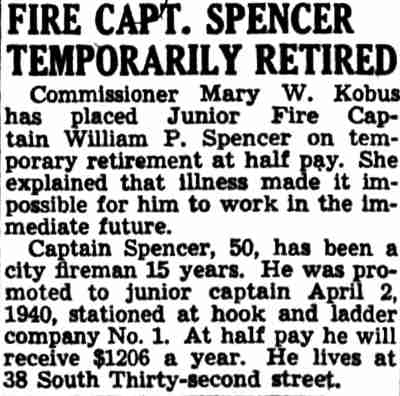
Fire Capt. Spencer Temporarily Retired
Commissioner Mary W. Kobus placed Junior Fire Captain William P. Spencer of 38 South Thirty-second Street on temporary retirement at half pay in April 1941 after illness left him unable to work.
Tag

Commissioner Mary W. Kobus placed Junior Fire Captain William P. Spencer of 38 South Thirty-second Street on temporary retirement at half pay in April 1941 after illness left him unable to work.

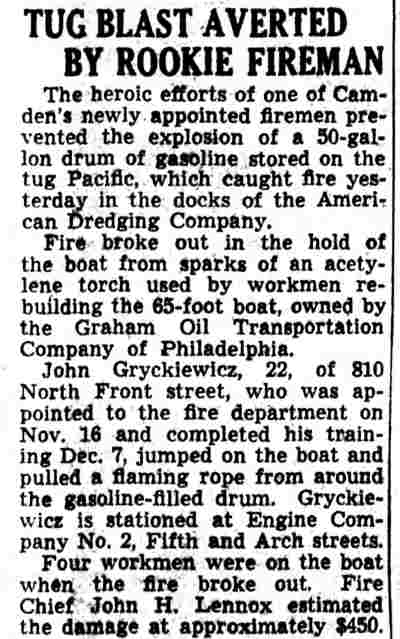
Newly appointed Camden fireman John Gryckiewicz pulled a flaming rope from around a 50-gallon gasoline drum aboard the tug Pacific at the American Dredging Company docks in December 1940, preventing an explosion.
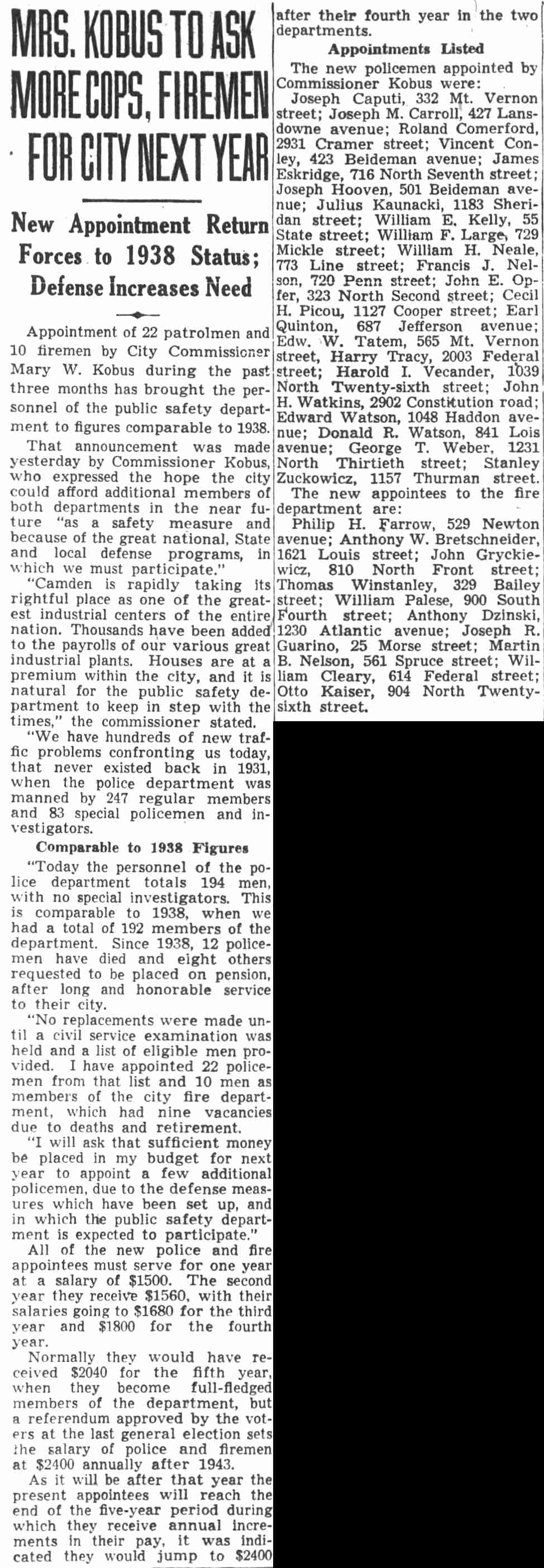
Camden Public Safety Commissioner Mary W. Kobus announced in December 1940 that her appointment of 22 patrolmen and 10 firemen had restored the public safety department to 1938 strength, and said she would seek money for more officers because of defense needs; John Gryckiewicz of 810 North Front Street was among the fire appointees.

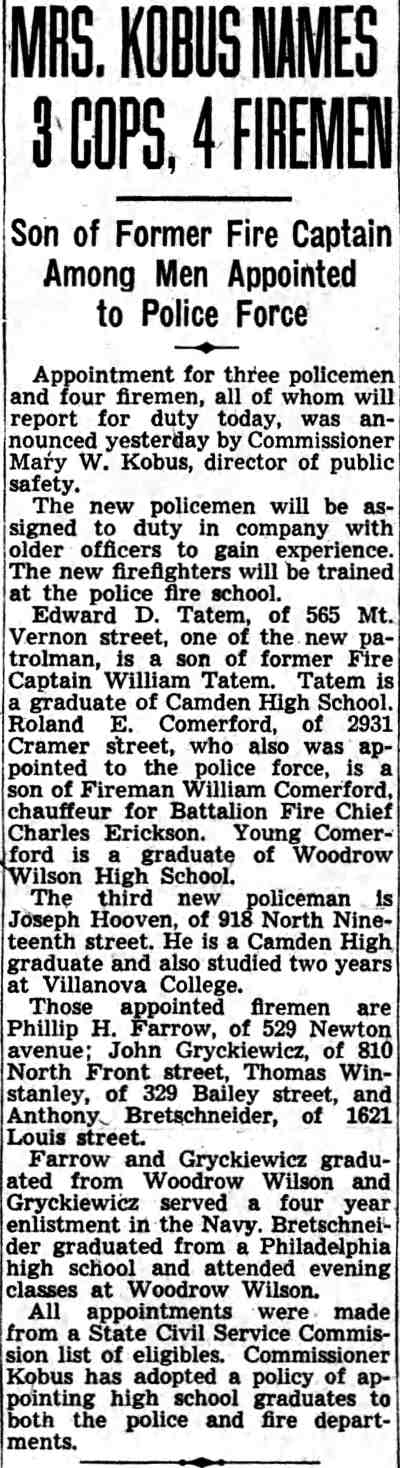
Commissioner Mary W. Kobus announced the appointment of three Camden policemen and four firemen in November 1940; among the new firefighters was John Gryckiewicz of 810 North Front Street.

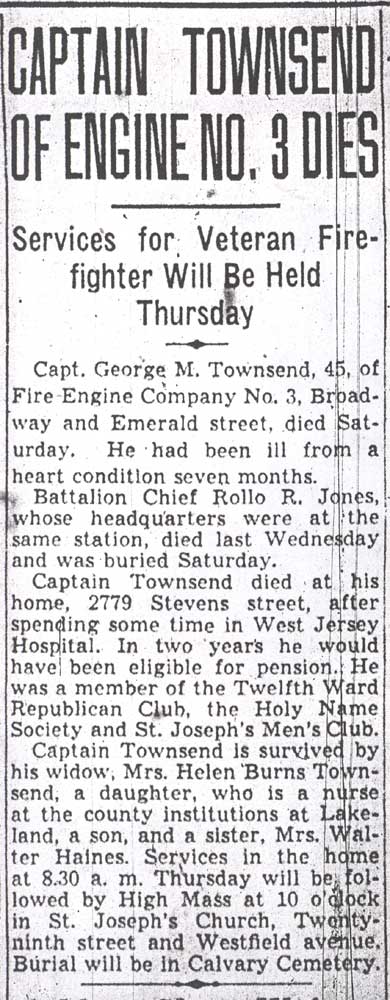
Camden Courier-Post, April 8, 1940. Capt. George M. Townsend, 45, of Fire-Engine Company No. 3 at Broadway and Emerald Street, died at his home on Stevens Street days after the death of Battalion Chief Rollo R. Jones of the same station.

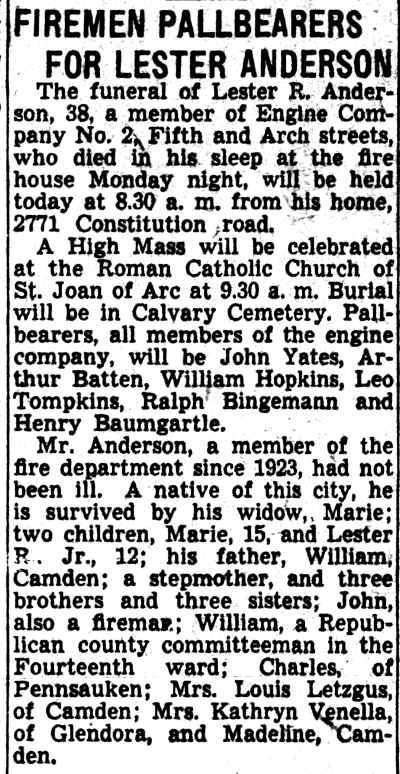
Funeral arrangements for Lester R. Anderson, 38, of Engine Company No. 2, who died in his sleep at the Fifth and Arch Streets fire house; Arthur Batten was among the pallbearers, all members of the engine company.

A three-alarm fire swept the wholesale store of the Antrim Hardware Company at 1514 and 1516 Federal Street, damaging $100,000 in stock, injuring several firemen and menacing nearby homes and the Standard Oil plant across the street.

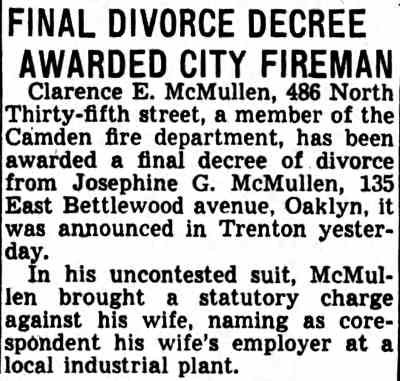
Camden fireman Clarence E. McMullen of 486 North Thirty-fifth Street was awarded a final decree of divorce from Josephine G. McMullen of Oaklyn in February 1939.

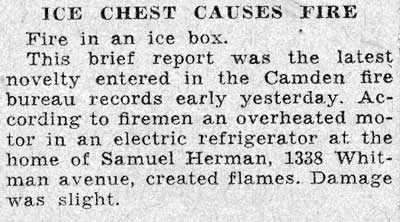
An overheated motor in an electric refrigerator caused a small fire at the home of Samuel Herman, 1338 Whitman Avenue. Camden Courier-Post, August 14, 1938.

Mrs. Anna Gleason, widow of Lester A. Gleason, was elected president of the Ladies' Auxiliary of the Camden Police and Firemen's Association at 1175 Whitman Avenue; Mrs. Mabel Batten was elected secretary.

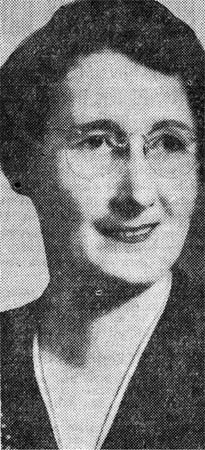
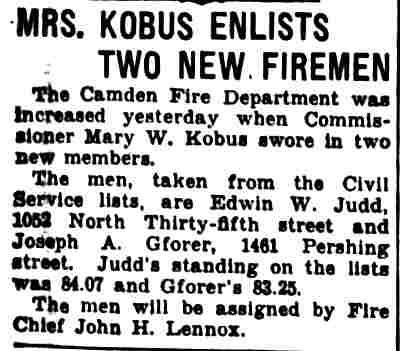
Commissioner Mary W. Kobus swore in two new members of the Camden Fire Department in April 1937 — Edwin W. Judd of 1052 North Thirty-fifth Street and Joseph A. Gforer of 1461 Pershing Street.

Junior Fire Captain Eli Hunt of Engine Company No. 3, 1813 Broadway, retired March 1 for disability, took formal leave of his comrades as Battalion Chief Charles Erickson and Commissioner Mary W. Kobus praised his service since 1918.

The second installment of Frank Sheridan's 1936 Courier-Post history of fire fighting in Camden traces the Weccacoe Fire Company, whose headquarters moved to the old City Hall lot on Federal Street, and the Mohawk, Independence and Shiffler volunteer companies.

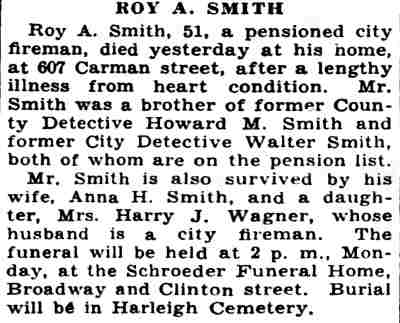
Roy A. Smith, 51, a pensioned city fireman living at 607 Carman Street, died after a lengthy illness from heart condition. He was brother to former County Detective Howard M. Smith and former City Detective Walter Smith.

A Camden fire engine bound for the fire training school and a Public Service bus collided on wet pavement at River Road and Federal Street, injuring fireman Harry Hess and four bus passengers.

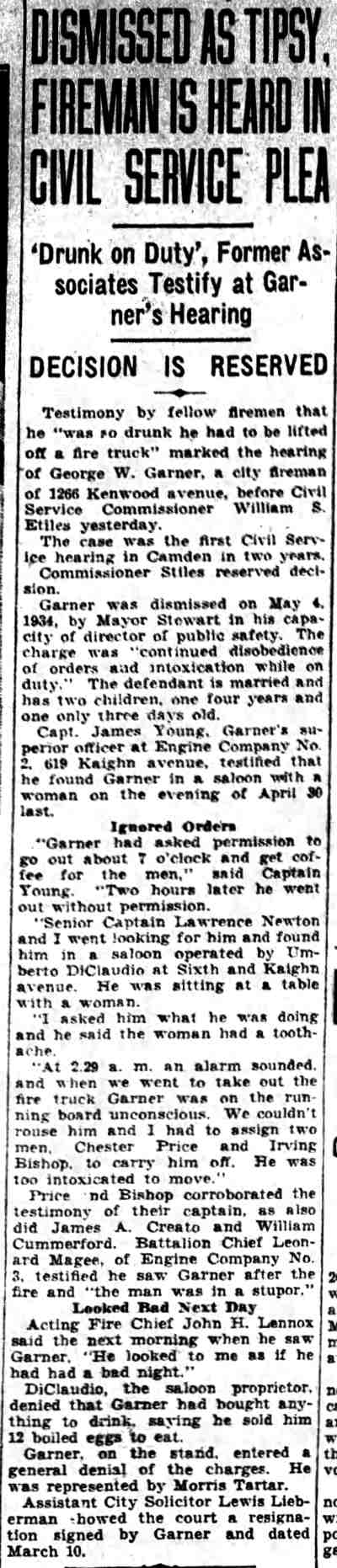
At the first Camden Civil Service hearing in two years, fellow firemen testified that dismissed fireman George W. Garner was found in a saloon at Sixth and Kaighn and was too drunk to be roused from a fire truck; the commissioner reserved decision.

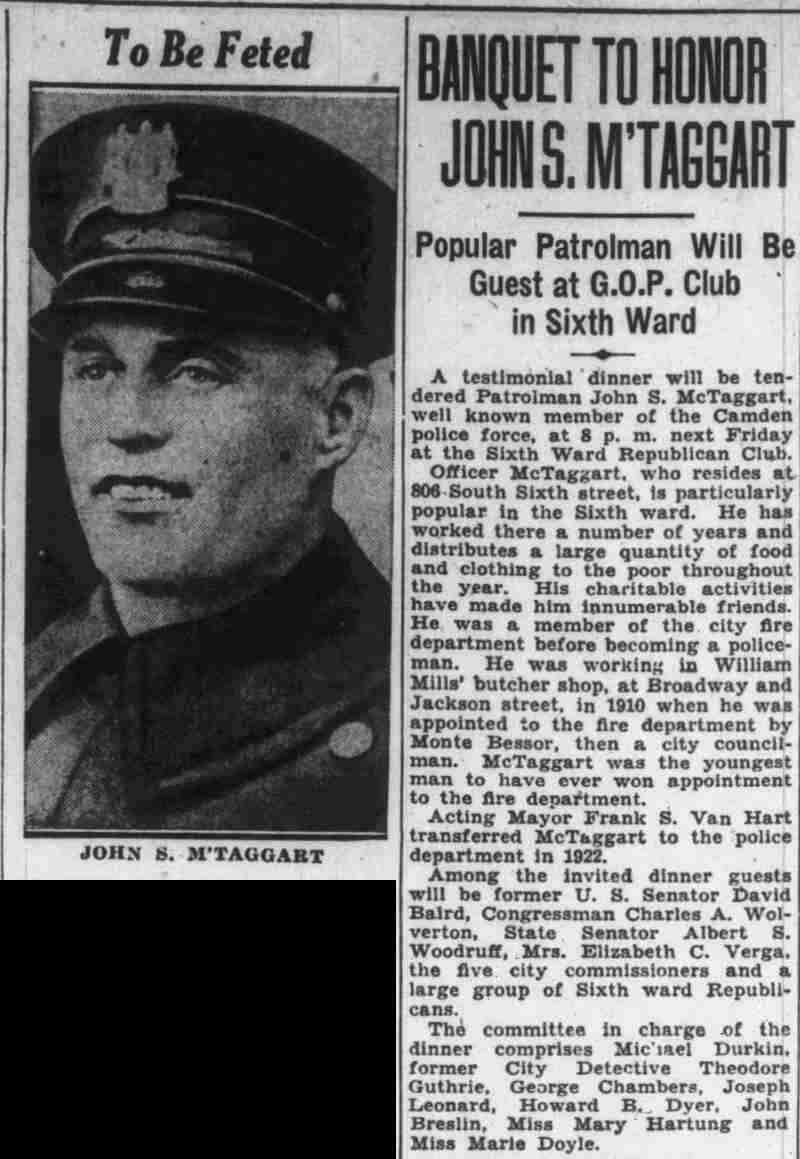
A testimonial dinner will be tendered Patrolman John S. McTaggart, well known member of the Camden police force, at the Sixth Ward Republican Club. He is particularly popular in the Sixth ward, where he distributes food and clothing to the poor.

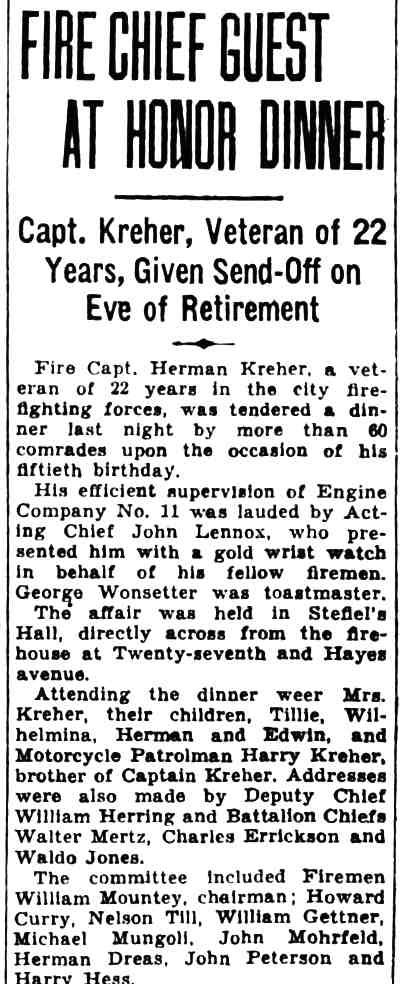
More than 60 comrades honored Fire Capt. Herman Kreher of Engine Company No. 11 at a dinner marking his fiftieth birthday and the eve of his retirement.

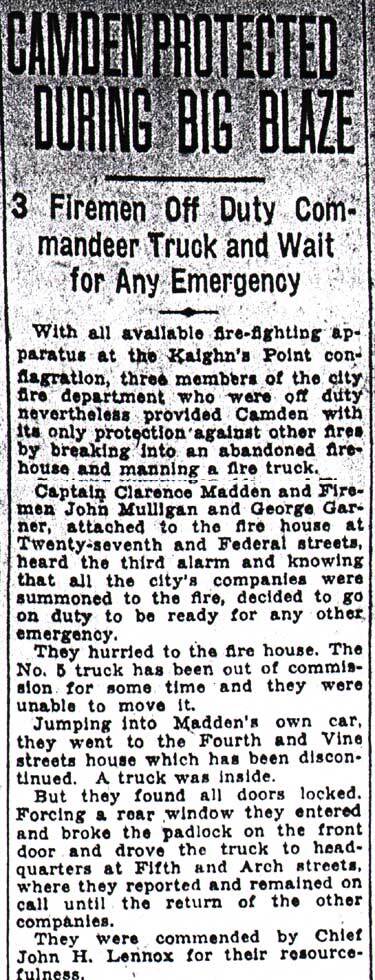
With all of Camden's apparatus at the Kaighn's Point conflagration, three off-duty firemen, Captain Clarence Madden and Firemen John Mulligan and George Garner, broke into the discontinued Fourth and Vine streets firehouse, drove its truck to headquarters at Fifth and Arch streets and stood by on call; Chief John H. Lennox commended them.

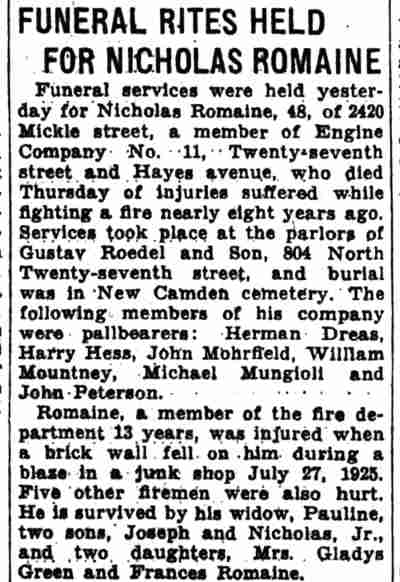
Funeral services were held in Camden for Nicholas Romaine, 48, a member of Engine Company No. 11, who died of injuries suffered fighting a junk-shop fire nearly eight years earlier.
Herbert Bott was re-elected president of the Camden Police and Firemen's Association on February 9, 1933, with William P. Spencer winning a three-cornered fight for vice president.
Notice of the February 9, 1933 election of officers of the Camden Police and Firemen's Association, with Herbert Bott unopposed for president. Russell Anderson was among ten candidates for fireman trustee.

Detective Robert Ashenfelter, wounded in the August 24, 1931 gun duel with a burglar at the American Store, Thirty-second Street and Pierce Avenue, and Accident Investigator John Sheeran applied for disability pensions before the Police and Firemen's Pension Commission.

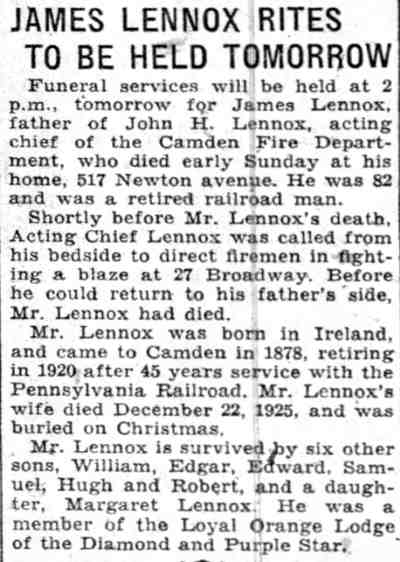
Funeral services were set for James Lennox, 82, a retired Pennsylvania Railroad man and father of acting Camden fire chief John H. Lennox, who died at his home at 517 Newton Avenue while his son was called away to fight a blaze at 27 Broadway.

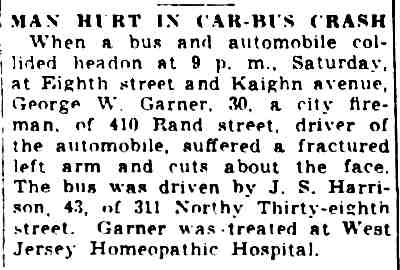
A December 1932 Camden Courier-Post report on a head-on collision between a bus and an automobile at Eighth Street and Kaighn Avenue; city fireman George W. Garner suffered a fractured arm, and the bus was driven by J. S. Harrison of 311 North 38th Street.

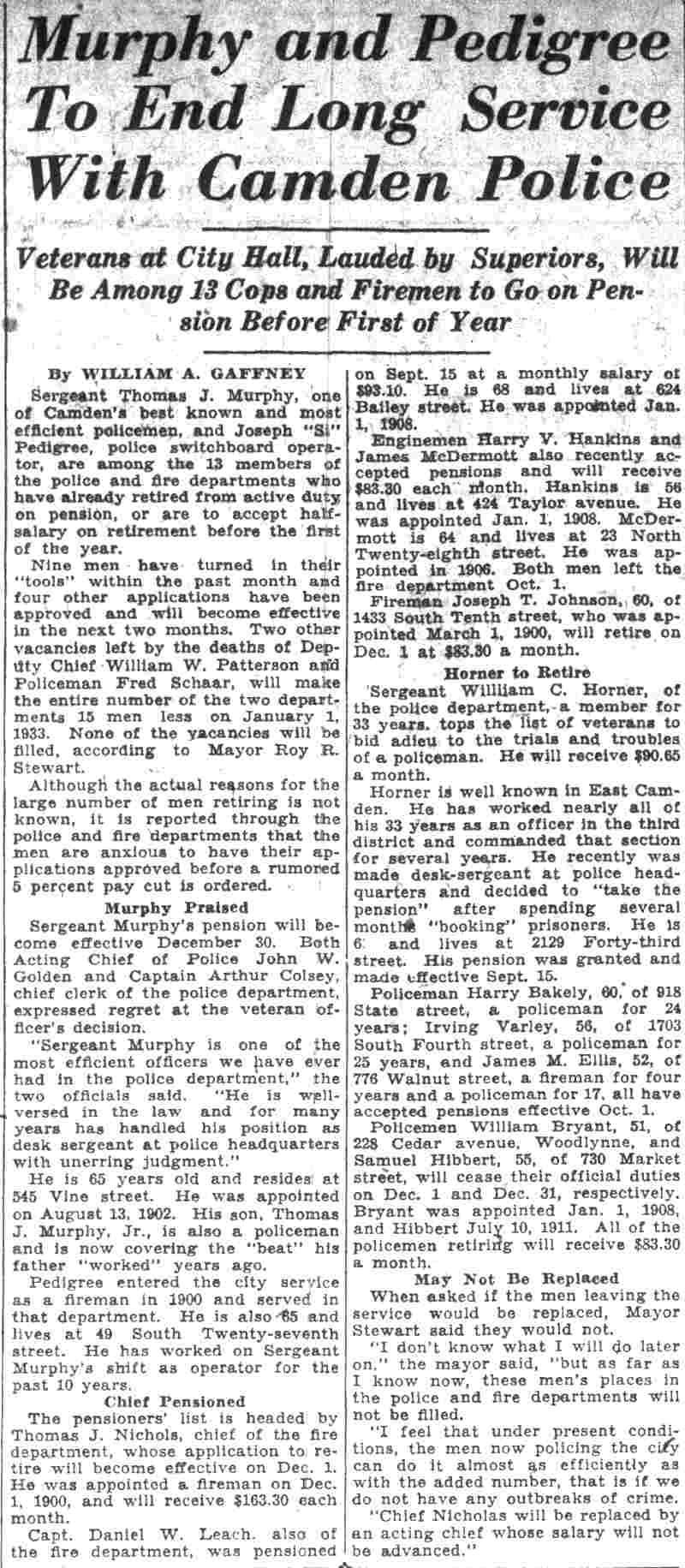
Sergeant Thomas J. Murphy and switchboard operator Joseph "Si" Pedigree of 49 South Twenty-seventh Street were among 13 Camden policemen and firemen retiring on pension before the first of 1933, and Mayor Roy R. Stewart said none of the vacancies would be filled. Camden Courier-Post, October 8, 1932.

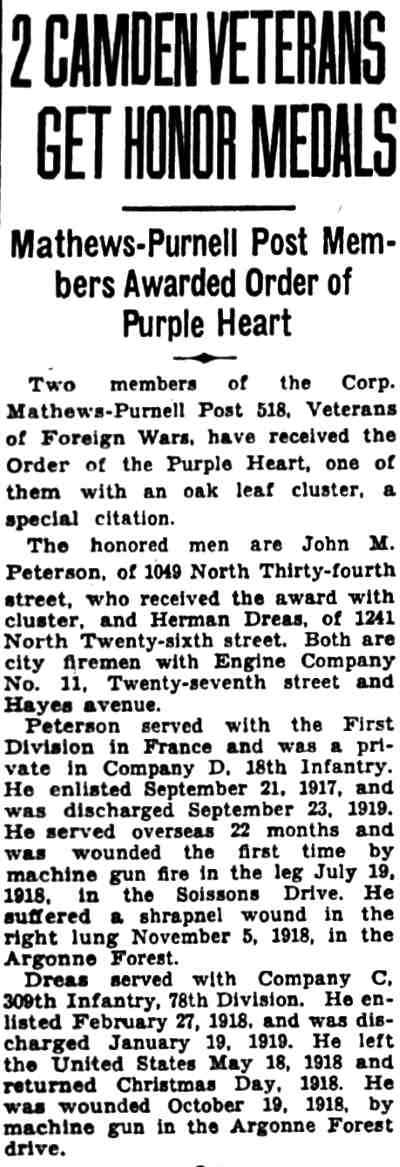
Camden firemen John M. Peterson and Herman Dreas, both of Engine Company No. 11 and members of Corp. Mathews-Purnell Post 518, Veterans of Foreign Wars, received the Order of the Purple Heart for wounds suffered in France.

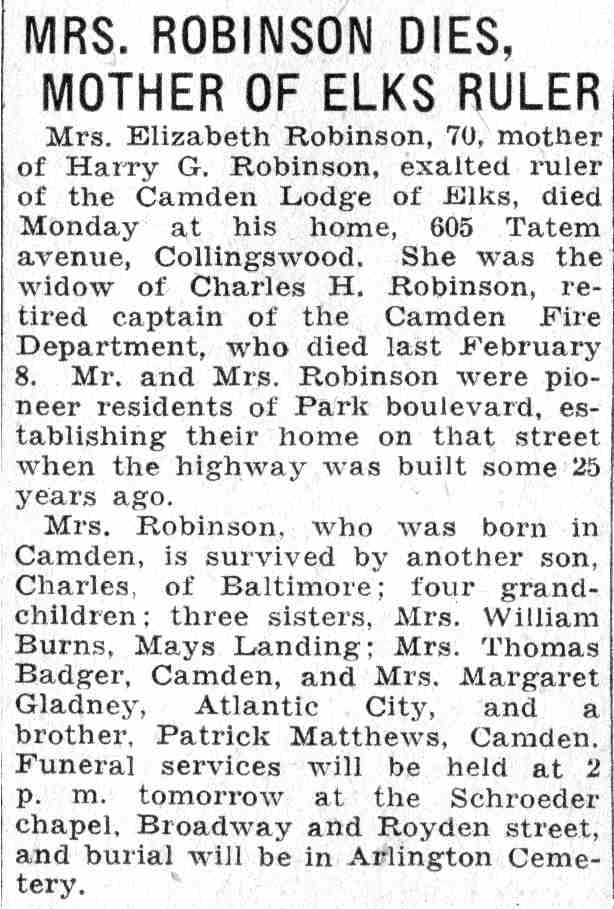
Mrs. Elizabeth Robinson, 70, mother of Elks exalted ruler Harry G. Robinson and widow of retired Camden fire captain Charles H. Robinson, died in Collingswood. The Robinsons were pioneer residents of Park Boulevard.

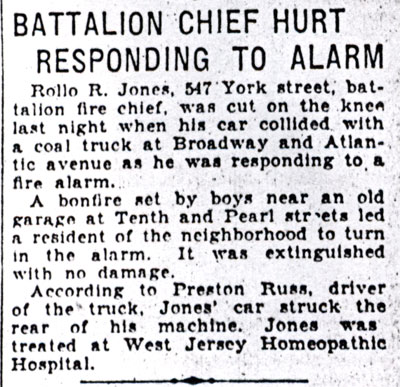
Camden Morning Post, November 29, 1930. Battalion fire chief Rollo R. Jones was cut on the knee when his car collided with a coal truck at Broadway and Atlantic Avenue while he was responding to a fire alarm.

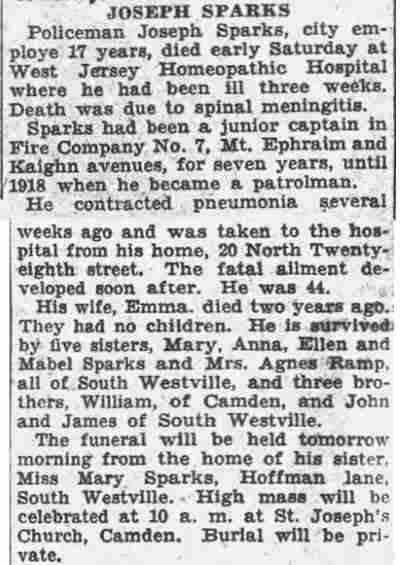
Policeman Joseph Sparks, a city employee for 17 years, died at West Jersey Homeopathic Hospital from spinal meningitis. He lived at 20 North Twenty-eighth Street and had served as a patrolman since 1918, after seven years as a junior captain in Fire Company No. 7.

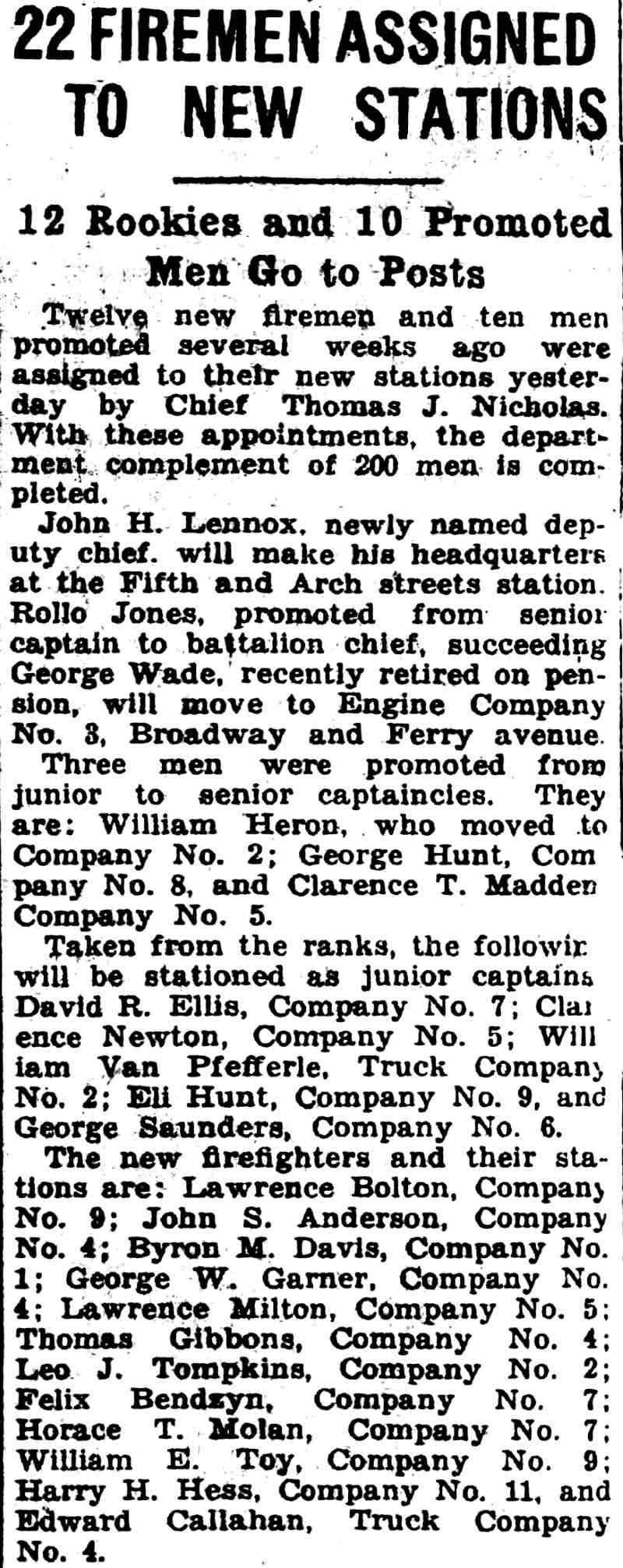
Camden Courier-Post, April 17, 1928. Twelve new firemen and ten promoted men were assigned to their new stations by Chief Thomas J. Nicholas, completing the department's complement of 200 men.

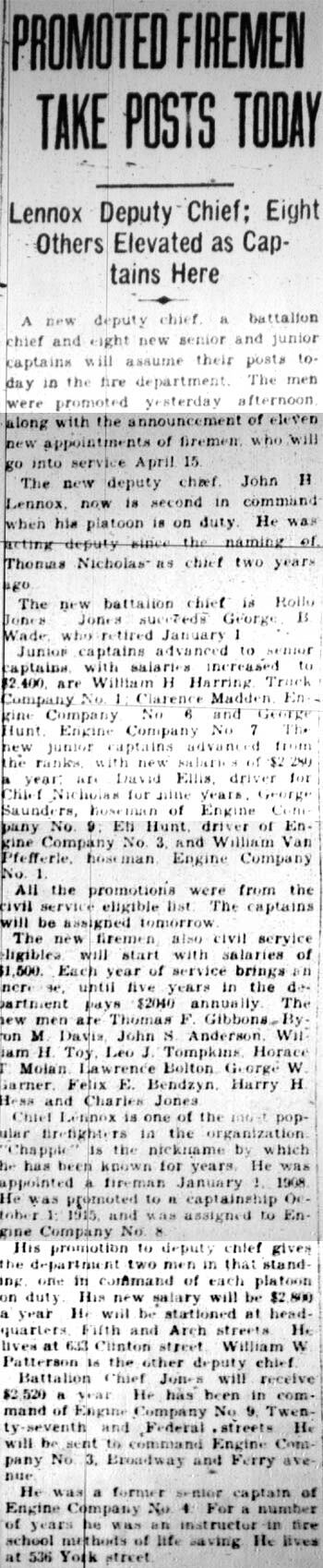
Camden Courier-Post, April 4, 1928. John H. Lennox was promoted to deputy chief and Rollo Jones to battalion chief of the Camden Fire Department, eight men were elevated to senior and junior captain, and eleven new firemen were appointed.

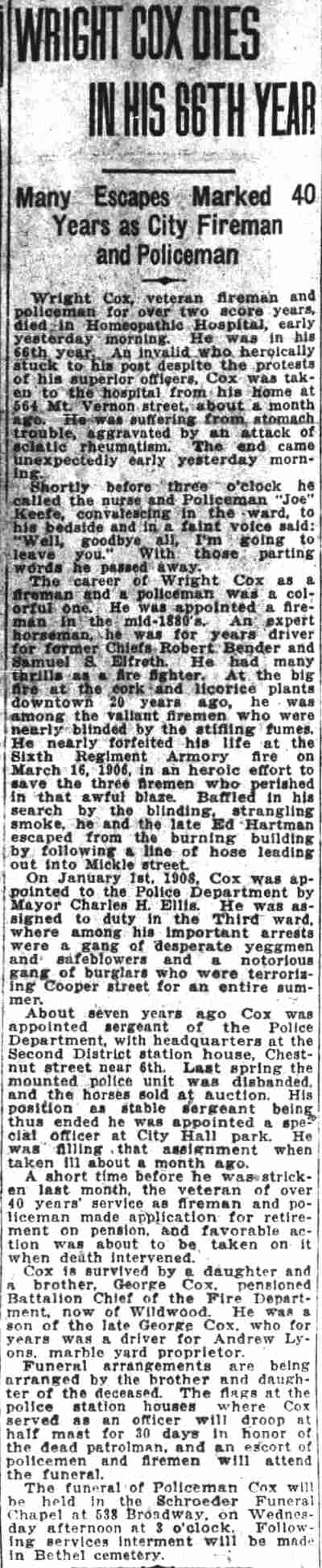
Wright Cox, a Camden fireman and policeman for more than 40 years, died in Homeopathic Hospital in his 66th year. His funeral was set for the Schroeder Funeral Chapel at 538 Broadway, with interment in Bethel Cemetery.

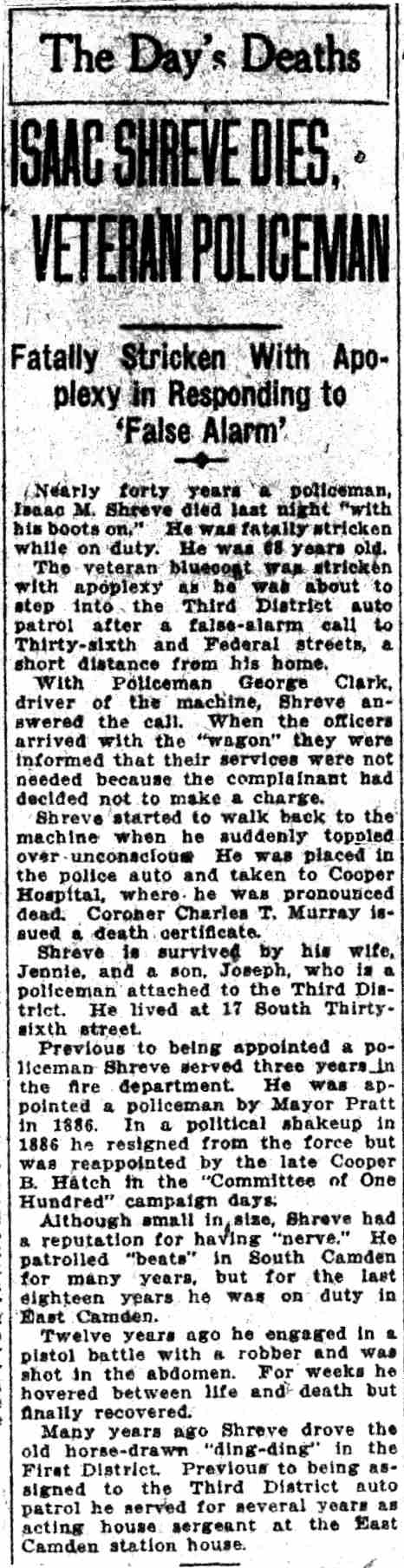
Isaac M. Shreve, a Camden policeman for nearly forty years, was fatally stricken with apoplexy while answering a false-alarm call at Thirty-sixth and Federal streets in June 1926. He had served in the fire department, been shot by a robber twelve years earlier, and spent his last eighteen years on duty in East Camden.

Dr. A. Haines Lippincott, surgeon to the Camden police and fire departments, submitted recommendations approved by City Council, including schools, medical surveys and firearms instruction. Nine men, among them Traffic Officer Raymond Stark, were expected to retire on disability.

Charles Morris, a merchant at 1203 Haddon Avenue, went on trial in Camden Criminal Court on arson, conspiracy and aiding indictments over a July 23 fire at his shoe store; Fire Chief Carter and Police Chief Hyde testified to oil fumes in the store.
Fire believed to have started through the drying of animal hair destroyed Hugh A. Greenan's frame building at 1736 South 7th Street; six horses were rescued and Chief Peter B. Carter sounded a general alarm.
Camden firemen were called to a three-alarm fire at Hugh A. Greenan's stables on South 7th Street just before marching to Captain Martin B. Carrigan's funeral, and to a drugstore fire on Everett Street on their return.

Hundreds lined the streets and firehouse bells tolled as the cortege of Captain Martin B. Carrigan passed through Camden to Arlington Cemetery, escorted by ninety-two firemen under Chief Peter B. Carter.
Camden's municipal buildings, police stations and firehouses were draped in mourning for Captain Martin Carrigan, who died of injuries received fighting the Kaighn Avenue fire; city council voted to pay the expense of his funeral.
Captain Martin B. Carrigan of Engine Company No. 2 died at Cooper Hospital of a fractured skull and severe burns received while leading his men at the Economy Store fire on Kaighn Avenue.
Four fires in Camden's business district within six weeks destroyed or damaged a dozen retail stores, with losses fixed at $595,000 — the Baker-Flick Department Store, Toone & Hollingshed, Nell's Haberdashery and the Economy Store.

Fireman Charles Gladney was overcome by smoke while fighting a fire at the Wearwell Gasket Company on the second floor of 32 North Third Street, Camden, and was carried out by Fireman Edgar Ellender.

Engineer John A. Dold retired on a pension after twenty-five years in the Camden Fire Department, and the men of No. 7 Engine Company presented him with a gold medal and a silk American flag before he marched out Kaighn avenue.

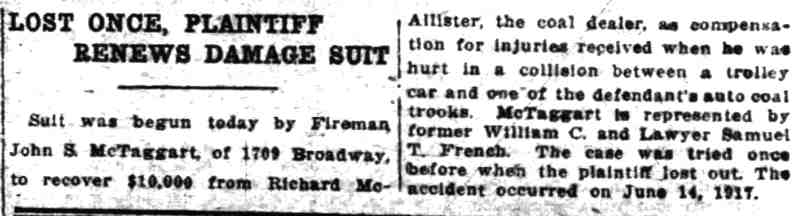
Fireman John S. McTaggart, of 1709 Broadway, renewed his $10,000 suit against coal dealer Richard McAllister for injuries received when a trolley car collided with one of McAllister's auto coal trucks on June 14, 1917. The case had been tried once before, and the plaintiff lost.

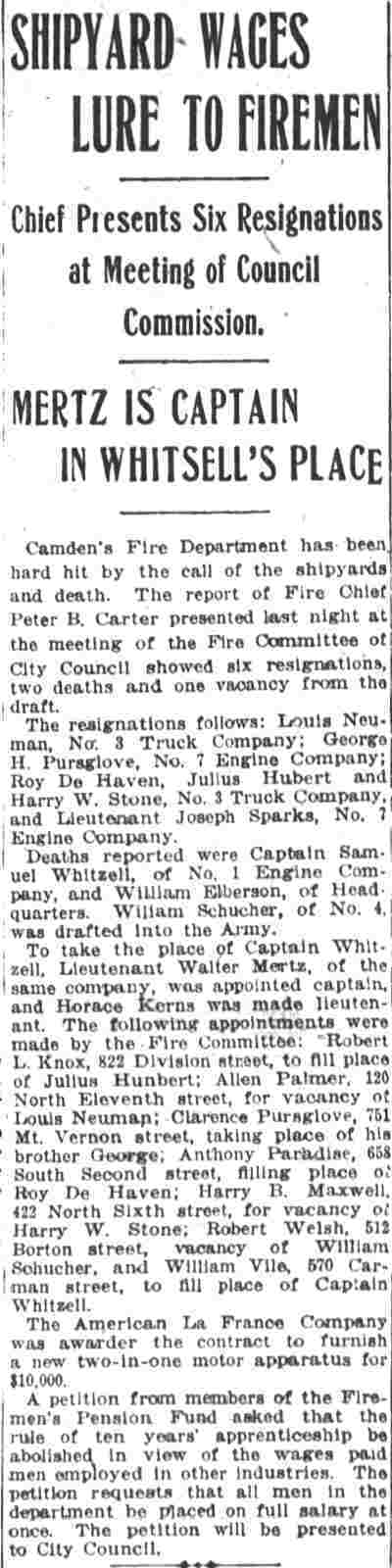
Fire Chief Peter B. Carter reported six resignations, two deaths and one vacancy from the draft as the shipyards drew men from Camden's Fire Department; Lieutenant Walter Mertz was made captain and the Fire Committee appointed seven new firemen.

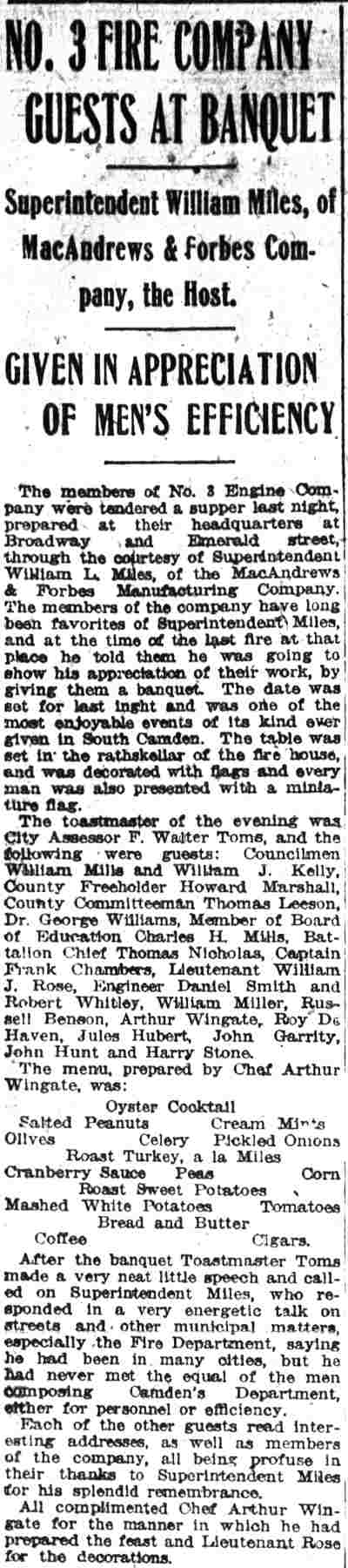
Superintendent William L. Miles of the MacAndrews & Forbes Company hosted a banquet for Engine Company No. 3 at their headquarters at Broadway and Emerald Street; Engineer Daniel Smith was among the company.

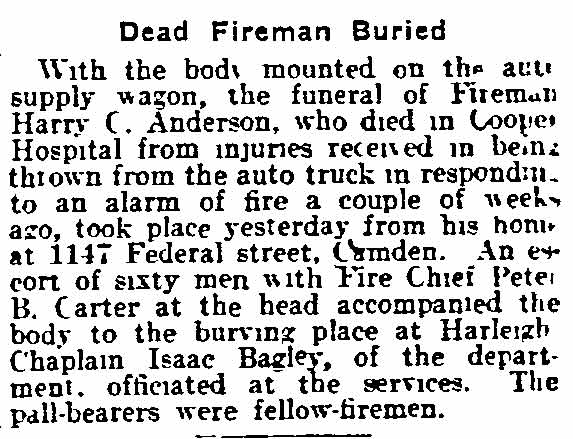
With the body mounted on the auto supply wagon, the funeral of Fireman Harry C. Anderson, who died in Cooper Hospital from injuries received in being thrown from the auto truck in responding to an alarm of fire, took place from his home at 1147 Federal street, Camden.

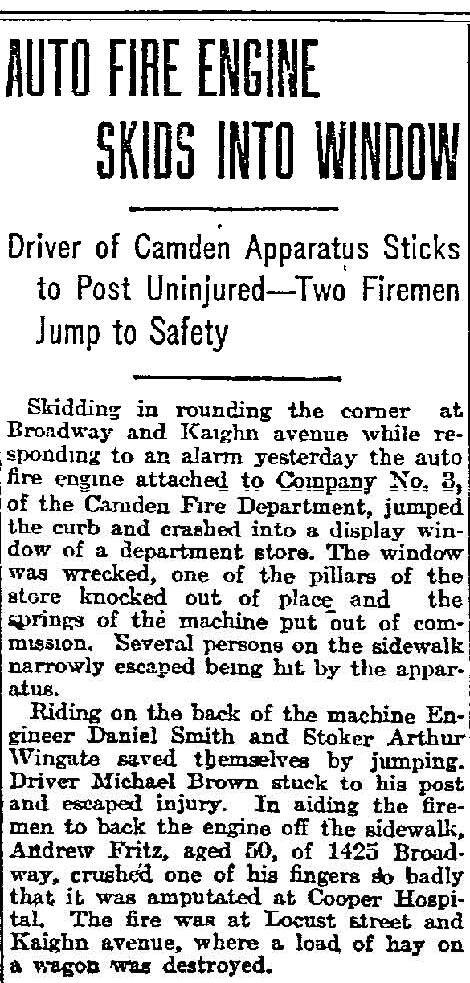
Company No. 3's auto fire engine skidded at Broadway and Kaighn Avenue and crashed into a store window at Broadway and Locust Street; Engineer Daniel Smith and Stoker Arthur Wingate jumped to safety while Driver Michael Brown stuck to his post.

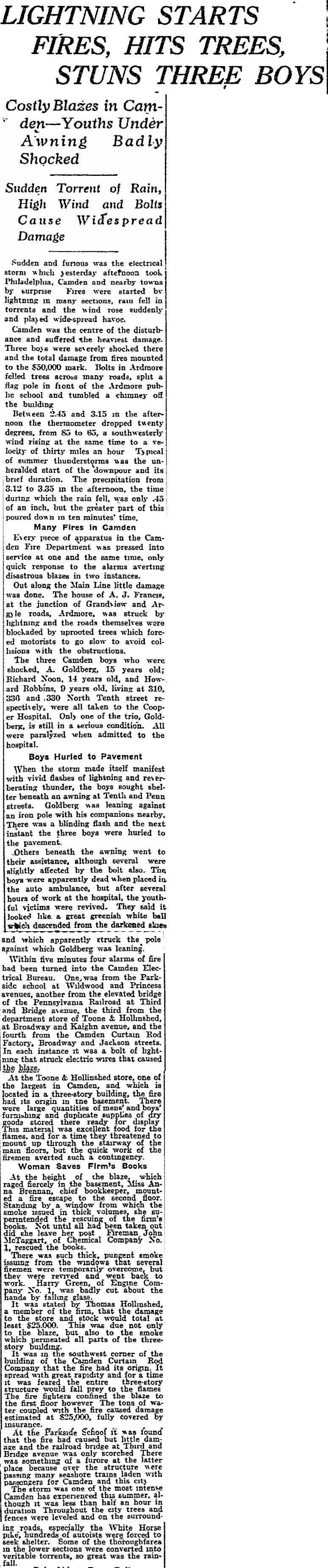
A sudden electrical storm on August 18, 1915 struck Camden hardest: lightning shocked three boys sheltering under an awning at Tenth and Penn streets, and set fires at the Parkside school, a Pennsylvania Railroad bridge, the Toone & Hollinshed department store at Broadway and Kaighn avenue, and the Camden Curtain Rod Factory at Broadway and Jackson streets.