Six Horses Saved in Sunday Blaze
Fire believed to have started through the drying of animal hair destroyed Hugh A. Greenan's frame building at 1736 South 7th Street; six horses were rescued and Chief Peter B. Carter sounded a general alarm.

Tag
Fire believed to have started through the drying of animal hair destroyed Hugh A. Greenan's frame building at 1736 South 7th Street; six horses were rescued and Chief Peter B. Carter sounded a general alarm.
Camden firemen were called to a three-alarm fire at Hugh A. Greenan's stables on South 7th Street just before marching to Captain Martin B. Carrigan's funeral, and to a drugstore fire on Everett Street on their return.

Hundreds lined the streets and firehouse bells tolled as the cortege of Captain Martin B. Carrigan passed through Camden to Arlington Cemetery, escorted by ninety-two firemen under Chief Peter B. Carter.
Camden's municipal buildings, police stations and firehouses were draped in mourning for Captain Martin Carrigan, who died of injuries received fighting the Kaighn Avenue fire; city council voted to pay the expense of his funeral.
Captain Martin B. Carrigan of Engine Company No. 2 died at Cooper Hospital of a fractured skull and severe burns received while leading his men at the Economy Store fire on Kaighn Avenue.
Four fires in Camden's business district within six weeks destroyed or damaged a dozen retail stores, with losses fixed at $595,000 — the Baker-Flick Department Store, Toone & Hollingshed, Nell's Haberdashery and the Economy Store.

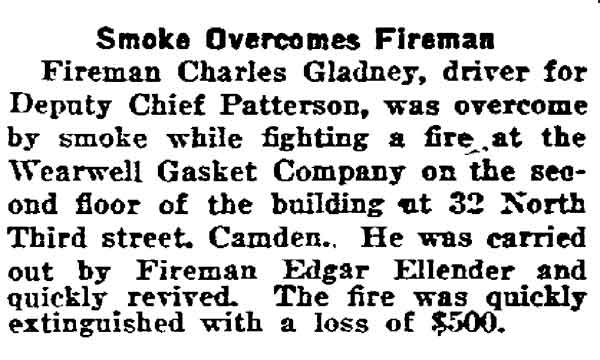
Fireman Charles Gladney was overcome by smoke while fighting a fire at the Wearwell Gasket Company on the second floor of 32 North Third Street, Camden, and was carried out by Fireman Edgar Ellender.

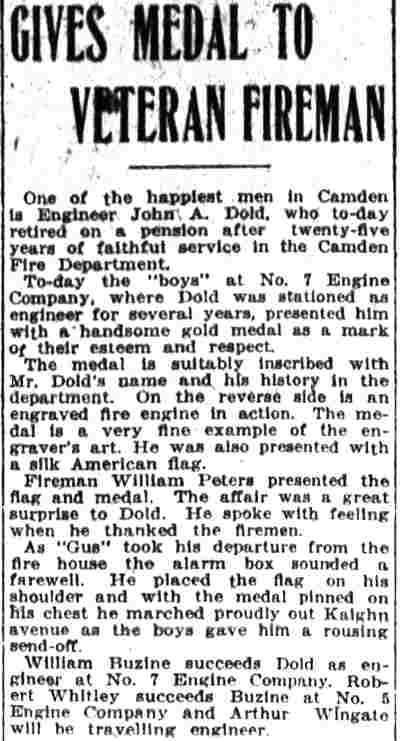
Engineer John A. Dold retired on a pension after twenty-five years in the Camden Fire Department, and the men of No. 7 Engine Company presented him with a gold medal and a silk American flag before he marched out Kaighn avenue.

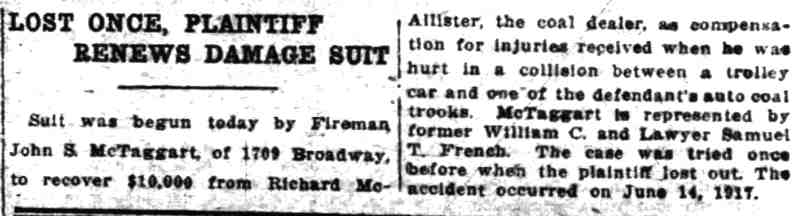
Fireman John S. McTaggart, of 1709 Broadway, renewed his $10,000 suit against coal dealer Richard McAllister for injuries received when a trolley car collided with one of McAllister's auto coal trucks on June 14, 1917. The case had been tried once before, and the plaintiff lost.

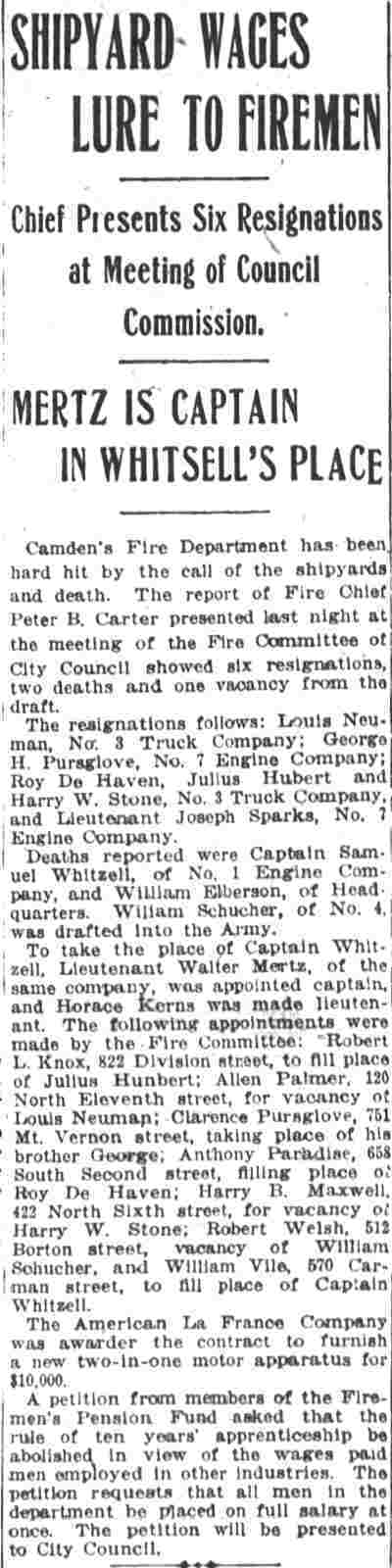
Fire Chief Peter B. Carter reported six resignations, two deaths and one vacancy from the draft as the shipyards drew men from Camden's Fire Department; Lieutenant Walter Mertz was made captain and the Fire Committee appointed seven new firemen.

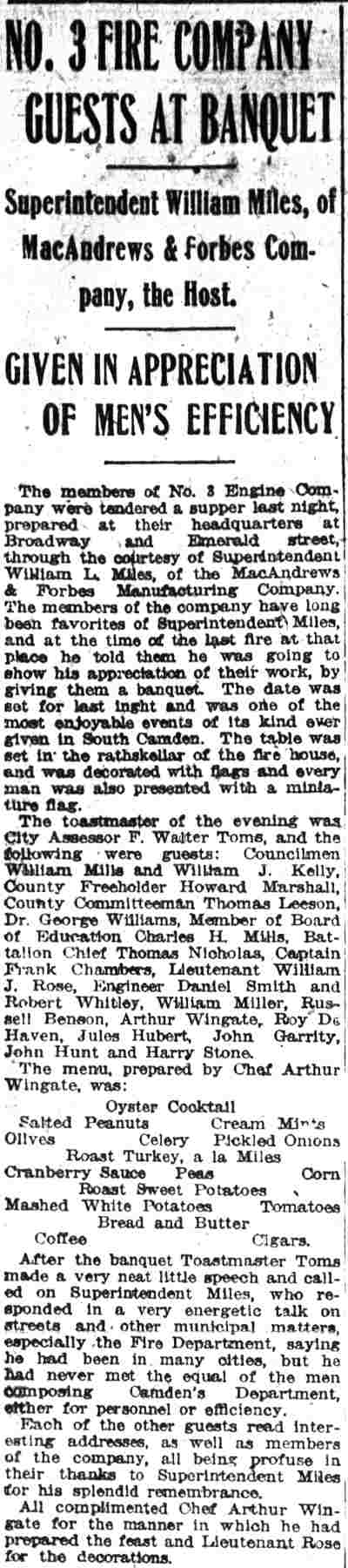
Superintendent William L. Miles of the MacAndrews & Forbes Company hosted a banquet for Engine Company No. 3 at their headquarters at Broadway and Emerald Street; Engineer Daniel Smith was among the company.

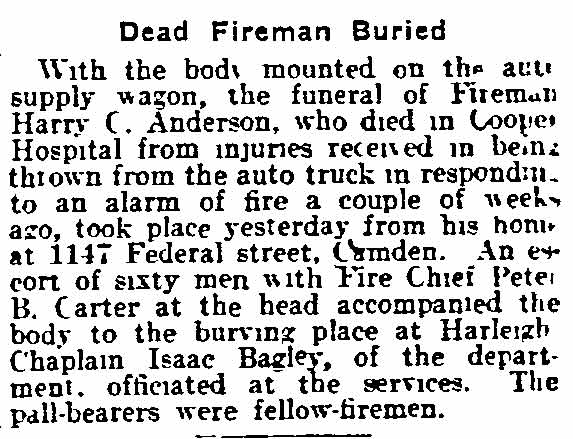
With the body mounted on the auto supply wagon, the funeral of Fireman Harry C. Anderson, who died in Cooper Hospital from injuries received in being thrown from the auto truck in responding to an alarm of fire, took place from his home at 1147 Federal street, Camden.

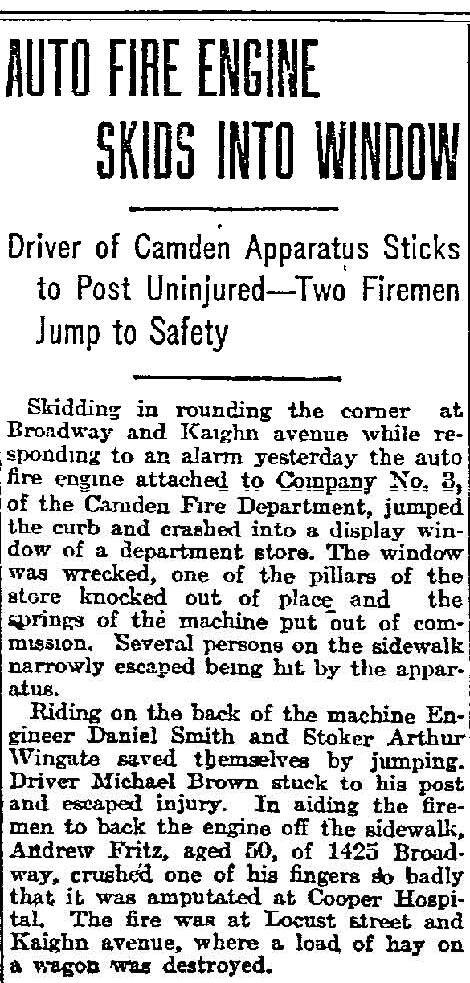
Company No. 3's auto fire engine skidded at Broadway and Kaighn Avenue and crashed into a store window at Broadway and Locust Street; Engineer Daniel Smith and Stoker Arthur Wingate jumped to safety while Driver Michael Brown stuck to his post.

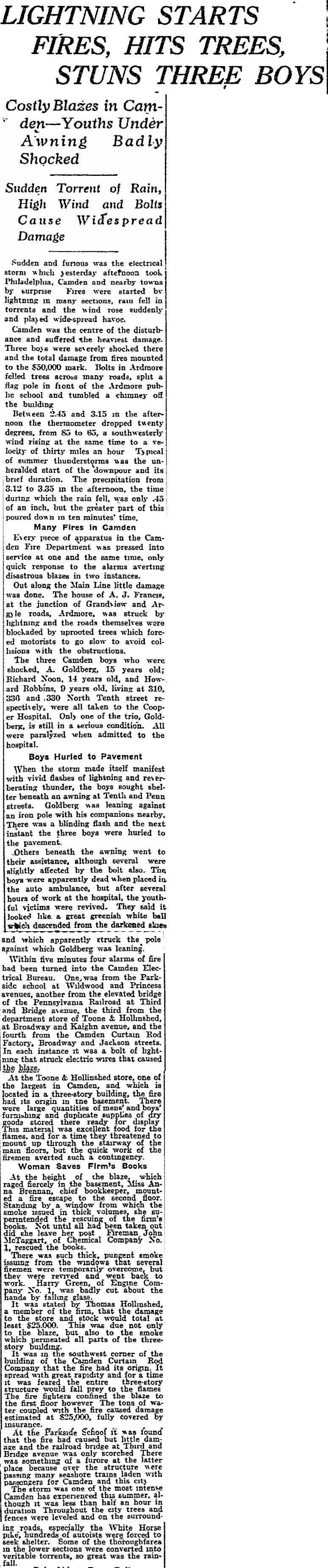
A sudden electrical storm on August 18, 1915 struck Camden hardest: lightning shocked three boys sheltering under an awning at Tenth and Penn streets, and set fires at the Parkside school, a Pennsylvania Railroad bridge, the Toone & Hollinshed department store at Broadway and Kaighn avenue, and the Camden Curtain Rod Factory at Broadway and Jackson streets.

Fire Chief John A. Stockton resigned after thirty-one years of service and City Council chose Deputy Chief Peter B. Carter as his successor, setting off a general move up in the Camden Fire Department.

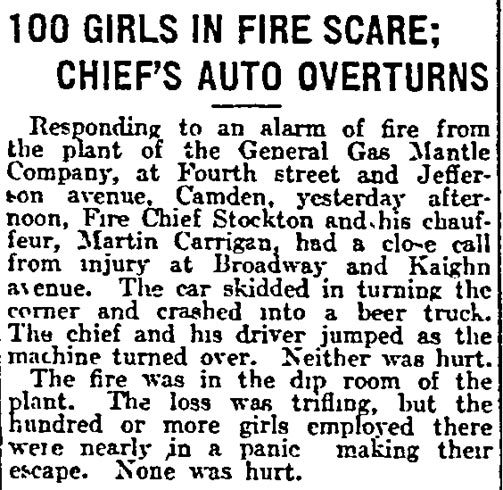
Fire Chief John A. Stockton and his chauffeur Martin Carrigan jumped clear as the chief's car skidded into a beer truck at Broadway and Kaighn Avenue while responding to a fire at the General Gas Mantle Company plant.

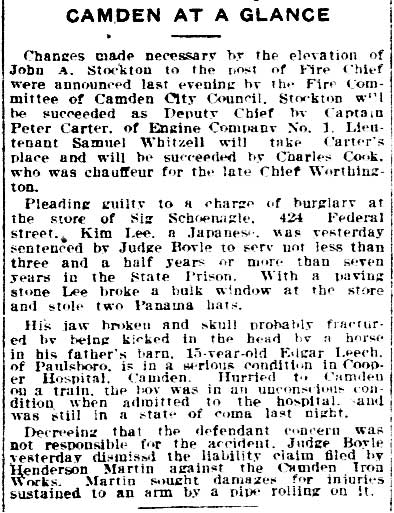
Captain Peter Carter of Engine Company No. 1 was named Deputy Chief after John A. Stockton's elevation to Fire Chief, and Kim Lee was sentenced for the burglary of Sig Schoenagle's store at 424 Federal Street.

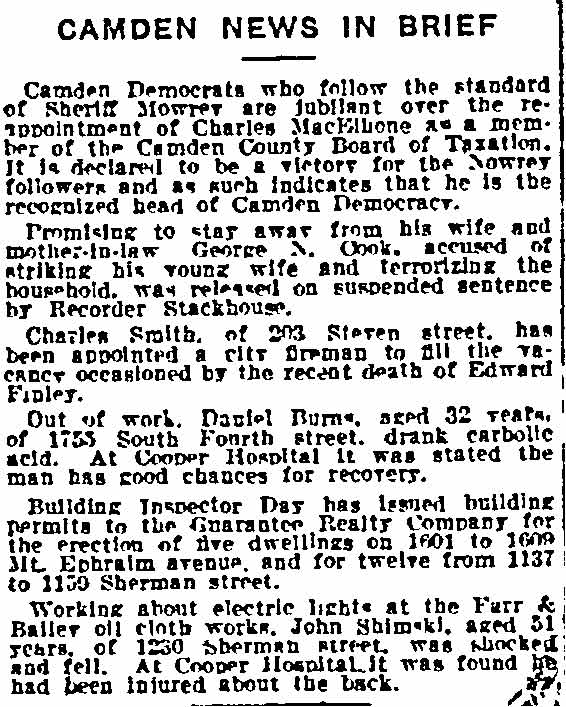
Camden briefs from the Philadelphia Inquirer of March 26, 1914, including the appointment of Charles Smith as a city fireman after the death of Edward Finley and building permits for twelve dwellings from 1137 to 1159 Sherman (Sheridan) Street.

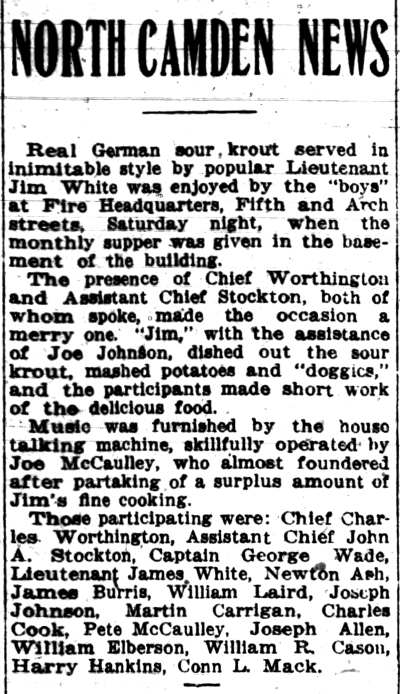
The monthly supper at Camden Fire Headquarters, Fifth and Arch streets, featured German sour krout served by Lieutenant Jim White, with Chief Charles Worthington and Assistant Chief John A. Stockton among the speakers.

New Year's banquets were held by Engine Company No. 7, the firemen at Headquarters, and Hook and Ladder Truck No. 1; Daniel Smith was among the diners at Headquarters.

Seven Camden firemen, six of them from the Kaighn Avenue house, fought their way out back to back when flames surrounded them in a fire that gutted three stores at 1118-1122 Broadway; Mrs. Tillie Sackett saved two small girls whose clothing had caught fire.

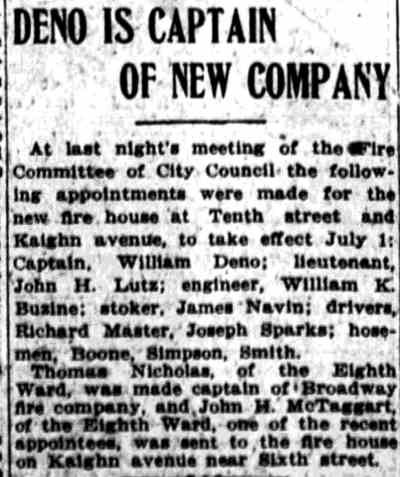
City Council's Fire Committee named William Deno captain of the new fire company at Tenth Street and Kaighn Avenue, effective July 1, 1910, and sent John H. McTaggart to the Kaighn Avenue firehouse near Sixth Street.

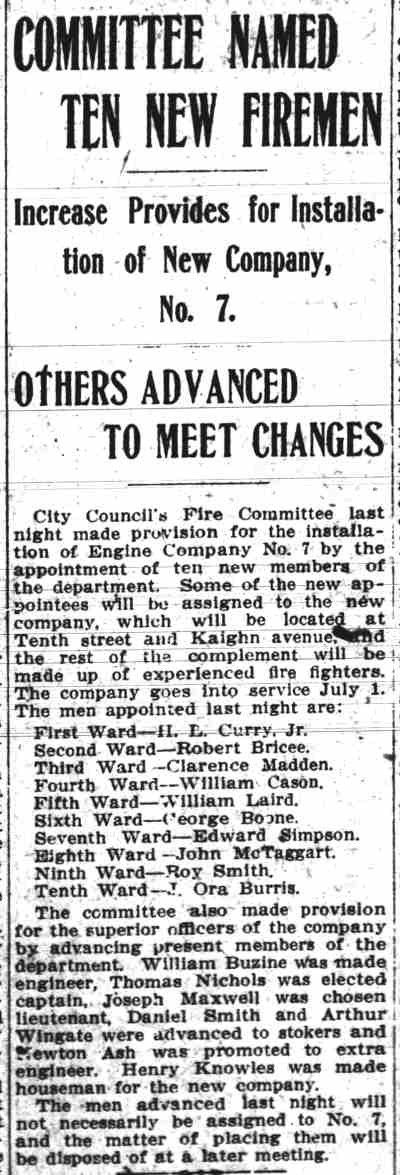
City Council's Fire Committee appointed ten new firemen for the new Engine Company No. 7 at Tenth Street and Kaighn Avenue; Daniel Smith and Arthur Wingate were advanced to stokers.

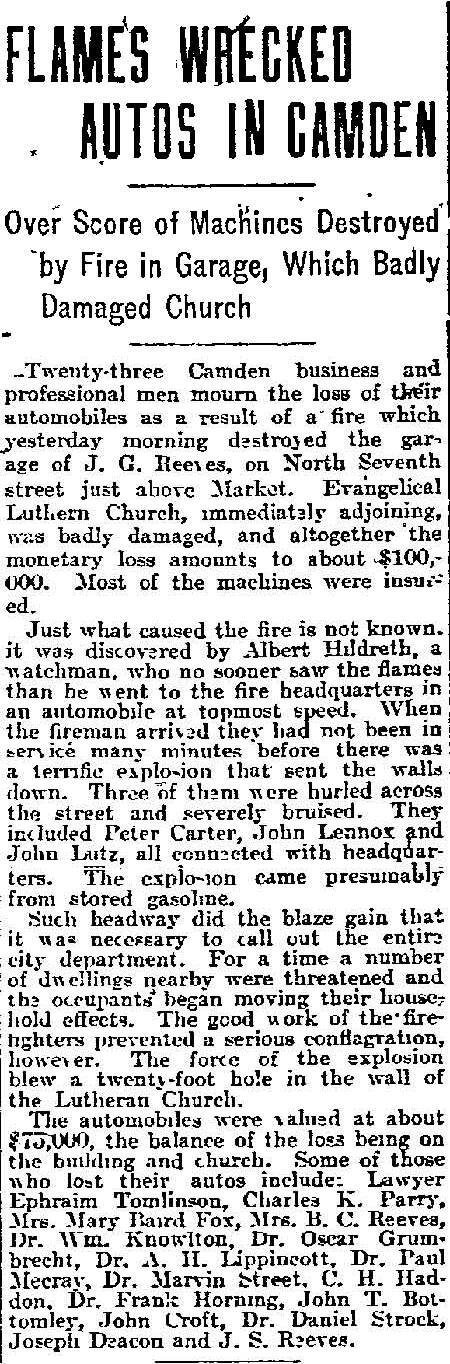
A fire destroyed the garage of J. G. Reeves on North Seventh Street just above Market, wrecking the automobiles of twenty-three Camden business and professional men and badly damaging the adjoining Evangelical Lutheran Church; an explosion hurled firemen Peter Carter, John Lennox and John Lutz across the street.

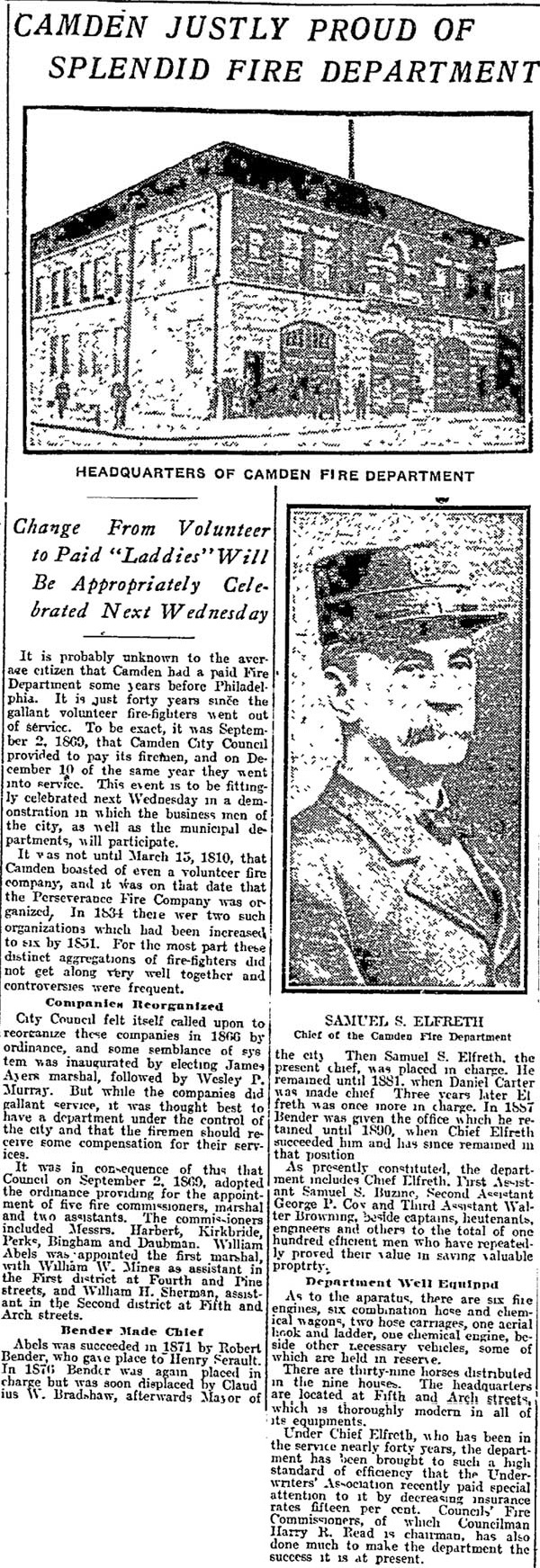
A Philadelphia Inquirer feature of November 7, 1909 recounts Camden's fire companies from the volunteer Perseverance Fire Company of 1810 to the paid department of 1869, and describes its chiefs, equipment and houses.

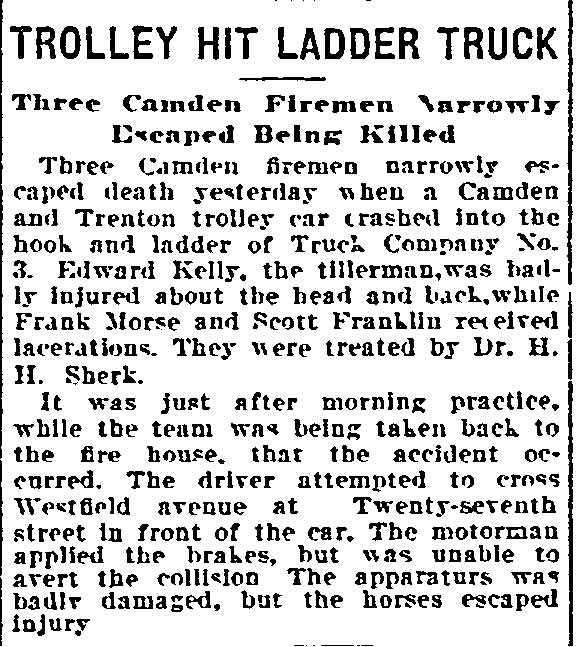
Three Camden firemen of Truck Company No. 3 narrowly escaped death when a Camden and Trenton trolley car crashed into their hook and ladder at Westfield Avenue and Twenty-seventh Street after morning practice. Philadelphia Inquirer, June 29, 1909.

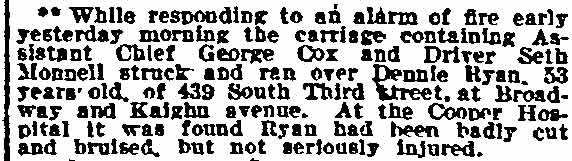
Responding to a fire alarm, the carriage carrying Assistant Chief George Cox and Driver Seth Monnell struck and ran over Dennie Ryan at Broadway and Kaighn Avenue; at Cooper Hospital he was found badly cut and bruised but not seriously injured. Philadelphia Inquirer, April 24, 1909.

A mixing-tank explosion touched off a disastrous fire that swept the N.Z. Graves Paint and Varnish Company plant on Twelfth Street, Camden, between Linden and Federal streets — destroying more than half a million dollars in property, injuring three, and driving families from their homes. (Philadelphia Inquirer, February 18, 1908.)

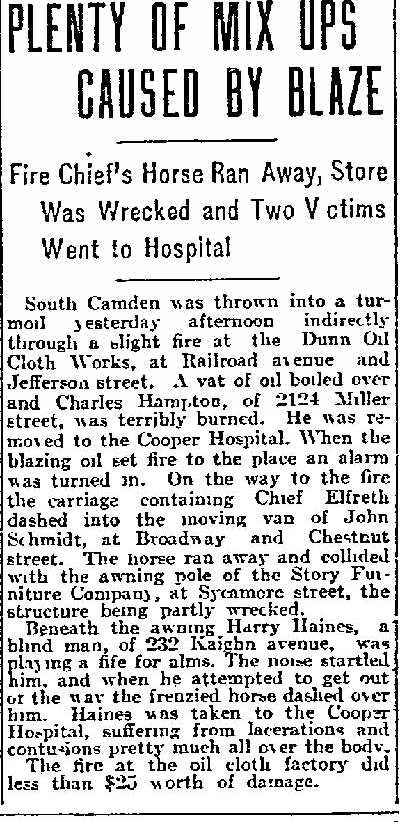
A slight fire at the Dunn Oil Cloth Works in South Camden badly burned Charles Hampton, and Fire Chief Elfreth's runaway carriage horse wrecked the Story Furniture Company awning and ran over Harry Haines, a blind fife player, in August 1906.
Fireman Daniel Smith underwent an operation on his arm, which had been injured in a trolley accident several weeks earlier.

Three firemen — George Shields, William Hillman, and William Jobes — are killed and nine people injured when fire destroys the old Sixth Regiment Armory in Camden.
The Altoona Mirror reports three Camden firemen killed and nine injured when the roof of the old Sixth Regiment Armory at Bridge and West streets fell, burying Fireman Harry Dease and the men he had warned; the injured were removed to Hooper Hospital.
The Lima Daily News reports that three Camden firemen — George W. Shields, William Hillman and William Jobes — were killed and nine others seriously injured in the fire that destroyed the old Sixth Regiment Armory, with the loss put at about $75,000.

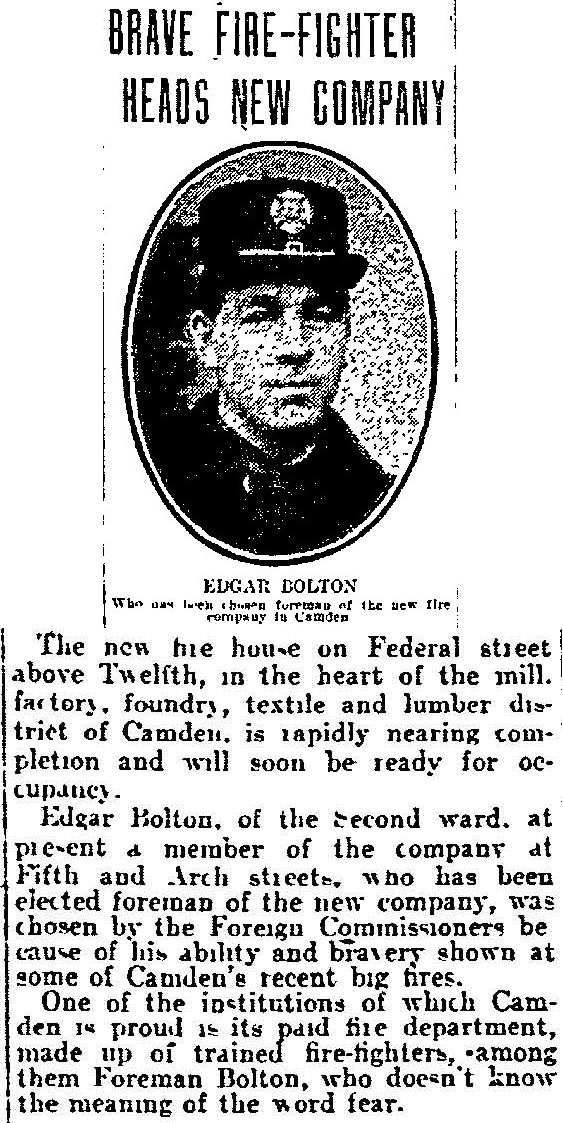
Edgar Bolton of the Second ward, a member of the company at Fifth and Arch streets, was elected foreman of Camden's new fire company, whose fire house on Federal street above Twelfth was nearing completion.

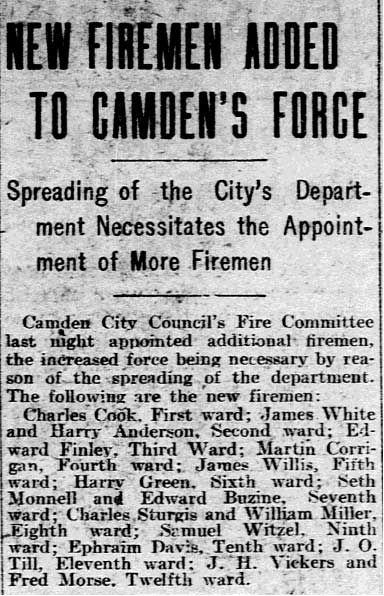
With the Camden Fire Department spreading across the city, City Council's Fire Committee appointed additional firemen, naming one or two men from each of the twelve wards.

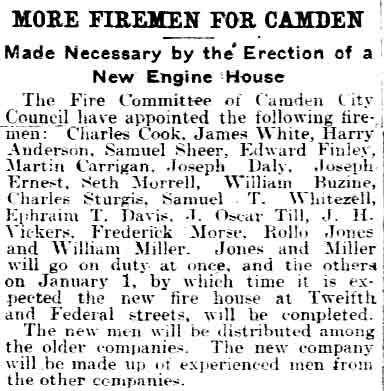
The Fire Committee of Camden City Council appointed a slate of new firemen — among them Martin Carrigan — ahead of the completion of the new fire house at Twelfth and Federal streets.

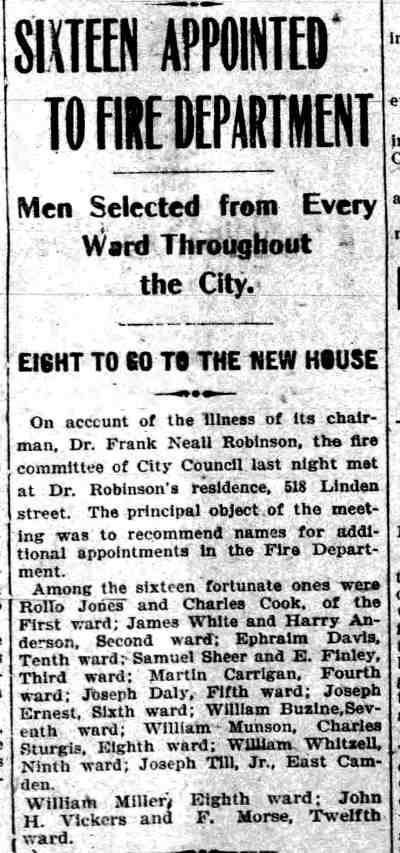
Meeting at the home of its ailing chairman, Dr. Frank Neall Robinson, the fire committee of Camden City Council recommended sixteen men — Martin Carrigan among them — for appointment to the Fire Department, drawn from wards throughout the city.

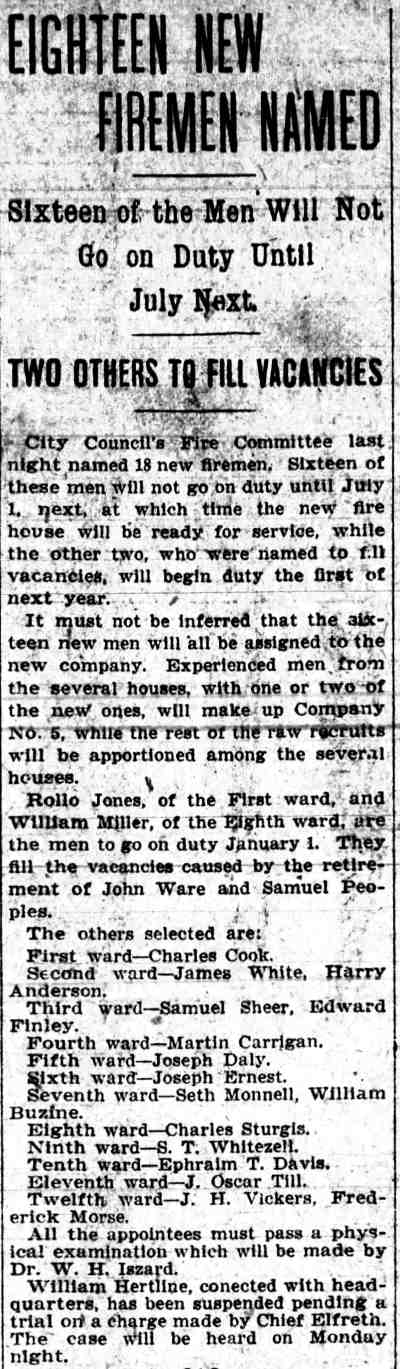
City Council's Fire Committee named eighteen new firemen — Martin Carrigan among them — sixteen of whom would not report for duty until the new fire house was ready the following July.

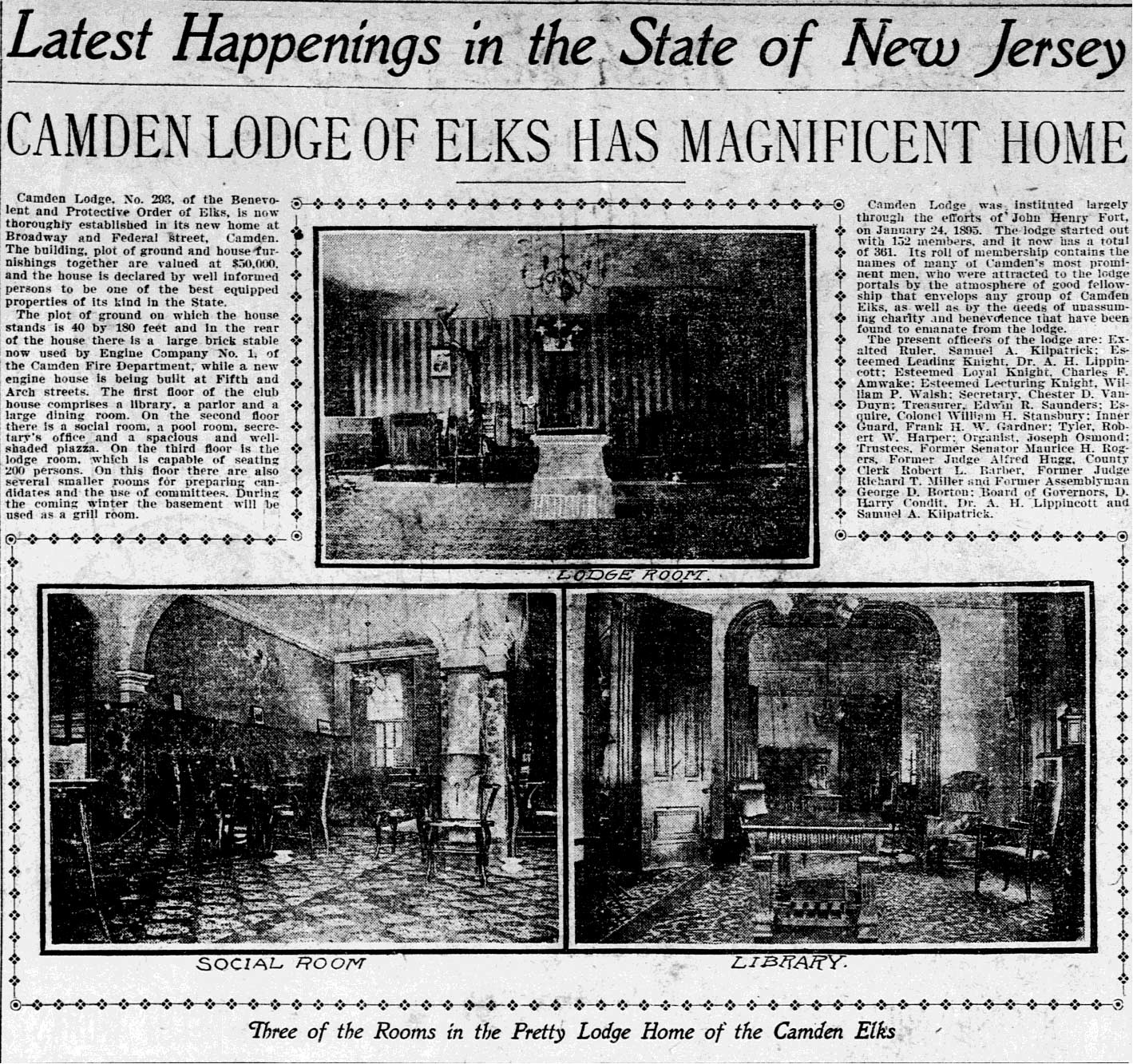
Camden Lodge, No. 293, of the Benevolent and Protective Order of Elks is established in its new home at Broadway and Federal Street, valued with its furnishings at $50,000. The Philadelphia Inquirer describes the club house and lists the lodge's officers.

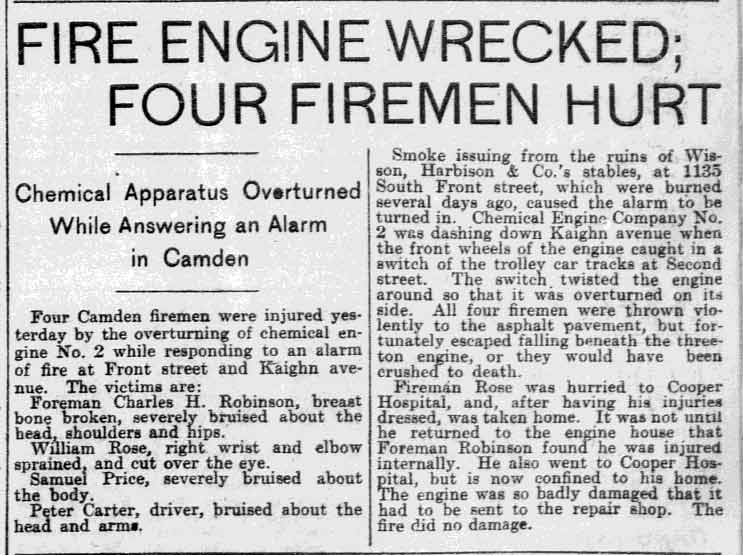
Four Camden firemen were injured when Chemical Engine No. 2 overturned after its front wheels caught in a trolley switch at Second Street while it was answering an alarm at Front Street and Kaighn Avenue.

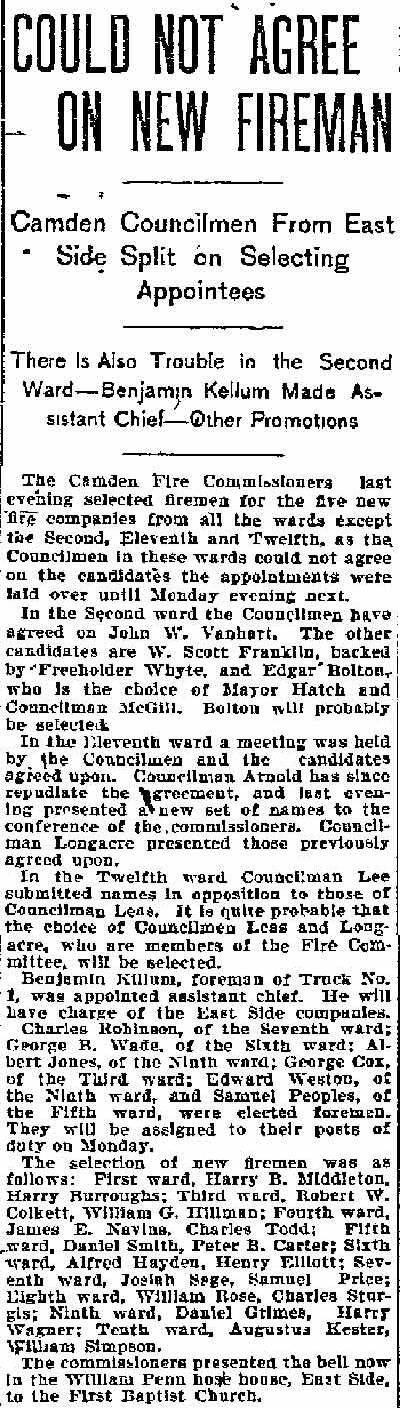
Camden's Fire Commissioners selected firemen for five new companies; Benjamin Kellum was made assistant chief and Daniel Smith was appointed for the Fifth ward.

William James, brother of fireman Albert James, fell from a ladder while working on a house on Ferry Avenue below Broadway and broke his wrist.

Camden City Council re-elected Samuel S. Elfreth chief engineer of the Fire Department and Samuel Buzine assistant chief.

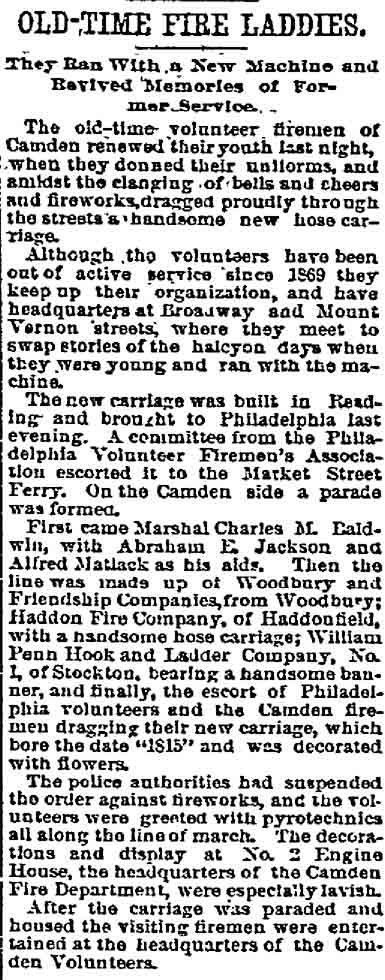
Camden's old-time volunteer firemen, out of active service since 1869 but still keeping their headquarters at Broadway and Mount Vernon streets, paraded a new hose carriage through the city with Marshal Charles M. Baldwin at the head of the line.

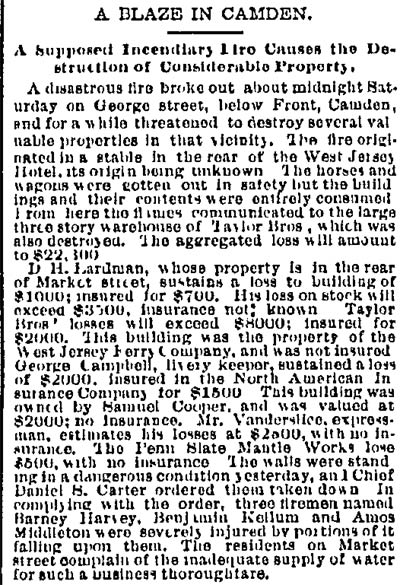
A fire that started in a stable behind the West Jersey Hotel on George Street, below Front, spread to the Taylor Bros. warehouse, causing $22,300 in losses; three firemen were injured when the walls were pulled down on Chief Carter's order.