Philadelphia Inquirer, November 28, 1900View transcription
BAD GAS AND UGLY POLES STIR CAMDEN CITIZENS
While They Must Submit to the Former, They Will Move Against the Latter in City Councils To-night.
Another Small-Sized Riot
Go where you will in Camden you hear nothing but complaints about bad gas, almost equally as bad electric lights and violent protests against the operations of the new telephone company that seems to think it has a right to rear its unsightly poles anywhere it seems fit, clearly in defiance of the law that declares the consent of property holders must first be had. And Camden people declare there is a peculiar relation existing between these gas, electric, trolley and telephone concerns that will not require much investigation to find certain prominent citizens identified in one way or the other with all of them.
Words of comment were heard on all sides in Camden yesterday on the report published in The Inquirer giving the situation regarding complaints against the bad quality of gas and the exorbitant prices charged.
The indignation of gas consumers can hardly be more pronounced than that of the property owners against the Eastern Telephone and Telegraph Company for its methods of raising poles. This part of the controversy reached a climax, and to-night the immediate revocation of the company's franchise will be demanded of Camden's City Council. This demand will be backed by an organization of property-owners, led by Philip Burch, a prominent young business man, of 510 Broadway.
SMALL-SIZED RIOT.
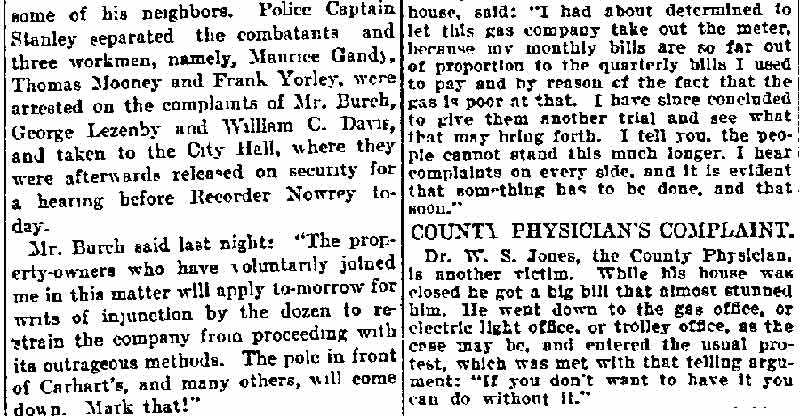
The organization of property-owners was brought about by the brave manner in which Mr. Burch, with the aid of a stream of cold water and buckets of hot water, endeavored to repel the company's gang of pole-raisers in front of a house adjoining his home yesterday. The workmen managed to get the pole up on the pavement in front of the house of Wilbur Carhart, at 512 Broadway, but while Mr. Burch was protesting verbally and with water in behalf of Mrs. Carhart, there was a violent collision between the workmen and Mr. Burch, who was aided by some of his neighbors. Police Captain Stanley separated the combatants and three workmen, namely, Maurice Gandy, Thomas Mooney and Frank Yorley, were arrested on the complaints of Mr. Burch, George Lezenby and William C. Davis, and taken to the City Hall, where they were afterwards released on security for a hearing before Recorder Nowrey to-day.
Mr. Burch said last night: "The property-owners who have voluntarily joined me in this matter will apply to-morrow for writs of injunction by the dozen to restrain the company from proceeding with its outrageous methods. The pole in front of Carhart's, and many others, will come down. Mark that!"
MR. COLES ON THE WATCH.
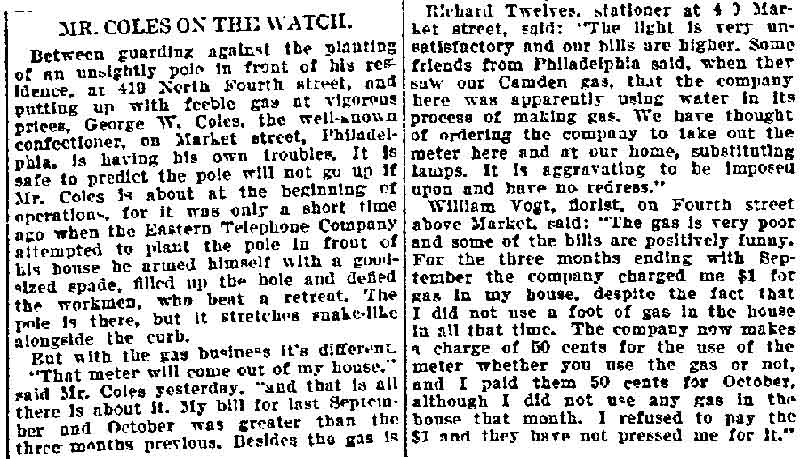
Between guarding against the planting of an unsightly pole in front of his residence, at 419 North Fourth street, and putting up with feeble gas at vigorous prices, George W. Coles, the well-known confectioner, on Market street, Philadelphia, is having his own troubles. It is safe to predict the pole will not go up if Mr. Coles is about at the beginning of operations, for it was only a short time ago when the Eastern Telephone Company attempted to plant the pole in front of his house he armed himself with a good-sized spade, filled up the hole and defied the workmen, who beat a retreat. The pole is there, but it stretches snake-like alongside the curb.
But with the gas business it's different. "That meter will come out of my house," said Mr. Coles yesterday, "and that is all there is about it. My bill for last September and October was greater than the three months previous. Besides the gas is bad, but what are you going to do about it? The electric lights are also poor and the crowd runs both. They come around to my house and try to plant a pole. I suppose they do that as a standoff for the privilege of permitting them to charge me an exorbitant price for gas. But you will observe that pole is not yet up, and there will be something doing if any attempt is made to plant it."
INSPECTOR TRIPPED UP.
Martin J. O'Brien, the well-known undertaker at 613 Market street, is among the army of people who have made a vigorous protest against paying big prices for a bad quality of gas and gone away with the if-you-don't-like-it-quit satisfaction. "Have I any complaint?" said Mr. O'Brien. "Well, rather. But what's the use? I have been down to the office, but could get no satisfaction. As an illustration of how they charge you for a flimsy gas let me tell you this: For the three summer months—say July, August and September—I had a gas range and had lights burning in both the office and dwelling part of my house, for which I received a bill for $15.30. It was high, and I protested, but that was the end of it. My sisters, who live at 561 Carman street, rarely paid more than $6 a quarter, but when they received their bill for the months I speak of it was $15.30—theirs a private residence and mine, you might say, a business place.
"What was the result? I sent around to their house an expert who inspected the meter and said, just $6.20 worth of gas had been consumed. I reported the matter to the office. They said they would send somebody around to read the meter again. They did send around another man, who took out the metre. So there is the satisfaction you get."
Robert H. Patton, paperhanger on Federal street below Broadway, said: "My gas bills are one-third more than they used to be, yet the service is much inferior. The gas is of a bad quality. Why, only the other night I attended a little meeting in an office on Market street and we could scarcely see to transact business with three burners going right overhead. I tell you the people of Camden are justified in registering this 'kick,' and not the least aggravating part of it is the fact that every consumer is obliged to pay 50 cents a month, even if the house is closed up for that time. But there is no redress, so we are obliged to submit."
Charles Markley, of 324 Elm, who is connected with a Dock street commission house, said: "I had about determined to let this gas company take out the meter, because my monthly bills are so far out of proportion to the quarterly bills I used to pay and by reason of the fact that the gas is poor at that. I have since concluded to give them another trial and see what that may bring forth. I tell you, the people cannot stand this much longer. I hear complaints on every side, and it is evident that something has to be done, and that soon."
COUNTY PHYSICIAN'S COMPLAINT.
Dr. W. S. Jones, the County Physician, is another victim. While his house was closed he got a big bill that almost stunned him. He went down to the gas office, or electric light office, or trolley office, as the case may be, and entered the usual protest, which was met with that telling argument: "If you don't want to have it you can do without it."
Richard Twelves, stationer at 4[illegible]3 Market street, said: "The light is very unsatisfactory and our bills are higher. Some friends from Philadelphia said, when they saw our Camden gas, that the company here was apparently using water in its process of making gas. We have thought of ordering the company to take out the meter here and at our home, substituting lamps. It is aggravating to be imposed upon and have no redress."
William Vogt, florist, on Fourth street above Market, said: "The gas is very poor and some of the bills are positively funny. For the three months ending with September the company charged me $1 for gas in my house, despite the fact that I did not use a foot of gas in the house in all that time. The company now makes a charge of 50 cents for the use of the meter whether you use the gas or not, and I paid them 50 cents for October, although I did not use any gas in the house that month. I refused to pay the $1 and they have not pressed me for it."
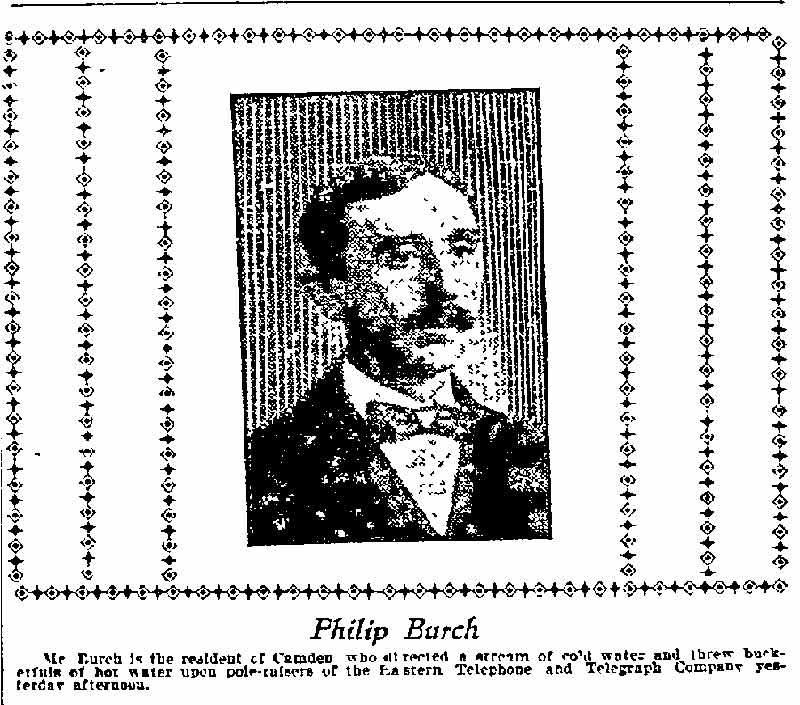
Philip Burch
Mr. Burch is the resident of Camden who directed a stream of cold water and threw bucketfuls of hot water upon pole-raisers of the Eastern Telephone and Telegraph Company yesterday afternoon.
Philadelphia Inquirer, November 28, 1900 — page 2Philadelphia Inquirer, November 28, 1900 — page 3Philadelphia Inquirer, November 28, 1900 — page 4Philadelphia Inquirer, November 28, 1900 — page 5Philadelphia Inquirer, November 28, 1900 — page 6
While They Must Submit to the Former, They Will Move Against the Latter in City Councils To-night.
Another Small-Sized Riot
Go where you will in Camden you hear nothing but complaints about bad gas, almost equally as bad electric lights and violent protests against the operations of the new telephone company that seems to think it has a right to rear its unsightly poles anywhere it seems fit, clearly in defiance of the law that declares the consent of property holders must first be had. And Camden people declare there is a peculiar relation existing between these gas, electric, trolley and telephone concerns that will not require much investigation to find certain prominent citizens identified in one way or the other with all of them.
Words of comment were heard on all sides in Camden yesterday on the report published in The Inquirer giving the situation regarding complaints against the bad quality of gas and the exorbitant prices charged.
The indignation of gas consumers can hardly be more pronounced than that of the property owners against the Eastern Telephone and Telegraph Company for its methods of raising poles. This part of the controversy reached a climax, and to-night the immediate revocation of the company’s franchise will be demanded of Camden’s City Council. This demand will be backed by an organization of property-owners, led by Philip Burch, a prominent young business man, of 510 Broadway.
SMALL-SIZED RIOT.
The organization of property-owners was brought about by the brave manner in which Mr. Burch, with the aid of a stream of cold water and buckets of hot water, endeavored to repel the company’s gang of pole-raisers in front of a house adjoining his home yesterday. The workmen managed to get the pole up on the pavement in front of the house of Wilbur Carhart, at 512 Broadway, but while Mr. Burch was protesting verbally and with water in behalf of Mrs. Carhart, there was a violent collision between the workmen and Mr. Burch, who was aided by some of his neighbors. Police Captain Stanley separated the combatants and three workmen, namely, Maurice Gandy, Thomas Mooney and Frank Yorley, were arrested on the complaints of Mr. Burch, George Lezenby and William C. Davis, and taken to the City Hall, where they were afterwards released on security for a hearing before Recorder Nowrey to-day.
Mr. Burch said last night: “The property-owners who have voluntarily joined me in this matter will apply to-morrow for writs of injunction by the dozen to restrain the company from proceeding with its outrageous methods. The pole in front of Carhart’s, and many others, will come down. Mark that!”
MR. COLES ON THE WATCH.
Between guarding against the planting of an unsightly pole in front of his residence, at 419 North Fourth street, and putting up with feeble gas at vigorous prices, George W. Coles, the well-known confectioner, on Market street, Philadelphia, is having his own troubles. It is safe to predict the pole will not go up if Mr. Coles is about at the beginning of operations, for it was only a short time ago when the Eastern Telephone Company attempted to plant the pole in front of his house he armed himself with a good-sized spade, filled up the hole and defied the workmen, who beat a retreat. The pole is there, but it stretches snake-like alongside the curb.
But with the gas business it’s different. “That meter will come out of my house,” said Mr. Coles yesterday, “and that is all there is about it. My bill for last September and October was greater than the three months previous. Besides the gas is bad, but what are you going to do about it? The electric lights are also poor and the crowd runs both. They come around to my house and try to plant a pole. I suppose they do that as a standoff for the privilege of permitting them to charge me an exorbitant price for gas. But you will observe that pole is not yet up, and there will be something doing if any attempt is made to plant it.”
INSPECTOR TRIPPED UP.
Martin J. O’Brien, the well-known undertaker at 613 Market street, is among the army of people who have made a vigorous protest against paying big prices for a bad quality of gas and gone away with the if-you-don’t-like-it-quit satisfaction. “Have I any complaint?” said Mr. O’Brien. “Well, rather. But what’s the use? I have been down to the office, but could get no satisfaction. As an illustration of how they charge you for a flimsy gas let me tell you this: For the three summer months—say July, August and September—I had a gas range and had lights burning in both the office and dwelling part of my house, for which I received a bill for $15.30. It was high, and I protested, but that was the end of it. My sisters, who live at 561 Carman street, rarely paid more than $6 a quarter, but when they received their bill for the months I speak of it was $15.30—theirs a private residence and mine, you might say, a business place.
“What was the result? I sent around to their house an expert who inspected the meter and said, just $6.20 worth of gas had been consumed. I reported the matter to the office. They said they would send somebody around to read the meter again. They did send around another man, who took out the metre. So there is the satisfaction you get.”
Robert H. Patton, paperhanger on Federal street below Broadway, said: “My gas bills are one-third more than they used to be, yet the service is much inferior. The gas is of a bad quality. Why, only the other night I attended a little meeting in an office on Market street and we could scarcely see to transact business with three burners going right overhead. I tell you the people of Camden are justified in registering this ‘kick,’ and not the least aggravating part of it is the fact that every consumer is obliged to pay 50 cents a month, even if the house is closed up for that time. But there is no redress, so we are obliged to submit.”
Charles Markley, of 324 Elm, who is connected with a Dock street commission house, said: “I had about determined to let this gas company take out the meter, because my monthly bills are so far out of proportion to the quarterly bills I used to pay and by reason of the fact that the gas is poor at that. I have since concluded to give them another trial and see what that may bring forth. I tell you, the people cannot stand this much longer. I hear complaints on every side, and it is evident that something has to be done, and that soon.”
COUNTY PHYSICIAN’S COMPLAINT.
Dr. W. S. Jones, the County Physician, is another victim. While his house was closed he got a big bill that almost stunned him. He went down to the gas office, or electric light office, or trolley office, as the case may be, and entered the usual protest, which was met with that telling argument: “If you don’t want to have it you can do without it.”
Richard Twelves, stationer at 4[illegible]3 Market street, said: “The light is very unsatisfactory and our bills are higher. Some friends from Philadelphia said, when they saw our Camden gas, that the company here was apparently using water in its process of making gas. We have thought of ordering the company to take out the meter here and at our home, substituting lamps. It is aggravating to be imposed upon and have no redress.”
William Vogt, florist, on Fourth street above Market, said: “The gas is very poor and some of the bills are positively funny. For the three months ending with September the company charged me $1 for gas in my house, despite the fact that I did not use a foot of gas in the house in all that time. The company now makes a charge of 50 cents for the use of the meter whether you use the gas or not, and I paid them 50 cents for October, although I did not use any gas in the house that month. I refused to pay the $1 and they have not pressed me for it.”
Philip Burch
Mr. Burch is the resident of Camden who directed a stream of cold water and threw bucketfuls of hot water upon pole-raisers of the Eastern Telephone and Telegraph Company yesterday afternoon.