Arthur Stanley
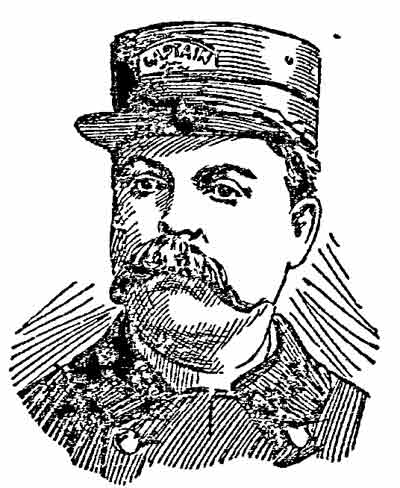
Arthur Stanley was born in England in February of 1845 to James and Eliza Stanley. He came to America with his family in 1853. The Stanleys were living in Camden's South Ward when the Census was taken in 1860. Besides Arthur and his parents, the family included older sister Louisa, 20, and younger siblings Harry 5, and Mary Jane "Jennie," 2. The Census states that Harry was born in Pennsylvania and Mary in New Jersey, so it is probable that the family moved to Camden at some point between the two births. The Census states that James Stanley worked as a shoe cutter. Arthur Stanley's entry on the Census sheet lists no occupation.
Arthur Stanley served with the Union Army during the Civil War, enlisting as a Private on July 28, 1862. Although just a teenager, he was promoted to Full Corporal on Jul 28, 1862. He was enlisted in Company G, 12th Infantry Regiment New Jersey on September 4, 1862. After two years of service, he was promoted to Full Sergeant on October 20, 1864. Sergeant Stanley mustered out with Company G, 12th Infantry Regiment New Jersey on June 4, 1865 at Munson's Hill, Virginia.
During his time with the Union Army, Arthur Stanley took part in the battles at Chancellorville, Gettysburg, the Wilderness, Spottsylvania Courthouse, North Anna River, Cold Harbor, Petersburg, and seven other lesser known battles. Arthur Stanley was an active member of the Thomas M.K. Lee Post No. 5 of the Grand Army of the Republic (G.A.R.), the Civil War veterans' organization, and at one time was the Post's commander. He was a longtime member of the Independent Order of Odd Fellows.
Arthur Stanley returned to Camden after the Civil War. He married Frances Irene Kirby, and a son, Milton K. Stanley, came from this marriage. However it appears that Frances Stanley had passed away by the time of the 1880 Census. Arthur Stanley's sister, Mrs. Louisa Vennell and her daughter Clara lived with him. As early as 1874 and through 1881 Camden City Directories list Arthur Stanley at 929 Newton Avenue. He was then working as an oilcloth printer. His father, James Stanley, lived at 428 Line Street as early as 1878 and as late as 1882, according to the City Directories.
By 1883 Arthur Stanley had moved back to 428 Line Street in South Camden. He would remain at that address through at least January of 1910. The Directories indicate that he was working as a paper carrier in 1883, a news dealer in 1887, and as a paper carrier in from 1888 through 1898. The paper he was carrying were newspapers.
In 1898 Arthur Stanley was appointed to the Camden Police Department, and was made Captain of the Second District. The 1899 Camden City Directory lists Arthur Stanley's occupation as Captain of Police. It appears that his military background may have given cause for him to be assigned an officer's post when he came into the department. In any event, he served in this capacity until his retirement in 1916.
The 1900 Census states that Arthur Stanley was living with his sister, Jennie. On September 19, 1905 he married for the second time. His wife, the former Gertrude Rammell, was from Williamstown, New Jersey. When the 1906 City Directory was compiled, they made their home at 428 Line Street in North Camden. The Stanleys remained there through at least the spring of 1910. By April of the following year they had moved to 423 Benson Street.
Son Milton had left home at the age of fourteen to pursue a career in show business, and was successful. In 1909 he was offered a job with the Camden Police Department.
In 1911 Arthur Stanley took a trip to Europe. He returned on August 6, 1911 aboard the steamship Merion, having sailed from Liverpool, England on August 2nd.
After retiring, Arthur Stanley stayed active in G.A.R. affairs.
Arthur Stanley passed away on February 1, 1925. His widow, Mrs. Gertrude Stanley, was living at 423 Benson Street when the 1927 and 1929 Camden City Directories were compiled. His son, Milton K. Stanley, served with the Camden Police Department, the Camden County Prosecutor's office, and as a federal investigator for many years.
Regimental History — New Jersey Twelfth Infantry (Three Years)
Twelfth Infantry. Colonels., Robert C. Johnson, J. Howard Willetts, John Willian; Lieutenant Colonels., Thomas H. Davis, Richard S. Thompson; Majors., John T. Hill, Henry F. Chew, Edward M. Dubois.
This regiment was raised under the second call of the president for 300,000 men, Robert C. Johnson, of Salem, formerly major of the 4th regiment (3 months' men), being commissioned as colonel early in July, 1862. Woodbury, Gloucester county, was selected as the rendezvous, and on July 25 the first detachment of troops, about 950 men, was mustered into the U. S. service. Many of the officers had already seen service in other regiments, but comparatively few of the men were familiar with military duties or requirements, though all entered cheerfully upon the work of preparing for the duties before them.
On Sept. 7 the regiment left the state for Washington, but at Baltimore was diverted from its course by Gen. Wool, commanding that district, who ordered it to proceed to Ellicott City, the county seat of Howard county, Md., 15 miles from Baltimore on the line of the Baltimore & Ohio railroad.
At Chancellorsville, on May 3, 1863, the regiment received its first taste of actual warfare. It behaved with great gallantry, though the loss was severe, amounting to 179 in killed, wounded and missing. Although under arms during the two succeeding days and nights, it was not again engaged, and on the night of the 5th it recrossed the Rappahannock and proceeded to its old camp, having in its first battle lost over one-tenth of its men.
Soon after reaching the field at Gettysburg on July 2, Co. I was sent out on the skirmish line, but the combat not yet being opened, only two or three casualties were sustained. In the afternoon a house and barn standing about 200 yards west of the Emmitsburg road and nearly equidistant from either army having been occupied as a cover by the Confederate sharpshooters, Cos. B, H, E and G were sent out to dislodge them, which they did, capturing 6 commissioned officers and 80 men, but with considerable loss, Capt. Horsfall of Co. E, a brave officer, being killed, and Lieut. Eastwick wounded. During the fearful infantry contest of the following day the regiment was actively engaged, but only lost 5 or 6 men killed and 1 officer and 30 men wounded.
On Oct. 14, when near Auburn mills, some 2 miles east of Warrenton, the Confederate cavalry made an attack upon the corps of which the regiment was a part, evidently hoping to capture its train, but they were repulsed with loss and the corps continued its retreat toward Centerville, the point which Lee was straining every nerve to reach in advance of the Union troops.
In the engagement at Bristoe Station, which lasted for 3 or 4 hours, several men of the 12th were wounded, Lieut. Lowe, of Co. G, being among the number. In the skirmishes at Mine Run the regiment did not sustain any casualties, although under fire on several occasions. In the affair at Morton's ford, some 10 men of the regiment were wounded, but only 1 fatally.
At the battle of the Wilderness, although not engaged as a whole, the regiment suffered considerably, Lieut. John M. Fogg, of Co. H, being killed, while Lieut. Frank M. Riley, of Co. K, and several others were wounded. Two days later the regiment lost heavily, Lieut.-Col. Davis and Capts. Chew and Potter being among the wounded.
In the magnificent assault at Spottsylvania, which resulted in the capture of over 3,000 prisoners and some 30 guns, the 12th again suffered severely, Lieut.-Col. Davis being instantly killed while bravely leading the regiment; Capt. H. M. Brooks and Lieut. E. P. Phipps were severely wounded and were obliged to quit the service in consequence.
In the assault at Cold Harbor the loss of the regiment was severe, Capt. McCoomb, commanding the regiment, being mortally wounded by the explosion of a shell, which also killed or wounded several privates. Up to June 16 the total loss of the regiment in this memorable campaign had been some 250 killed, wounded or missing—a large proportion of the wounded being officers.
From this time forward the regiment was in position at various points on the line, and in July it participated in the movement and affair at Strawberry Plains and Deep Bottom, on the north side of the James. Thence, by a forced march, it returned to the Petersburg front, arriving in time to support the assault at the explosion of the mine, July 30, though not actually engaged. It participated in the second movement to Deep Bottom, charging the enemy's picket line under Capts. Chew and Acton, and upon returning marched to the extreme left flank of the Army of the Potomac, whence it was marched to Reams' station, on the Weldon railroad, where the 1st division of the corps had preceded it. In the severe action at the latter place Lieut.-Col. Thompson, commanding the regiment, was severely wounded and Lieuts. Rich and Stratton were killed.
After the action at Reams' station the regiment was in various positions along the Petersburg front, Fort Hell on the Jerusalem plank road, Fort Morton, and at other points, until late in October, when it moved out and participated in the action known as the battle of the Boydton road, where it lost 4 killed and 9 wounded—including Capt. T. O. Slater. In the winter of 1864-65 it took part in the various actions at Hatcher's run, where in one instance it charged across the run, waist deep, and took the enemy's works, upon which its color-bearer, Ellwood Griscom, was the first to plant the national colors. It was present in the movements of the army preceding the main assault on the Petersburg defenses; took part in the assault, under the command of Maj. Chew, and aided in the various actions during Lee's retreat until his surrender. It returned, via Richmond, to Bailey's crossroads, in front of Washington, where in June, 1865, the old battalion of the regiment was mustered out of service, and in July the remainder of the regiment. Its total strength was 1,899, and it lost, by resignation 14, by discharge 171, by promotion 56, by transfer 206, by death 261, by desertion 216, by dismissal 3, not accounted for 29, mustered out, 943.
— Source: The Union Army, vol. 3
Gettysburg After-Battle Report
Report of Maj. John T. Hill, Twelfth New Jersey Infantry.
Hdqrs. Twelfth Regt. New Jersey Volunteers, July 16, 1863.
Sir:
I have the honor to report the action of the regiment I have the honor to command during the engagements of the 2d, 3d, and 4th instant to have been as follows:
At 5 p. m. on the 2d instant, four companies (B, H, E, and G) were detailed to take a large barn on our picket line, taken from us and held by the enemy. Under command of Capt. Jobes, Company G, they charged gallantly upon the building, surrounding it, and capturing 92 prisoners, including 7 commissioned officers; losing in the attack 2 officers and 40 men killed and wounded.
At 6 p. m. the same day the balance of my command moved to the front line, taking position behind a stone fence to the left of Kirby's battery, remaining in this position until the afternoon of the 5th instant.
At 7.30 a. m. of the 3d instant, five companies (D, C, K, F, and A), under command of Capt. Thompson, Company K, again drove the enemy from the shelter of the barn, capturing a major and 1 man, relieving our lines from an annoying fire from the enemy's sharpshooters posted therein.
At 4 p. m. of the 3d instant, the whole line became engaged in repulsing an attack in force made by the enemy, completely routing them, capturing prisoners estimated to number 500 men, and 2 colors.
We collected and turned in 751 small-arms, picked up in our immediate front.
(* Medals of honor awarded to Privates Mayberry and McCarren.)
Officers and men behaved with the greatest gallantry. I take pleasure in calling your attention to the meritorious conduct of Capt.'s Thompson, Jobes, and Chew, Adjutant Franklin, Lieut.'s McComb, Trimble, Acton, Phipps, Williams, Eastwick, and Dare, Sergeant-Maj. [Edward M.] Du Bois, and Color Sergeants [Charles E.] Cheeseman and [William H.] Griffin.
Our casualties were—
Officers and men. K. W. M. T.
Commissioned officers … 2 4 … 6
Enlisted men … 21 75 11 107
Total* … 23 79 11 113
k=Killed. w=Wounded. m=Missing. t=Total.
I am, colonel, very respectfully, your obedient servant,
JOHN T. HILL, Maj., Comdg. Twelfth New Jersey Volunteers.
Col. Morris, Comdg. Second Brig., Third Div., Second Army Corps.
— Source: Official Records: Series I. Vol. 27. Part I. Reports. Serial No. 43
Battles Fought
- Fought on 3 May 1863 at Chancellorsville, VA.
- Fought on 2 Jul 1863 at Gettysburg, PA.
- Fought on 3 Jul 1863 at Gettysburg, PA.
- Fought on 14 Oct 1863 at Bristoe Station, VA.
- Fought on 28 Nov 1863 at Mine Run, VA.
- Fought on 6 Feb 1864 at Morton's Ford, VA.
- Fought on 4 May 1864 at Wilderness, VA.
- Fought on 5 May 1864 at Wilderness, VA.
- Fought on 6 May 1864 at Wilderness, VA.
- Fought on 8 May 1864 at Spotsylvania Court House, VA.
- Fought on 10 May 1864 at Spotsylvania Court House, VA.
- Fought on 12 May 1864 at Spotsylvania Court House, VA.
- Fought on 15 May 1864 at Spotsylvania Court House, VA.
- Fought on 18 May 1864 at Spotsylvania Court House, VA.
- Fought on 24 May 1864 at North Anna River, VA.
- Fought on 26 May 1864 at North Anna River, VA.
- Fought on 3 Jun 1864 at Cold Harbor, VA.
- Fought on 4 Jun 1864 at Cold Harbor, VA.
- Fought on 16 Jun 1864 at Petersburg, VA.
- Fought on 17 Jun 1864 at Petersburg, VA.
- Fought on 23 Jun 1864 at Petersburg, VA.
- Fought on 25 Jul 1864 at Deep Bottom, VA.
- Fought on 24 Aug 1864 at Reams' Station, VA.
- Fought on 25 Aug 1864 at Reams' Station, VA.
- Fought on 1 Oct 1864 at Petersburg, VA.
- Fought on 27 Oct 1864 at Boydton Plank Road, VA.
- Fought on 28 Feb 1865 at Dabney's Mills, VA.
- Fought on 25 Mar 1865 at Hatcher's Run, VA.
- Fought on 28 Mar 1865 at Hatcher's Run, VA.
View transcription
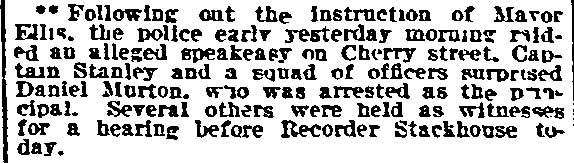
•• Following out the instruction of Mayor Ellis, the police early yesterday morning raided an alleged speakeasy on Cherry street. Captain Stanley and a squad of officers surprised Daniel Murton, who was arrested as the principal. Several others were held as witnesses for a hearing before Recorder Stackhouse today.
— Philadelphia Inquirer, September 18, 1911
Tag: arthur-stanley
Walter Edgerton
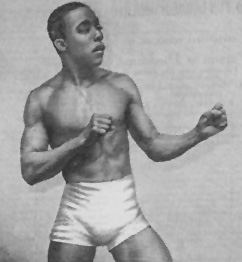
Walter Edgerton (1854–1930), Camden professional boxer who fought as "Kentucky Rosebud." A featherweight who boxed professionally from 1886 to 1921, fought featherweight champion George Dixon, and won a bout past age 60.
Coates Alley
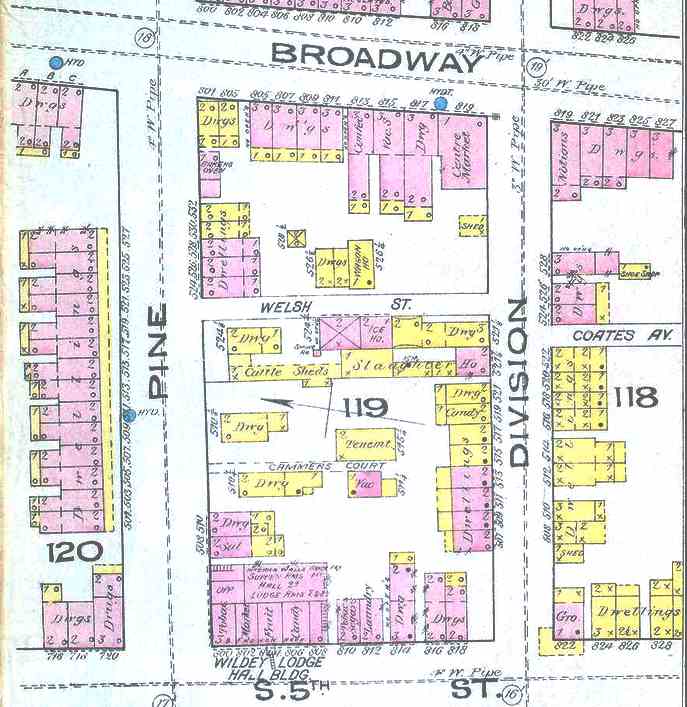
Coates Alley is a short street in Camden that originally ran parallel to Broadway and South 5th Street from Cherry Street north across Spruce Street to Division Street. Today it is one block long, running from Spruce Street to Division Street.

Baxter Street
Baxter Street (formerly Newton Street and locally known as "Hog Alley") ran from South 7th Street to Mount Ephraim Avenue in South Camden, notorious for decades as a hub of illegal activity; largely demolished, the 700 block survives as an overgrown alley.

Sycamore Street
Sycamore Street is one of Camden's "tree" streets, originally running east from Front Street to Haddon Avenue; its intersections at 7th, 8th and Louis Streets were hubs for different ethnic and cultural communities.

9th Street
Ninth Street is one of Camden's longest north–south thoroughfares, running from the Delaware River waterfront in North Camden, through the city's central corridor, and far south through Cramer Hill and Whitman Park. Block numbering begins at Federal Street.

Arch Street
Arch Street ran from Delaware Avenue to North 5th Street between Federal and Market Streets in downtown Camden. Formerly known as Plum Street, it was home to Oetzel's Saloon, the Genova Cafe, the Collings Carriage Company, and the Camden Fire Department headquarters at 5th and Arch.
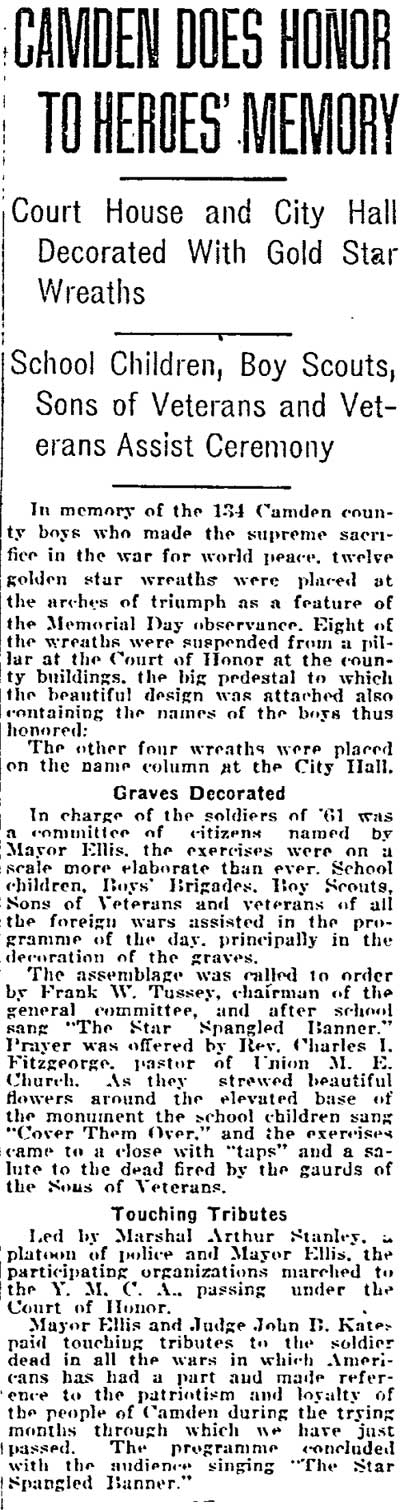
Camden Does Honor to Heroes' Memory
Camden's 1919 Memorial Day observance placed twelve gold star wreaths for the 134 county men who died in the war. Marshal Arthur Stanley led a platoon of police and Mayor Ellis in the march to the Y.M.C.A. under the Court of Honor.
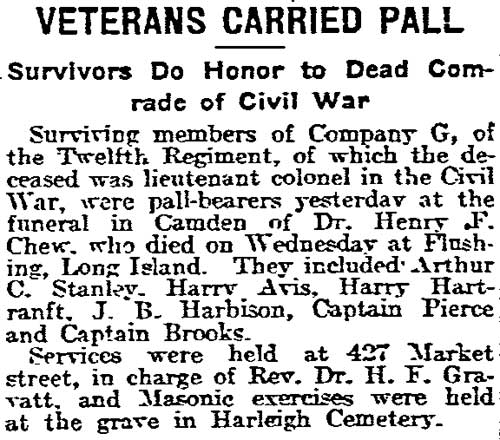
Veterans Carried Pall
Surviving members of Company G, Twelfth Regiment — Arthur C. Stanley among them — served as pall-bearers at the Camden funeral of Dr. Henry F. Chew, the regiment's Civil War lieutenant colonel.
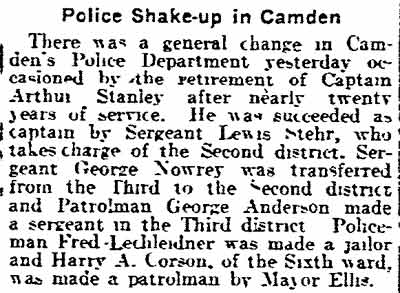
Police Shake-up in Camden
There was a general change in Camden's Police Department yesterday occasioned by the retirement of Captain Arthur Stanley after nearly twenty years of service.
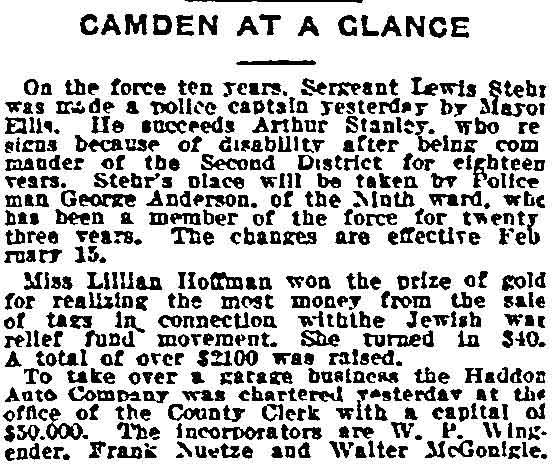
Camden at a Glance
Philadelphia Inquirer, January 29, 1916 — Camden at a Glance Philadelphia Inquirer, January 29, 1916 On the force ten years, Sergeant Lewis Stehr was made a police captain yesterday by Mayor Ellis. He succeeds Arthur Stanley.
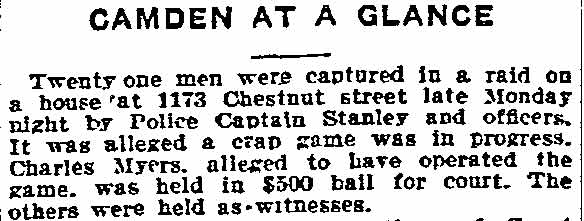
Camden at a Glance
Twenty-one men were captured in Police Captain Stanley's raid on a house at 1173 Chestnut Street where a crap game was alleged to be in progress; Charles Myers was held in $500 bail for court.
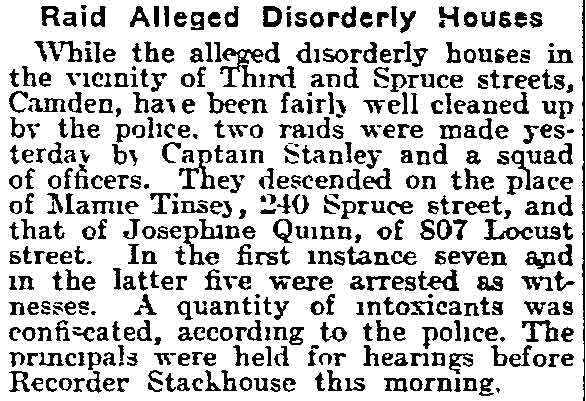
Raid Alleged Disorderly Houses
Captain Stanley and a squad made two more raids near Third and Spruce Streets, descending on the places of Mamie Tinsey at 240 Spruce Street and Josephine Quinn at 807 Locust Street.
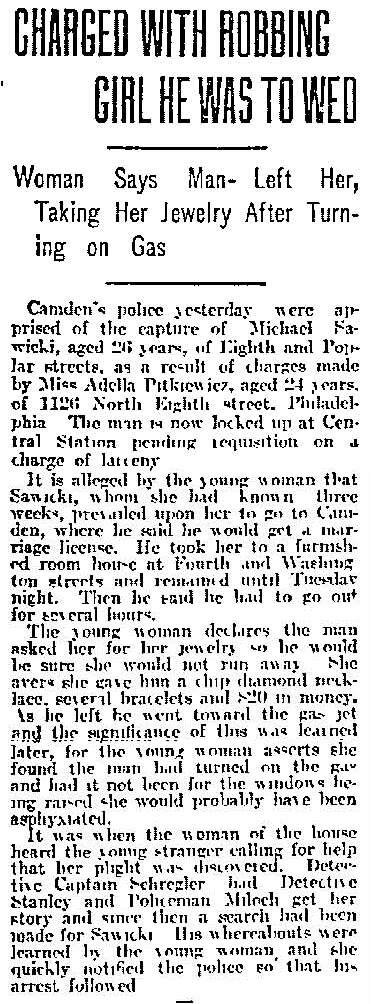
Charged with Robbing Girl He Was to Wed
Detective Captain Schregler's men trace Michael Sawicki, accused of robbing Adella Pitkiewicz of her jewelry and leaving her to the gas in a Camden rooming house.
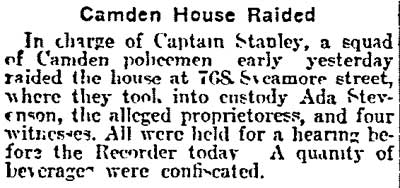
Camden House Raided
A squad of Camden policemen in charge of Captain Stanley raided 768 Sycamore Street, taking alleged proprietress Ada Stevenson and four witnesses into custody and confiscating a quantity of beverages.
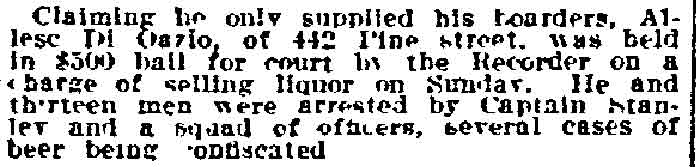
Sunday Liquor Seller Held for Court
Allese Di Dazio of 442 Pine Street, claiming he only supplied his boarders, was held in $500 bail for court on a charge of selling liquor on Sunday after Captain Stanley's squad arrested him and thirteen men.
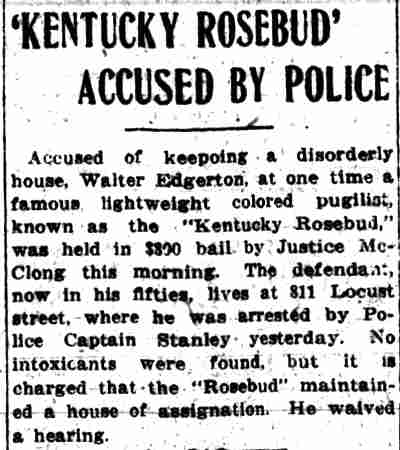
'Kentucky Rosebud' Accused by Police
Walter Edgerton, the former lightweight pugilist known as the "Kentucky Rosebud," was arrested by Police Captain Stanley at 811 Locust Street and held in $800 bail on a charge of keeping a disorderly house.
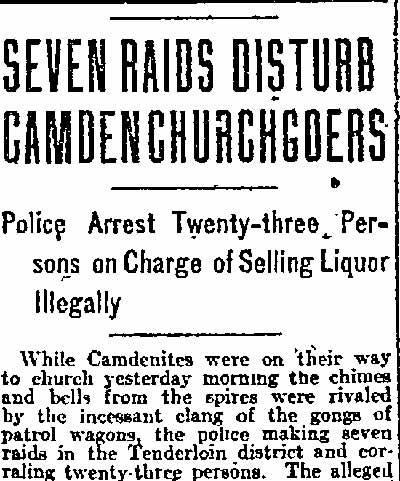
Seven Raids Disturb Camden Churchgoers
Camden police made seven simultaneous raids in the Tenderloin district on a Sunday morning, arresting twenty-three persons accused of selling liquor without a license. The raids were directed by Police Captain Arthur Stanley.
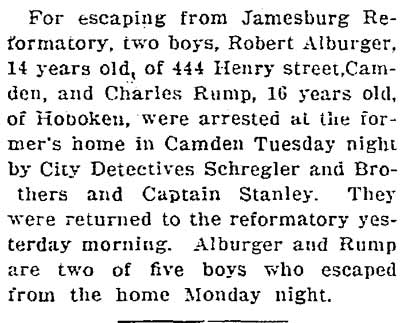
Reformatory Escapees Arrested
City Detectives Schregler and Brothers and Captain Stanley arrest two Jamesburg Reformatory escapees at a Camden home; both boys are returned to the reformatory.
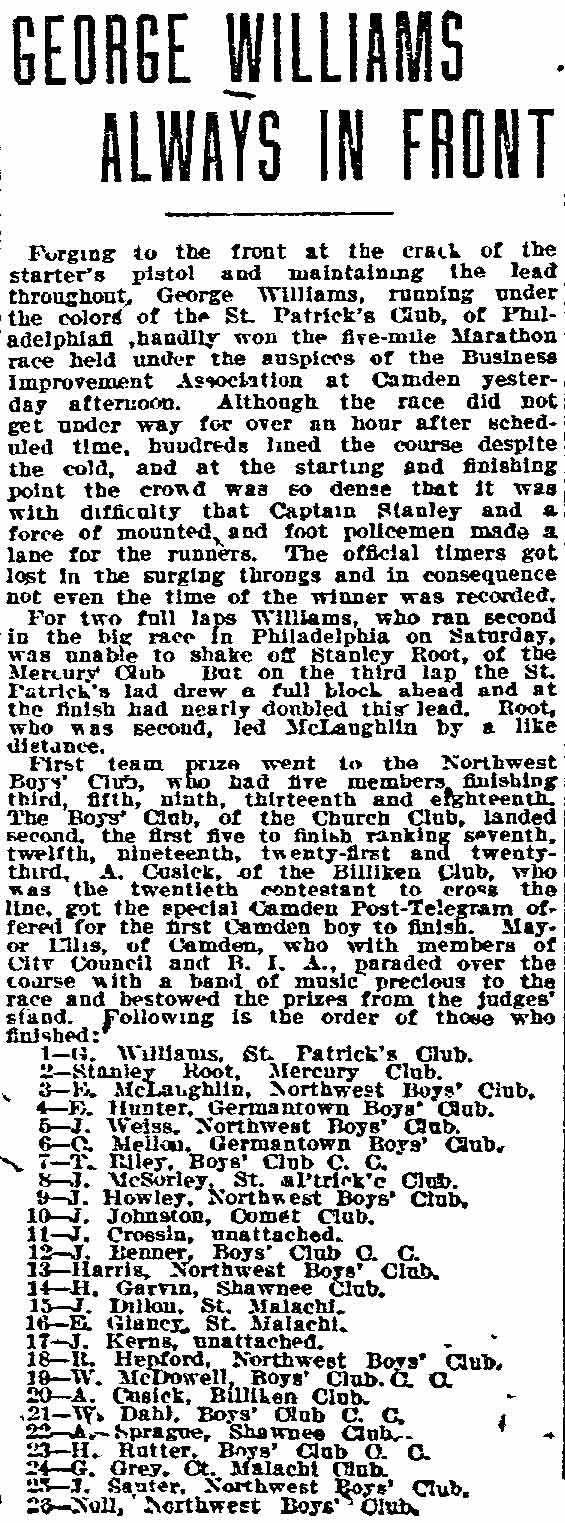
George Williams Always in Front
George Williams of Philadelphia's St. Patrick's Club won the five-mile Marathon race staged in Camden by the Business Improvement Association. Captain Stanley and a force of mounted and foot policemen struggled to open a lane through the dense crowd for the runners.
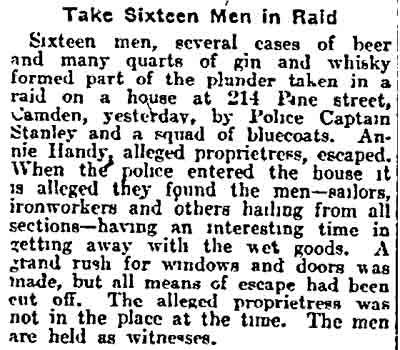
Take Sixteen Men in Raid
Sixteen men, several cases of beer and many quarts of gin and whisky were taken in Captain Stanley's raid on a house at 214 Pine Street; alleged proprietress Annie Handy escaped.
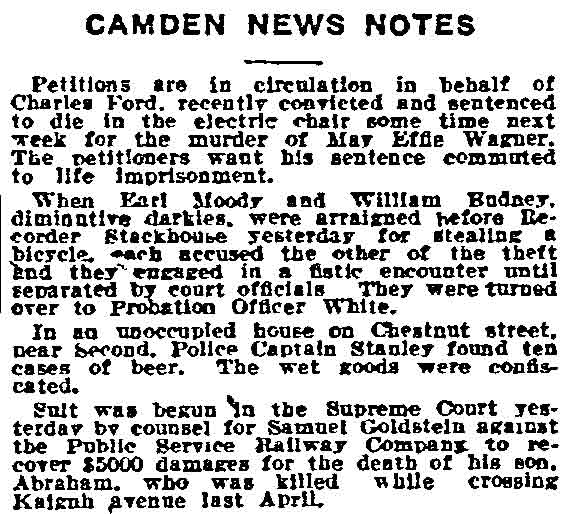
Camden News Notes — November 19, 1912
Camden briefs for November 19, 1912, including Police Captain Stanley's discovery of ten cases of beer in an unoccupied house on Chestnut Street near Second.
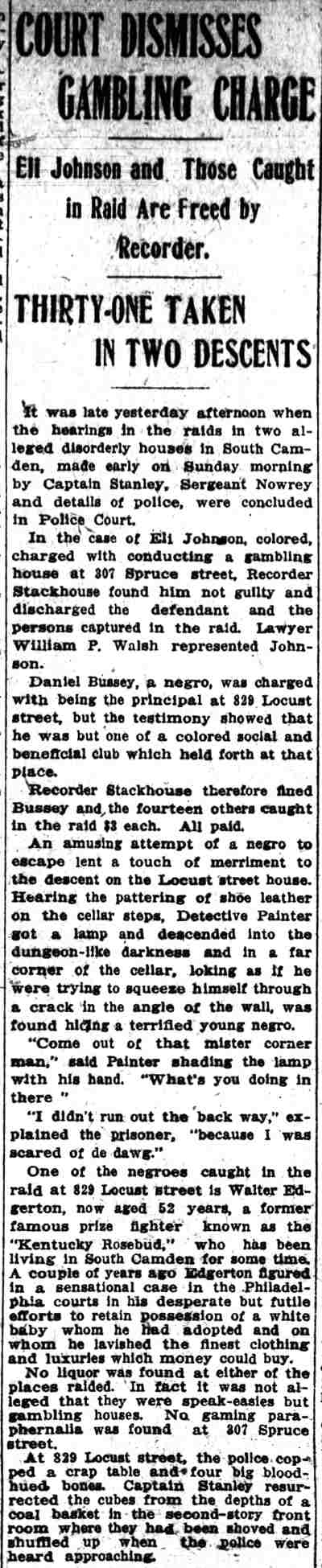
Court Dismisses Gambling Charge
A Camden Post-Telegram account of the April 1912 police raids on two alleged South Camden gambling houses. Eli Johnson and Daniel Bussey were discharged or fined; among those caught at 829 Locust Street was former prize fighter Walter "Kentucky Rosebud" Edgerton.
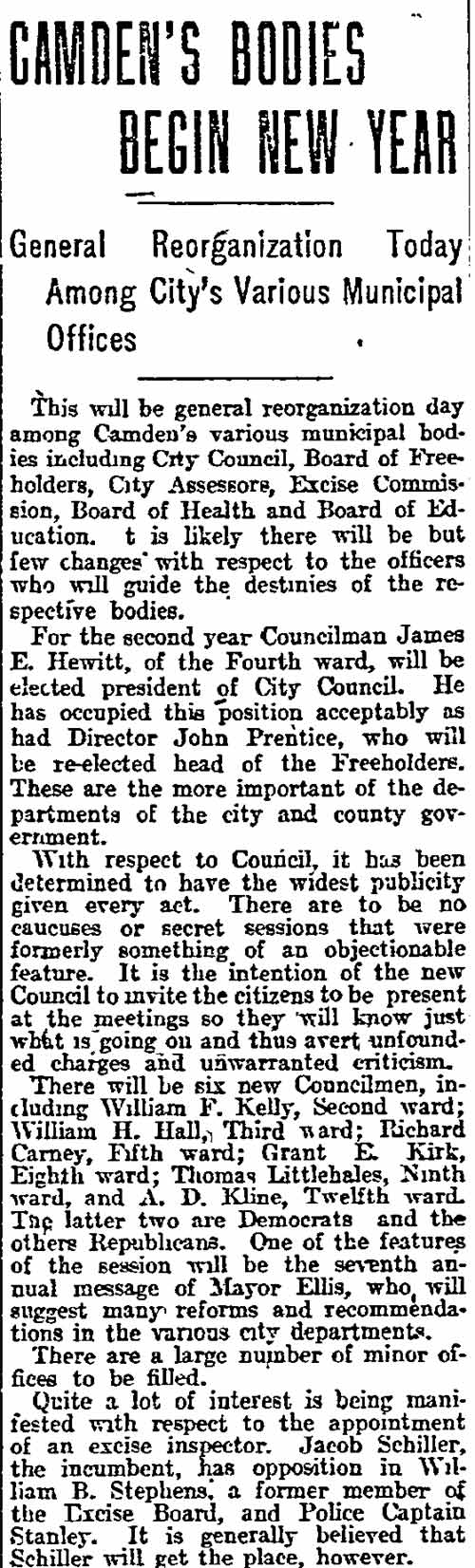
Camden's Bodies Begin New Year
Camden's municipal bodies reorganized for 1912 with James E. Hewitt returning as Council president. Police Captain Stanley was among those in contention for the post of excise inspector.

Burglar Escapes After Stanley's Pursuit
Policeman Stanley found a burglar in the act of breaking into the home of H. O. Cliver at 447 Benson Street; after leaping several fences the prowler escaped.
Twenty Years Ago To-Day in Bridgeton
A Bridgeton Evening News retrospective column recalling the 18th annual reunion of the Twelfth New Jersey Regiment held in Camden, at which Secretary Arthur Stanley called the roll.
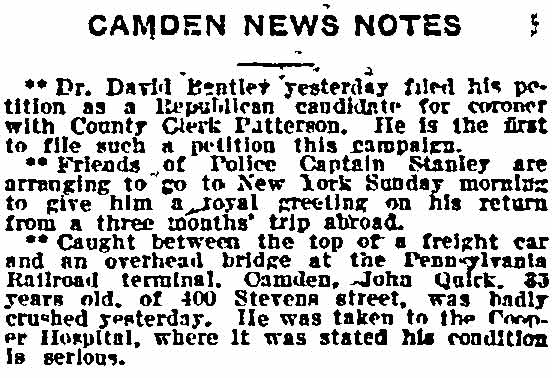
Camden News Notes — August 11, 1911
Camden briefs for August 11, 1911, reporting that friends of Police Captain Stanley were arranging to go to New York to greet him on his return from a three months' trip abroad.
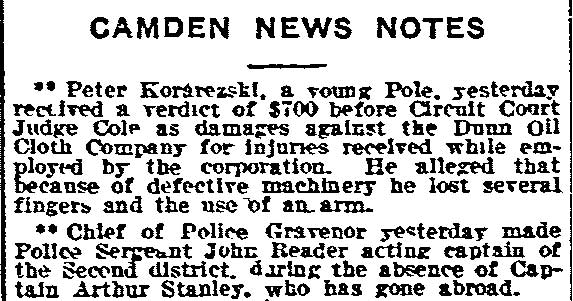
Camden News Notes — May 19, 1911
Camden briefs for May 19, 1911, reporting that Chief of Police Gravenor made Sergeant John Reader acting captain of the Second District during Captain Arthur Stanley's absence abroad.
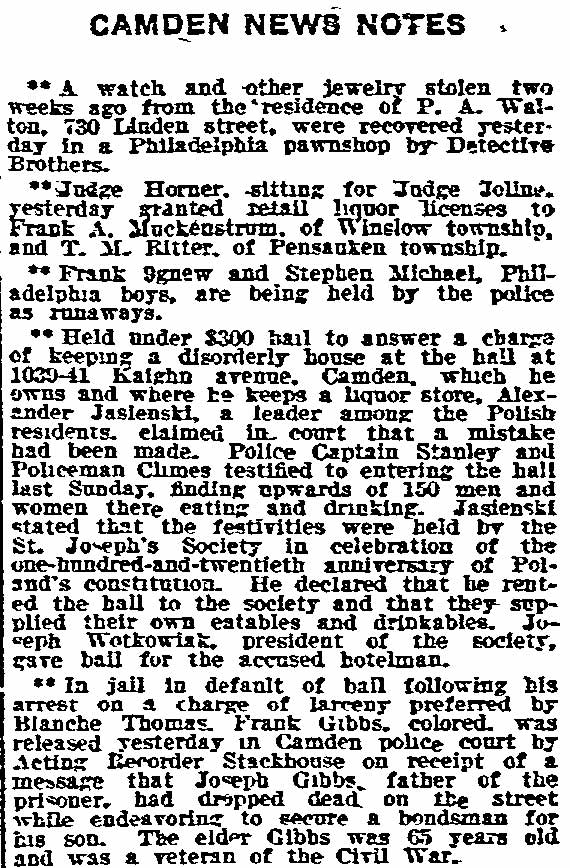
Camden News Notes — May 6, 1911
A May 1911 Philadelphia Inquirer item reporting the arrest of Alexander Jasienski, a leader among Camden's Polish residents, over a St. Joseph's Society celebration of the anniversary of Poland's constitution held at his Kaighn Avenue hall.
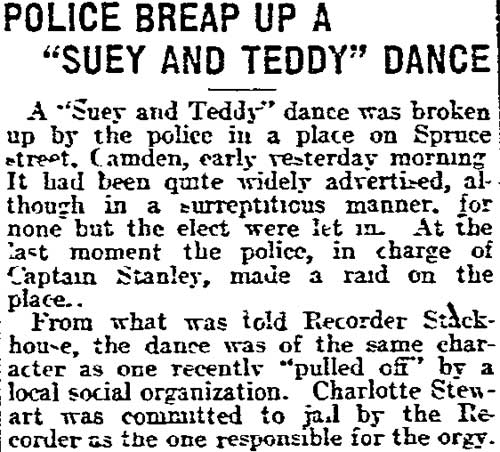
Police Break Up a "Suey and Teddy" Dance
Police under Captain Stanley raided a surreptitiously advertised "Suey and Teddy" dance on Spruce Street; Charlotte Stewart was committed to jail as the one responsible.
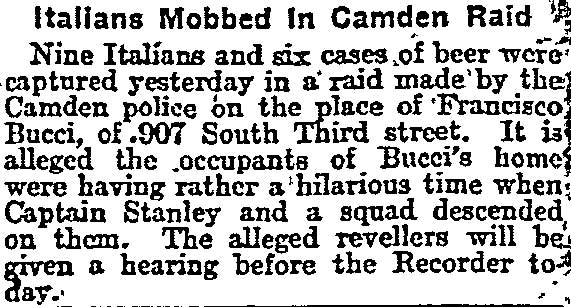
Italians Mobbed in Camden Raid
Nine Italians and six cases of beer were seized in a Camden police raid on the home of Francisco Bucci at 907 South Third Street, made by Captain Stanley and a squad.
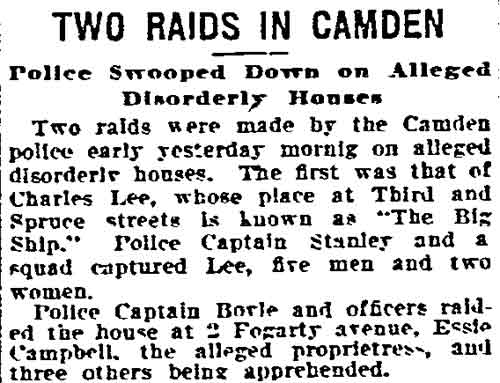
Two Raids in Camden
Camden police raided two alleged disorderly houses: Captain Stanley took Charles Lee's place at Third and Spruce Streets, known as "The Big Ship," while Captain Boyle raided 2 Fogarty Avenue.
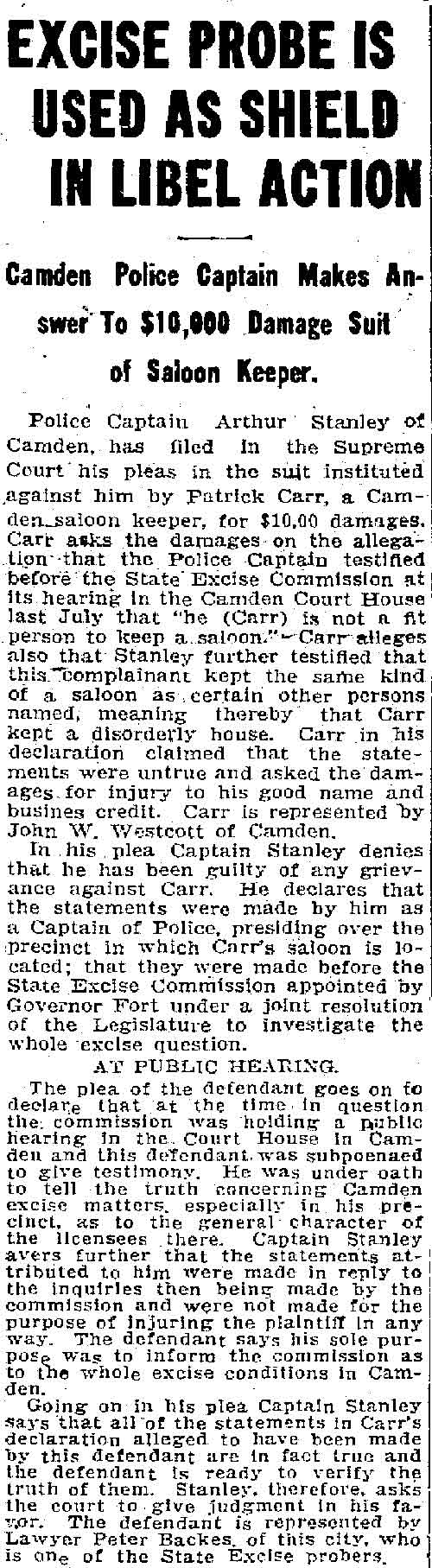
Excise Probe Is Used as Shield in Libel Action
Captain Arthur Stanley filed his pleas in Patrick Carr's $10,000 libel suit, arguing that his statements about Carr's saloon were made under oath before the State Excise Commission and are in fact true.
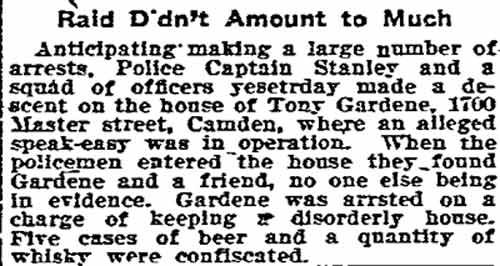
Raid Didn't Amount to Much
Expecting many arrests, Captain Stanley and a squad descended on Tony Gardene's house at 1700 Master Street but found only Gardene and a friend; five cases of beer and a quantity of whisky were confiscated.

Murders Wife Who Threatened to Leave
Adolph Walker, 27, shot and killed his wife Anna at their home at 906 Coates Alley, then turned the revolver on himself.
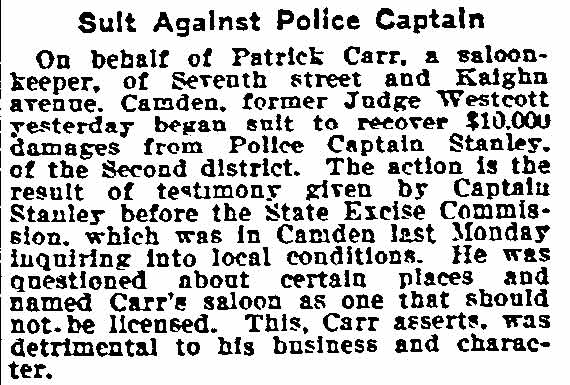
Suit Against Police Captain
Saloonkeeper Patrick Carr of Seventh Street and Kaighn Avenue sued Police Captain Stanley for $10,000, alleging that Stanley's testimony before the State Excise Commission naming Carr's saloon as one that should not be licensed damaged his business and character.
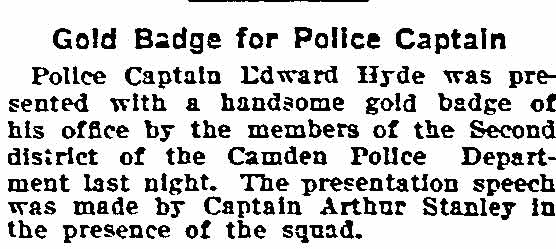
Gold Badge for Police Captain
Police Captain Edward Hyde was presented with a gold badge of his office by the men of Camden's Second District; Captain Arthur Stanley made the presentation speech.
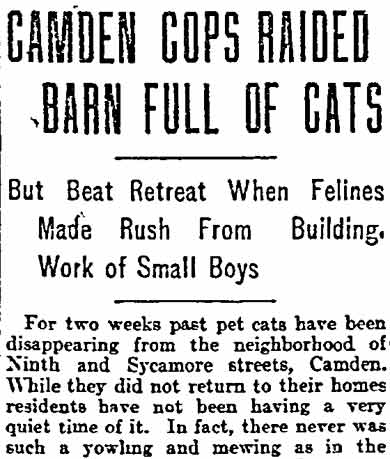
Camden Cops Raided Barn Full of Cats
Captain Stanley investigated the disappearance of pet cats near Ninth and Sycamore Streets and opened an unoccupied barn, from which at least a hundred half-starved felines bounded out — the work of neighbourhood boys who believed the barn was haunted.
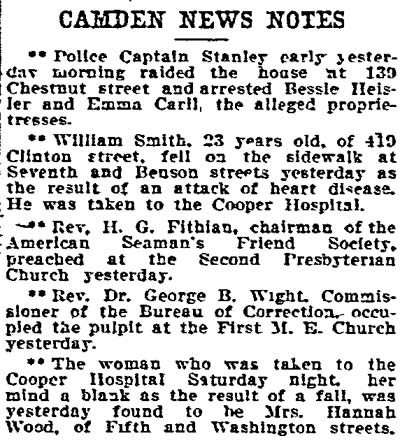
Camden News Notes — July 15, 1907
Camden briefs for July 15, 1907, opening with Captain Stanley's early-morning raid on 139 Chestnut Street and the arrest of alleged proprietresses Bessie Heisler and Emma Carll.
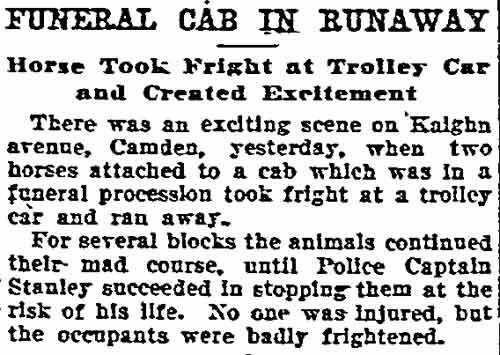
Funeral Cab in Runaway
Two horses drawing a cab in a funeral procession on Kaighn Avenue took fright at a trolley car and bolted; Police Captain Stanley stopped them at the risk of his life.
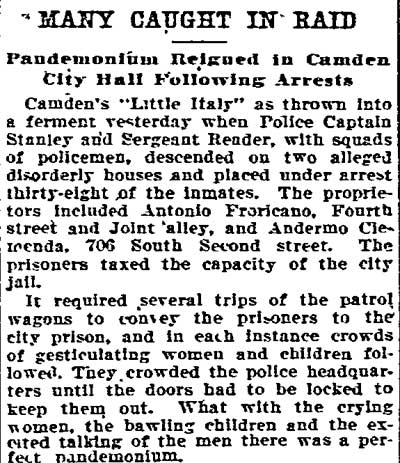
Many Caught in Raid
Captain Stanley and Sergeant Reader descended on two alleged disorderly houses in Camden's "Little Italy," arresting thirty-eight inmates and filling the city jail; crowds followed the patrol wagons to police headquarters.
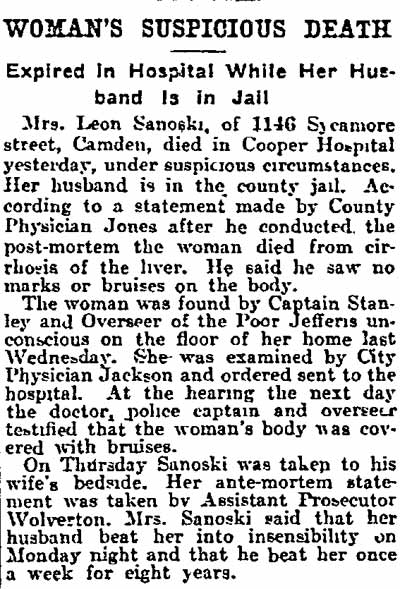
Woman's Suspicious Death
Mrs. Leon Sanoski of 1146 Sycamore Street died at Cooper Hospital under suspicious circumstances while her husband sat in the county jail. Captain Stanley had found her unconscious at home; her ante-mortem statement alleged eight years of weekly beatings.
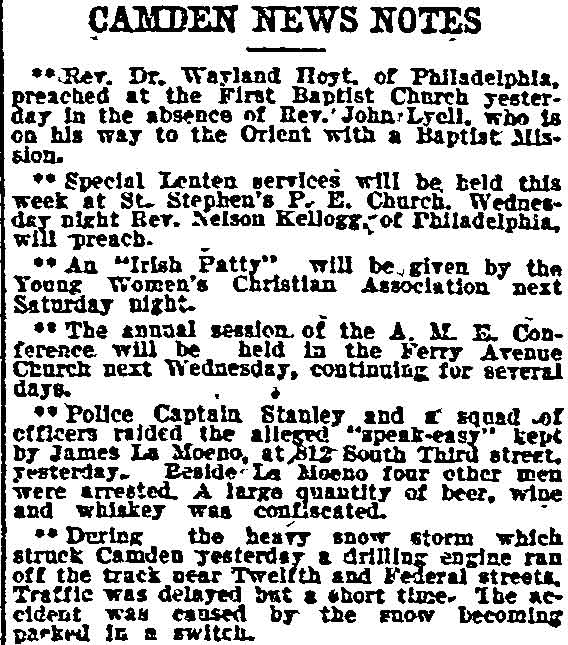
Camden News Notes — March 11, 1907
Camden briefs for March 11, 1907, including Captain Stanley's raid on an alleged speak-easy kept by James La Moeno at 812 South Third Street, where beer, wine and whiskey were confiscated.
Halseys Committed for Disorderly House
Harry Halsey and his wife, of Sixth Street and Kaighn Avenue, were committed to the county jail on a charge of keeping a disorderly house after a raid by Captain Stanley and squad.
Kaighn Avenue House Raided
Captain Stanley and a squad descended on 260 Kaighn Avenue before dawn, capturing alleged proprietor Charles Fordyce and eight others; Fordyce was charged with keeping a disorderly house.
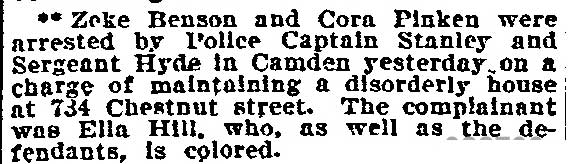
Benson and Pinken Arrested for Disorderly House
Zeke Benson and Cora Pinken are arrested by Captain Stanley and Sergeant Hyde on a charge of maintaining a disorderly house at 734 Chestnut Street.
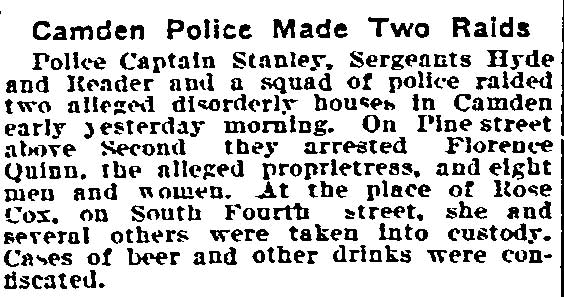
Camden Police Made Two Raids
Captain Stanley, Sergeants Hyde and Reader, and a police squad raid two alleged disorderly houses in Camden, arresting the proprietors and confiscating cases of beer.
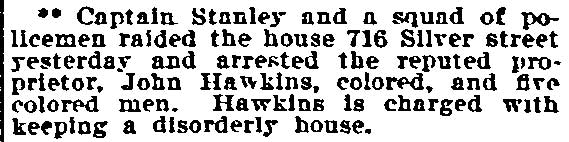
Silver Street Disorderly House Raided
Captain Stanley and a squad raided 716 Silver Street and arrested reputed proprietor John Hawkins and five other men; Hawkins was charged with keeping a disorderly house.
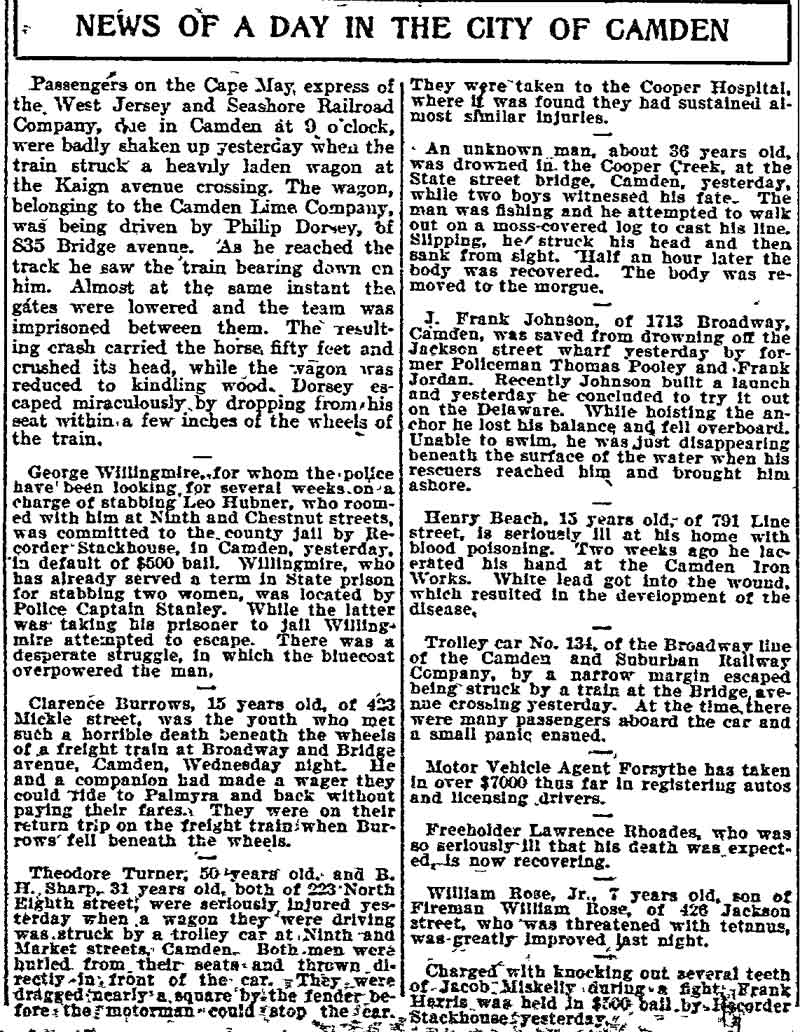
News of a Day in the City of Camden
A full day's Camden news for July 27, 1906, including Police Captain Stanley's capture of George Willingmire, wanted for a stabbing at Ninth and Chestnut Streets, after a desperate struggle on the way to jail.
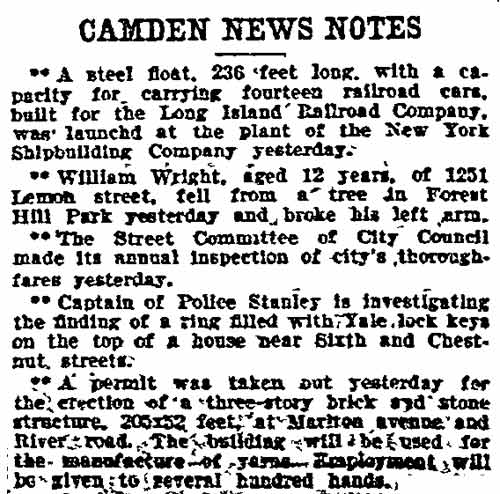
Camden News Notes — May 27, 1906
Camden briefs for May 27, 1906, including Captain of Police Stanley's investigation into a ring of Yale lock keys found on the roof of a house near Sixth and Chestnut Streets.
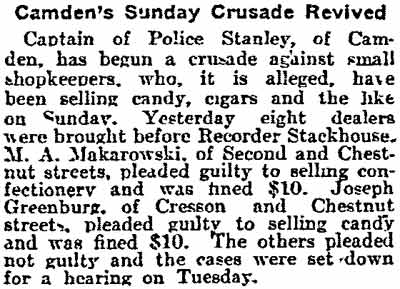
Camden's Sunday Crusade Revived
Captain Stanley began a crusade against Camden shopkeepers selling candy and cigars on Sunday; eight dealers were brought before Recorder Stackhouse and two pleaded guilty and were fined $10 each.