Boys Playing With Matches Started a Big Fire
Philadelphia Inquirer, May 14, 1900
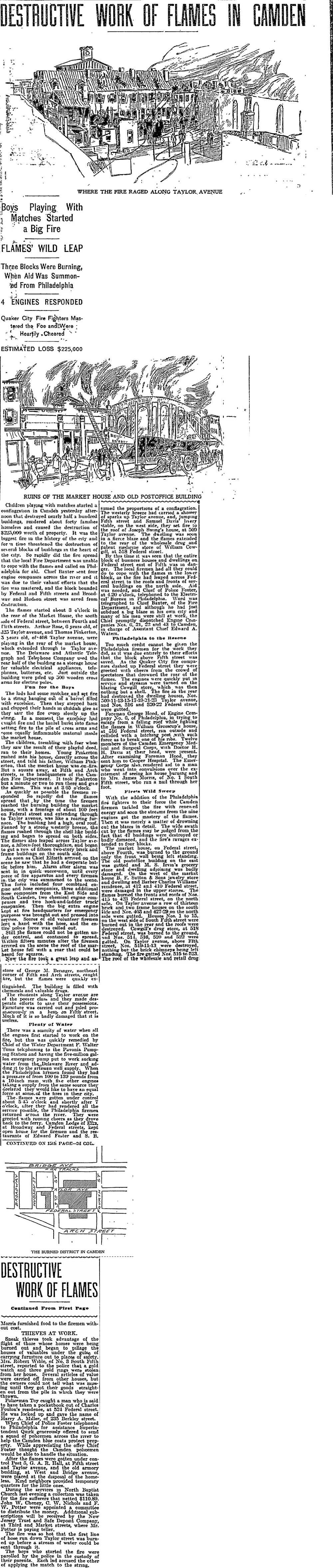
View transcription
Flames' Wild Leap
Three Blocks Were Burning, When Aid Was Summoned From Philadelphia
4 Engines Responded
Quaker City Fire Fighters Mastered the Foe and Were Heartily Cheered
Estimated Loss $225,000
Children playing with matches started a conflagration in Camden yesterday afternoon that destroyed nearly half a hundred buildings, rendered about forty families homeless and caused the destruction of $225,000 worth of property. It was the biggest fire in the history of the city and for a time threatened the destruction of several blocks of buildings in the heart of the city. So rapidly did the fire spread that the local Fire Department was unable to cope with the flames and called on Philadelphia for aid. Chief Baxter sent four engine companies across the river and it was due to their valiant efforts that the fire was mastered, and the block bounded by Federal and Fifth streets and Broadway and Hudson street was saved from destruction.
The flames started about 3 o'clock in the rear of the Market House, the south side of Federal street, between Fourth and Fifth streets. Arthur Rose, 6 years old, of 325 Taylor avenue, and Thomas Pinkerton, 3 years old, of 408 Taylor avenue, were playing in the rear of the market house, which extended through to Taylor avenue. The Delaware and Atlantic Telegraph and Telephone Company used the rear half of the building as a storage house for valuable electrical appliances, telephones, batteries, etc. Just outside the building were piled up 300 wooden cross arms for electric poles.
Fun for the Boys
The lads had some matches and set fire to a string hanging out of a barrel filled with excelsior. Then they stepped back and clapped their hands in childish glee as they saw the fire creep slowly up the string. In a moment the excelsior had caught fire and the barrel burst into flame setting fire to the pile of cross arms and some equally inflammable material inside the market house.
The children, trembling with fear when they saw the result of their playful deed, ran to their homes. Young Pinkerton rushed into his house, directly across the street, and told his father, William Pinkerton, that the market house was on fire. But a square away, at Fifth and Arch streets, is the headquarters of the Camden Fire Department. It took Pinkerton but a minute or two to run there and give the alarm. This was at 3:05 o'clock.
As quickly as possible the firemen responded. So rapidly did the flames spread that by the time the firemen reached the burning building the market house, with a frontage of about 100 feet on Federal street and extending through to Taylor avenue, was like a roaring furnace. The building had a high, oval roof. Fanned by a strong westerly breeze, the flames rushed through the shell like building and began to spread on both sides. The flames also leaped across Taylor avenue, a fifteen-foot thoroughfare, and began to gut a row of fifteen two-story brick and frame buildings on the south side.
As soon as Chief Elfreth arrived on the scene he saw that he had a desperate battle before him. Alarm after alarm was sent in quick succession, until every piece of fire apparatus and every fireman in the city was summoned to the scene. This force included four combined engine and hose companies, three additional hose companies from the East Side and South Camden, two chemical engine companies and two hook-and-ladder truck companies. Then the big extra engine kept at fire headquarters for emergency purposes was brought out and pressed into service. Scores of old volunteer firemen lent a hand with the hose, and the entire police force was called out.
Still the flames could not be gotten under control, and continued to spread. Within fifteen minutes after the firemen arrived on the scene the roof of the market house fell with a roar that could be heard for squares.
Now the fire took a great leap and assumed the proportions of a conflagration. The westerly breeze had carried a shower of sparks up Taylor avenue, and, jumping Fifth street and Samuel Davis' livery stable, on the west side, they set fire to the roof of Joseph Swing's house, at 509 Taylor avenue. The dwelling was soon in a fierce blaze and the flames extended to the rear of the wholesale drug and patent medicine store of William Cowgill, at 518 Federal street.
By this time it was seen that the entire block of business houses and dwellings on Federal street east of Fifth was in danger. The local firemen had all they could do to cope with the flames in the lower block, as the fire had leaped across Federal street to the roofs and fronts of several buildings on the north side. Aid was needed, and Chief of Police Foster, at 4:20 o'clock, telephoned to the Electrical Bureau in Philadelphia. Word was telegraphed to Chief Baxter, of the Fire Department, and although he had just subdued a big blaze in his own city and many of his men were still at work, the Chief promptly dispatched Engine Companies Nos. 6, 21, 22 and 43 to Camden, in charge of Assistant Chief Edward A. Waters.
Philadelphia to the Rescue
Too much credit cannot be given the Philadelphia firemen for the work they did, as it was due entirely to their efforts that the block above Fifth street was saved. As the Quaker City fire companies dashed up Federal street they were greeted with cheers from the crowd of spectators that drowned the roar of the flames. The engines were quickly put in service and streams were turned on the blazing Cowgill store, which was then nothing but a shell. The fire in the rear had destroyed the dwelling houses, Nos. 509-11-13-15-17-19-21-23 Taylor avenue, and Nos. 516 and 520-22 Federal street were gutted.
Foreman George Hood, of Engine Company No. 6, of Philadelphia, in trying to escape from a falling roof while fighting the flames in William Grosscup's house, at 510 Federal street, ran outside and collided with a hitching post with such force as to break one of his ribs. Twelve members of the Camden Emergency Medical and Surgical Corps, with Doctor H. H. Davis at their head, were present. After examining Foreman Hood, they sent him to Cooper Hospital. The Emergency Corps also rendered aid to a man who went into convulsions over the excitement of seeing his house burning and to Mrs. James Morris, of No. 1 South Fifth street, who ran a nail through her foot.
Fire's Wild Sweep
With the addition of the Philadelphia fire fighters to their force the Camden firemen tackled the fire with renewed energy and soon the streams from the nine engines got the mastery of the flames. Then it was merely a matter of drowning out the blazes in detail. The wide swath cut by the flames may be judged from the fact that 47 buildings were destroyed or badly damaged, and the fire's ravages extended to four blocks.
The market house, on Federal street, above Fourth, was burned to the ground only the front wall being left standing. The old postoffice building on the east was gutted and M. S. Irvin's grocery store and dwelling adjoining was badly damaged. On the west of the market house B. F. Sutton & Sons jewelry store and dwelling and Barber Charles Williams' residence, at 412 and 410 Federal street, were damaged in the upper stories. The flames burned the fronts and roofs of Nos. 415 to 423 Federal street, on the north side. On Taylor avenue a row of thirteen brick and two frame houses on the south side and Nos. 403 and 427-29 on the north side were gutted. Houses Nos. 1 to 15, on the west side of South Fifth street, were burned out in the rear and the roofs were destroyed. Cowgill's drug store, at 518 Federal street, was burned to the ground, and Nos. 514, 516, 520 and 522 were gutted. On Taylor avenue, above Fifth street, Nos. 519-11-13 were destroyed, nothing but the brick chimneys being left standing. The fire gutted Nos. 515 to 523. The roof of the wholesale and retail drug store of George M. Beringer, northeast corner of Fifth and Arch streets, caught fire, but the flames were quickly extinguished. The building is filled with chemicals and valuable drugs.
The residents along Taylor avenue are of the poorer class and they made desperate efforts to save their possessions. Furniture was carried out and piled promiscuously in a heap on Fifth street. Much of it is so badly damaged that it is useless.
Plenty of Water
There was a scarcity of water when all the engines first started to work on the fire, but this was quickly remedied by Chief of the Water Department F. Walter Toms telephoning to the Pavonia Pumping Station and having the five-million gallon emergency pump put to work sucking water from the Delaware River and adding it to the artesian well supply. When the Philadelphia firemen found they had a pressure of from 100 to 139 pounds from a 10-inch main with five other engines taking a supply from the same source they declared they would like to have an equal force at some of the fires in their city.
The flames were gotten under control about 5:45 o'clock and shortly after 7 o'clock, after they had rendered all the service possible, the Philadelphia firemen returned across the river. They were greeted with rousing cheers as they drove back to the ferry. Camden Lodge of Elks, at Broadway and Federal streets, kept open house for the firemen and the restaurants of Edward Foster and S. B. Morris furnished food to the firemen without cost.
Thieves at Work
Sneak thieves took advantage of the flight of those whose homes were being burned out and began to pillage the houses of valuables under the guise of carrying furniture out to places of safety. Mrs. Robert Wible, of No. 3 South Fifth street, reported to the police that a gold watch and three gold rings were stolen from her house. Several articles of value were carried off from other houses, but the owners could not tell what was missing until they got their goods straighten out from the pile in which they were thrown.
Policeman Toy caught a man who is said to have taken a pocketbook out of Charles Foulon's residence, at 524 Federal street. He was locked up and gave the name of Harry A. Miller, of 235 Berkley street.
When Chief of Police Foster telephoned to Philadelphia for assistance Superintendent Quirk generously offered to send a squad of policemen across the river to help the Camden blue coats protect property. While appreciating the offer Chief Foster thought the Camden policemen would be able to handle the situation.
After the flames were gotten under control Post 5, G. A. R. Hall, at Fifth street and Taylor avenue, and the old armory building, at West and Bridge avenue, were placed at the disposal of the homeless. Kind neighbors provided temporary quarters for the little ones.
During the services in North Baptist Church last evening a collection was taken for the fire sufferers that netted $110.89. John W. Cheney, C. W. Nichols and F. W. Potter were appointed a committee to distribute the money. Additional subscriptions will be received by the New Jersey Trust and Safe Deposit Company, at Third and Market streets, where Mr. Potter is paying teller.
The fire was so hot that the first line of hose run down Taylor street was burned up before a stream of water could be sent through it. The boys who started the fire were parolled by the police in the custody of their parents. Each lad accused the other of applying the match to the string.